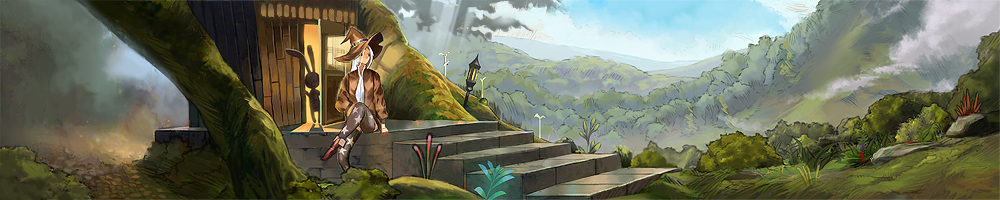
Quiz Magic Academy OVA Review – 60/100


I originally wanted to put this among the quick first impressions, until I found out that this OVA just has one episode, which puts this OVA in the category of quick watches. With an airtime of only thirty minutes, did Quiz Magic Academy turn into an OVA to recommend? Well, no.

This OVA is based on a much larger manga, and ultimately, it just becomes a glorified commercial for this manga. There are no really redeeming values, and the episode just consists of the characters (students and teachers of the titular magic academy) having a bit of fun at the school festival. In the end, the entire 30 minutes are pretty much pointless.

Thankfully, it’s not all bad. The cast of characters is huge, so you won’t have the time to get bored of their different stereotypes. The creators manage to keep things fresh in the end. I especially liked the transfer student who is way above the age-limit, and I especially disliked the pink-haired teacher who acts like a mahou shoujo-wannabe. For a minute, I also feared that the spunky main character would take up too much of the airtime, but overall the creators managed to balance the episode quite well, so that each character at least gets half a minute of time in the spotlights.

But yeah, you can’t escape stereotypes with just 30 seconds of airtime, and most members of the cast just remain stereotypes that we’ve seen over and over. On top of that, the writers hardly ever attempt to change the mood: every single scene is semi-energetic, without any quiet moments. There’s just way too much sugar in this OVA.

Overall, I’d label this together with Haru no Ashioto: it’s just a silly advertisement for the original source, but somewhat fun to watch. Emphasis on “somewhat”.

Storytelling: 5/10
Characters: 7/10
Production-Values: 7/10
Setting: 5/10

Detroit Metal City – 04


Short Synopsis: Krauser II gets invited to sing his pop songs in a trendy bar and meets one of his former classmates.
Highlights: The drunk Krauser was hilarious.
Overall Enjoyment Value: 8/10
Another hilarious episode from Detroit Metal City. I was beginning to fear that the creators would keep the bit where Negishi loses himself in front of Aikawa going a bit too long, but this episode goes into other directions, and Aikawa finally hears him sing. The irony in this episode seems to be that everyone thinks that Negishi’s music sucks, apart from the friends he had on high-school.

Although, I guess that Tetrapod Melon Tea did receive some popularity for them to be featured in a karaoke magazine. I think that one of the big problems with Negishi is that he hangs out with the wrong people; otherwise he’d never have been able to found Detroit Metal City and met the sadistic president. Although frankly, his sweet songs are badly written and way too sugary. I can imagine how not many people would like it.

Some quick first impressions: Kaitou Tenshi Twin Angel, Cobra The Animation and Battle Spirits Shounen Toppa

Kaitou Tenshi Twin Angel

Short Synopsis: Our lead characters are a bunch of crime-fighting mahou shoujo.
Highlights: It’s actually not bad.
Overall Enjoyment Value: 6,5/10
Mahou Shoujo OVAs have a questionable reputation of being incredibly dull, after the likes of Dokuro-chan and Ryoufuku-chan were just big excuses for fanservice. Kaitou Tenshi also has a very questionable start. It’s just a bunch of moe girls who beat up stereotypical bad guys, there was no way for this to work. Imagine my surprise when it turns out that this first episode actually did have a clear goal: take the overconfidence that usually comes with the god-moded mahou shoujo, and smash this into the ground. There are a lot of references to Sailor Moon (the first season anyway). The problem, though, that apart from that, there’s hardly anything that really stands out. Characters are standard, the villains are standard. There’s also that matter that the second episode of this series can only go through predictable paths (although it would be awesome if the creators realized this and went with something totally different).

Cobra the Animation

Short Synopsis: Our lead characters meets a cute woman who is involved with an intergalactic space-complot.
Highlights: Is too busy overglorifying its own protagonist.
Overall Enjoyment Value: 5/10
Cobra the Animation seems to be another attempt to revive an old anime franchise, but unfortunately this one didn’t go so well. Overall, it feels very much like a half-assed attempt. The plot so far is rather unimpressive, but the biggest turn-off is that Cobra is just too perfect of a person. He’s an excellent marksman, he’s popular with the ladies, he possesses the latest physics-defying gadgets to steal anything that’s loose. He’s just too awesome, without any weaknesses whatsoever. Add that to the tendency of the creators to just make Cobra appear at the exact places where the story needs him to be without any explanation, and the massive amounts of useless fanservice and you just lost my interest.

Battle Spirits Shounen Toppa

Short Synopsis: Our lead character is obsessed with a children’s card game.
Highlights: Full of stereotypes, but what else did you expect?
Overall Enjoyment Value: 4,5/10
Well, so this is the latest addition to shows that are only aimed at kids. It’s one of those genres that lives off seeing who can rip each other off the most, so it’s not surprising that this is the umpth one about playing card games. To make matters worse, either its rules are very incomprehensible, or they’re inconsistent with each other, which is not really a good start. All the stereotypes are also present: spiky haired bratty lead, female love interest, talented tsundere rival, father who’s either dead or gone, et cetera. Still, it’s not all bad. It’s got a decent OP and ED (which were most likely animated by the same animators as Power Puff Z, giving them a stylish look), and my favourite part: all the cool main characters have cute and fluffy pets that accompany them. The writing is also solid enough when the characters aren’t playing cards, but overall it’s nowhere near Net Ghost Pipopa, the series that I consider the best kiddie-show of 2008 (based on the first episode I watched anyway).

Bonen no Xamdou – 09


Short Synopsis: Raigyo gets his proper introduction.
Highlights: Haru.
Overall Enjoyment Value: 8/10
A quiet episode this time, which was just meant to give Raigyo’s character some time to catch up in terms of background and fleshing out. Nothing much happened, even for a Xam’d-episode, As it turns out, Raigyo had been travelling the world for two years of his own free will, and in the meantime he brought back a bunch of souvenirs. The crewmembers on the ship apart from perhaps the captain are thrilled to see him back, so of course Akiyuki starts to suffer from an inferiority complex when he’s around. Fairly standard, although I guess that this was a valuable chance for Akiyuki to realize that he’s not special, and that there are more people of his kind.

In any case, I don’t think that I would have suspected this after just the first episode, but Haru’s really turning into my favourite character from this series. She doesn’t take anything for granted, and because of Akiyuki, she continues to doubt her superiors, and yet at the same time she doesn’t run around and throws tantrums to anyone who wants to listen.

Benikawa came with an interesting twist this episode: she actually plans to attack the Northern Government. That was quite a surprise to me, as she’s been behaving like a pacifist for the majority of the series. Well, it does make sense now, why the Zanbani has assault weapons, and why the members are so skilled with fire weapons. Benikawa’s pacifism turns out to be her habit of not getting involved in pointless fights that’ll only put the crew in needless damage.

I do have to say, though, that the website of Bonen no Xamdou sucks. When I want to look up something as simple as the name of one of the characters, it makes me wait more than a minute before the site has fully loaded. That’s way too long, for such a tiny bit of information.

Macross Frontier – 23


Short Synopsis: Ranka and Brera arrive at the home planet of the Vajra.
Highlights: Well, finally it seems that the love-triangle is over.
Overall Enjoyment Value: 7,5/10
Okay, so this episode was meant to spice up the upcoming finale a bit. It was a it of a mixed bag, like usual with this series. There were some things I liked:
– Sheryl’s little bits of screen-time
– Some more exposition about the nature of the Vajra and Ranka’s background. The creators actually remembered that huge space-craft of ten episodes ago and explained what it was about. As it turns out, Grace once lived together with Ranka and her mother, and they lived happily together with the Vajra.
– A few scenes here and there about the casualties that the recent Vajra outburst caused.

There were also some things I didn’t like. Most importantly Ranka, getting captured by the Vajra like the damsel in distress that she is. Really, I want to like her, and her character isn’t badly written at all. It’s just the way that the creators use her that bugs me like no other. Especially since now it seems pretty much clear that she’ll end up together with Alto. Okay, Alto said that he’d rather kill Ranka than let the Vajra use her for destruction, but I really doubt whether the creators have the GUTS to kill her off.

There’s also this bit about Brera, being Ranka’s brother, which has been delayed way too much in my opinion. It was pretty obvious that the two were siblings more than thirteen episodes ago, and only now the creators decide to reveal it to the characters. This should have been clear much earlier, to allow for some development between the two. To think that even Brera didn’t know.

Please, Ranka. There are two episodes left. Please do something in that finale other than predictably provide a Deus ex Machina ending. Kick Grace in the ass, make the Vajra kill Leon, anything as long as you don’t end up being some god-moded damsel in distress!

RD Sennou Chousashitsu – 23


Short Synopsis: The secretary general gets some more background, while the search for Kushima’s consciousness continues.
Highlights: Extra bit of depth about the secretary general was very much appreciated.
Overall Enjoyment Value: 8/10
Okay, so I’m probably the only one who’s still crazy enough to watch this series without subs. Still, this episode featured a lot of interesting things. It’s slowly getting clearer as to what the heck happened, back in episode 21: apparently, Kushima is experiencing the same thing that Haru went to go through for fifty years at the moment. His brains that were found in the previous episode didn’t carry his consciousness, and only a few programs were left on it. One of them is an emergency AI-program he wrote for himself. It’s a really neat idea, to just be able to automate some of your thoughts, in case your consciousness loses it. In this case, humans have really become like machines, and the only thing that separates androids from real humans is that they’re completely mechanical, and their memory programs are designed to be functional, when compared to the whimsical nature of human brains. That’s one thing I really like about this series. It may have screwed up with its characters a bit, but Masamune Shirou’s setting for this series is rock-solid.

In any case, this episode gave some very much needed background to the secretary general, and shows the moment when she met with Souta, and fell in love with him. From here, we can probably guess that they started working together, and at one point she forced herself onto him. She really feels much more as a balanced character after this episode, but the problem is that this should have been a point of character-development. Instead, this episode just showed different sides of her. This shouldn’t be happening THIS LATE in a series, and there’s still that matter of Jennie’s lack of development. there are only three episodes left, but PLEASE give the guy some depth!

I still haven’t figured out what exactly Jennie is planning, but it seems to have to do something with the artificial island that had been built. And whatever it is, it seems to be in the interest of most of the inhabitants of the island. There also seems to be something that’s threatening the artificial island, which I guess is the same thing that Haru encountered.

Natsume Yuujin-Chou – 10


Short Synopsis: Natsume gets visited (read: possessed) by a youkai who used to play a traditional Japanese instrument called the “koto”.
Highlights: Yet another great character-study, and the gender-bending was hilarious too.
Overall Enjoyment Value: 8,5/10
Like I mentioned before: the past summer-season has been different from nearly all other seasons so far, in the way that I was able to blog a relatively huge amount of series, in comparison to the amount of series that came out. This allowed me to experiment with a number of series that I normally wouldn’t have the time to blog about. In some cases, I was pleasantly surprised, like with Ultraviolet and Birdy the Mighty’s cases, and other series became rather pointless blogging-exercises, like Mission-E, and strangely enough also this series. Which is really ironic, since it’s one of my favourites of the past season.

The strange thing is that even though this series has great characters, I hardly have any inspiration when I try to write an entry. Right now it’s the same, which is why I’m rambling a bit right now about something totally unrelated to this excellent episode. This is much more a series that you want to enjoy in a relaxed way, not try to over-analyze things. I also now know that it was a good decision not to blog Mokke, but instead casually enjoy its greatness. Some shows are meant to be thought about, others aren’t. Natsume and Mokke are typical shows that you just enjoy, nothing more.

Ah well, with three episodes left, I might as well continue to blog this series for such a short time. If there is a second season coming, I might give things some serious thoughts whether I want to blog the same thing again. If there isn’t going to be a second season (which unfortunately is likely, since Brains Base has never produced a series of more than 16 episodes), then I really wonder how the creators are planning to end things. There probably is going to be one episode dedicated to Nyanko-sensei, explaining what he’s been doing at his few nightly trips, and I’d also like to see one more episode that focuses at Reiko, which tries to explain why she compiled the Yuujin-chou in her youth, and what became of her. I’ve got tons of unanswered questions about her, and I’d love to see at least some of them answered.

There’s also one point of criticism I have for this series: this series is supposed to be “Natsume’s Book of Friends”, and yet it’s been ages since Natsume used the damned thing. It needs to come into the foreground some more.

Ultraviolet: Code 044 – 11


Short Synopsis: 044 finally gets the chance to talk with Luka
Highlights: They were a bit sudden, but the love-scenes worked really well.
Overall Enjoyment Value: 8/10
Okay, one episode left! This show has the potential to make for a solid ending. This episode introduced enough subplots for this series to work with to fill one episode. I predict that the first half of the next episode will be Luka vs. Daxus, and the second half settles the score between 044 and Daxus, with both of them probably dying. In between, the cult leader and Garcia also probably have their minute in the spotlight, and this fits about perfectly in 20 minutes.

This episode was of course mostly about settling the score between 044 and Luka. Where he seemed like a raging gorilla in the previous episode, he came back to his senses in this episode, and seeing 044 trying to heal him worked really well. Although this episode was a bit rushed, it did get across the main point: Luka is a terrorist, nobody would care about him, and he lived his life probably without being loved, which is why he probably was able to just throw his life away for the cult. And then his big enemy comes and tells him that she genuinely cares about him. I can see love coming from that, especially since he already was in such a confused state.

Overall, the past season has been a really interesting one. For most of the seasons, I have too much series I want to blog for the amount of shows I pick up. For the past summer-season, this was the complete opposite: I had too little series that I really wanted to blog, so I could experiment with a few series. In cases like Mission-E this rather failed; looking back, I don’t really see what was so special about blogging it. However, I’m glad I decided to stick with this series. It’s been a really interesting short series. It’s never going to make any top-10 lists, but the intensity and direction-style has made this series worth watching.

One thing that I did notice in this episode: the lip-synching was really off… let’s hope the final episode will do this better.

Blade of the Immortal – 05


Short Synopsis: Next up: the swordsman who walks around with Rin’s parents’ sword.
Highlights: This series quite possibly has the fastest-paced start of any Bee-Train series so far.
Overall Enjoyment Value: 8,5/10
Ah, screw the manga that this series ruined. I might end up reading it as soon as the series is over, but for now I’m really enjoying this series, manga or no manga. You can really see that Bee-Train is trying out something new, and it working out really well so far. It’s amazing to think how much has already happened in this series, especially since in your average Bee-Train series, the first ten episodes are spent fleshing out the characters instead. The past five episodes, though, have kept pushing the storyline forward.

What I really liked about this episode is that everything just happens with minimal exposition and yet it works. This series knows what it is, and is built around its action-sequences. And okay, so the action-sequences themselves are rather dull, everything around them rocks.

The guy from this episode, Magatsu, is one who thinks he’s special because a samurai killed his sister in the past, up to the point where it almost sounds like he’s proud of it. He never really learned to let go of the horrible experience, to the result that it continues to haunt him even though it happened decades ago.

As it turns out, a major theme in this series is acting out of impulses. Rin was already guilty of this, but in this episode Manji also shows that he can be quite the impulsive bastard, and go running off without notifying anyone. This episode also shows that the Ittou-Ryuu have more enemies than just Asano Rin. This could become interesting.

And I’ve also been wondering: why do the eye-catch and the ED show the characters in a modern setting? Could the creators be planning to set the second half of this series in modern times? Did this happen in the manga as well?

Mission-E – 10


Short Synopsis: Chinami does what more anime characters should attempt: try to talk things out.
Highlights: A bit forced, but it’s good to see this series heating up.
Overall Enjoyment Value: 7,5/10
So what first seemed to be a standard calm-before-the-storm episode turned into the introduction for the finale of this series. While there is some potential, I do admit that I’m rather afraid of what this series is going to turn into. Mission-E was at its best when it focused on its characters and the fun action-sequences, so I’m not sure what a dramatic climax can add to that.

At the moment, I still like Code-E better. But then again that’s just me, since Code-E was hated by just about everyone else, it seems. It’s a bit hard to explain, but I feel like Code-E’s dramatic climaxes had more impact than what we’ve seen in Mission-E, where the whole issues around Maori and Adol may have been interesting, but just a bit too much on the clichéd and predictable side. You can especially see this in this episode: like expected, Milsslowly starts to awaken after Maori visits her.

Then there’s also the new suit, that arrives exactly at the right time when the bad guys have found a way around the original power-suits, and Adol, who was just about to switch sides, but dies instead. It all feels just a bit uninspired. The thing I appreciate about this series was that it really tried to be different. Instead of Code-E’s slow style of combining the mystery with its short but effective climaxes, Mission-E has chosen for a more upbeat style, and a more solid sort of storytelling. It takes GUTS to do this, but at the same time, it’s also very difficult, as this series has shown.

Looking back, this series wasted too much time with Maori’s conscience-crisis. She’s an interesting character, but unfortunately the overall storyline had to take some huge sacrifices for this. When looking at the small picture, this is a very entertaining series. It’s just that the big picture has a few problems deciding what it wants to be.