Wooper: Three-fourths of this post has been finished for more than a week, but one of these shows requires such focus to follow that I kept putting it off day after day. (If you’re curious, it’s the one that “makes me feel like a detective,” a phrase you’ll spot in its introduction.) I wasn’t idle during that time, however. Work on the Summer Season Preview has been progressing nicely, meaning it will go up on either the 24th or 25th. That’s “will,” not “should” – season previews are my favorite thing to write at this point, so the upcoming edition’s timely appearance is a guarantee. Before it pops to the top of the site, though, here are my belated thoughts on some nearly month-old spring offerings (and one early glimpse of summer).
Smoking Behind the Supermarket with You – 1-2
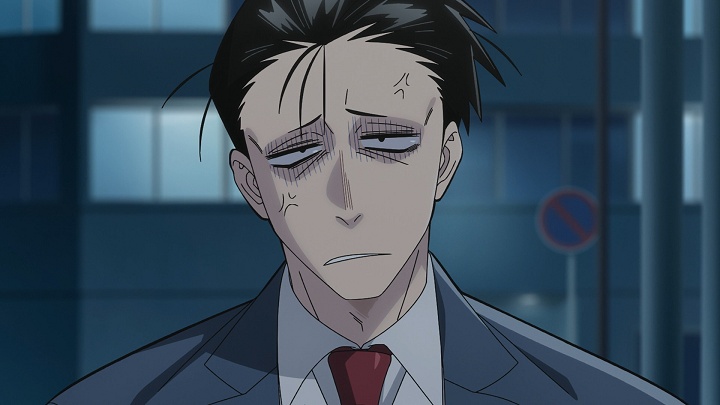
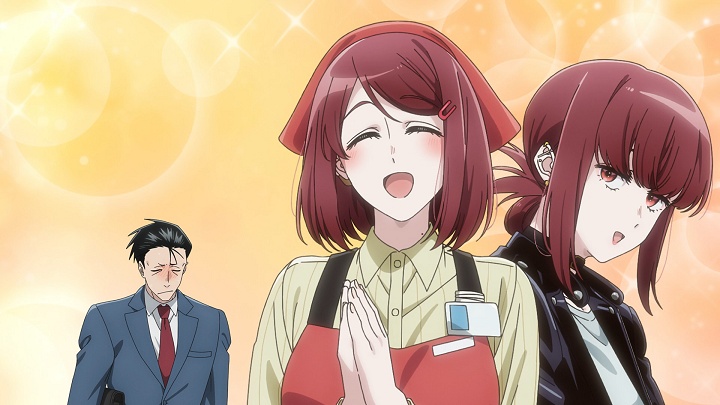
This is technically a summer series, so it won’t air on TV until early July, but it had an early streaming release with a half-episode format, which suits it pretty well. YaniSuu (as it’s portmanteaux’d in Japan) is about a middle aged salaryman who develops a flirty rapport with a supermarket employee after she invites him for a smoke behind the store – and not much else. I’ve only seen two episodes (which combine to match the length of an ordinary half hour show), but the details of protagonist Sasaki’s job are kept so vague that the series’ only real focus is likely to be his personal relationships. It’s a very seiyuu-forward show, especially since Seena Hoshiki essentially plays two characters, and the performances met my expectations (barring the vocal histrionics of office worker Suzuki), but the two major settings aren’t much to look at. Let your eyes wander the aisles of the grocery store during the script’s shopping trips and you’ll see what I mean – keep your eyes on the characters, though, and you’ll be rewarded with Sasaki’s slouched gait and Yamada’s seductive gestures. Their banter is greatly aided by that visual characterization, so the show is definitely hitting its targets, and the smaller episode lengths work in its favor. Still, it feels thin enough that I’m unlikely to venture far beyond this point.
Nippon Sangoku – 7-8
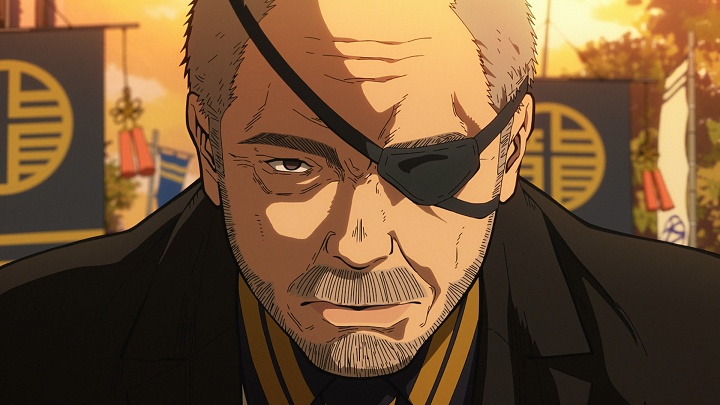
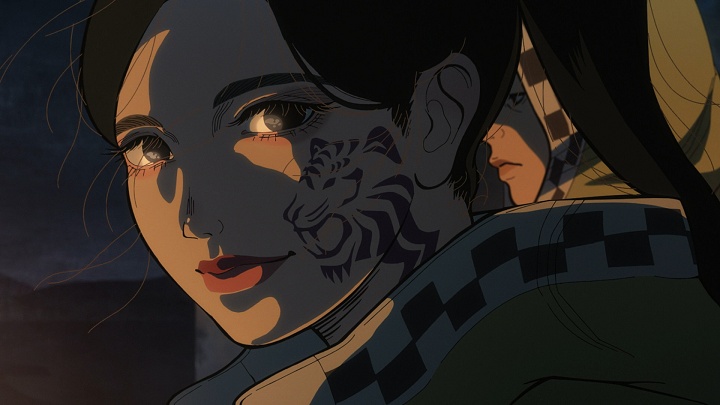
I was immediately met with some disappointment at the start of episode 7, which did not continue the Battle of Kuzuryu Castle that previously served as a cliffhanger. After that awesome musical accompaniment to the start of the fighting, all we got here was a scene of Wajima and her advisor walking amongst the corpses of its aftermath, with some lip service paid to the battle’s commanders. Visually, Nippon Sangoku’s character designs are its strong suit, not its animation, so I can understand the omission from a production perspective, but it was still a let down – and not the last one from these two episodes. The repeated use of the ‘unexpected gunman’ trope during Seii’s assassination attempt on Sugoh and Taira’s son made the introduction of their savior Nagamine (Sugoh’s counterpart atop the Yamato ranks) feel less impactful, and episode 8 felt somewhat protracted given all its build-up to Ryumon’s fateful tea ceremony. I’ve enjoyed all the dragon and tiger imagery the show has used to foreshadow his conflict with Wajima, but dozens of lines from Wajima’s inner monologue dulled the impact of his successful gambit. These episodes were less satirical and more strategically-oriented than ever, so perhaps I just don’t prefer the show in that mode – though that’s probably the tack it ought to take as it prepares to shift the focus back to Aoteru, its initial protagonist.
Dorohedoro S2 – 7-8
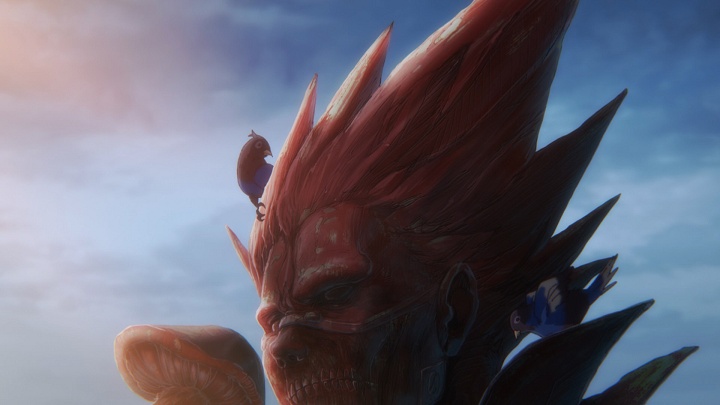
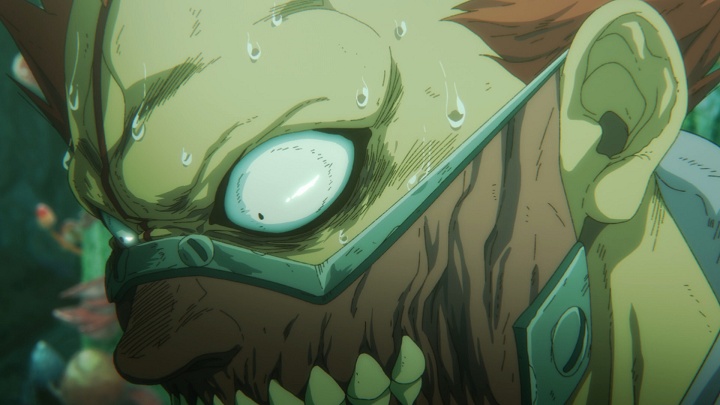
Dorohedoro got a great adaptation in 2020, and its second season has been even better thus far, but if I had powers like the sorcerers in its fictional universe, I’d use them to make the show entirely hand-drawn. Setting aside for a moment its stellar background art, all its best-looking shots are traditionally animated close-ups that intensify its characters’ emotions far more than computerized models ever could. When En considered the possibility of squaring off with the Cross-Eyes boss in episode 7, his bulging eyes and sweat-beaded face necessitated a human touch, and it looked fabulous, selling his utter terror despite his overwhelming strength. You can also contrast Nikaido’s brief duel with Aikawa in the same episode (made less legible due to constant camera movement) with her younger self’s martial arts smackdown of Kawajiri’s attackers in number 8, which served as a refreshing departure from the series’ computerized action. This’ll be the only time I nitpick the 3D (an easy promise to keep, as season 2 has just three more episodes after this), but the traditional stuff really outshone it this week. And damn if Shin and Noi’s magic broom chase scene through endless CG streets wasn’t ugly as sin.
Of course, there was plenty of warped amusement to be had in these episodes regardless of its hybrid production style. The scene that preceded that magic broom chase, where culinary sorcerer Turkey baked a giant pizza and sliced a doppelganger of En out of the center, gave me big first season vibes, not only due to the presence of a cooking segment but also because Ebisu was laughing her head off in the background. Fujita’s futile quest to restore Ebisu to life in episode 7 was a highlight (despite the inconsistent translation of Kikurage’s on-screen thoughts), and the detail of Chota’s hair pin getting fused into her reconstituted body was both humorous and potentially plot-altering. Caiman’s identity crisis continues to be a source of both puzzlement and admiration, with Aikawa, the Cross-Eyes boss, and even Curse all making appearances (the latter for just five seconds or so, but with more visual clarity than ever). Even if we don’t live in a realm where Dorohedoro’s animation is Mappa’s number one priority, it remains my favorite of their many series.
Awajima Hyakkei – 7-8
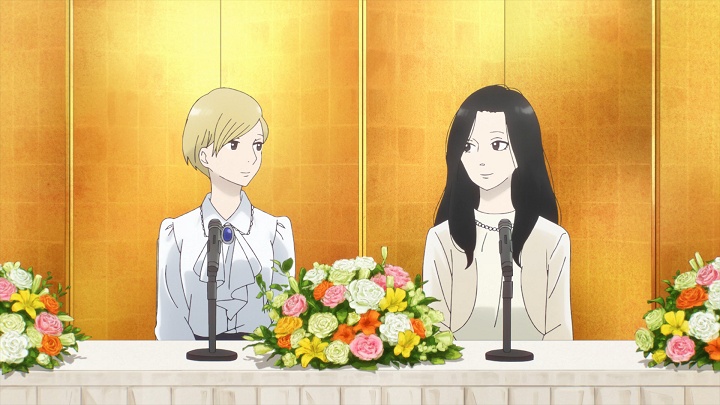
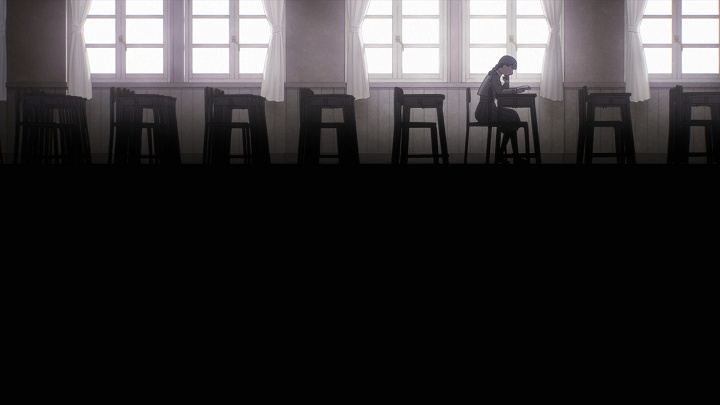
Watching this series makes me feel like a detective, as it’s constantly jumping around in time and introducing cast members with loose ties to previous characters. It’s ten times easier for the show’s intended audience to connect the dots, I’m sure, but it’s a tall order for a non-Japanese speaker who takes big breaks between episodes. Thankfully, episode 7 was the rare Awajima Hyakkei outing that told a single story, and even more conveniently, it had only two POV characters, one of whom we’d already met. That would be Saori Yamagata (stage name Yuuki Kaburagi), whose academic and professional relationship with newcomer Mikako Takeuchi was explored in great detail here. Illness was a crucial element of their story, as both women took each other’s place on stage as a result of poor health during their careers, and the resentment engendered by those replacements found an excellent counter in the episode’s penultimate scene. The visual of rose petals floating on black liquid, along with the growing optimism of the orchestration as they talked out their frustrations, led into the announcement that they’d be sharing a leading role in their next production. That sort of happy ending isn’t common for Awajima Hyakkei, which has thus far depicted trauma, envy and attempted suicide – perhaps it was placed right at the show’s midpoint as a brief reprieve before jumping back into the deep end.
Then again, episode 8 was also fairly light, which is just as well, since it had a lot of narrative responsibility on its shoulders. It took us into the future, with a new generation of Awajima students represented by three girls: Sara Takanashi, Eri Fujisawa, and Shizuka Utagawa. With their introduction, every “main character” listed on the show’s website has now appeared at least once, and one of them is indirectly connected to another main character, Kinue Takahara (now an adult with the stage name Akira Takanashi). Sara’s aunt by marriage is Ryouko Ueda, a childhood friend of Kinue’s, and that tenuous link alone is enough to send Sara and her new friends at Awajima into a tizzy – but Shizuka’s experience with her middle school classmates’ jealousy of industry-connected girls casts a minor shadow over their enthusiasm. As for Eri, her fanciful musings on the spelling of her classmates’ names during the episode’s middle portion completely eluded my understanding. I did enjoy the typesetting of various kanji appearing, disappearing, and replacing one another on screen during her internal monologue, though. We’re meant to gather that she’s searching for her identity, I imagine, and perhaps that she’s prone to envy, given her fixation on the beauty of other girls’ names. That jealous tendency creates some symmetry with Shizuka’s backstory, so we may be headed for a bad breakup here, but so far the girls are thick as thieves, so I’ll enjoy that while it lasts.

I always prefer hand drawn animation to Computer Generated Imagery and I wish the Dorohedoro anime just stay 2D throughout it’s run.