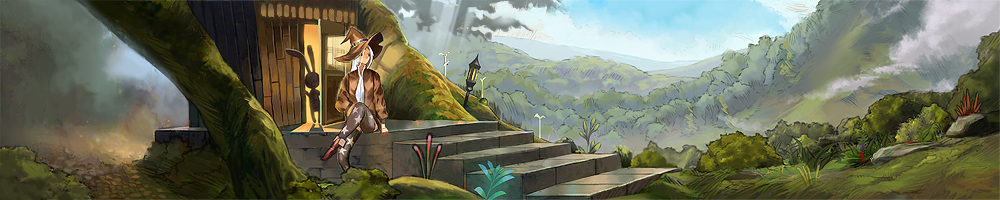
Porfy no Nagai Tabi – 36


Short Synopsis: Porfy meets a masked woman who lives together with a terrible sister.
Highlights: The series’ attempt at mystery turns out pretty nicely.
Overall Enjoyment Value: 8/10
The key to having a successful episodic series is knowing that you can play with your own concept. Because the episodes are relatively short, there are many chances for different storylines. If all you’re going to do is a dull pool or beach-episode, then yeah, it’ll get boring. The past string of episodic stories though has shown a great variety of different characters, settings and focuses. This time: mystery.

I don’t really think that this episode deserves a comprehensive summary. What basically happens: Porfy meets a masked woman, who lives near an abandoned gas station. She has a sister who has terminally ill, and Porfy often hears her fighting with said sister. As it turns out, the woman lost her parents in a fire, five years ago. She herself gained a scar on her face from it. Because of this, she became scared to show herself in public, and ended up wearing a mask. She then created an alternative personality called Sandra, to ease herself from her loneliness. This episode had lots of messages against self-loathing.

In the end, everything was between the girl’s head. The villagers didn’t hate her at all; she just scared herself into isolation. In any case, in terms of mystery, this episode did pretty well, even though this isn’t a mystery-series. It was pretty soon obvious that Marissa had a bipolar disorder, so this episode wasn’t much about its surprises, but instead Marissa turned into quite a sympathetic character in the end.

This episode also had a lot of references to Natsume Yuujin-chou. I’m not sure whether that was intentional or not, but Natsume also meets a lot of Youkai who are originally masked, and then at the end show their faces. Porfy no Nagai Tabi showed a more “realistic” side to this story. (Not that Natsume Yuujin-chou isn’t realistic enough already, but more in the way of nothing supernatural).

Porfy no Nagai Tabi – 35


Short Synopsis: Porfy gets caught in a rainstorm.
Highlights: Talk about different from a usual Porfy-episode.
Overall Enjoyment Value: 8,5/10
Whoa, instead of the usual travelling stories, this episode goes to tackle existentialism and throws a critical eye at religion. This probably was the most thought-provoking episode of this series yet, especially since it built further upon Damon’s words, back in Greece. Unfortunately, it also meant lots of talking, so I didn’t quite get most of the dialogue. Anyway, here’s what I did pick up:

It’s evening and pouring outside, while Porfy walks down a path, soaked. In the meantime, Carlos, Mina and Isabella are dry in a local pub, while Carlos is losing big, up to the point where he attempts to gamble Mina away. Isabella obviously doesn’t appreciate that attempt, so she smacks him. I mentioned before that Carlos was a walking time-bomb, but Isabella is also beginning to look like one.

Porfy meanwhile arrives at a small cottage. A local pastor (riding a motorbike with side-car) seems to be using the cottage as well, as a shelter for the rain. While Porfy leaves his clothes to dry, he tells the pastor what happened. He stopped by an inn, but they didn’t let him in (probably because the rooms were full, but that’s just my guess). The pastor introduces himself as Juliani, and Porfy tells the usual story about how he’s trying to find his sister.

The next morning, Apollo wakes up to find Porfy with a nasty cold, so he wakes up Juliani, who brings him to the local monastery to rest. Porfy has a few nightmares about Mina, A while later, Porfy wakes up in one of the beds at the monastery, and Juliani greets him. The fever subsided, and Juliani offers him a bit of hot wine, a local recipe against such a fever. The head monk of the monastery then arrives, and greets him as well.

That night, the head monk and Juliani have a small discussion. It was quite hard to understand, but it seems to come down to that Juliani was once a Greek as well, but he stayed at the monastery because of the word of Christ. The next day, Porfy joins Juliano as he preaches in front of a crowd. He talks about what faith is, and saving the poor, but again, it’s hard to fully understand what he’s talking about.

That afternoon, Porfy runs into the head monk, wondering whether he could help cleaning or something. The head monk then laughs, and wonders whether Porfy wants to confess things in front of the church. Porfy then starts to wonder again why god put him and Mina through such hardships. The rage this time is worse than when Porfy lashed out at Damon because of this, probably because he was still very confused.

In any case, Juliani answers with quite a peculiar answer: he claims that Porfy, travelling around because he believes he’ll meet Mina is the same as himself, becoming a Christan because he believes in Christ.

It’s interesting, how most anime lash out against religions, but Porfy no Nagai Tabi instead asks the question of why people still continue to believe in god, even though he puts them through hardships. Especially in Porfy’s case, he has a lot of reasons to doubt god. I myself am very far from a Christian, but it’s interesting to hear the other side of the story. Juliani had a good point: it doesn’t matter who you believe in.

And by the way, I noticed how there was hardly any background music in this episode. The effect was very interesting: most of the series, apart from the earthquake-arc and some others had mostly bright and colourful music. Now that that’s gone, the entire atmosphere of this series suddenly changed to a more down-to-earth version. Also, it’s subtle, but you can see that Porfy is beginning to grow up.

Porfy no Nagai Tabi – 34


Short Synopsis: Porfy arrives at a town with some strange customs.
Highlights: Porfy’s back! New background tunes! Awesome background art! Thought-provoking story! Increased pacing! No “I need to save you”-subplot!
Overall Enjoyment Value: 8,5/10
Okay, I think the phrase “IT’S ABOUT BLOODY TIME” fits here like no other. It’s been more than TWO WEEKS since this episode aired. I suspect that the one guy who did the uploads for this series went on a holiday or something, and that’s when you get this. Still, I have no idea who this bloke is, but thanks for continuing to upload this wonderful series, even though its low popularity.

The summary is going to be very short this time, as I have a ton of thoughts and I still have two more episodes waiting to be blogged. Basically, Porfy arrives at a town, and stays with a poor family. There’s something strange going on in that town, though: they have a ritual where they sacrifice old things to the angels, so that they can live a happy life afterwards. This goes for dolls, but also living things as donkeys and old people. The entire episode was basically about Porfy, realizing that there are people with very different customs than himself.

And the best thing: HE NEVER DID ANYTHING TO CHANGE THEIR VIEWS! There was no sort of “here he comes to save the daaaaaay!”-themes that you could find in the travel arcs between episodes 20 and 30. This is exactly what I’ve been waiting for: Porfy who meets other peoples and cultures, and gets a bit of a taste of their customs. I really wonder what Porfy would have done if he ran into this town, right after starting his journey. I bet that he would have bugged the villagers to change their ways.

I must say: I really hope that the episodic stories continue. It’s strange: some series are better when their stories are just one episode long, while others are better with multi-episode arcs. As it turns out, Porfy’s travel arcs are at their best when they’re just quick storylines that only take up one episode. It really keeps the series on its toes, through the already incredibly slow pacing of this series.

Also, the background art in this episode seemed better than it’s ever been. Especially the flower-garden was absolutely gorgeous, but the entire town was beautiful. There also were some new tunes added to the soundtrack, and they also sounded really nice. They added to the empty mood that came from the town in this episode.

Still, I do think that the next instalment of the World Masterpiece Theatre does need to put some more effort into establishing its viewer-base. As this episode showed, there are hardly any people who are interested in this series, apart from World Masterpiece fanatics that happen to know Japanese. You indeed need to put some effort into this series in order to be really able to enjoy it, since nothing really happens throughout the first twelve episodes. I think that the next WMT, whatever it’s going to be, needs to spice its introduction up. Make people want to come back and watch it, instead of starting immediately with the building up. There’s no doubt that this is one of the most well-written series of 2008, but that’s not going to matter if nobody wants to check it out. Seirei no Moribito, for example, did things a bit more wisely: it also had a lot of slice-of-life moments, where nothing really happened, and its pacing was also very slow, but the third episode did feature an awesome fight-scene that kept its viewers watching long enough to see the other beauties of that series.

Armored Trooper Votoms – Pailsen Files Review – 85/100


I’m a large fan of Ryousuke Takahashi. He’s one director who manages to take Sunrise’s love for epic storylines, and adds to that a great sense of realism, politics and storytelling. The same goes for the Pailsen Files, the continuation of a franchise he started in the eighties, probably as a reaction to Tomino’s Gundam. This twelve-episode OVA is very smart, and critical of both itself and various tropes of the mecha-genre.

There are quite a few things that stand out in this series. First off is its large focus on politics: especially the first episode will be information overload as it sets up the story for the rest of the OVA. The focus on military tactics is also immense: this series knows exactly how certain small actions can trigger a huge snowball full of consequences, while remaining realistic and believable. Seriously, I wonder what would have happened if Ryousuke Takahashi got assigned for the team of Code Geass.

Then there are the characters, another point at which this series deviates from most other anime. Nearly every character here is meant to be hated. They’ve all got some huge flaws in their personality that makes their company downright unpleasant. And yet at the end of the series, they’re all fleshed out and subtly developed, making for a rock-solid ending.

The only oddball in here is the main character: Chirico. He’s got what you can call the Patlabor-Syndrome. The guy has already been fleshed out and developed in the Votoms-TV series, so those (like me) who haven’t watched it are left out on this. The effect this has is pretty interesting; I don’t think I can recall any main character that feels more like a pawn than he does. He’s more like an observer to the entire story than an actual player in it. It’s something I appreciate a lot, but at the same time there’s so much wasted potential in his character, simply because he’s the least fleshed out of the entire cast.

This obviously isn’t a series for everyone: you have to like politics, or otherwise you’ll be bored for more than 50% of the airtime. This also is a series that takes a long time to get going, and don’t expect to see the big picture within six episodes. It’s not one of those series that’ll jump up and down, screaming “like me! like me!”. There’s also one particular twist about the white haired-kid at the end of the series that feels a bit fake. Still, this is a series worthy of Ryousuke Takahashi’s repertoire, and I’m eagerly anticipating his next work.

Storytelling: 8/10
Characters: 8/10
Production-Values: 8/10
Setting: 10/10

Wild Arms Review – 85/100


Wild Arms: one of Bee-Train’s lesser known series. Of course, anyone who even remotely knows this site probably knows that I’m a huge fan of said production-company, even though it’s after Gonzo the most hated producer out there. The same goes for Wild Arms: it seems that most of the reactions to this series were rather negative (shown by very low overall ratings on sites as AniDB, MyAnimeList and ANN), and yet I absolutely loved it.

Wild Arms is typical Bee-Train: it’s a travelling series, where the first half is spent on random unrelated stories, with a plot and character-development in the second half. It’s a solid set-up, and Bee-Trian has proven over and over that it works, despite the obvious disadvantages. If you hate fillers with the burning intensity of 1000 suns, then don’t even think about watching series, because there’s no overall plot whatsoever in that first half.

Still, both halves have their own advantages. The first half may not get anywhere in terms of plot progression, but the creators make the individual stories so much fun to watch, that this doesn’t really matter. You often see series struggle when they need a standalone story to fill one episode (with often a rather cheesy result), but the creators know exactly how to make such a thing work. The stories often centre on characters, whose actions are completely against any logical reasoning, and the fun is to see what drove them to these actions. Especially as the series goes on, the creators become bolder, and start to experiment with a number of hilarious plot-twists, with as my favourite an episode that can only vaguely be described as “Baccano: The Abridged Episode”.

The different main characters are all fun and original, from the strange creatures called “Popepi Pipepo” (who for once don’t try to be overly cute) to the big tough scientist to the 25-year-old main character who got stuck in the body of a 10 year old kid. All the characters have many sides and traits to them, making them a delight to watch and they set themselves apart from any stereotypes immediately.

As the series hits its second half, the fun adventures unfortunately mostly disappear, and instead a serious storyline appears. I feared that this would be the point where this series would fall flat on its face, but it actually gets away with its storyline pretty decently as the storyline evolves into an interesting post-apocalyptic mystery setting. Again, the characters can be blamed for making it turn out so well, because they’re all neatly fleshed out and stay far away from stereotypes.

Of course, this series does have some major flaws. It takes a lot of artistic liberties, resulting into a lot of plot-holes. Especially the plot-hole that plagues 95% of all other anime (characters who coincidentally just “run” into each other) gets rather taken into the extremes here when the main characters just keep meeting each other over and over. It’s like the creators were saying: “don’t mind this, we just want to tell our story”. The ending of the series also fails to answer a few burning questions. So yeah, this isn’t really the most solid series.

If you’re wondering whether you’ll enjoy Wild Arms or not, I think you need to ask yourself this question: did you enjoy El Cazador? If you did, then you’ll probably like Wild Arms. There are no lesbians or stalking psychopaths, but the basic set-up is the same, although Wild Arms is more geared to its storyline. Overall, Wild Arms was for me a very enjoyable series to watch with an excellent cast of characters. Oh, and let’s not forget the awesome soundtrack. 😉

Storytelling: 8/10
Characters: 9/10
Production-Values: 8/10
Setting: 9/10

Ultraviolet: Code 044 – 10


Short Synopsis: Luka (or what’s left of him) makes his re-entrance in this series.
Highlights: Mostly build-up, but an episode well-spent with lots of eye-candy.
Overall Enjoyment Value: 8/10
Well.. so this week I decided to not watch the low quality raws from horribleraws (since these also mess with the video-resolution, which just doesn’t do justice to this series’ sense of visuals). This wasn’t the best timing for that decision, because it seems like the raw providers went on strike this week, explaining why this entry is so horribly late. Ah well, at least it’s not like Porfy no Nagai Tabi: it’s been TWO bloody WEEKS and still no episode 34.

In any case, like predicted, this episode started the final arc of this series. It’s of course mostly building-up, but it was an episode well-used, with especially Luka gaining some more depth. The woman he ran into was cute: she lost her boyfriend, and therefore picked him up for emotional support. There were some things I didn’t like, though. In the end, Luka found 044 due to a coincidence (this woman turns out to be a maid at the hotel 044 is staying at), and he may have been a bit too similar to a gorilla in this episode. Especially the red glowy eyes were a bit too much.

This was probably the lightest episode of the entire series (I was really surprised to see these characters in broad daylight ^^;), but at the same time, this finally allowed 044 to relax a bit, resulting into a touching scene where she was finally able to cry her eyes out and let the stress of all that happened to her go.

Okay, there are two episodes left. I think that the creators just need to focus on creating a solid final episode, centred on the action and style of the previous episodes. There’s no need for any fancy plot twists, and I can see this series actually finishing off with a satisfying climax, if the creators just do what they’re good at, there shouldn’t be any problems.

Nijuu Mensou no Musume – 19


Short Synopsis: That scientist isn’t willing to give up that easily, and prepares for a second attempt to zap Tokyo, while keeping Chiko and the others out of his way.
Highlights: Excellent aftermath, apart from that climax perhaps.
Overall Enjoyment Value: 8/10
Really, this series has a strange idea of the concept of hiatus: it stops, right after the climax, only to show an aftermath instead of starting a new and fresh arc. I must say that a lot of spring-series share these themes of fooling the viewer: Kaiba first advertised itself as a tragic love-story, Real Drive first seemed a Ghost in the Shell-clone, while it was actually a strange combination with slice of life and science fiction, Himitsu ~ The Revelation at first seemed to be a series about its stories, while the characters turned out to be its main focus instead. But the king of these games obviously is Nijuu Mensou no Musume, where you can absolutely not predict what path it’ll be heading into for the next arc. And of course its very misleading ED also counts.

In any case, I’m glad to see that the previous arc merely served as build-up for the final arc of this series. In a way, this episode was more intriguing than all the four episodes of the previous arc combined. The creators seemed to have gone for the thriller-approach to end this series, and there’s a lot of potential. What I especially liked about this episode was how every member of the cast seems to have his or her own agenda and troubles. A lot was going on in this episode and it was a lot of fun to see how everyone reacted to that beam of light in the previous episode. The angry mob also was perhaps a bit clichéd, but it did portray the anxiety of the general public, right after the war, and their fears for more casualties perfectly.

But please. Did the creators really have to end the episode with that flying airship? It’s not the fact that it’s an airship that bugs me, but out of all the possible ways that the creators could have introduced it, they went with a Deus ex Machina, and a pretty blatant one at that: you know the scenario, the hero is cornered and at the last possible moment a saviour comes from out of nowhere. I mean, the creators could have at least shown Ken as he arrived at the airship, and as he took off, he suddenly saw Chiko jumping around on the roofs.

Birdy the Mighty Decode – 10


Short Synopsis: Senkawa and Nakasugi go on a date and Natsumi and Muroto go after some rumours about Syamalan.
Highlights: Yet another episode that delivers.
Overall Enjoyment Value: 8,5/10
And here I thought that this would be a simple intermezzo, where the series takes a small break, and takes its time to introduce the next arc. Instead, the creators managed to turn this episode into both an intermezzo and an episode that yet again pushes the plot forward. Especially the mysteries around Syamalan continue to tighten as this series goes on.

I must say that I like this series more and more with every episode, and it’s really one of those examples of a series that starts off rather weak, and only picks up later in the story. In fact, I see the entire first season as just one big introduction for the second season. My guess is that this first season takes care of everything around Syamalan (consider him as a sort of mid-boss), so that the second season can focus on Capella, and the guy with shades and his boss.

I’m really curious to how the creators planned to end the first season. It’s probably just going to be an average climax, where Syamalan gets stopped, but I can’t help but think how both Noein and Escaflowne’s thirteenth episode were absolutely amazing. I wonder whether the director has the same in mind for Birdy the Mighty, or would he rather provide a solid introduction for the second season instead?

Telepathy Shoujo Ran – 11


Short Synopsis: It’s back to the regular arcs as Ran, Rui, Rin and Midori help one of Rin’s classmates find out what happened to her brother who disappeared.
Highlights: Interesting premise so far.
Overall Enjoyment Value: 8/10
Well, the past few light-hearted episodes did make me hungry for the serious arcs again, so even though they were fun to watch, I’m glad to see that this series has switched back to mystery. It seems that the brother of one of Rin’s classmates’ went after some strange rumours about an old guy, after which the old guy attacked him with an axe.

There seems to be much more to the story than just that, though. Said classmate (Reika) gets kidnapped at the end of the episode, supposedly because she reminds the old guy (Shimotsuki) about his daughter whom he lost decades ago. But then again, who wants to kidnap a girl, just because she resembles someone from your past? There are also these telepathic abilities of Shimotsuki, along with the strange telepathic abilities of Reika’s brother. Reika’s brother also made a note about how Shimotsuki is related to his roots. I’m not sure if I picked this up correctly, but I suspect this Shimotsuki to have some major influence on Reiko’s parents’ death.

In terms of characters, the past few episodes have put a really high emphasis on putting Ran and Midori together. That really became apparent in this episode where they split up, and the two of them ended up in the same group, but also their bickering at the table. It’s interesting, because their characters often shine (when not counting their banter, of course) when they’re apart from each other. There’s this interesting rivalry going on between the two of them: when they’re together, they form a perfect team that complements each other’s weaknesses, and when they’re apart they get fired up to be the most helpful to solve the case.

Detroit Metal City – 03


Short Synopsis: The president visits Krauser II’s apartment.
Highlights: Just when you thought that this series couldn’t get much worse…
Overall Enjoyment Value: 8,5/10
Okay… I think we explored some new depths here at this episode of DMC. Finally there’s another episode with 100% original content, and the result is an episode that goes even further than the introduction went… And here I thought that the image of death metal-fans couldn’t get more butchered…

In the first half, Aikawa attends one of the concerts of DMC to report on how awful their music is, and subsequently Negishi calls her a pig slut whore. This caused Aikawa to develop a deep hatred for pigs, and Krauser to feel even more sorry for himself. I also love the voice Negishi adapts when he slips into his Krauser II-role.

There’s just one thing that’s really bugging me in this series, though: the music is beginning to sound tamer and tamer. I can understand why the creators did it, to focus more on the dialogue, but it sortof misses that heavy-feeling of heavy-metal (or as Aikawa calls it: death metal).

The second short was awesome, in which the president turns the owner of Negishi’s apartment (an average middle-aged guy), where in the end three guys ended up stripping and dancing very strangely to DMC’s music (really, haven’t those creators ever heard of head-banging?).