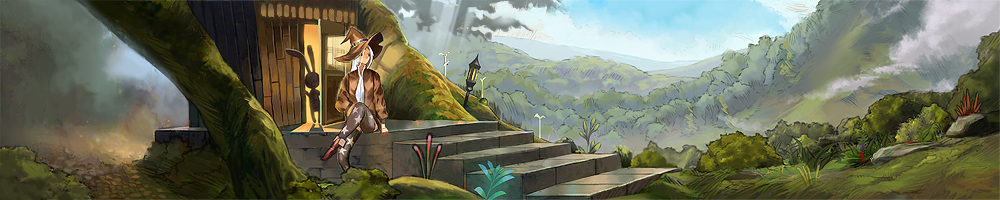
G-9 Review – 75/100


Well, time for a quick review about another very obscure OVA from a few years ago. It’s basically about fifteen minutes ling, and what you’d call a minimalist anime: there’s no real animation, but instead the story is told by showing a number of drawings in quick succession, combined with sound effects, a bit of music here and there and two voice-actors. The result is a nice way to spend 15 minutes.

What’s especially nice is that the short starts with one big question-mark, and as it goes on it gradually starts explaining itself, until everything makes sense at the end. There’s a continuous haunting atmosphere, and especially the few fights simply delve into the surreal. The characters aren’t anything special, but so what? Who cares, it’s only fifteen minutes.

I like these kinds of short movies that only take up such a relatively short time. They’re able to experiment a lot with different animation techniques and concepts, which would be too risky for full fledged movies or even TV-series. Things as Genius Party, Robot Carnival or individual shots as Atama Yama, She and her Cat and Comedy. They lack the time to fully flesh out their storyline and characters, but nevertheless, they’re all interesting to watch. G-9 seems to be part of the GA-Nime franchise, and I hope to see the rest of it subbed some day.

Storytelling: 9/10
Characters: 6/10
Production-Values: 8/10
Setting: 7/10

Zipang Review – 85/100


A modern Japanese cruiser that somehow through some strange cosmic reason travels back in time to 1942. Of course, for these sorts of premises it’s easy to simply fall into a “let’s use this chance to show those American pigs how superior we are”-formula, though it’s one that Zipang does pretty well at avoiding these clichés. Instead, it becomes an intense and thought-provoking war-drama.

The interesting thing is that despite this being a series about the Second World War, there’s hardly anyone that’s really portrayed as a bad guy, apart from a number of high Japanese officials who hardly ever get any screen-time. This series isn’t looking to provide excuses for what happened back then, but instead focuses on completely different issues: if you had the power to prevent the loss of thousands of lives, yet this involved a radical change of history in who knows what kind of direction, would you do it? And what do we people who have lived in these times of peace, know about what being in a real war is like?

It’s a surprisingly intense series, and what makes it so interesting is that every single character has a different view on the events that happen through the series. Everyone has different ideals and priorities, which quite often clash with each other. Characters like Kusaka, Yonai and Kikuchi and their ideals are a delight to watch.

As for downsides, this series showed me why Studio Deen’s series hardly ever feature any major use of CG: they’re just not good at it. They were unable to evade it with this series, and the CG-warships look pretty fake. It’s a shame, because the characters look excellent and down to earth, not to mention the terrific soundtrack. Then there’s also that final episode: it’s rushed, doesn’t really solve anything, and simply stops at a point where the manga went further. Sure, I can understand that the series was planned for 26 episodes, and that the manga’s storyline simply doesn’t fit in such a length, but at least some kind of closure would have been preferred.

Overall, Zipang is for those who are looking for series about realistic warfare, which lacks humanoid mecha and instead focuses on traditional military weaponry. In fact, most of the action here is psychological warfare, rather than fast-paced and flashy dogfights. Thumbs up to Kazuhiro Furuhashi, the director of Chevalier, Amatsuki and Rurouni Kenshin Tsuiokuhen.

Storytelling: 8/10
Characters: 9/10
Production-Values: 8/10
Setting: 9/10

2008 Summary – Part I

Well, it’s the time of the year again for the obligatory posts that look back at the highlights (and some of the lowlights) of the past year. This time, I decided to split this entry in two halves, otherwise the list would simply become too huge. I’ll post the second half tomorrow, after Porfy no Nagai Tabi and Mouryou no Hako finish.

Overall, what has struck me the most about 2008 is the surprising amount of series that just took up 13 episodes. When compared to previous years, there was a much bigger share of series that just went on for one single season, or that divided its airtime up in multiple of those short seasons. It’s perhaps because of this that there weren’t as much top-tier series as in previous years, and yet at the same time the average quality of the series that aired did rise, and this year had a fine selection of outstanding series.

Biggest Disappointment

Nijuu Mensou no Musume

Disappointments are the worst if created from high expectations, and that’s exactly what happened for me with this series. It went so well during the first half, the premise was intriguing, the plot twists kept you guessing, and then it all went down the drain because of that lacklustre final arc. Such a shame. Also disappointing were Hatenkou Yuugi (promising manga ruined by downright lazy staff members) and Zoku Sayonara Zetsubou-Sensei (went from absolutely hilarious to incredibly dull in just one season, but then again it had it coming).

Worst First Episode

Akikan

At the start of December, I was certain that I would be handing out this award to Bihada Ichizoku, the cheesy shoujo series that was advertising make-up products to young kids. Then KissXSis and Akikan aired, surpassing even that one in terms of badness with their ridiculous premises. In the end, Akikan gets the award because of the most pathetic excuse to get a guy and a girl to kiss each other.

Worst Series

Chocolate Underground

Of course, this only goes for series that I managed to finish. Who knows, perhaps Bihada Ichizoku became the best thing since sliced bread after its first episode? In any case, this one pretty much goes to Chocolate Underground. I kept watching it because I had faith in Production IG, and I’d like to thank this series for destroying that faith…

Best Cheese

Suteki Tantei Labyrinth

Um, yeah. I just had to include this series somehow. ^^; There’s good cheese and bad cheese. I’m not going to deny that Suteki Tantei Labyrinth was bad at times; it really had some horrible parts, and yet it never ceased to be amusing, especially the second half was just full of weirdness and delicious cheese.

Most Promising Studio

P.A. Works

In 2008, these guys for the first time went and produced a series of their own, rather than simply assisting random projects. The result was True Tears, a very solid romance series with equally excellent animation. If their future projects are as solid as that one, then these guys are something to watch out for.

Best ED

“Candy Line” by Hitomi Takahashi – Gintama

There were not many EDs that stood out for me this year. The ones that did the most were Mission E (way too much sweetness and yet somehow it worked), Shikabane Hime (Excellent vocals and nice imagery) and Gintama’s fifth ED: an excellent song, that also succeeds in putting its cast into a completely different setting and making it actually seem plausible. No really, Gintama: The High School Days would actually have lots of potential.

Best Movie 2006/2007

Kara no Kyoukai – Remaining Sense of Pain

I didn’t watch that many movies this year, so I don’t have many choices for this one. I’ve yet to see Ponyo and the Sky Crawlers, which I suspect would have gotten this award if I did. Still, the third Kara no Kyoukai movie was a good movie, with excellent visuals and a nice story to keep the viewer busy for an hour.

Best Suspense Series

Himitsu ~The Revelation

In terms of Suspense, Himitsu really was the best this year. A number of episodes was simply mind-boggling. The creators knew exactly how to keep the viewer’s interests, revealing just enough information at a time while keeping the viewer hungry for more. Also excellent in this depart are Kurozuka and the third season of Jigoku Shoujo.

Best OP

Mononoke Dance – Hakaba Kitarou

Lots of great OPs this year, but the best of them definitely was the one from Hakaba Kitarou. It’s a funky song, and the comic-book effect that pays homage to the original Gegege no Kitarou manga really works. Other series with great OPs this year include Zoku Sayonara Zetsubou-Sensei (so the show went pretty downhill, but at least the opening rocked), Ultraviolet (surprisingly good Engrish), Mokke (just cute), Shikabane Hime (great vocalist) and Kaiba (haunting). I was also going to list Kurozuka, but then again, that’s basically a song you get when you drink too much and happen to be near a recording studio…

Best Romance

Mahou Tsukai ni Taisetsu na Koto: Natsu no Sora

This was a tough award to decide, since I’m usually not that much into romance, although there were a few series that really stood out. Porfy no Nagai Tabi had a very strong episode dedicated to it, and Saiunkoku Monogatari and True Tears also were really good in this aspect. Still, in the end the best has to be Natsu no Sora, with its incredibly subtle storytelling that really shows the best and most natural form of romance, rather than the overblown and overly cheesy one.

The This-Needs-A-Sequel-So-Badly Award

Amatsuki

Gunslinger Girl, Blade of the Immortal and Amatsuki: three excellent series that have so much potential left if they receive another season. The most annoying is Amatsuki, though. It really ended just as things were getting good, and it’s a Studio Deen-series: it usually makes sequels for every one of its series that needs one, APART FROM THIS ONE.

Best Background Art

Porfy no Nagai Tabi

Sorry Macross Frontier, you may have a very amazing backgrounds here and there, but in no way did it match up to Porfy no Nagai Tabi: every single episode treated us with the most amazing and detailed backgrounds, perfectly representing the area that Porfy was in at the time, and it did so for fifty-two consecutive episodes.

Best Music

Blade of the Immortal

And for the third year in a row a Bee-Train series walks away with this award. It’s not as much overkill as in last year with El Cazador, though. The soundtrack from Himitsu, Gunslinger Girl – Il Teatrino, Kaiba and Bonen no Xamdou were also simply awesome, but Blade of the Immortal’s soundtrack really delves in the surreal at times. It’s completely unpredictable and will work on many people’s nerves, and yet for me it strangely really worked.

Best Animation Studio

MadHouse

No question possible here. Sure, they may have had a few screw-ups here and there, but some of the strongest series of the year came from their hands. In this year, they’ve proven to create a wide variety of different series with imaginative premises and excellent executions. Runners up for me were Studio Deen and Nippon Animation. I’d love to list Production IG with them, but for that to happen they really need to break their ties with Trans Arts…

Best Horror

Ghost Hound

With horror, I obviously mean the Japanese psychological kind, that tries to capture the viewer with intense storytelling, rather than lots of scary images (anime never was that scary anyway). The best horror this year came from Ghost Hound for me, since I absolutely loved the way it emphasized sound effects to create its creepy atmosphere. The other excellent horror shows this year were of course Kurozuka (combining horror with action) and Hakaba Kitarou (combining it with comedy).

Best-Looking Graphics

Casshern Sins

For this category, I’m not looking for animation quality, but simply a series that “looks good”. Madhouse was very good in this department this year: Himitsu ~The Revelation~ was a visual feast, despite the at first sight simple character-designs, and Kaiba too looked very original. Outside of the studio, Michiko e Hatchin also had lots of eye candy, but I’m going to give this award to Casshern Sins, the series with definitely the best character-designs of the year, and the architecture of some of the buildings also looks downright gorgeous.

Top 20 Anime of 2008: #20 – #11

#20: Saiunkoku Monogatari

This series isn’t as high on the list as usual, due to the constant hiatuses that the series kept taking and that it ended at the point where the juicy part was only about to begin. Still, despite that the series’ final episodes were great at building up, and making every character count despite the already huge cast of new and old characters.

#19: Blade of the Immortal

This turned out to be an experimental series, where Bee-Train was trying out a few new things here and there. The result was a series witha number of creative and interesting fights, surrounding a very enjoyable leading couple. The only shame is that there still isn’t some sort of second season announced.

#18: Hakaba Kitarou

Combine horror with comedy. You just have to think of it. Hakaba Kitarou stood out in the past winter season as a series with incredible amounts of imagination stuffed into it. The different goons that Kitarou would run into were all fun to watch, and it made this series nothing like its Gegege-counterparts.

#17: Natsume Yuujin-Chou

Brains Base have proven themselves yet again to be a high-quality animation studio. Natsume Yuujin-Chou is the perfect summer series, with a calm atmosphere, and yet very impressive episodic stories and characters. Not to mention the awesome Nyanko-sensei.

#16: Michiko e Hatchin

Anime that are set outside of Japan are already a minority, but setting a series in South America is nearly unheard of (I can only recall two other series that did the same, but both are more than twenty years old at this point). Michiko to Hatchin may have only just started, but it’s already an engaging and true to life series, with a staggering contrast between on one side the cute adventures of a ten year old, and on the other side the brutal and complex inner struggles of gang wars.

#15: Gintama

As usual, Gintama is the best comedy on this list. What makes this series so special, and a step above 95% of all other comedies is that it’s not just funny, but it’s been funny for NEARLY 100 EPISODES ALREADY, and the series is just getting better and better. Not to mention that the best moments of the series actually aren’t the comedy-ones, but the moments when the serious storylines pop up, filled with manly tears.

#14: Crystal Blaze

This year, I became a big fan of the kind of short series that don’t try to go extremely deep, and simply want to tell an interesting story or create a nice atmosphere. These shows were Ultraviolet, Kurozuka and Crystal Blaze, of which I enjoyed Crystal Blaze the most. From the outside it doesn’t look like anything special, and yet it succeeded in making optimal use of its short length by providing a thriller. It was a lot of fun to watch from beginning to end, and that’s why I’m including this series on this list.

#13: RD Sennou Chousashitsu

So it had a few balance issues, but nevertheless RD Sennou Chousashitsu or Real Drive did succeed in creating a very imaginative view of what the world would look like in sixty years time. The genre combination between slice of life and science fiction really worked and it was overall a very interesting series.

#12: Casshern Sins

If this series would already have been finished, I just know that it would have ranked even higher on this list. Casshern Sins has already proven to have an excellent sense of storytelling. The individual episodes may be episodic, but they’re masterful in fleshing out the characters that appear in them. It’s a very emotionally powerful series, which you wouldn’t suspect from a series that is about robots.

#11: Mokke

Yeah, this series completely sold me with its heart warming and sappy atmosphere. It’s not the first time where we have a series where the lead characters interact with youkai, but Mokke did it with personality. Mizuki and Shizuru were just too cute to not watch.

Well, so that’s the first half of the list, the rest follows tomorrow. In the meantime: what were your favourites of 2008?

Princess Nine Review – 80/100


I remember how I one had a very strange bias against sports anime. I’m still not sure exactly why it was, but after watching shows as One Outs and Princess Nine, this bias is completely gone. Princess Nine makes baseball look fun.

You shouldn’t go into this series as a baseball-fan, however. At heart, this is a typical shoujo series about a bunch of characters who simply happen to play baseball. If you want baseball action, you should go and watch One Outs. Princess Nine is really about its characters. To give you an indication: episodes 1 to 20 only feature two official baseball matches. The rest of the time is really used to flesh out the cast, and give them depth. It’s a formula that works surprisingly well, although it’s not the most perfect execution.

Nevertheless, the creators succeeded in bringing an entire baseball team alive, including coach and manager. What especially shines is the series’ team spirit, as a baseball team that’s made up of girls tries to break through in a male dominated sport. It’s very well explained: while overblown a bit, but if you take talent from the entire country and gather it in one team, then you’ve got a pretty strong team that’s able to compete with males in a professional level.

The problem with this series come from its shoujo roots. The creators just love to let things play out like a soap opera, by throwing in lots of dramatic plot twists whenever they can. Think of random punks that arrive, just before a male and female character are about to meet each other, and especially the love triangle between the main characters gets a bit too melodramatic as the series goes on.

The series’ finale is without a doubt the weakest point of this series: not only does the love triangle really get in the way of everything that makes the series good, but the creators also tried to stuff an entire tournament in only four episodes. There’s no way to make these short matches have any impact, and so every unnamed player becomes a total noob, rather than the formidable opponents that they were portrayed as in the earlier parts of the series. I also think that the creators made the powers of their female lead a bit too powerful, up to the point that she only throws weak balls when she’s feeling lovesick, rather than standing against powerful opponents.

Nevertheless, I really liked this series, if only because of the downright awesome soundtrack. The creators managed to get the Warshaw Philharmonic Orchestra to perform for this series, and it shows: the soundtrack is rich, varied and epic. The series is most definitely overblown, but the characters nevertheless remain lovable, and of the kind that you can’t help but root for, despite that the matches themselves are perhaps a bit predictable.

Storytelling: 7/10
Characters: 9/10
Production-Values: 9/10
Setting: 7/10

Blade of the Immortal Review – 85/100


Blade of the Immortal is Bee-Train’s latest series, based on the rumoured excellent manga of the same name. It’s a series that’s definitely not for everyone, especially fans of the manga who are hoping to see a faithful adaptation, neither is it for those who have a very slim taste in music. However, if you’re looking for a number of well-coordinated fights and engaging characters, then you’re at the right address.

The series basically follows an immortal samurai (Manji), helping a weak but determined young girl (Rin) in exacting revenge on the death of her parents. What makes this series especially worth watching is the growth of Rin, as she questions what it means to take revenge, and whether it’s going to be worth it, and what her purpose is if she just keeps going to be rescued by Manji. In only 13 episodes, she grows into a strong character, despite her weak physique. Manji himself doesn’t exactly grow too much, but instead the creators manage to flesh him out really well in a relatively short amount of time, and he becomes a fun and interesting character to watch.

Fights also form a large part in this series, and for those who were afraid that Bee-Train has lost the ability to create good action-scenes, this series is there to prove them wrong. It’s daring, but the creators decided to go for an experimental animation style for the battles. The characters look fairly normal, and the animation budget isn’t particularly high either, but the series is full of interesting and creative camera-angles and poses. Overall, it’s a really nicely choreographed series.

But the biggest experimental feature of this series is the music. Bee-Train was already know as the studio with awesome music, but they carry that even further with this series: the soundtrack is unlike anything ever heard in an anime series. Kou Otani managed to produce an incredibly varied piece of work that feels incredibly random, yet somehow works. It’s a soundtrack you’ll either love or hate.

The biggest weakness of this series? It’s too damn short! The series ends just at the point where the series is done warming up, and there’s so much potential left in it that it would be a huge shame not to have some sort of second season. Blade of the Immortal is an excellent horror-series that may not be really faithful to the original manga, but nevertheless managed to create an excellent atmosphere.

Storytelling: 8/10
Characters: 9/10
Production-Values: 9/10
Setting: 8/10

Blade of the Immortal – 13


Short Synopsis: Rin tells Manji about who she met last episode.
Overall Enjoyment Value: 8/10 (Excellent)
Okay, so this felt absolutely nothing like an ending. The final battle? A sparring match between Rin and Manji. This episode was much more about the side-characters, and actually introduced much more than that it wrapped up. Is this really the end of the Blade of the Immortal anime? I most definitely hope not!

The most important event of this episode was the death of Taito’s sister, through the hands of Shira. It seems that he is indeed working together with Hyakurin and Giichi to get rid of the Ittou-Ryuu. The question now remains whether we’re ever going to see that one animated. This episode also shows how Rin comes to accept that she’s weak, and that she wishes to improve (hence the sparring match between her and Manji at the end).

But what I loved most about this episode is that the music really went all out on this episode. The soundtrack of this series is truly original, even though many people will dislike it. The wide variety of instruments and mood changes felt awesome.

Some quick first impressions: Akikan, Maria Holic and Kurokami The Animation

Akikan

Short Synopsis: Our lead character turns a can in a cute girl (no, really).
Chance of me Blogging: 0% (No way in Hell)
So, this is an early start to the upcoming Winter-season, and I hope that this isn’t some sort of premonition, because oh my god. The creators of harem anime are getting desperate here. To what kinds of depths do you have to sink to create an anime about cans that turn into girls, for goodness’ sake?! Out of all the uninspired premises I have seen this year, this has got to be one of the worst ones. On top of that, the dialogues are very poorly pasted together. Still, I admit that it made me chuckle one or twice. Still, the comedy is one thing, but the drama in this episode was downright abysmal. It was forced, non-sensical and way too cheesy for its own good. I can really see that lesbian in love with the lead character by the end of the series…

Maria Holic

Short Synopsis: Our lead character enters a prestigious high school.
Chance of me Blogging: 10% (Very slim)
If you’re wondering about the “Chance of Blogging”-bits, it was requested, and I personally think it as appropriate as well, rather than those ambiguous episode ratings that were quite inaccurate the last time I used them. In any case, Maria Holic started out incredibly dull: the character-designs are bland and uninspired, the maid feels out of place, and the concept of a girl entering a prestigious high school has been done many times before. Then, however a nice twist in the second half made the show a bit more interesting, and at least the second half enjoyable. My fear is just that I’m not sure whether the premise is large enough to fill 12 episodes. The cast still feels most like stereotypes. Also, even though this seems to be a Shinbo-series, it feels like the blandest thing that he’s managed to produce since Tsukuyomi Moon Phase. What this series needs to do is develop the characters beyond their stereotypes, but we already know that Shinbo is simply not good at that.

Kurokami The Animation

Short Synopsis: Our lead character lives in a city where trucks like to hit people.
Chance of me Blogging: 20% (Only if the rest of the season is baaad)
With a title as “Kurokami”, I pretty much guessed that it would involve somehow around a female character with black hair, and indeed: that was spot-on. What we have here is again a seemingly random guy who meets a mysterious girl and gets involved with a huge plot. What’s interesting about it is the concepts of doppelgangers. I’m not sure about everyone with a doppelganger being hit by a truck, but there’s nevertheless a lot of potential with such a concept. The show also featured a number of pretty and varied background arts, so that’s all good. What wasn’t so interesting was that female lead… The male lead is actually pretty decent: he has a lot on his mind with the death of his mother, but he doesn’t seem like an idiot and instead is curious. The female lead was very annoying, however. The main villain also seemed too much like a “Muahaha, look at me: I’m evil because I’m evil!”-villain, which also could cause lots of problems for this series in the future.

Mobile Suit Gundam 00 – 38


Short Synopsis: Celestial Being and Kataron both try to destroy Memento Mori.
Overall Enjoyment Value: 8/10 (Excellent)
I must say, that even though it was a pretty straightforward episode, it nonetheless was the perfect closure for the third quarter of Gundam 00, and definitely the best episode of the second season so far. At this pace, it’s going to easily surpass the first season. It’s also good to see that the white -haired commander is gone now.

This article is a pretty interesting one, and it shows that anime staff do check the opinions on the net. Unfortunately, on the wrong places such as 2channel… It also confirms a suspicion I’ve had for some time now: the producers indeed were quite limited in coming up with the storyline for this series. I really think that the “Mr. Bushido”-part was thought up by some crazy Sunrise executive who apart from that wasn’t that involved with this series, which is only confirmed by the guy’s glaring absence in any action so far. My biggest problem with Sunrise is with their top executives, who try way too much to make their series sell, rather than the actual production staff. Especially Mizushima did a great job of dragging Gundam back from the pit where Gundam Seed Destiny left it.

The question is of course where this series is going to go after this. Memento Mori is destroyed now, but I doubt that the innovators are going to give up that easily. The huge space fortress is also still missing, so I wonder when that one’s going to show up, although right now I haven’t seen any indication or hint as to how and why the thing will have to be built.

One thing that annoys me though is that these innovators refuse to die after being pwned by Setsuna. They always manage to escape in some sort of escape capsule, even though most other unimportant soldiers simply die when they’re shot. I guess that that’s the privilege of having your own custom built machine, but it remains a bit jarring.

Junjo Romantica 2 Review – 75/100


Junjo Romantica: it may have been a yaoi-series, but it was an actually good one, focusing more than simply hawt bishie-on-bishie action, it explored what it meant to be in a relationship with another person. I hoped that the second season would be much of the same, continuing where the first season left off, but unfortunately I was disappointed. Junjo Romantica 2 is definitely a step back from Junjo Romantica 1.

This mostly can be blamed to balance issues. For those who have yet to see the first season: the series focuses on three different stories about three different and unrelated couples: Romantica, Egoist and Terrorist. The latter two already were in a minority in the first season, but they become virtually non-existent in the second: Egoist only has two episodes, while Terrorist only has one single episode. That’s way too short to get some get some good development out of them.

What makes things even worse is that the creators lacked the inspiration to fill up the Romantica storyline. If the creators had a good storyline to fill up the nine remaining episodes, then okay, I could live with the extremely unbalanced episode count, but the story becomes downright dull and ridiculous. The creators introduce the most ludicrous love triangles you can imagine, that get absolutely nowhere. The creators would have done much better to use this time on the much more interesting Terrorist and Egoist storylines, which suffer from a lack of conclusion because of their staggeringly low episode count.

The only good part in terms of drama in the Romantica-storyline is that we do get to know the main characters better, and especially Usagi’s family problems become a bit clearer and fleshed out in the second season. If the creators simply focused on that, and removed all the love triangles, it would have made for a pretty interesting story.

My big problem with these Shounen Ai series is that nearly all of them play in a world where every single character is gay. It seems to be a taboo of including any straight romance in these sorts of series, and that’s really a wasted opportunity. I wished that Junjo Romantica would turn out more like Antique Bakery, which just has one gay guy and enough people who are simply straight. Junjo Romantica 2 has now turned simply into a series that you can laugh at: it’s consistently capable of raising chuckles and laughs, whether intended or not doesn’t matter. Unfortunately, the first season was more than just that, and that’s what I’m missing here.

Storytelling: 7/10
Characters: 8/10
Production-Values: 7/10
Setting: 8/10

Kannagi Review – 75/100


With a title as “Crazy Shrine Maidens”, the first thing you’d expect is a highly energetic silly slapstick comedy involving shrine maidens, but Kannagi is a bit different from that, and it’s actually more slice of life than slapstick. This series basically tells about a group of high school kids, one of which is some sort of tree spirit or god turned into a human. I kept watching it because I hoped that there would be some potential in its second half, but in the end I can’t really say that I’m glad to have watched it, or that it’s been a great series, but there have been a few interesting episodes.

What mostly turned me off about this series wasn’t the speed at which it developed into a harem, but rather that the show has an identity crisis. It felt to me that the creators never really knew what they wanted to do with this series. They’d go: “let’s have a simple slice of life series with a quirky man couple”, to “now let’s insert a complex back-story”, and soon enough “I want a harem”, “it’s been too serious, more comedy”, “Yaoi! We need Yaoi!”, “How about karaoke?” to eventually “crap, we still have an unsolved storyline! We need more drama!”.

Through the series, the series jumps from one theme to the other like an indecisive grasshopper. It makes the series varied, but also inconsistent, and the different segments don’t really feel complete and don’t flow well into each other. The whole back-story of the series gets completely ignored after only a few episodes, and in the end the drama that makes up the finale of the series may feel well developed as a standalone story, but within the series it feels forced and out of place.

There are however a number of standalone episodes that are quite a bit of fun to watch. It often involves episodes that are completely dedicated to one single subject, like the lead characters going to a karaoke-place, or like in the first episode of Lucky Star, where the characters kept talking about food. Because these episodes are so centred around one topic, they’re really able to get the best out of them, rather than feeling like an uninspired attempt to fill up an episode.

Another reason to check out this series: the godly animation of the first two episodes. In those, the creators really tried to animate EVERYTHING, and the result looks really gorgeous. Unfortunately, this disappears and doesn’t return for the rest of the series at all, so those who are watching this series for the eye candy might as well drop it after episode 2.

But in the end, the series wasn’t enjoyable enough to make me really recommend it to others. There’s so much better stuff out there, and Kannagi simply feels like a decent series. Above average, but not much more. It’s good for those moments where you have half an hour to burn, but you shouldn’t go out of your way to watch it. The creators simply wanted to do too much in only 13 episodes.

Storytelling: 7/10
Characters: 8/10
Production-Values: 8/10
Setting: 7/10