Some quick first impressions: Strait Jacket, Minami-ke Okawari and Gunslinger Girl – Il Teatrino

Strait Jacket

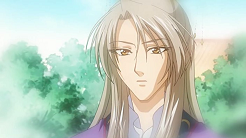
Well, this OVA has been pretty dull so far. The biggest reason for this is a rather dull cast of characters. None of them really stands out, and they’re all rather stereotypical. On one hand, the creators want to be all serious and dramatic with gruesome deaths and killings, and on the other side the biggest priority of the cast of main characters is whether or not they look good. So far, the first episode did introduce the concept, but the overall storyline (which should be important for an OVA like this) is dangerously ignored. The premise is solid so far, but the creators do need to try harder in the next episodes if they want to make this work out.
Minami-ke Okawari

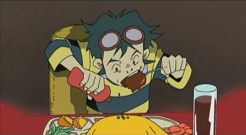
I dropped the original series after two episodes because it just wasn’t that funny, but I became interested in this series when I learned that this season of Minami-ke would be handled by an entirely different production-team. The three main characters still aren’t that interesting, though. They’re all a bunch of stereotypes. I do admit that the side-characters are quite funny, though, when they stand in the spotlights. The OP is quite interesting as well, though I don’t think that these factors will make up for the rather lacklustre lead-characters, so I doubt that I’m going to continue watching this series. If you were a fan of the original, though, you might want to check this one out.

Gunslinger Girl – Il Teatrino

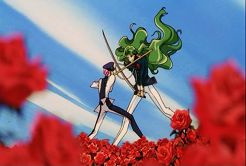
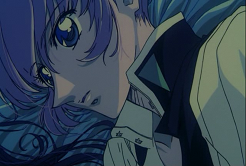
One thing that should be noted first: yes, the character-designs changed. Is it me, or are animators getting lazier nowadays, with hardly any attempt to look different? In any case, the second season of Gunslinger Girl starts with an action-packed episode. While it was definitely exciting, it’s not what the original series great, and I hope that the new staff realizes this for the second season as well. But there’s no need to worry for now. The first season also started with the most action-packed fight of the entire series, and this episode gave enough hints to the deep characters and dialogue. Fans of the series will have to get used a bit to the new style, but apart from that this episode couldn’t have been a better introduction to the second season, and I’m glad to see more of the concept. The new soundtrack also is great. Along with Porfy’s Long Journey the best of the season.

Arete Hime Review – 89/100


Before I start with the review, I have a small announcement to make. Anyone who’s looked at my blog for the past two weeks will probably have noticed the heap of movie and OVA-reviews. Well, with the review of Arete Hime, this special holiday-schedule has ended: every show should be getting out of their hiatus by now, the Winter-season has started as well, and tomorrow my studies will start again as well. I must say that it was a great way to spend the past two weeks, and this was probably the largest amount of activity you’ll see from me in like, ever (according to animeblogger, I managed to churn out more than fifty posts over the past two weeks ^^;). I also managed to greatly reduce my movie-watchlist, in fact, there are only nine titles left of movies and OVAs that I still want to see (three OVAs and six movies, to be exact), and I should be finished with that list in about two months, depending on how busy my studies will become.

Anyways, onto the review. For the past two weeks, I’ve seen a lot of good stuff, but the definite highlights for me were Tokyo Godfathers and this charming movie called Arete Hime, or Princess Arete. This movie really restored my faith in Studio 4C. Every thing has its bad points, and I guess that for Studio 4C this was Spriggan. Still, Arete Hime showed me that these guys remain a bunch of very talented storytellers.

Let me get one thing straight, though: boredom is a major theme of this movie, so yes: it’s slow. Don’t even dare to expect any action in this movie. Still, one flaw that I found in a lot of movies is that they tend to rush things along a lot, while forgetting to build up properly. Arete Hime delightfully avoids this flaw, and makes sure not to rush one minute of its storyline. Of course, the premise of a princess, locked up inside a tower has been done many times before, and yet the creators managed to create a setting with this that stands apart from the rest. The storyline and setting may be simple, but that makes sure that they’ve gotten sufficient development. It was definitely interesting to see the customs and habits of the people who live in a fantasy-influenced medieval setting, without any clichés or stereotypes.

The cast of characters is also well-developed, from the main characters to the side-ones: everything fits, and most of them are smarter than your average anime. You may not suspect it from first sight, but Arete is quite clever for her age, and the major villain too has one of the most interesting back-stories I’ve seen in a long while.

To be honest, if I were asked about the best movie-creating company, I’d answer Studio 4C instead of Ghibli. Sure, Hayao Miyazaki has made some great movies, but they all felt like they were missing something. That final spark to become truly interesting. The works from Studio 4C feel complete, varied and nearly all of them have a terrific sense of storytelling. Both studios try to be different and don’t care about popularity and mainstream. Princess Arete is yet another great example of this. Sure, I can imagine how it’ll put people to sleep, but the storytelling definitely makes up for all of the slow pacing.

Some quick first impressions: Shigofumi, They are our Noble Masters and Porfy no Nagai Tabi

Shigofumi

Ever since the past spring-season, Saturday has by far been my busiest day in terms of blogging, and it doesn’t look like the Winter-Season is going to change this, with yet another excellent series. Even though we’re only halfway the season yet, I’m pretty sure that Shigofumi has the best episode of all the new shows that have aired. It’s only the first episode, and it kept my interest throughout the entire episode with some excellent storytelling (and a very nice twist at the end. ^^;). Shigofumi turned into an excellent combination of Shinigami no Ballad and Jigoku Shoujo, and grabbed the best elements of them. The main character for this episode would have been better if he was a bit smarter (what idiot fires off an amateur-rocket in the middle of a city anyway?), but overall, we’ve got ourselves an gem here.

They are our Noble Masters

Well… at least it doesn’t take itself seriously, unlike the abominations of Rosario to Vampire and H2O, though something makes me suspect that some kind of melodramatic element will appear in the semi-final episode or something. In any case, instead of bad, They are our Noble Masters is just boring. There are lots of stereotypes and fanservice, but at least the plot doesn’t seem to be written by a whiny twelve-year-old who’s just hit puberty. Nearly everything about this series is just mediocre, though at least there is chemistry between the characters that kept me from falling asleep. Overall, this series will never become memorable, though at least it’s not the worst this season’s had to offer.

Porfy no Nagai Tabi

Okay, I know that this is rather useless, but please, someone sub this series, and don’t let it get horribly ignored like what happened with Les Miserables. There’s a very good reason why this is a series that’s part of the World Masterpiece Theatre-series: there’s no moe, no forced climaxes, no stereotypes, and instead it’s got genuine and detailed storytelling. Like expected, the big earthquake that separates Porfy from his sister has yet to happen, and I can imagine how the creators decided to use the first few episodes to flesh out the two of them and their mother, and already it has been an excellent slice-of-life series. Sure, this is definitely going to be the slowest series of the entire season, but it’s going to be worth it when the drama kicks in. To add to that: this series also has the best background-art of the entire season. It looks absolutely gorgeous and life-like. The music also is excellent, just like what you’d expect after Les Miserables (the Greek influences really work). Unfortunately, a lot of people will probably not give this series a chance, but you can be sure that I’m going to be blogging it from beginning to end. This definitely is one of the most promising series of the season.

Card Captor Sakura – The Sealed Card Review – 84/100


Card Captor Sakura, when it was aired on the Dutch TV, was basically along with Gundam Wing and Digimon the series to really make me interested in anime. Looking back, it was really the best amongst these three. It was like Jigoku Shoujo: repetitive, but a great premise with great execution. I also saw the first movie a few years ago, though I never got around watching the second one until now. Turns out that this is the conclusion of the series, even though I ended up only watching the first half of it (blame the Dutch broadcasting-companies who’d rather show Sailor Moon than this gem). Still, I figure that anyone who got to the first major climax of the series will have no problems following the second movie.

First up, I must congratulate this movie for reminding me what made the series so great. Especially the first half has an excellent combination between light-hearted quirky characters and serious scenes. The cast for Card Captor Sakura is a really memorable one, and I especially loved Tomoyo, one excellent supporting character.

Then the second half kicks in, and the comedy takes a step back for the story. Overall, it formed a very nice ending for the series, though unfortunately there were quite a few convenient plot-holes, including a deus-ex-machina-ending. Something also tells me that the creators overestimated the acting- and singing-abilities of mere grade-schoolers. ^^;

Still, despite this, The Sealed Card is a must-watch for any fan of the original series. While the first movie was basically a glorified filler, the second movie gives a nice conclusion, and it has enough elements of what made the original series great. Surely, this is along with xxxHolic the best of what I’ve seen from Clamp.

Some quick first impressions: Hatenkou Yuugi, Persona – Trinity Soul and True Tears

Hatenkou Yuugi

Haha! I knew that the winter-season was going to be awesome. Hatenkou Yuugi had an excellent episode with an excellent combination of comedy and drama, and it would be great if it could continue this for the rest of the series. Both the storytelling and dialogue are excellent and I really like the main female lead: she basically sees a guy holding a gun, and instead of running away she decides to travel along with him. I like strong female leads that don’t need to hide behind their boyfriends. There are few things that weren’t explained in this episode (like, how did the lead girl get magical powers, and how did she get acquainted with the third main character?), but that shouldn’t be a problem for the future episodes to answer. I’m definitely going to keep watching this!

Persona -Trinity Soul-

Well, the first episode was decent enough. It basically played out like your average superpower-series: a bit of introduction, after which our main character comes into contact with the strange power at the end of the episode. The strange power for this series is very much alike Mushiuta and Ayakashi: you control some kind of monster that ordinary people can’t see. Based on the title for this series, I’d guess that these are called “souls”. For men, they look like random mecha, while for women they take on the shape of random goddesses. So far, the main character is nothing to write home about, though he’s not bad either. He actually has two brothers, instead of the clichéd sisters that you usually see around these kinds of persons. There have been a few hints of a female love interest for the guy, but she didn’t appear in this episode yet. Let’s hope that she won’t ruin this series.

True Tears

Oh, a romance-show with a male lead that I actually enjoyed? Finally. True Tears has a nice sense of building-up, and so far none of the scenes have felt forced, unlike so many other shows of its kind. There is also not as much fanservice as I expected, which seems to show that the creators are going for the drama, instead of the moe, which is always good to see, though unfortunately the bathing-scene did found its way into the series (seriously… don’t these people ever lock their doors?) The male lead also isn’t annoying as many of his counterparts, and for once the stereotypical best friend didn’t feel annoying to me. Overall, there are a few clichés here and there, but some nice storytelling makes up for it.

Spring and Chaos Review – 73/100


My favourite kind of cat-people is definitely those from Kenji Miyazawa’s stories. For as far as I can recall, they’re the only ones who don’t try to act cute and moe. I was looking forward to his adaptation of Spring and Chaos, because aside from the cat-people, the stories that I’ve seen from him all had something unique. And indeed, Spring and Chaos isn’t what you’d call your average anime-movie.

The movie basically follows a writer with the name of Kenji Miyazawa (autobiographical?), who is rather eccentric and has rather trouble to fit into society with is idealized views and ideas. This movie sees him trying out various things in order to relieve him from his frustration. The entire thing is quite thought-provoking at times, but I don’t know… it seems to be missing the spark that I saw in Night on the Galactic Railroad and Gauche the Cellist.

After I finished watching the movie I still didn’t quite know what this movie wanted to be, or what its point was, and it just didn’t hit me like some of Kenji Miyazawa’s other works. The creators hop from one thing to the other without much coherence or logic, and I think that that rather spoiled this movie. I think that this was another case of too much ambition on the creators’ side: they wanted to do Miyazawa justice, so they tried to stuff too much in just one hour. It’s a shame.

One thing that did turn out interesting for this movie is its graphics. They’re quite pretty to look at, both the “usual” scenes and the CG-scenes that basically all happen in the main character’s mind. Still, I think that Kenji Miyazawa’s stories are better off with a quiet, down-to-earth approach like with Night on the Galactic Railroad or Gauche the Cellist. They don’t need to be so spectacular and ambitious to work.

Area 88 Review – 87/100


When I originally looked at the promo-art, I thought that Area 88 was another one of the works of Matsumoto Leiji. Turns out it wasn’t, though I can imagine how the creators did get their inspiration from him. Area 88 is a realistic war-story about war-mercenaries in a poor African country. Make no mistake; even though there are only three OVAs, the total amount of airtime for this anime is over three hours. Due to this relatively long size, this turned into one of the least rushed OVAs I’ve seen in a long while.

There are a lot of battles in the sky for this OVA, but the real purpose of the movie is to show the fighter-pilots themselves. What goes on in their mind when they fly? Why do they fight and kill? How does the war change them? All questions get sufficiently answered, and are nicely packaged around the story of one of these pilots, who basically gets blackmailed into joining the mercenaries. There are a few coincidences here and there, but overall Area 88 has turned into quite a memorable OVA for me. I can understand why fifteen years after the original production, a television-series-remake was made (seriously, more movies and OVAs should get that treatment. Battle Angel Alita, Akira, Please Save my Earth, etc)

While I haven’t seen anything of the original Gundam Universal Century-storyline, I can imagine how anyone who liked it will like Area 88. Both the main and side-characters have been sufficiently developed, considering the length of the OVA, and there are no overpowered teenagers who stand in the centre. I must say that after seeing more and more of the genre of realistic war-stories, I’m beginning to like it more and more. It’s OVAs like these that show that you can be manly, even if you don’t pilot a mecha that throws galaxies.

Hyper Future Vision: Gunnm Review – 86/100


This is rare: Hyper Future Vision Gunmm, or Battle Angel Alita (two titles of which I have no idea why they were given to this anime) is a two-episode OVA, based on a much larger work of nine volumes of manga. Most movies and OVAs in the same situation don’t seem to care about explanations and leave huge holes in the characters and storyline. But Battle Angel Alita is different: I only spotted one or two moments were more explanation was needed. Apart from that, this movie felt surprisingly complete, despite its relatively short length.

And that’s not all, because it’s not like the plot and setting are simple. There’s quite a large, varied cast of characters that all are developed a bit and especially the main characters are developed a lot, considering that this OVA only has two episodes to work with. The storyline also keeps getting pushed forward, and the combination between plot- and character-development is excellent. I must praise the scriptwriters for this OVA: they had to face a lot of difficulties, were extremely limited, and yet they pulled it off to put such a storyline in just two episodes.

The characters are also more sympathetic than you think, and especially the second episode is quite emotionally charged, but therein lays the problem. If the creators could already do so much with just two episodes, then just imagine what they’d be able to do if they were given an extra episode to work with. The few holes in the storyline that were left would have been easily filled, and there was more than enough potential for the characters to be more even more sympathetic than they already were. Simply enough: I want more, but there’s no way there’ll be more. Still, despite this, Hyper Future Vision is an excellent recommendation for if you’re looking for something short, yet good.

Black Jack Special Review – 69/100


In 2003, four episodes of Black Jack were produced to celebrate the 30th birthday of Osamu Tezuka’s creation. After watching The Two Doctors of Darkness, I was looking forward to seeing more of this franchise, though unfortunately some bad decisions on the creators’ side turned this Black Jack Special disappointing. I definitely don’t hope that the rest of the series and OVAs are as annoying as this one. I’ll probably end up watching the TV-series in the very distant future, but for now I don’t feel like watching more of this concept.

Lest me start with the thing that by far annoys me the most: Pinoco, Black Jack’s daughter/assistant/wife. I can understand why Makoto Tezuka decided to cut her off in the Two Doctors of Darkness, because the more she appears on the screen, the more annoying her whining becomes. I really like the concept behind Black Jack, but Pinoco serves no purpose at all apart from lightening the mood a bit, though there are much better ways to do this.

Then there comes the storyline itself, and it just doesn’t live up to the Two Doctors of Darkness. Instead of a continuous storyline, there are just four random stories, probably taken from the manga. The first and fourth story work, and give some interesting background to Black Jack himself, though the second and third episode are pointless, far-fetched and way too disappointing for me to recommend this.

It’s a shame. I read somewhere that the Black Jack Special captured the essence of the original manga, though this only strengthens my point that Osamu Tezuka’s material may not be much in his own hands, but can be turned into gold when handled by the right hands. If you want to see examples of this then you should go for Hi no Tori or Metropolis. I can indeed see how much Osamu Tezuka has meant for the anime today: his works may have their flaws, but as a source of inspiration, they were more influential than even Ghost in the Shell. In a few years, I’ll probably watch the tv-series, but for now I’ve seen more than enough of Pinoco’s whining.

Black Jack – The Two Doctors of Darkness Review – 81/100


One thing that I’ve been noticing with Osamu Tezuka’s works is that whenever it’s adapted by someone else, the result turns out great, but when he directs a movie of his own work himself, the result turns out much less spectacular. Metropolis was awesome and Hi no Tori turned out brilliant, while Unico had a lot of potential, but its major villain made no sense at all. The Marine Express also had some great storytelling, but the plot-twist in the middle was just entirely ridiculous. The second Black Jack movie shows the same. While it’s level of quality is nowhere near that of Metropolis or Hi no Tori, it remains a very enjoyable movie.

Anyway, The Two Doctors of Darkness is basically the first thing I’ve seen from the Black Jack-franchise, which consists out of two movies, two tv-series (totalling a staggering amount of 78 episodes), an OVA and a tv-special. After watching it, I can understand why the premise caught on so much: it’s been a while since I saw an anime that toys so much with morals as this one. It’s really one of Osamu Tezuka’s many trademarks.

This movie looks at death at a totally different perspective compared to the usual. Black Jack is basically an incredibly talented surgeon, who can cure almost anything that’s curable with ease. And yet he doesn’t spend his days into a hospital like most other doctors and charges ridiculous fees for his clients. I like how, even though this isn’t the first Black Jack-movie, it does a fine job of introducing the viewer to the concept and main-characters, although I guess I need to watch the television-series for the development of the side-characters, which were just too bland and pointless, making me wonder why they were included in the movie in the first place.

It seems that the one who was given the task to direct this movie was Osamu Tezuka’s son, Makoto Tezuka. For the job, he did a very fine job, like expected of his father. The movie feels complete, it doesn’t drag on and it makes fair use of its ninety minutes. If there weren’t numerous surgical-scenes, I’d recommend this for the younger audiences to watch as well. The fact remains that Makoto does have a lot to learn. The major problem for this movie that it gets a bit too far-fetched at times, and there are a few convenient coincidences at times that spoil the mood that the movie has been building up for. Yet, while knowing nothing about the source-material, I can imagine how the guy could have done far worse than he’s shown now.