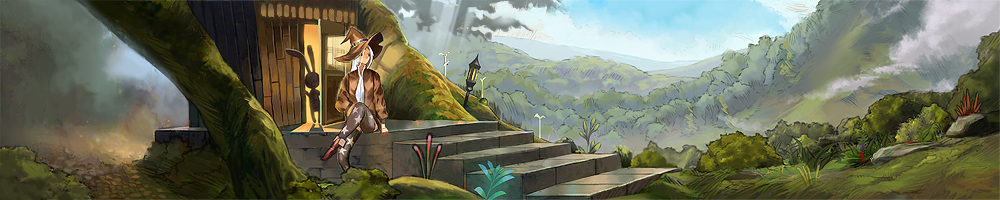
Loups Garous Review – 70/100


Ah, such a shame! Loups Garous is a movie with quite a few interesting twists and turns, offering a slight twist to your usual science fiction premise. It’s the kind of children’s adventure that’s not really meant for children: innocent at one side, really heavy and dark at the other. With the right execution, this really could have been a stunning movie. It’s just too bad that the execution sucks.

Loups Garous is the kind of movie where the writing staff either didn’t get enough time, or didn’t want to take enough time: it’s a collection of neat ideas unable to mesh together, tied together very poorly. The directing for example can’t even keep track of which scene it’s in: randomly it just skips time without even an introduction; things just happen because they’re interesting for the plot. There are countless of things that just don’t make any sense (we’re who knows how many years in the future, and yet there isn’t a single gun in the entire series), the hacking in this movie ranges from interesting to ridiculously stupid (especially during the final climax) and the bad guys have the most pathetic security system out there.

The main problem with this movie however is that it doesn’t know the concept of fleshing things out. It spends a lot of its time on mindless drivel, but it makes no attempt at familiarizing the viewers to its setting. The setting of this movie never gets analyzed beyond its premise, and only one of the characters has any depth at all: the rest are just stereotypes. The villains are also utterly terrible: all of them are just one dimensional stereotypes. People try to murder for the stupidest reasons (the pink-haired girl takes the cake: I dare you to find a dumber reason for her to get chased by a bunch of random punks out to kill her), the main villain is just laughably bad, the conclusion is a joke.

I’m getting a bit tired of Trans Arts, to be honest. They continue to abuse Production IG’s name to produce these ambitious titles that they have no idea how to correctly pull off. The only series in which they didn’t fail horribly was with Kemono no Souja Erin. The production of Loups Garous was horribly rushed and it shows through its entire airtime. I admire the spirit of these people, but please: first learn something from the people who actually know what they’re doing.

Storytelling: 6/10 – Disjointed story, plot holes, deus ex machina, stupid plot twists, poorly paced. Does no justice to its heavy themes. You can see that it’s going somewhere, but there are so many errors along the way.
Characters: 7/10 – Absolutely pathetic villains, likable but shallow characters.
Production-Values: 8/10 – Nothing special for movie standards, but it it does look good and stylish.
Setting: 7/10 – Has a lot of interesting ideas, but never uses them. Completely fails at getting the viewer accustomed to the setting.

Suggestions:
– RD Sennou Chousashitsu
– Dennou Coil
– Metropolis

Some Quick First Impressions: Starry Sky

Starry Sky

Short Synopsis: Our lead character is a transfer student who is in love with a cute girl.
Oh lord. You remember this thing that harem series really like to pull? The flashback to when the lead couple still were children, they met each other once and this left such a strong impression on the girl that she can’t stop thinking about anything besides the male lead for the rest of her life? Well, this episode was the reverse harem version of this. And while the episode was only 10 minutes long, it was ENTIRELY DEVOTED to that bloody overused trope. This is the ultimate fantasy for these insecure teenaged girls: a guy you met years ago still loves you and can’t think about anything but you. That’s also his only trait, by the way. Considering how all of the other episodes are going to focus on the other bishies of this show (there are a whopping TWELVE of them, meaning ten minutes per bishie), this episode pretty much spent its entire time glorifying an overused cliche. The episode also tried to play this as straight as possible: it really believed that this was actually a plausible scenario. I guess I don’t have to say that the result was ridiculously cheesy. The voice acting also was typical bishie schlock, so stay away from this one. Gah, even Neo Angelique was better than this.
ED: This one pretty much summarized the entire series, with really cheesy Engrish quotes that didn’t go through a spell check (“Distiny – I don’t want to be bound by anything!” “How can I COME to BELIEVE in YOU?”).
Potential: 0%

Togainu no Chi Review – 57,5/100


I don’t touch hard yaoi in the same way that I’m not going to talk about those extreme fanservice OVAs, but beyond that I do enjoy a good shounen ai series like Uragiri or Antique Bakery from time to time, despite being a straight guy. The main problem with most of the series of that genre however is that most of them are just so horribly uninspired. That however isn’t the problem with Togainu no Chi: its creativity is in fact the only part of this show with which there’s nothing wrong; it really had the potential to be an interesting and intense story about drugs and violence. If only it were handled by people who actually knew what they were doing.

And I guess that the soundtrack too deserves points for its cheese factor. Everything else however, is just downright poor. The story is incredibly cheesy and ridiculously poorly paced. Nothing really happens for a reason, things just happen for the heck of it and the few reasons that are provided are the corniest in the book. The characters are all flat as a pancake and any attempt made to develop them is just restricted to cheesy plot twists that try to be dark but only end up laughable.

The thing that really sets this show apart is how ridiculously poorly it’s executed, though. The direction is utterly terrible, and none of the voice actors manage to deliver any line correctly. The animation… is even worse than Iron Man. The characters are consistently stiff and feel like cardboard cut-outs. During fights, characters fight like experts one time and like sissies the next. Especially the final two episodes are a complete disaster in which the producers just flat-out give up. The entire final battle is riddled with just pans of random landscapes in the middle of the action scenes. There are animation restrictions due to small budgets, but this was animated by people who put no effort whatsoever in what they were putting out.

Granted, this series is better than Iron Man: its characters are stupid, but not THAT stupid. That however says just about everything positive that can be said, though. It’s just such a shame here that we have two series that do focus on adults, compared to the hordes of teenagers you see nowadays, and yet the characters have the emotional complexity of a bunch of ten year olds.

Storytelling: 5/10 – Is that supposed to be storytelling? Random twists, poorly paced, pointless story.
Characters: 5/10 – These characters couldn’t even act themselves out of a paper bag.
Production-Values: 6/10 – You actually have to put in effort to get visuals that are thisunimpressive.
Setting: 7/10 – At least it has potential.

Suggestions:
– Uragiri wa Boku no Namae wo Shitteiru
– Night Head Genesis
– Himitsu ~ The Revelation

Soredemo Machi wa Mawatteiru Review – 82,5/100


At the start of this season, Natsu no Arashi was the last time in which I actually liked a Shaft series, so I guess that it’s no surprise that I wasn’t really looking forward to their two shows: Arakawa Under the Bridge and Soredemo Machi wa Mawatteiru. Nevertheless, the latter surprised me by being a pretty charming slice of life series. It neither feels like a rehash of one of Shaft’s previous series, nor does it take its style to the point where it gets in the way of the storytelling.

From the outside this seems like another show full of cliches, with the maids and all, and while this show certainly could have done without the maids, it’s the execution that makes this a fresh series. It’s especially good at fleshing out its characters though its dialogue, which is interesting, varied and really brings the characters alive. The entire cast has a good chemistry, and the show continues to juggle them in different situations and combinations in order to keep the series fresh throughout 12 episodes. I especially liked the conflicts between Hotori and her math teacher: they’re pretty much the polar opposites of each other and the tension between them is quite addictive.

There are some annoyances throughout the series, though. First of all is the way in which this series uses these eye catches that already were obnoxious back when Sayonara Zetsubou-Sensei used them. Hotori herself also has this really annoying voice actress, who really manages to portray her as this immature teenaged girl. It’s a good characterization, but her yelling will get on your nerves in one way or the other. The most annoying are the scenes that focus on Hotori’s love interest, though. His inner monologues about how he wants to get inside Hotori’s skirt are boring, overdone and go on for way too long, and it never really amounts to anything.

In terms of the graphics, Shaft really put the earnings of the DVD sales of Bakemonogatari too good use, as this series is really well animated, especially the first two episodes. There are few of their usual shortcuts that have gotten old at this point, and instead it’s able to fully animate its characters while still able to experiment a bit. This definitely adds an interesting dynamic to the characters.

An interesting note is that Soredemo Machi wa Mawatteiru is the first series since the first Sayonara Zetsubou-Sensei that Shinbo actually directed himself, rather than acting as some sort of supervisor. The results really show: this series is skillfully directed and balanced instead of just using Shaft’s style for the heck of it. There’s enough to keep you busy and the characterization is surprisingly good when you look past the initial annoying characters.

Storytelling: 8/10 – Sometimes funny, sometimes not. Doesn’t aim to be the most spectacular, but manages to keep things surprisingly interesting for a slice of life series.
Characters: 8/10 – Characters don’t shy away from being annoying, especially the lead character. They’ve all got a bit of depth and background and are quite likable, though.
Production-Values: 9/10 – Very well animated, especially the first two episode.
Setting: 8/10 – Solid, aside from the one or two weird moments where the show delves into the supernatural.

Suggestions:
– GA Geijutsuka Art Design Class
– Natsu no Arashi
– Gakuen Utopia Manabi Straight

Tantei Opera Milky Holmes Review – 82,5/100


Okay, time to talk about the most underrated show of the season. Autumn 2010 featured a lot of comedies. Out of all those shows, the series with the best jokes was without a doubt Milky Holmes.

And yeah, I know that from the outside, it looks like the cheesiest moe show imaginable, but that’s its entire point as a parody: this series takes the piss out of the phantom thief and the moe genre; it makes fun of all kinds of annoying and overused tropes, including itself. It’s completely over the top and nonsensical, but this really allows it to come up with some very inspired episodes and scenarios. Some of the things it comes up with are as brilliant as they are bizarre, despite the overall stupidity of the plot.

A plot which granted isn’t the most solid for a comedy. The series has a general premise that’s quite an interesting twist on the usual Phantom Thief genre, but as a series it mostly stands as a series of unrelated episodes with a conclusion at the end. Some of these episodes are brilliant, while others are a bit less impressive and try too hard, making this a very inconsistent series. The cast of characters is very fun to watch, but also flat and two dimensional, with the very notable exception of Henriette: a wonderful character who on her own manages to carry the entire plot of this show.

But seriously, it’s been ages since I laughed as hard as I did with the series. Especially the sarcophagus scene is just utterly priceless. The way this series makes its jokes is unlike any other, and a real recommendation for any parody fan. It does have its share of cheesy episodes, and at times the fanservice gets a bit out of hand, but those moments are vastly overshadowed by the good stuff.

Storytelling: 9/10 – Perhaps not consistent, but when it’s funny it’s absolutely hilarious. uses its lack of subtlety wonderfully with its comedic timing.
Characters: 8/10 – Especially Sherlock and Cordellia are always fun to watch, despite their flat characters. The rest of the cast is also flat but great to watch.
Production-Values: 8/10 – Surprisingly good, really. Some of the action scenes are better animated than most shounen series. Beyond the action scenes it could have been more solid, though.
Setting: 8/10 – Leaves nothing intact from the phantom thief genre, but its overall backstory could have been more fleshed out.

Suggestions:
– Marie&Gali 1st Season
– The Law of Ueki
– Skip Beat

The World God Only Knows Review – 75/100


Manglobe is quite possibly one of the top five of best production companies out there (for me, at least). They’ve produced some truly unique and engaging series, but unfortunately those turned into a commercial flop. Especially Michiko e Hatchin and Sarai-ya Goyou didn’t sell well at all. So yeah, they’re also making mainstream moe shows now.

The World God Only Knows, at first sight I wasn’t really looking forward to a show that starred a guy who was the world champion of playing dating sims, but really: it’s not a bad show at all. Its big problem however is that it’s completely redundant in just about every way. “Underwhelming” is the best way to phrase this show.

This first season consists out of four main arcs, all separated by a side-story episode. The side-stories are meant to flesh out the cast and look at the nature of dating sims, while the main arcs feature Keima, the protagonist, as he has to try and get a kiss from a cute girl that has some sort of problem. They form the main meat of this series, and therefore it’s a big problem that most of them just aren’t interesting. The idol and rich girl arc in particular are very poorly characterized, with shallow developments. The the first one is probably the best, and the last one has its charms, but also leaves a lot to be desired. At first sight, these girls all try to be different from the usual stereotypes, but half the time they don’t get anywhere.

All of this isn’t really helped by a dull lead couple. Keima at first sight looks like an interesting yet eccentric character, but his delivery feels just uninspired. His voice acting is bland and lacks subtlety and the only part at which he’s really interesting is in the very first episode. Elcea, his female co-star is a terrible character, though: she’s the only thing about that series that’s genuinely bad. Her whining never seems to stop. She’s a completely annoying klutzy airhead with no likable traits whatsoever. The creators also try to use her in an attempt to parody the moe genre, but completely fail at this, playing everything she does straight, from trying to “bond” with her brother while bathing, having terrible cooking and tripping and falling at random moments. A parody actually requires a good joke to work, dear series!

In the end, what keeps this series afloat is its structure: it doesn’t forget what it is, and is constantly comparing the world of games with the real world. The characterization may leave a lot to be desired, it does bring some interesting stuff to the table. In particular there is one very impressive episode that analyzes broken games that is by far the best episode of the series. This solidness is what kept me from dropping this series and what actually might make the second season better. Still, anime needs to stop making these series that only suffice to build-up. There are plenty of ways that you can make your story exciting while building up at the same time.

Storytelling: 7/10 – With the occasional exception, slow and dull delivery.
Characters: 7/10 – Mediocre voice acting, shallow characters, really annoying Elcea.
Production-Values: 8/10 – Without a doubt, this is the ugliest series that Manglobe ever produced. The animation not bad and has its moments, but those are few and far inbetween.
Setting: 8/10 – The attention to dating sims saves this series from being a complete waste of time.

Suggestions:
– NHK ni Youkoso
– White Album
– Kuchuu Buranko

Gintama The Movie – Benizakura-Hen Review – 65/100


The beginning and the ending of the Benizakura movie continue some neat new material that breaks the fourth wall, especially the beginning is quite funny. The rest though… it’s exactly the Benizakura-arc of the Gintama series. It’s the laziest kind of recap movie in which you don’t even need to cut and paste anything.

So, does it work? Well, the thing is that I have a hard time figuring out for who this movie was made. The fans have already seen this movie. And in fact, watching the same movie a second time caused me to only pay more attention to its flaws, like how Gintoki gets stabbed like five times and never seems to really be bothered by it. At the same time though, people who never have seen this movie will not get why this was one of the best arcs of the series. It’s true that the Benizakura arc is a standalone story, but it relies a lot on characters who have been fleshed out in the previous arcs. This movie depends a lot on its running jokes, and you won’t get them if this is the first thing you see of the series. It’s the same for the background it provides for the main characters: this arc was so great because it gave Gintoki and Katsura a ton of new depth, but you won’t get that without having sat through forty episodes of their antics.

So yeah, this movie is pointless. It gets some points for being a good story with nice action and voice acting, but all of that was just completely copied from the TV-series. The sketch at the end of the movie that has characters fighting over being the lead character is also just basically the same dialogue that the series loved to use in its recaps. I don’t really see any reason to watch this movie.

Storytelling: 6/10 – It’s exactly the same as the Benizakura arc. The few minutes of extra banter at the beginning and end do not make this movie worth watching.
Characters: 7/10 – The characters are good, it gives background to the main characters, not having seen the TV-series makes them lose all their impact.
Production-Values: 7/10 – The only graphical updates are that things are in wide-screen now. That’s far from enough.
Setting: 6/10 – With a recap movie, I always ask “what’s the point?” This movie has none.

Suggestions:
– Mahou Shoujo Lyrical Nanoha The 1st Movie
– Macross – Do You Remember Love
– Macross Frontier – Itsuwari no Utahime

Nurarihyon no Mago Review – 75/100


You know these really long shounen fighting series, of which people say “yeah, it starts bland but after 30 or so episodes it gets really good”. That’s this show; at least according to the many people who have read the Nurarihyon no Mago manga. And yes, it has only 25 episodes.

Nurarihyon no Mago does have a fairly intriguing premise, chockful of the Japanese Shinto culture. It’s pretty solid in the way that it builds up its main characters, side characters, setting and premise. A lot of episodes of this series go into background, fleshing out the different characters, so much even that building up is pretty much the only thing it does. In order to see it pay off, we’re going to have to wait for the second season and because of that I can’t really recommend this season standalone because 25 episodes is a long time to sit through.

The different story arcs throughout this series aren’t bad; they’re just unremarkable. The main problem is that Rikuo (the main character)’s grown up form is just too powerful, taking away the tension of all of the fights he’s in. It establishes a lot of character background, but never really uses it, and that’s my main problem with this series: there is hardly anything that keeps your attention. The biggest culprit is the second half of this series: a lot of build-up there goes into Rikuo’s classmates, who in the end turn out to have no purpose whatsoever in the main story of that arc, leaving the really imporant characters of that arc way too underdeveloped.

Compare that to Letter Bee’s first season: that too went on for really long, yet at least that one delivered some great standalone stories, and kept viewers on a hook with a terrific cliff-hanger towards its second season. Nurarihyon no Mago has none of that. If I hadn’t heard the praises that the manga readers give to the chapters that follow the point where the series ends, I might even have dropped this show.

Storytelling: 6/10 – It’s an entire series of build-up. That’s not good storytelling!
Characters: 8/10 – A solid cast with likable characters. Nothing special, though.
Production-Values: 8/10 – Great character and youkai designs, animation that’s nothing special.
Setting: 8/10 – Again, an interesting background for the second series to work with. It will, right?

Suggestions:
– Letter Bee
– The Law of Ueki
– Hikaru no Go

Shinryaku! Ika-Musume Review – 82,5/100


This season was actually quit ea good one for comedies. Eight series really made me laugh over and over, in completely different ways: we have a parody, a series that uses cute humour, one that uses sex and violence jokes, two that depend on the chemistry between eccentric characters and a dialogue heavy one. Squid Girl’s style of humour is entirely focused on its characterization.

The set-up is as follows: we have a Squid turned into a girl who thinks that she’s going to take over the world, who ends up working at a beach cafe. Each episode is divided into three segments, all focusing on a different scenario. Throughout the series, Squid Girl runs into a bunch of nutcases, who all react differently to her and her strange powers.

The show has a fairly large cast of characters, and granted, some of them aren’t as good as the others. The scientists in particular are a downright insult, and the obsessive Sanae is used too much throughout the series and therefore gets repetitive. Yet, The good ones however, more than make up for it. In particular, Squid Girl herself is an absolutely adorable character; her characterization is just fantastic, her antics are always fresh and hilarious. Her unconventional way of looking at the world is more than enough material to fill twelve episodes. Eiko also proved to be a wonderful straight man for her antics.

The result is a series that made me laugh many times. Out of all the comedies this season, it didn’t make me laugh the hardest, but it did make me laugh the most. There are a few segments that don’t work, but they are overshadowed by the good parts, unlike for example Mitsudomoe last season, which did get caught up with its own repetition. And yeah, you can say that it’s a very unambitious series: it’s just there to provide laughs, nothing more. But the thing is, that for a show to make me laugh so consistently with such a well characterized main character… it’s really something that deserves to be watched if you’re in for some light-hearted fun.

Storytelling: 8/10 – Builds up its jokes neatly, and knows how to deliver them.
Characters: 9/10 – Squid Girl is adorable beyond words. There are some bad characters, but they’re overshadowed by the good ones. Just don’t expect character development here.
Production-Values: 8/10 – Very good in the first few episodes, but dulls in after that.
Setting: 8/10 – Down to earth setting despite the silliness, and for a squid girl she has many interesting talents.

Suggestions:
– GA Geijutsuka Art Design Class
– Sexy Commando Gaiden
– Hyakko

The Dissappearance of Haruhi Suzumiya Review – 85/100


I wouldn’t call myself a fan of Haruhi; I liked the TV-series, but I didn’t consider it to be THAT good. The main story was very good, but only few of the random stories didn’t bore me. Having said that though, Haruhi’s Disappearance is by far the best thing I’ve seen from the franchise.

For starters, I don’t think I’ve ever seen a single anime movie that was longer than this one and I have to praise Kyoani for actually giving its story the time that it deserves. This way, it really was able to portray the characters as realistic as it did in the TV-series. The movie is slow, but very down to earth because of this and the plot flows as smooth as water. The story of the movie is also a great mystery story, starting off really slowly but delivering a ton of interesting turns during the second half.

The best part of the movie however was the cast of characters. This movie gives a ton of insight and new developments on Kyon and Yuki, and all of the other characters also receive a lot of new depth. The story does a lot of interesting things with them, and they’re used quite creatively. When everything finally comes together, it really feels like something special. The character whose development I liked the least was Haruhi, though. To delve into why would be a bit too much of a spoiler, but let’s just say that it’s a bit too theatrical.

Now, there are two things that this movie lacks, yet what I really liked in the TV-series, however. They’re mostly technical things, but I did miss them a lot here. The first is the acting: while still good, it’s not as solid as it was in the TV-series. Kyon is still witty, but at the same time his dialogue isn’t as sharp and lively as it once was, and characters tend to overact a bit during the dramatic parts.

Also, the animation is significantly different from how it was in the TV-series. On one hand, this went on a positive note, as the creators put a lot of money and attention on the inbetween frames. The animation is incredibly smooth, and there are plenty of parts in which the animation is as smooth as possible, and the animation is a lot freer and diverse than it was in the TV-series. The animation style here feels like a combination of Clannad and K-On, but at the same time I miss the restraint of the animation of the first half of the first season: the type that consistently neither moves too much or too little, that really gave the characters the sensation of being alive, which was one of the reasons why I really liked the first half of the first season.

Those are mere details through, the Disappearance of Haruhi Suzumiya has enough to like, even for the people who didn’t really like Haruhi in the first place. This movie does a lot of things right in terms of storytelling and characters, and it definitely was a great watch.

Storytelling: 8/10 – Great story, not as solid as the TV-series, but still wonderfully paced and told.
Characters: 9/10 – Excellent character development.
Production-Values: 9/10 – Very smooth and detailed.
Setting: 8/10 – Nicely plays around with events that happened in the past and the entire concept of this series.

Suggestions:
– Tenchi Muyo In Love 2 – Tenchi Forever
– Kara no Kyoukai – The Garden of Sinners – Paradox Spiral
– Toki wo Kakeru Shoujo