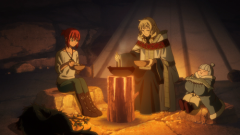
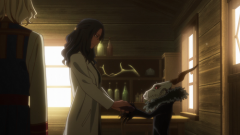
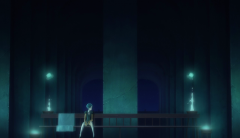
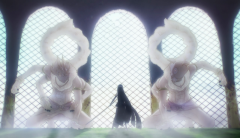
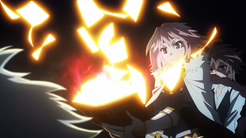
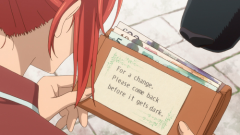
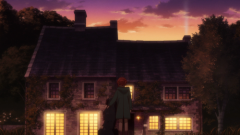
This week proves to be the most action-packed episode Houseki has been offering so far and unconventionally, it’s Dia who takes the central stage at facing the most ridiculously overpowered Lunarian Titan to date. Well, I said “unconventionally”, but when the narration and the execution (the camera work, in particular) come together in such neat package I have no complain whatsoever. Viewers might point to the second half of this episode as Houseki’s most memorable moments, and they’re indeed correct, but for me the first half is just as equally impressive, despite… well, nothing really happens. Take the first segment for example, where Phos just sits in one place and other characters pop in and out of the picture, in sequence, it feels like we’re in a play. Indeed, that segment is constructed like a theatre play, with Phos sometimes sits in the middle of the “stage”, talks to one cast member at a time and then narrates themselves. Moreover, just by the way Phos interacts with different Gems we can learn immediately about Phos’ current role in this gems’ society: helping out Lexi about Lunarian’s types, taking a patrol job from Jade, still a topic of curiosity from Rutile, partnering up with Bort, and most importantly, we learn that Phos is still haunted by the loss of Antarc. All that and Houseki never betrays its quirky sense of humor. The moment those jellyfishes jump off their pots totally win me over. I didn’t even notice that the Gems use jellyfish as a light source before. That explains the light changes color depending on which Gems taking a spotlight was the jellyfishes deciding to change color, and obviously has nothing to do with Houseki’s artistic liberty.
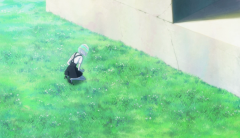
Dia’s reaction towards receiving the news from Phos has to be Houseki’s most expressive reaction in the whole season, because it fits Dia’s character too well. Shock at first, but Dia quickly accepts that fact and even forces Phos to accept the personality of Bort. I know they’re Gems so they have different concept than us human when it comes to pairing/ partnering, but for me the Gems’ break up is just as hard as ending a relationship. Dia takes those sad feeling all to themselves – of course they’re never worthy enough to be paired with Bort. Of course now that Phos is stronger, it’s only natural for Bort to team up with Phos. The moment Dia just sits there picking flowers in complete loneliness, follow immediately by them looking at their old partner from afar is both sad and heartfelt. Houseki is really spot on at delivering those little character moments. Dia’s arc comes to a satisfying closure at the end of the episode, when Dia gets out of their own insecurity to face the beast head on, and later on when they see Bort again in their own shattered state, Dia fully lets all their burden go. “I’m glad we spilt up” and “From afar, I see just how much you mean to me”. Both are true, spoken from the bottom of their heart (if they ever have one).
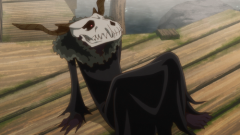
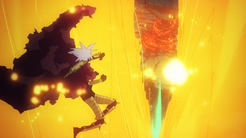
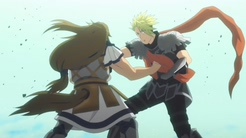
Finally, holy cow! The animation, the choreography and the camera work really something else altogether. I would expect that level of excellence in theatrical movie or a top-notch 3D game, not in a “budget” anime show. To put it simply, Houseki is a prime example of an anime that uses the CG right. The two fights are stunning with some of the best cinematography that play almost entirely in one single cut. Just watch the fight sequence of Dia and Shiro in full movements and the long take makes us feel like we were participating in the fight along with Dia. Or the sequence before that when we follow Dia hiding behind the box, we get to see they leaning forward and back in real time, then the camera just zooms out while Dia hides so we can feel in sync with the situation Dia is in. Also I have to note that the way Dia uses their own leg and their own sharpness as a weapon is a smart move, since diamond is weak under impact but extremely lethal when it comes to cutting. At long last, Shiro is cut in half… and split into two smaller Shiros. With only Bort fighting them, how can they pull it off? We have one of the best action-sequence of this whole year and for my money one of the best episode of this season. Houseki goes completely insane this week and ends up outdone themselves. The only issue remains… All these cliffhangers are really bad for my blood-pressure.