3-gatsu no Lion – 30 [Midday Moon/Adventurers]

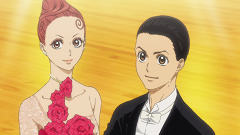
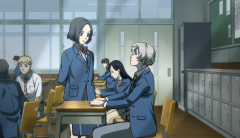
Look at me, posting this review just hours after episode 30 showed up online! This must be the start of a new chapter in my blogging career, and my reward is a pretty good episode of 3-gatsu. I say “pretty good” rather than “great” because, as is often the case with this show, one of the manga chapters it covered was much better than the other. Thankfully, the team at Shaft seemed to recognize this, because they devoted a lot more time to Nikaidou’s story than to the dialogue between Rei and Hayashida-sensei. This is the second of these student-teacher chats that we’ve seen this season, and while they’re important for establishing Hayashida as a fatherly presence in Rei’s life, this one wasn’t as strong as the original. The close-ups, head tilts, and repetition of past jokes (countering “monster parents” with other monsters) were particularly distracting this week. Really, the only thing I gleaned from this scene was the way in which the Kawamotos’ father disappeared – he found a new girlfriend, abandoned his family, and started a new one somewhere else, just like that.

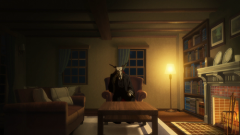
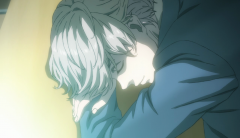
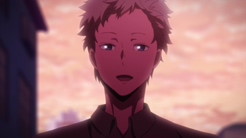
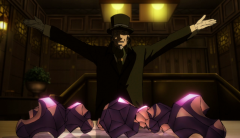
There’s more that could be said about “Midday Moon,” but the Kawamoto family wasn’t the real focus of this episode. That honor belongs to Nikaidou, who some 3-gatsu fans cite as their least favorite character due to his role as a loud, hotheaded rival character. If there were ever an episode capable of changing their minds, though, it would be this one, which explored his history as a shogi player, his struggle with chronic illness, and his fierce competitive mentality. Shimada is the perfect conductor for these flashbacks due to his status as Nikaidou’s shogi “brother” and his recent mentorship of Rei. Even more than his present relationship to their characters, however, his initial dislike of Nikaidou is what sells “Adventures” as a complete story. Shimada first dismisses him as a rich kid looking for kicks, resenting his wealth because of the poverty in which he himself grew up. But after perusing his semifinal match records, he realizes Nikaidou is an obsessive student of shogi, and that his sickness must have created the conditions where he’d be able to fully devote himself to the game.

Knowing this about Nikaidou, it’s easier than ever to draw a parallel between him and Kiriyama, his arch rival. Rei was essentially forced into shogi in both his biological and adoptive families, and continued to use it as an unhealthy mode of escape even after becoming independent. For both boys, the game functions as something of a curse, but it’s also a life preserver in an ocean of pain both psychological and, in Nikaidou’s case, physical. He can’t bear the thought of anyone going easy on him, because for him, shogi is the only contest in the world where he’s on a level playing field with everyone else. That’s why he begs Shimada not to tell Rei about his illness – not only does he want to avoid burdening his friend, but he also wants to maintain their rivalry as a means of personal growth. As I watched this scene, I remembered Kyouko’s past strategy of telling Rei about the strained family life of another shogi player, hoping to sabotage her stepbrother by generating sympathy for his opponent. The hurt that Rei experienced in childhood makes him scared of hurting others, so it seems Nikaidou was on the right track by concealing his condition from his best friend.

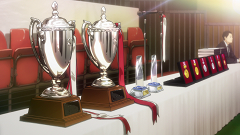
The question of whether Rei can still treat Nikaidou as a rival is left unresolved here. Shimada reveals that his opponent in the semifinals forced a second game after a threefold repetition, which has a direct equivalent in chess. In that game, such deadlocked board states are typically avoided, but can be intentionally pursued to manipulate the game clock, which appears to be what Nikaidou’s opponent had in mind. Whether he purposely took advantage of the boy’s poor health isn’t clear to us yet, but either way, Rei has an opportunity to avenge his friend in the finals. That match will function as a landmark moment in Rei’s shogi career, but Shimada is more interested in whether he can still be merciless Nikaidou, as his opponent was. And although Rei is determined to win his next match, he dodges Shimada’s question, which signals to me that he now sees Nikaidou in a totally different light. Even if the finals end in victory for Kiriyama, it’s going to take a lot more than a trophy and a promise of vengeance to bridge the gap that has formed between them.

Fate/Apocrypha – 20[Soar through the Sky]

We return to what I feel Apocrypha does best, action, and what an episode to kick off the final confrontation. We have the black team approaching the hanging Gardens of Babylon in a group of airplanes. This kicks off a fights between Atalanta and Joan, as well as Achilles and Chiron. This fight is great, thrilling and for once the animation and sound design don’t ruin it. It’s an explosive confrontation between these servants as they jump from plane to plane trying to take each other out. Quite frankly this is what I came to this show for, to see historical figures duke it out in the more over the top ways possible. Of course learning about these figures and seeing how they interact and are characterised is a personal draw in this franchise for me but it’s clear we won’t have time for that. Still I do lament its absence even if signs of deeper characterisation are present. For example, we know that Achilles cares a lot for Atalanta but as a matter of fact the reason for this is because Atalanta was his first crush. When he was trained, Chiron used to tell Achilles stories about Atalanta which caused Achilles to gain a schoolboy crush on her. His caring for her in this series is actually his leftover feelings from that period. Though this requires clarification as while I seen it mentioned, I cannot find anything referencing it. There is also the nice detail that Achilles deeply regretted killing an Amazon Queen during his life and because of that he swore to never unleash the power of his spear on a female opponent. I really do wish that little details like this were included and utilised in the anime. Likewise i can’t really find anything about Chiron having a degree of precognition but hey, Achilles never had a flying chariot and it makes the fight more interesting.

It’s nice to have a little Shakespeare and amusing as hell that Shirou knew that Shakespeare would prefer to write the ending of this story as a tragedy rather than allow a happy ending. In other words Shakespeare actually wants Shirou to fail cause the tragedy of it would be far more interesting. So why does Shirou have to force Shakespeare to not turn his recount of this story into a tragedy? That is because Shakespeare’s writings have power, in fact he can pick up a pebble off the ground and turn it into a E rank Noble Phantasm. He can create up to C rank noble Phantasms just by writing about the object. As such there is a very real possibility that what Shakespeare writes about Shirou’s plan could affect it and Shirou cannot take that chance. Thus like a forceful editor, he must order Shakespeare to not write such an ending. It’s funny that in a way Shakespeare could have saved the world from Shirou’s plan but only done so because it would be more interesting to him. I really do love his character and the way in which he manages to get Semiramis to reveal more of her character goes to show how much more of a boon he could have been to the story if he was given more screentime. Just having Shakespeare running around inquiring into the servants characters could have given so much development to them.

So time for Nasuverse 101. In the Nasuverse there is magecraft and there is true magic. Magecraft is the kind that mages in this series use and it is magic but it has it’s limitations. True magic on the other hand, has no limitations. Bring back the dead, time travel to the past, enter alternative dimensions, even achieve true immortality. These are the things possible for true magic. There are five known true Magic’s but for simplicity sake we shall only talk about the one that is relevant here, that being the third magic, Heaven’s Feel. Heaven’s Feel is materialisation of the soul, essentially removing the soul from the body and allowing it to interact with the real world. What this would accomplish would be to give a kind of immortality as souls would never die and live forever. In fact the manner in which servants are summoned into the real world is a kind of third magic. This magic is actually the main goal of the Holy Grail War for the Einzberns as well as Zoukens main goal. This is also the reason that the Holy Grail War can be alternatively called “Heaven’s Feel”, in case this wasn’t confusing enough. Thus in the after credits scene of this episode we have Shirou’s goal be to use third magic on all humanity, hereby making humanity immortal and rendering death obsolete. In truth this isn’t the best solution as while it may work in theory, i believe there are Nasu works in which humanity has obtained immortality and it lead to the problem of humanity stagnating. It’s unlikely that he will succeed giving the current narrative but I hope we see some good fights till then.

Dies Irae – 07[Swastika]

After the episode we had last time, it’s only fitting that this episode is more down to earth. Don’t want to burn out the staff animating action scenes like that every week. So this week we have our protagonist and antagonist sitting at a table to have a little chat. In that regard it’s nice to get to know Reinhard and his general demeanour of arrogance. But unlike Gilgamesh, he doesn’t belittle his opponents. Frankly Reinhard wants Ren to put up a fight, to push him to use his full power so that he can feel alive. For Reinhard is suffering from the same thing that Shirou is suffering from, a constant sense of deja vu.(Or foreknowledge if you prefer. People get huffy about them not being the same but the general rundown is people feeling like they have been through something before and thus it feels trivial and routine.) It’s amusing to see Reinhard have the complete upper hand and yet just give back Marie after Ren declares he will kill him. From this talk we learn a few things. That Reinhard is looking to remodel the world into something fulfilling to concur and he requires eight swastika’s to be released around the city. A city which was apparently constructed for the sole purpose of being sacrificed to Reinhard. And that Mercurius is the being who gave Reinhard the power and drive to do all of this.

Now to address the line likely to have raised a few eyebrows which is where Rea asks Ren to either rape her or kill her. So first off you cannot ask someone to rape you, because asking them to do it is giving consent and it’s not rape if you consent to it. If he was assaulting you against your will, then it’s rape. Basically you are asking him to sleep with you, not rape you. Secondly, this out of nowhere request actually has some logic behind it, flimsy though it may be. Basically in order for Reinhard’s plans to succeed, Rea needs to be alive and a virgin. Though the second aspect, unknown to Rea, isn’t really needed. Now i will need to go on a tangent here to explain this scene better but let me begin by stating that it is a common misconception among the anime community to consider Visual Novels, eroge and Dating sims to be different words for the same thing. This is not the case as Dating Sims are more stat focused games about dating girls. Eroge stands for erotic game and pretty much stands for any game featuring erotic content. Visual novels can sometimes fall into this category though the level of erotic content varies between games. For example, DangonRonpa qualifies as a visual Novel but it isn’t a eroge. Whereas Huniepop qualifies as a dating sim and a eroge but not a visual novel. It can get murky due to the terms vagueness but the terms are not mutually exclusive. Now where Dies Irae comes into this is that the game is technically an Eroge but primarily a Visual Novel. But the only reason it can be considered a Eroge is because sex scenes were crowbarred into the story because of a strange obligation in the VN industry.

This is something somewhat influenced by Fate/Stay Night which originally wasn’t going to have erotic content but Type Moon thought that the game wouldn’t sell unless it had erotic content. It was a huge success and thus from that point forward all visual novels crowbarred sex scenes into their narratives. You can always tell when these scenes come in because they are jarring and sudden. Often bringing with it a serious downgrade in writing quality. So with this we finally get to Rea’s abrupt “Bang me or kill me” request. Here’s the thing, this part featured a sex scene, or at least I assume as I played the all ages version of Dies Irae.(Some of you may call blasphemy on that but hey, I ain’t waiting months for a adult patch to come out. Besides I don’t even care about sex scenes and truly didn’t feel like I was missing out on anything) As such the script demands sex, so sex must happen. Logic or proper timing be damned. And it is these things that makes it awkward to recommend visual novels to others. Well line aside i felt the whole heart to heart here was falling a bit flat, with Rea and Ren relating their similar feeling that they somehow both knew that this event would happen, and lament the loss of their ordinary life. It’s just…I don’t really care about these two. I have said it before but I find the protagonist side of this story to be quite underwhelming. As a last note, Marie is back and after getting stabbed in the chest she had upgraded her emotional range from innocent puppy to moeblob waifu. Sigh…such a pity that a lackluster character should have such an appealing design.

Mahoutsukai no Yome – 8 [Let Sleeping Dogs Lie]

Hello and welcome to another week of Mahoutsukai. This week, as predicted, Chise gets a new friend, our evil Sorcerer gets a name, and Chibi art ruins scenes. Lets jump in.

To start off, lets talk about Chise. Its a good week for her. She shows off her own magic power and smarts with the Tarantula Hawks, a wasp species that hunts spiders. She shows to have potential equal to or above Elias’s, with devouring his hand accidentally, and she binds a familiar. Who, by the way, I am looking forward to seeing more of. Our pair needed a third person to bounce off of. For Chise, I am glad she is standing out more and more, as this is her story.  Shes no longer the cowering new slave from episode one. However, there are still some things that bother me.

Continue reading “Mahoutsukai no Yome – 8 [Let Sleeping Dogs Lie]”

Juuni Taisen – 09 [The Man Who Chases Two Rabbits Catches Neither]

Oh fuck… Turns out Dragon’s plan all along was to chime in, just so that he is immediately taken down by the flying Rabbit. Lame. What a load of crap. I mean, Dragon has been contributing absolutely zero significance to the plot so far. The reason he wasn’t the first one to have his head chopped off? Because he was standing behind Snake. The reason he survived within the top 5? Because he’s freaking flying and hiding. And just when he makes a speech last week and decides to fight, bam, his body gets cut in half. Duh. I don’t feel like I care anymore.

Maybe Dragon’s very purpose in the story comes afterward, when the now Zombie-Dragon again combines Zombie-Snake as an invincible team to battle Bull and Tiger. I honestly don’t get Bull’s plan part that suggest Tiger taking the ice tank because Bull could have done it himself without relying on the not-to-good-with-thinking Tiger. Anyways, I kinda enjoy the dynamic between Bull and Tiger. Believe it or not they’re quite similar when it comes to fighting style: all aggressive, lone-wolf, no strategy style (simply because they’re too strong and quick to even need a strategy). That is exactly why their style doesn’t work well against zombies, whose body parts keep risen again after getting chopped up. Fortunately, Tiger finally caught on with the plan and uses the ice tank from Dragon to finish those annoying zombies off.

I was curious to see how Juuni Taisen tackles this Rabbit episode, arguably the most mysterious, maddening character of this series. He is the only one who doesn’t have a prolife page in the Light Novel, implying that his backstory is a mysterious one. As it reveals, this week we have… Tiger’s extended backstory instead on how she was a spirited fighter and then broken down due to the ugliness of war and thus turns her into the bloodthirsty beast who drunk on blood and booze and stop worrying about anything else. If there is a central message in Juuni Taisen: their world is harsh, grey-morally and mad and those who still keeps a bright, hopeful sentiment (like Monkey and in an extend, Chicken) will be the first to die. What I find amused about this particular backstory is how Tiger was raised in such a traditional dojo, something that when we saw her fighting stance in few previous back we wouldn’t have guessed correctly. Drinking away, stop thinking and worrying too much in a way free herself to all the commitments and her moral dilemma about the pointlessness of it all. She starts to lose sense of time, of the faces around her and her life seems to be an extended, endless day with more soldiers to kill and booze to drink.

Bull and Tiger meet the formidable Rabbit and to our surprise, they kill Rabbit at a single whoop. But consider Rabbit has fair amount of dirty tactics, I come to suspect that this is all his plan along. Anyone noticed he bites his tongue before getting chopped off? After all he’s a necromantic so it only makes sense that he could raise himself back from the death. In addition, he still has Monkey lurking around somewhere and her ability is simply too powerful. The production this week fares a bit better than the poor execution last week, although the obvious CG still stands out too much in a bad way. A lot of fight scenes this week, however, will somewhat compensate for the lack of any fighting in previous few weeks. So I expect next week will be a fair fight between the best-dynamic fighters to date, and then we will see how Rabbit comes back from the death to haunt those two. In a meantime, Rat just waits out for everyone killing themselves and then claim a victory lap by doing absolutely nothing.

Houseki no Kuni – 08 [Antarcticite]

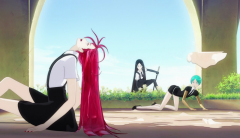
Houseki’s just getting better and better huh? This episode is a knock-out, this series is truly a knock-out. It must be Houseki’s most devastating episode, leaving Phos, Antarc and Kongou-sensei the deep wound that won’t easily be healed. Let’s get to the main turn of event upfront: Antarc is taken away by the Moon people. This result, in a way, is a paid price for Phos getting their new arms. Just two episodes since their first appearance, Antarc has earned more than enough to become a reliable, yet surprisingly poignant and humane character and they’re undoubtedly one of my favorite characters in Houseki. Just two episodes since their first appearance, but the loss of Antarc feels profoundly impactful, not only with us viewers (since Antarc was the very first gem from our point of view to be taken by the Lunarians), but also with both Phos and Kongou-sensei, the only two beings who share a deep connection with Antarc. But boy, the Iced Gem does put up a good fight. In a way, it’s more like Antarc is unlucky when they encounter a string of bad luck all by their own: Phos’s in the situation where they can’t help (another instance where Phos being useless when it counts the most), the sky is unexpectedly clear, Kongou-sensei being hold up and most of all, the Lunarians attack them TWICE. They’re a persistent bunch, to put it very mildly.

But Antarc’s character strength shines through all over this episode with many, many great character moments. From the very early on, where we can clearly see their frustration towards Phos’ losing the forearms. Diving deep into the sea of ice, risking their own safety and nearly losing their hand, all we can hear was “they’re gone”. It’s more like the far cry from Antarc that they blame the loss of Phos’ forearms as their own lack of teamwork experience. Or their furious later on when they wanted to take their hand back because they don’t want to lose any memories with the sensei. Or even later when they literally breaking apart, they do their best to take care of Phos and tells Phos to take care of sensei and carry on the winter job in their place. Antarc sure will be missed; an unsung hero who exits the field almost too soon, leaves a big impact to those remaining players, especially Phos.

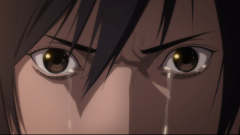
Like how we expected last week (and frankly this was the only plot development that comes as expected, the rest is fairly unpredictable), Phos’ getting a new pair of hands and they’re much stronger, albeit much harder to control, than Phos’ previous arms. This is a true “body-horror” element if you ask me, unfamiliar limbs attached to the host and then grow accustomed and spread all over the body and go out of control. At first, these golden arms take completely out of hands, building themselves up into the golden jelly, then golden solid cage which completely “swallow Phos whole”. However, with the devastating feeling of watching Antarc broken apart, then being taken away by the Lunarians, Phos goes pass their own limits to control those freak arms and manage to make them a useful, powerful weapon. This is the first time, however, that we witness the desperation in the eyes of Phos. The laid-back, why-so-serious character becomes angry, distraught, and later, deeply disappointed about themselves that they can’t do anything to bring their friend back. Big part of why Phos is still very likable despite their seemingly-annoying attitude lies in the dynamic voice acting work from Tomoyo Kurosawa, who did a marvellous job voicing Kumiko in Sound Eupho last year. In an interview, the staff comment that they build Phos’s body acting based mostly on the nuance of Miss Kurosawa’s voice (which is not a common practice by all mean since usually the voicing session comes much later in the production phase), and here we can see the easy dynamic from Phos that made them click like a stick.
Houseki again drops another crucial setting: A Chord Shore where supposedly all the Gems are born in, and for my money, where it all begins. We get the see the brief part of an incomplete crystal who washed up, drop into the ground and become nothing. Only in rare occasions, the complete Gems are born, and they were taken immediately into the swings of Kongou-sensei, who teach them about the world and assign them to their jobs. All I’m getting at is that Kongou-sensei definitely controls their income of knowledge and he obviously hides something underneath the surface. Even Yellow Diamond, the oldest gem, admits that they already forget the reasons they fight the Lunarians. All other gems don’t know either the reasons they fight except that they were told to fight. I guess the main reason here has to do with Kongou-sensei, in the sense that those gems fight the Moon people to protect himself from the Lunarians. Just looking at the way the Lunarians “ambush” the Monk: for me their actions all hint towards to “worshipping” Kongou-sensei, and I suspect that they gather the Gems in order to make the best material to submit him. But what intrigue in the settings doesn’t lessen the fact that Houseki has delivered some of its most emotional-wrenching moments to date. I have a strong feeling that Houseki keeps building itself up to an epic drive, both in terms of emotion, as well as its narrative scope.

Kino’s Journey -The Beautiful World- – 08[Country of Radio Waves]

This episode almost seems like a compromise formed from the complaints I had last episode. Namely because the first half of the episode was what I look for in Kino and the second half was the most pointless fluff to grace the series to date. So let’s deal with the first part first which was quite good. Not the best KIno has to offer but still pretty solid and this week’s episode deals with a modern like country and it’s problem with radio waves. Kino is once again out of the protagonist seat and instead we have Riko, Shizu and Ti. Funny enough these three are not traveling for fun like Kino is and are instead looking for a country which they can settle down in. Considering their current role as secondary protagonists, I am guessing that plan won’t go so well. Sure enough the three find out that the relatively normal country has a problem with people going crazy every few years and committing horrible criminal acts. The reason behind this appears to be machines implanted in all the citizens brains from a time when they were slaves and a radio tower which sends out bad radio waves that cause people to commit horrible crimes. However it turns out that the radio tower is broken down and has not been operational in a very long time.

Therefore the horrible crime that happened in this episode where a teacher massacred his classroom of students, was in fact an act that he committed by his own will. Shizu once again shoots himself in the foot here by confirming this to the people, only to have them call him a liar and decide that he is now under control of the radio waves, despite how ridiculous that notion sounds. Again the characters in this episode don’t really act realistically and if you try you can certainly poke some holes into the setup. For example it’s fairly unrealistic that no traveler was sent out to investigate the radio tower before Shizu despite them living with it so long. But again, that’s not the point. The point here is the meaning behind the story and in this case I believe it’s people’s tendency to try to rationalize the illogical. It reminds me of conspiracy theory in a way as people, instead of accepting a simple truth, attempt to find some kind of underlying evil to blame. For example, there is a popular theory on the Jack the Ripper murders being a series of assassinations to cover up a secret marriage in royal family and orchestrated by a secret organization known as the freemasons. This theory is off course, ridiculous and falls apart when placed under closer scrutiny. However this theory is a far more comforting thought in that the murders had meaning and that these women at least died for a reason, as evil though it may be. This is at least a work of logic and easier to accept that over the far more terrifying truth. That a psychopath came to London and killed five women for absolutely no reason. For isn’t it far more reasonable if the devil or aliens made people do such horrible things? Surely ordinary people could not willingly commit such monstrous acts without remorse? No, of course it wasn’t their fault, it’s all because of the video games/corporations/government/satan/society/parenting/god or whatever you care to name.

So in this country they would prefer to believe that a giant evil radio tower was forcing innocent people to commit horrible crimes than accept that these crimes were of the people’s own choice. Unfortunately this belief is likely the reason for the high crime rate in the first place as the authorities do not punish those who commit these crimes and simply isolate them for a time before releasing them back into society. It’s up for debate whether there is anything to this radio story, it doesn’t make sense on a fundamental level but the criminal who killed that classroom did seem like he was behaving erratically as though there was a supernatural force at play. I somewhat wonder if this thing is thing is more of a subconscious suggestion and people just forsake any moral control because they are under the impression that they are being controlled. I could be possible that when Shizu lied about their being another radio tower to the man that just the very idea of it would be enough to push that man to become a criminal. All in all I do like this story though the payoff was a bit expected. But then there is the second half of the episode where we follow a day in the life of our resident grenade loli.

Let me preface this by stating that I like Ti. I like the dynamic of her looking emotionless while being prone to emotional outbursts, while Riko is a dog that looks happy go lucky when in reality he’s much more serious and Shizu is Kirito isekai-ed into Kino’s world to get karmically kicked in the nuts for all the crap he pulled in SAO. Ti wants the same thing that Riko and Shizu want but has an underlying desperation to her. To her, these two are her last chance for happiness and if anything whatsoever comes to threaten that then she will resort to any means necessary to protect it. I do really like that, she’s like an emotional time bomb who you never know when or how she will be set off. Her fascination with as well as endless supply of grenades only making her all the more dangerous. In a two cour series I won’t mind having half an episode to just show Riku and Ti bonding but as far as I know this is one cour and time is precious. So why is this prioritized over more important stories? You can’t tell me there were no stories to fit a half an episode timeslot. I mean it’s cute and all, almost makes me forget this girl was threatening to kill a baby just ten minutes prior, but don’t we have more important things to get to? As far as I know we have four episodes left and while I enjoyed my time with Kino I still feel like there is a well of untapped potential that it is failing to draw from. I hate to use the word disappointing as I feel this show doesn’t deserve the label but once again I feel that frustration I felt with Little Witch Academia, where in a good show could have been great if things just went a little differently.
Inuyashiki – 7 [Shion Watanabe]

As disappointing as it is to admit, Inuyashiki has broken its hot streak. This week, thought it has both highs and lows, was on average a let down. From heel-turns to a blistering pace, there is a good deal to cover, so let’s jump in.

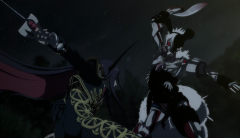
While the show is named Inuyashiki, we have seen far more of Hiro than of the titular main character. This episode, we finally see Hiro own up to what he is. He admits to Shiro he is the killer, opens up about being a robot. It feels like some progress is about to be made for him. Then in a ridiculous heel-turn, Hiro decides to heal people to make up for all his murder. On one hand, I like their exploration of “the good outweighs the bad”. It’s a worthy concept to look at. Yet on the other, it’s so sudden and comes after a veritable murder spree, because a girl he doesn’t care about asked him to. Its like he is latching on to anything to make him feel human.

Continue reading “Inuyashiki – 7 [Shion Watanabe]”

Girls’ Last Tour – 08 [Memory – Spiral – Moonlight]

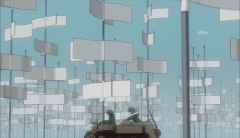
Girls’ Last Tour again addresses many things about the meaning of life through its very minimalist method. This week, the girls encounter massive filing cabinets that remind me a great deal to the terrific Terry Gilliam’s visual style. Most of them are secured, but in the only few that are opened, there are only useless items: a dysfunctional radio, a button, a piece of cloth, an empty shell. The girls have no idea what those objects even mean, until they encounter the stone statue that it hits them. These items serve as a remnant, a memory to those who passed away. Here, the idea of memories is discussed and admittedly the one that I am sometimes wondering myself: when we get to the end of our lives, isn’t our existence defined by the memories of people we meet in our lives, and those people will be soon gone as well? Memories can be easily fade away, with the faces and the even the names you no longer recall. Our mere existence is goddamn futile. In this episode, Yuu already has a difficult time remembering Kanazawa and Ishii, despite just met them few episodes ago (and in the world where they hardly meet another human being, it does strain some credulity here. But we’re talking about Yuu after all, so it could happen), but she does remember Kanazawa through his camera, an item he gave to the girls as a parting gift. As long as the camera is there, the girls will remember him, just like the various unusable objects in that filing cabinets.

Then our girls head their ways ascending to the upper level. The way the girls spiralling around and around is a great metaphor for their lives, and pretty much our lives, are structured in the same model. We keep doing our daily routines in circle, in an endless loop that finally lead up to the final destination – our death. Well, Girls’ Last Tour isn’t that kind of bleak, pessimistic show so we also have Chi-chan getting dizzy with her cute dizzying expression and they escape death by the touch of hair trying to get across the unstable track (and effectively destroyed their track as well, I feel sorry for the next guy who go upon this path). Once they reach the next level, the new ruined landscape looks more organized, and less tumbledown than previous lower levels, with the sight of full moon to boost. They discover a golden liquid named “Beeu”, drinking them and dancing under the moonlight. Drunken Chi-chan might be the best version of Chi-chan ever. Moreover, the girls always have that close physical relationship with each other, the way they feel utterly comfortable lingering beside each other, and that quality again shines brightly under the spell of the moonlight and alcohol. I love the way Chi-chan breaks her character, to be even more expressive and active than Yuu. Just look at the girls enjoying those little happy moments despite the vast emptiness of the world around, whatever the end of this last tour might be (I’m starting to think we might have a very sad, bleak ending here), I know that they won’t have much regrets whatsoever.

3-gatsu no Lion – 28/29 [Small World…Hachiya]

Before I launch into things here, allow me to express my apologies for the double episode review. 3-gatsu is the type of show that ought to receive weekly coverage, but I’ve been busier than usual during the past month. Among my list of preoccupations was a marathon of the 3-gatsu manga, which I couldn’t stop myself from reading once the bullying arc began. Before I knew it, I was caught up, and the agonizing year-long wait for new material had begun. How great is it that there are still fifteen episodes left this season to help tide me over? I can’t wait to watch each one, and hopefully blog about them not too long after they’ve aired. (For anyone wondering how the manga compares to the show, I’d say it manages to be even more emotional despite the limitations of its format – I can’t recommend it enough.)

For several episodes now, Rei has been thinking about what kind of help he can offer to Hinata during this difficult period. He has a plan to support her financially, should that become necessary, and he’s made himself a constant presence in her life, keeping the promise he made by the river in “Ladybug Bush (Part 2).” But now he’s approaching the problem as directly as he can, by asking her to describe her school life little by little. Rei even uses his connection with Hina’s schoolmate (and crush) Takahashi to provide her with an escape route during her unbearable lunch hour. Though Takahashi is certainly doing her a favor by springing her from that oppressive environment, he misses the mark in another way. As the two of them play catch, his hard throws cause Hinata to yelp in pain, but he denies that the pitches were fast enough to warrant that response. He can’t understand that stinging sensation because he doesn’t share her perspective, the same way that those who minimize the negative effects of bullying don’t realize how damaging it is. Maybe I’m reading too far into the scene, but it seems like the show is presenting this solution to Hina’s isolation as a temporary, imperfect one.

Of course, Takahashi does more to help than just injuring Hinata’s glove hand. He remembers Chiho, who once gave him half of her lunch during a school trip, which gives Hina an opportunity to talk about her. He also invites Takagi (the head bully) and her friends to play catch, only to intimidate them by using his full strength, sending a clear message that his friends aren’t to be messed with. But his involvement in their class backfires when the jealous Takagi (or one of her flunkies) scrawls an insulting message on the chalkboard, and their teacher sidesteps the issue by calling Hinata “uncooperative.” The look on her face at the end of “Letter” closely resembled one of Kyouko’s bitter facial expressions, which is a scary parallel to consider. Hina describes the anger she feels in the episode’s most striking segment, which featured violent colors splashed on a dark background, closely matching her desire to beat the bullies in her class to a pulp. Despite her bottled-up rage, though, the conclusion to this scene was more sad than anything else, as we learn that Chiho is now at a rehab center, having failed to attend her new school. For all that Hina has had to endure, she’s proven to be resilient, but the same treatment was enough to break her sweet friend.

Even Akari is a victim of this awful situation, facing feelings of inadequacy as a mother to her younger sisters, and dreading the inevitable parent-teacher conference that will be arranged if Hinata continues to keep her chin up. Though Rei managed to find the perfect words to reassure her several weeks ago, he’s so moved by her plight here that he loudly proclaims his support for her before God and several dog walkers. Akari charmingly accepts, which apparently causes the younger boy’s heart to thump, but it isn’t just his heart that responds; as Rei rides the train to his next shogi match, he recalls that seeing Akari smile against the sunset like that caused a bolt of desire to shoot through him. This poses a sizeable predicament for him, since he already cares very strongly for her younger sister, though not in an overtly romantic sense. It’s hardly a surprise that Rei would feel something for Akari – not only has she showered him with attention and care since they met, but she’s a beautiful woman with a highly desirable body. The natural way that this attraction was introduced came as a relief, since there are plenty of other series that would linger on the subject for too long. We’ll see how willing the show will be to explore it as the season progresses.

Rei is forced to shut down that line of thinking before his match with Hachiya, AKA the Irritated Prince of the East. All of his ticks, from tongue clicking to fast, aggressive play, really pulled me in during their showdown. 3-gatsu is generally good at making shogi interesting for those of us without any knowledge of the game, but it slipped a bit during the back half of its first season. For me, this was a return to form, but the most interesting thing about Rei and Hachiya’s match came after its conclusion, when Yanagihara and Smith declared them to be totally alike. Like Rei, I didn’t agree with that assessment one bit – at least, not at first. During their match, Rei assumes Hachi to be totally self-absorbed, because he doesn’t think about how his noise-making affects his opponents. But despite Rei’s willingness to consider the needs of others, especially in this arc, he does have a tendency to focus inwards, likely because of the isolation he experienced at school and in his second home. This intense introspection can make him blind to the feelings of others, especially Nikaidou, whose friendship he often takes for granted. There will be an even better example of this limited perspective in a few episodes, though, so I’ll put a pin in this theory until then.