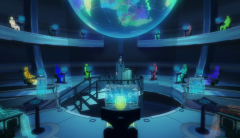
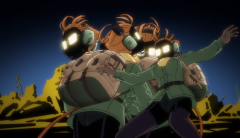
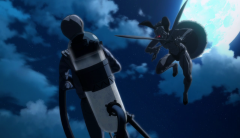
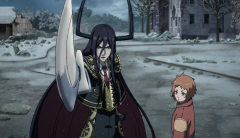
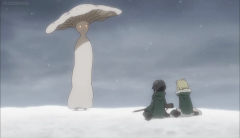
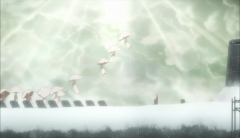
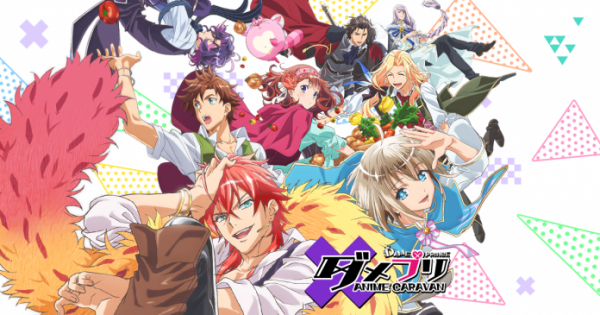
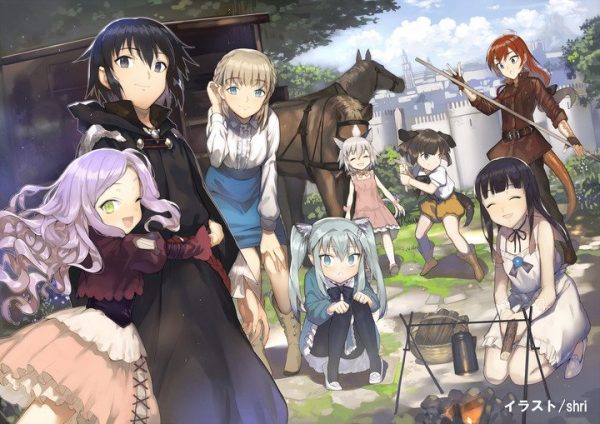
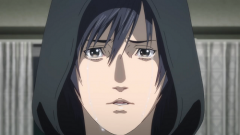
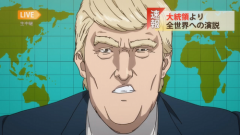
It would not be an exaggeration to say that my favorite type of anime is the political-military epic. This comes partly out of my profession, I study war and politics, but also my hobby, as military and political history is something I enjoy. When it comes to anime there is a clear sub-category that can be called political-military epics that covers elements of politics and war. These shows are characterized by some commonalities. First of all direction wise, is the large cast. When your characters are introduced with subscripts for titles, you know you are in political-military epic territory. Second, there is narrator who plays a crucial role in moving the story along.
Story wise the shows can be place into a continuum anchored by the great Chinese epics. On the one side you have those stories which are closer to the thematic of the Chinese “Journey to the West”. Political and Military events provide a backdrop, but the stories essentially focus on the story of a hero within the world. On the other side are stories in which the politics and the military events are the protagonist. There is no real protagonist per se, but instead central characters through which we see the events unfurl. The literary example of this in Chinese cultures is “The Romance of the Three Kingdoms”. Stories that go further and relegate characters to a truly secondary role cross into thematic territory that is more in synch with the ancient Greek history, “The Peloponnesian War”. Anime wise, a recent example of the first type was “Akatsuki no Yona”. Stories in the theme of the “Romance of the Three Kingdoms”, including directly based on it abound in anime, with “Shouten Kouro” being the most recent example in my mind. Finally, “Legend of Galactic Heroes” stands the closest to the “Peloponnesian War”, though it is still anchored around two protagonists.
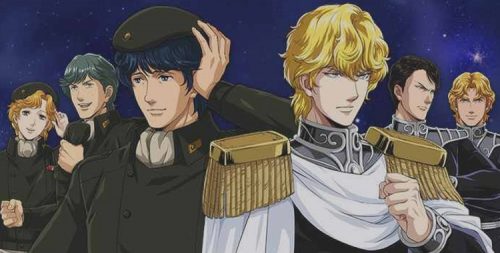
Due the central role of the politics and military events in these stories, characters are either decision makers, or people who are privy to decisions. This is what differentiates from me the political-military epic, from what I would call only military anime (in which many times the characters are not privy to decisions-for example a lot of the Gundam franchise). Thus are protagonists are ministers, princes, kings, and generals, or the people who put into effect the decisions of such personages.
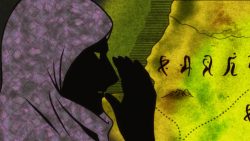
The two shows I will review here both wish to tell an epic story of politics and war. The Heroic Legend of Arslan (Arslan Senki) is the creation of the author behind Legend of Galactic Heroes, Yoshiki Tanaka. Thus we have a author who has experience in telling such epic tales. The animated version I am looking at is the recent one directed by Noriyuki Abe, based on the manga interpretation by Hiromu Arakawa, of Full Metal Alchemist fame. This is quite the pedigree of creators. There was an older anime based on Tanaka’s work, which I personally liked a lot, but which did not cover much of story (which is in progress). So I was looking forward to this new interpretation. The other show is based on a manga by Kotono Kato, a historian by trade, and is their first work of note. The anime was directed by Kazuhiro Furuhashi who has some solid work behind them, but nothing exceptional per se. SuperWooper reviewed the first 12 episodes, but I decided that show deserves a full review, and he kindly let me take care of it.
Before going into the particulars let me summarize my review. Both shows suffered from a number of issues that denied them the character great, let alone exceptional. But ultimately I felt that Altair promises a lot more, and was able to craft the more interesting story. This was surprising, and to be frank after watching Arslan Senki I wondered if it really was written by the same person who wrote Legend of Galactic Heroes. It is not that it is per se a bad story, but quite underwhelming especially in the crucial area of characters. So let us go a bit more into the reasons for my conclusion.
Story
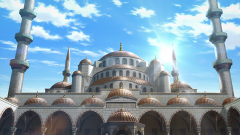
Ultimately a good political-military epic tells a good story. It posits a conflict that is both expansive and epic, but something that is beyond just a mere territorial spat. In LOGH Tanaka weaved into the story a whole semester worth of political science material ranging from questions about the trajectory of history, the meaning of war, to the relative merits of democracy and enlightened autocracy. I literally use parts of it in my lectures. Altair as a show is much closer to LOGH and the “Peloponnesian War” or the “Record of Three Kingdoms” than Arslan is. The word is more expansive, with many more powers, the politics are thus richer. Both shows try to invoke uniqueness by using as the basis of their world historical cultures that are not the usual staple of anime (or even western media). In Altair our protagonists are part of an idealized Ottoman Empire, active in a world with state that are inspired by ancient Greece, Renaissance Italy, and with the antagonist being a much more aggressive version for the Holy Roman Empire. In Arslan, the titular character is a prince of Pars, a setting inspired by Sassanid Persia, facing a fanatical stand-in for European Crusaders, and surrounded by states inspired by Turkish and Hunnish tribes, and Indian medieval princes.
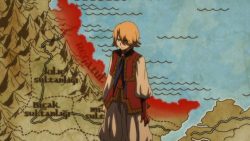
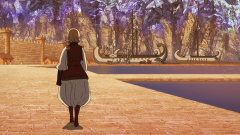
While both settings work to enrich their regions, I ultimately felt that Altair did a better job of showcasing its world, compared to Arslan. And this is despite its pacing issues it has (more on this later). To put it simply, I found the city -tates, empires and kingdoms of Altair much more intriguing, than those of Arslan. A lot of this might be though that Arslan in its first arc is more like a “Journey to the West” story, focusing on the travels of the protagonist and his coterie of characters. Now, Altair also does this. But here is the difference. In Altair the story of individual travel is well-meshed to the story of the politics. In Arslan it is not. Turghil Pasha in his travels not only to get companions, he crucially meets decision makers and comes to understand, and show us, the politics of his world. In Arslan, Arslan meets companions, and he learns about the world, but he learns by being told about it by said companions, rather than by experiencing it. This was crucial difference.
I also felt that despite the pacing issues of Altair, the political decisions there made sense. That was not always the case with Arslan.
The different approach to the story also meant that Altair could get way with weak characters, while in Arslan they doomed it. In Altair, you could forgive some of the characters because the characters were always enriched by the environment. The cultures of Rumeliana (the Europe of Altair) were all so unique and interesting, that they enriched characters who stood as their proxies. In Arslan that was not the case. In general I felt the story of Altair to be richer, and more intriguing, than that of Arslan. While both had an element of a coming to age story, I felt that Altair was more able to mesh it to the political and military situation. And this helped the characters. Speaking of characters,
Characters
It is unavoidable that with their massive casts, political-military anime while have a slew of underdeveloped characters. As long as those characters are given some singular trait that makes them interesting, and as long as the protagonists are fleshed out, this is not an issue. As long as characters are not caricatures, they can be forgiven a bit of thinness. This is why story and environment play such an important role. This of course cannot be forgiven with the protagonists. A good political-military anime will have multiple protagonists, shared by the two main warring factions, and even more. They will be decision makers, or close allies of decision makers. They will be essentially our eyes and ears into why things happen, and provide some investment in the politics by having their fate and beings tied to it. The problems start when the central characters are either uninteresting, or relegated to a secondary role by the other protagonists. Altair succeeds in avoiding this, while Arslan fails.
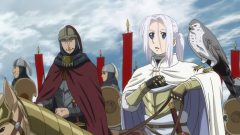
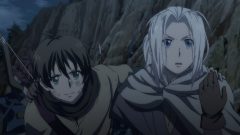
Now both Mahmud Turghil Pasha and Prince Arslan share some character traits. They are both seen as politically naïve by others, and they are both struggling to find their place in a complex world. The starting arcs of both anime are focused on their journey to maturity and wisdom. The problem is that while we can see and appreciate Turghil Pasha’s growth, Arslan’s is not as easy to learn. This is not because he does not grow. But his growth is tethered and ultimately smothered by his companions. Too much of Arslan is about Arslan asking his chief strategist Narsus (a bad character inspired for Zhuge Liang from “Romance of the Three Kingdoms”) about what to do. There is a lot of that. As a result, Arslan’s growth is always feeling as pedestrian, predicted, boring. Turghil Pasha is never completely eclipsed like that. His growth is not always predictable, and we always see it in action.
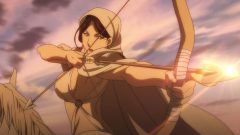
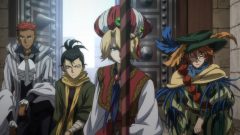
It does not help that by a large the secondary cast in Arslan is boring. Of his companions that only two I found interesting are the warrior Daryun, who is not a rich character, but he is a well done example of the warrior template, and the fun and adventurous bard Gieve. The others did not stand out. This expands to the secondary characters on the side of the heroes. Most are bland, and boring. In Altair, despite the fact that many of the secondary characters are just as “thin”, I did not find them boring. Whether Halil Pasha, Suleiman Pasha, or Kiros and Abriga, they never seemed to hold the show down. The mayors, princes, kings that populate Rumeliana are not anymore developed than the characters in Arslan, but the combination of smart focusing on a specific trait, and their close connection to their cultures makes them interesting.
The issue becomes worse for Arslan when it comes to the question of antagonist. Now it is true that neither show comes close to the almost excellent balance of characters on both sides that LOGH had. But Altair comes closer. To put it simply ad brutally, the enemy in Arslan is boring. You have the always scowling, yelling, always angry Prince Hermes. You have the scheming, scowling, perpetually frustrated Guiscard. You have the caricature coward, scowling Bodin. Indeed there is a lot of scowling and furrowing of brows, and yelling going on. And that that is it. None of these people are remotely interesting. What drives them is boring, and thus their schemes are boring. No great questions can be put forward by such characters, and thus the battle really is more like a black and white fight, despite the continuous talk by characters that this is not the case (for the sake of all that is holy, one of the secondary antagonists chose the enemy side simply because he felt it would not be fair if there is no one on the side of the guy with he himself does not consider ready to be a king!). Hell, the most interesting opponent of Arslan is his frenemy Rajendra, who is pretty much an interesting character because he has a level head on his shoulders. The more interesting questions in Arslan are always about Arslan’s plans for the future of Pars, and that is pretty much an intra-ally discussion.
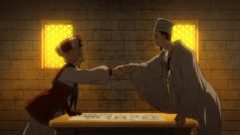
On a first glance Altair could also be considered weak on the enemy front. If there is one criminal failure for Altair, is that it never invests as much as it should in the enigmatic figure of Prime Minister Louis (a characterized for Machiavelli and Richelieu). This is partly because for a long part of the anime the “antagonist” is the equally interesting Zaganos Pasha. But the show in its second course presents us with an interesting array of Imperial opponents that give us an insight into what drives the Balt-Rhein empire forward. Their motives are much better than those of Arslan’s foes, and between Turghil, Zaganos, and Louis some major questions are put forward about the nature of hegemony, pacifism, and practical politics. The contrast between the perpetually yelling Hermes and Guiscard, and the calm Zaganos and Louis (whose voice actor is great) is in a way the encapsulation of the difference between the two shows.
Direction
Both shows suffer from direction issues. In a way they suffer for exactly opposite reasons. Altair suffers from an insane pacing, which leaves one bewildered about why and how things happen. Characters enter and leave before we have a chance to understand them or their place in the story. Essentially the fact that Altair is an advertisement for the manga can be seen in the terrible pacing, which tries to cram as much material as possible into the 24 episodes. . Arslan on the other hand, has pacing that is too slow, which means we get too much Narsus, being Mr.Perfect (I dislike Narsus, don’t I?), or Hermes scowling (GGRRR GRRRR). The pacing issues in Altair ruin a bit the enjoyment of unraveling the politics behind the scenes. But at least the politics unravels. In Arslan , we go through 36 episodes to just get back were we started, Arslan and companions on a trip.
Speaking of direction, the narrator, which is a character in these shows, was a bit more useful in Altair than that in Arslan. Also despite it pacing issues, I felt Altair was able to create some set-pieces that were quite nice, more often than Arslan. That said there was only so much the direction could do with the animation the shows got.
Animation
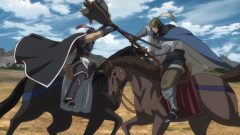
Well to put it simply animation in both cases was not something to write home about. While there were some well animated scenes (the fight between Turghil Pasha and Rod Orm, the fights between Hermes and Daryum), in general the animation was lackluster. Massive battles are the bread and butter of these shows and neither did a good job at it. Arslan opted for using CGI graphics, and the battles ended up having a rather Total War Rome feel to them (only TWR had more model variation). Altair, perhaps wisely, eschewed that for mostly still frames and traditional animation. They both get their story across, but there is none of that wow I got from the massive battles of LOGH.
Art
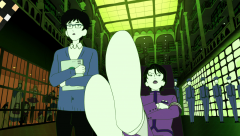
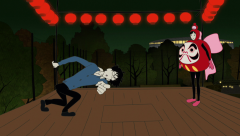
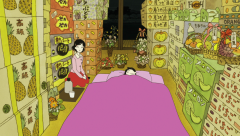
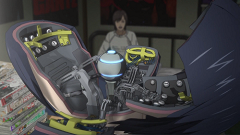
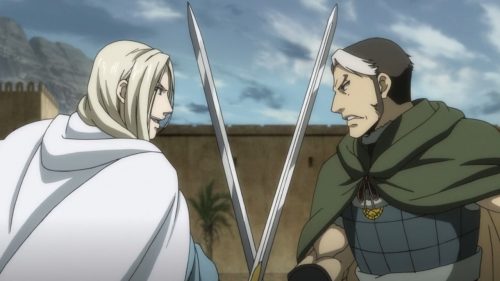
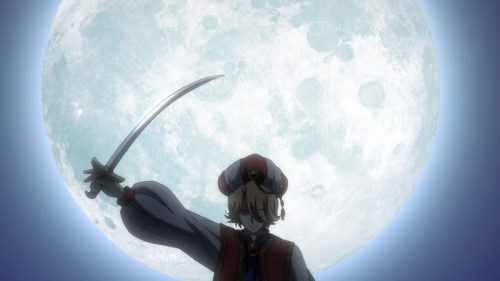
While I like Arakawa’s art I felt it plain compared to that of Altair. In general the world of Altair was more colorful and varied than that of Arslan. The Turkish, and Italian Renaissance basis of the clothes showed in Altair. There were some bad choices (the naval uniforms are too much One Piece like for my taste, and the uniform of the officers of the Balt-Rhein empire too LOGH Empire style) but in general they nailed the look. In Arslan the looks are servisable, but that is about it. One of the other blog commentators said that there was something whimsical in the art of Altair, and while initially I did not like it, it came to grow on me. I believe that if Altair had the animation budget of Arslan it would had been a much more beautiful show.
Music
The Opening and Endings of Arslan and Altair were in general generic and boring. I found the second Opening of Altair the most interesting, partly due to the good direction. When it came to soundtrack, Arslan had the better one, with the track Tenchi Rai Sanka standing out and being well used in the series for memorable scenes (Sher Senani! Sher Senani!). Altair was not graced with a soundtrack that was as good. It does its job, but that is it.
Final “Feel”
Ultimately I felt that the story that Altair tried to tell was a more epic and nuanced story, in a richer world. I felt that the political principles at stake were more expansive and interesting. It is not that Arslan does not have a good question at its center (the nature of kingship). It is more that the story failed to work with it well (since Narsus, has all the answers!). To be fair, nor does Altair really do a good job fully exploring its question. Indeed it more teases it. Perhaps the biggest thing holding Altair back, is that it is an anime conceived as a advertisement for the manga, with all associated issues in pacing, characterization etc. And to be frank it does that job well. Despite my initial dislike of the manga art, I came to be interested in it. Arslan’s issue is much more fundamental. It does not know what it wants to be. Is it a story of development like “Journey to the West”, or a war and political epic like “Romance of the Three Kingdoms”. This is never clear, and to be frank from some summaries I have read of the books not animated, it gets worse, with fantasy elements invading with increasing vehemence.
Thus both shows fail to reach their potential. And perhaps I ask for too much. I mean LOGH had over 150 episodes to develop a sweeping and epic tale. That would be a fair rejoinder. But not in a world with Tanya Senki (Tale of Tanya the Evil). Tanya Senki is also a political-military epic. And despite its short course of 12 episodes, tight direction gave us tale that was rich enough. Tanya proves that you can tell a good political-military epic in 12 episodes. And thus the inability of both shows to do better in double the episode length is disappointing. With that said though, I believe Altair has the promise to tell a tale worthy of LOGH down the way. Arslan less likely.
Final Scores
Characters: Altair Record of Battles: 80/100; Heroic Legend of Arslan:70/100
Plot: Altair Record of Battles:80/100; Heroic Legend of Arslan: 70/100
Art: Altair Record of Battles: 70/100 ;Heroic Legend of Arslan: 70/100
Sound-Music: Altair Record of Battles: 70/100 /Heroic Legend of Arslan: 75/100
Final:
Altair Record of Battles: 75/100
Heroic Legend of Arslan: 70/100