Ballroom e Youkoso – 12 [Meeting]

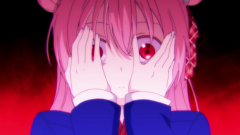
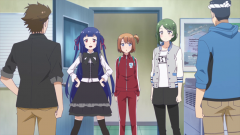
We’ve reached the halfway point of Ballroom e Youkoso’s projected 24-episode run, and along with a new high school life for Fujita Tatara comes a new OP/ED combo. Unison Square Garden returns to do the intro for the second cour, and I’m loving the new song choice. Both openings have been serviceably energetic for a shounen series, but I prefer the backbeat-driven danceability of the new one to the vocal theatrics of the original. The new ED trades clever waltz-pop fusion for even more J-rock, though, which is a definite step down. One notable thing about both visual sequences is their heavy emphasis on Chinatsu, the redhead that we glimpsed last week and to whom we were briefly introduced this time around. The OP’s use of a thunderstorm as the setting for her dance with Tatara tells us everything we need to know about her personality, and the contentious relationship she’ll have with her eventual partner. But that’s a topic for another time, as the present episode features Gaju and even Sengoku more strongly than any one newcomer.

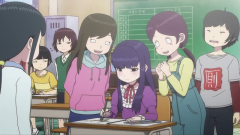
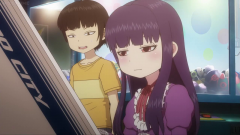
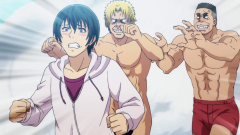
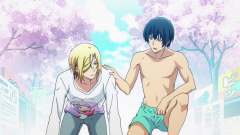
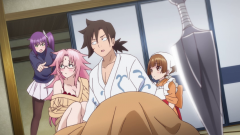
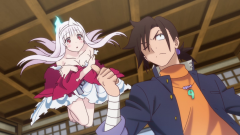
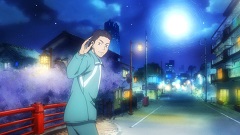
Unfortunately for our hero, Tatara’s first year at his new school doesn’t get off to the blossoming start he’d hoped for. The cute girl sitting in front of him mocks his hobby, which he was brave enough to mention during his class introduction, and a new gang of thugs recruit him to be their errand boy on day one. The poor kid just wanted to make some new friends in high school – he even thought to himself on the way to homeroom that five was plenty! A hooded figure appears to save him from a year of subservience, though, who is eventually revealed to be our favorite mullet-head Gaju. It’s great that the elder Akagi sibling happens to go to the same school, and that he properly befriends Tatara after beating up the bullies who were on his case, but I’d love to see Tatara meet new people or stand up for himself using some of the confidence he’s learned from dance. For now, though, I’m glad he’s got somebody he can talk to between classes, even if Gaju’s the kind of weirdo who gets upset that his sister has started wearing a bra. Anime keeping it classy as always.

Something I noticed while watching this episode were the minor tweaks Ballroom made to its characters in the move to its second cour. There’s been a bit of a timeskip since the Tenpei Cup, which could explain a slight shift in their attitudes, but it was still troubling to me in a couple spots. Gaju’s sheepishness when asking for Tatara’s cell number was one instance, since it doesn’t gel with his brash personality. It felt like the show was working overtime to make him sympathetic, since he functioned as a bully himself just a few weeks ago, but in most other scenes he was his usual hotheaded self. The bigger sin, from my perspective, was turning Shizuku into a blushing Tatara fan and beacon of encouragement. Her speech about enjoying the Tenpei Cup because of his presence bore zero resemblance to her ice queen demeanor at the event itself, and while we know that was just a façade, I don’t understand why she’d drop it so completely now. Nor am I able to grasp why she wants to compete with him again so badly, since she’s light years beyond his skill level. Their whole conversation was a setup for Tatara’s new goal of finding a partner and rising through the JDSF rankings, but Shizuku needn’t have become the Perfect Girl for that to be communicated.

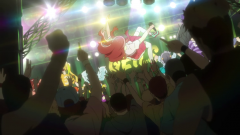
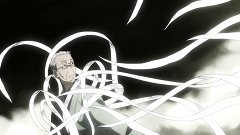
The show’s second act was devoted to a professional dance competition where Sengoku (and his partner Chizuru) were the main attraction. Tatara and Gaju go to watch them perform, which is a rare opportunity now that he’s traveling abroad once more. There’s a distinct sense here that the world of Ballroom is expanding, as Tatara realizes that Sengoku spends most of his time overseas, being a major figure in the DanceSport world, and that it’s a miracle he managed to attract his attention. Tatara’s self-doubt comes to the forefront in this scene, leaving him unable to make eye contact with Sengoku as he leaves the floor, but as his former coach passes by, he instructs him to “watch closely.” What follows is an exhibition of skill that the show really needed to nail, and I think they pulled it off nicely. There were several clear, fluid dance sequences here, nestled amidst the disorienting effects used to illustrate Sengoku’s unorthodox movement. (Even the CG background dancers looked better than usual, although that could have been my imagination.) His performance is so captivating that a mob of screaming fans chase him as he leaves the arena, and who else should Tatara happen to spot among them but Chinatsu? Hearing her explain away that earlier dismissal of ballroom dancing ought to be good, but then, so will everything else involving her character – she’s my favorite!

Ballroom e Youkoso – 11 [Evaluation]

And so the Tenpei Cup comes to a close at last. It took five episodes to get from the first round to the awards ceremony, and not all parts of the competition were created equal, but I’m happy that my girl Mako managed to claim the Ballroom Queen award. After she received the trophy, there were several key players in the crowd who gave Tatara all the credit for leading so well, but I’m chalking that up to shounen hero bias. Mako is the more experienced dancer, with better form and greater stamina, and she’s one who managed to break up the Gaju/Shizuku pair and team with her brother once again. Despite everything that’s been said about their mismatched heights and skill levels, Gaju seemed relatively accepting of the situation (after pouting for a bit, that is), so we ought to see the Akagi siblings pairing together at future events.

Of course, Tatara played an important role in Mako’s victory, but his obvious fatigue and sloppy footwork helped to land them at the bottom of the finalist rankings, which translated to a 7th place finish out of 43 couples. That’s nothing to be ashamed of, considering it’s his first competition (if you don’t count his stint as Hyodo’s body double earlier in the series), but Tatara is ashamed, which is right in line with his character. Immediately after hearing that he hadn’t placed in the top two, he confessed to his coach that he’d been dwelling on his poor dancing abilities for the entire affair. There were tears in his eyes as he made that admission, which I felt were appropriate, but might have been more impactful if Ballroom hadn’t turned on the waterworks at least once a week for the entire Tenpei arc. All Sengoku could do was pat his head and tell him to take the floor with a smile, which he managed to accomplish. Given what we know about Tatara, though, this loss will weigh heavily on his mind for some time to come.

Tatara wasn’t the only character to be deeply upset by the final standings, however. Although Gaju and Shizuku placed first with ease, the loss to Mako in the Ballroom Queen category caused Shizuku no small amount of grief, as we learn from a brief post-competition scene where she cries quietly to herself in front of a restroom mirror. More interesting than her sadness, though, is her frustration, which shone through with the self-targeted accusation, “You’re terrible!” I’ve written a lot over the past few weeks about the similarities between Tatara and Mako, but this critical, unforgiving attitude is the first time I’ve picked up on a real link between Tatara and Shizuku. Their goals couldn’t be more different, but it’s possible that they share more narrative DNA than meets the eye. Both are newly partnerless, as well – could they possibly join forces for the upcoming DanceSport season?

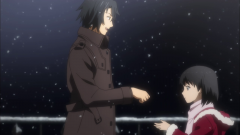
If you watched past the ending credits this week, you were treated to a handful of scenes revolving around Tatara’s high school entrance exams. Near the end of the episode, as he and his dad celebrate his acceptance, a redheaded girl can be seen smiling and walking away from the jubilant pair, though the camera refuses to travel above her mouth. If you’re familiar with anime character introductions, you know that withholding part of someone’s face means they’re an important part of the story. Spoiler alert: this girl is Tatara’s new partner, not Shizuku. The redhead’s name is Chinatsu, and she’s my favorite character in the manga, which begins to focus on Tatara’s high school life after this point. I like Ballroom most when the characters are bouncing off one another outside the competitive setting, so hopefully the anime director has resisted the urge to truncate some of my favorite parts of the story. Fingers crossed!

Shoukoku no Altair – 10 [Dance of the Moonlit Beauty]

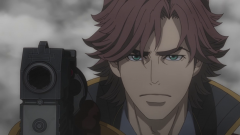
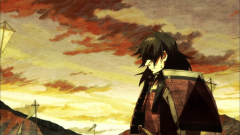
This was the busiest episode of Altair yet, with a script that pinballed between Turkiye’s four stratocracies, introduced a handful of new characters, and chronicled the formation of both alliances and rebellious plots. To try and recap everything that happened this week would require hundreds more words than I’m willing to expend, so let’s assume we’ve all seen the episode and jump to its most important reveal: Beyazit’s demonstration of the musket’s power just before the closing credits. These last few moments marked the first time in a while that Altair has kept my full attention – it was a great choice to cut the background noise and put reverb on the sounds of the gun being loaded, then raise the orchestra after its firing. As the music indicates, the introduction of handheld firearms into this world has history-altering implications, which is lucky for Team Mahmut, since he’s been tasked with leading revolutions in all four sultan-led territories. Beyazit claims to have 77 of these deadly weapons at his disposal, which is enough to convince an important new character to join forces with him.

That character is Ismail, prince* of Buchak, which is perhaps the most important of the four stratocracies, narratively speaking. That’s because of the trade route its sultan Uzun is constructing between his country and Balt-Rhein, which has promised to support them after they break from Turkiye. This road is the key to Buchak’s financial independence, which means the coup that Mahmut is engineering must succeed before the route’s completion. Ismail’s willingness to betray his father, though, should give our plotters an advantage in their dangerous game of thrones. Another of their allies, Aishe (princess of a different stratocracy – how nice for Mahmut that these connections have fallen into his lap), concocts a plan to gather all the sultans in one place. She’s engaged to be married to Orhan (yet another prince, this time of Kuluch) and proposes to his father that he announce a date for their ceremony, which ought to be attended by all the people that Mahmut aims to take down. The masked sultan Selim, who only submitted to the Empire for the safety of his country, agrees to Aishe’s gamble, and thus anime’s version of the Red Wedding is set to occur within an episode or two.

(* Although the show uses non-Western titles for its stratocratic royalty, I’m opting to use familiar terms for my own sanity. The subtitles I’m reading are inconsistent with their terminology and spelling in the first place, so this makes things easier for me.)

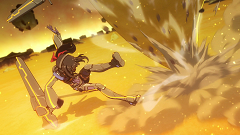
That’s enough plot summary for this week. Let’s talk about fight scenes – specifically, the one that opened this episode. Rod Orm have never been especially threatening on a small scale, but Mahmut still managed to look like a badass here, calling Iskender to claw open one flunkie’s back and slicing another across the chest himself. Watching a newly one-handed Eleanor plead for her life was satisfying, especially since it gives us the sense that both Mahmut and the show have undergone a significant evolution. The former general isn’t taking prisoners at this stage in the game, especially with a shot at redemption in Turkiye on the line. He does let eyepatch girl escape, but Altair can hardly afford to give her another second of camera time, given how quickly things are moving elsewhere in the world. Blood is about to be spilled in Kuluch, and with time running out for the rebellion, no one is exempt from the dirty business of killing.

Ballroom e Youkoso – 10 [Voltage]

When I was a kid, my friends and I included my brother in our games, but only reluctantly. He was younger, smaller, and slower than all the other players, whether the contest was bike racing or tag or touch football. If I were a team captain, I’d be sure to pick him for my side, but not until the last round – I didn’t want to arm the neighborhood brats with any reason to pick on me. Obsessed with the safety of my own reputation, I failed to notice his embarrassment until years after that part of our lives had passed. You might imagine, then, that the scene in this episode where Gaju shooed Mako away from his grown-up kickball game sent a pang through my chest. Before this flashback, his primary role had been to mock his sister at every turn, but now we have another piece of the puzzle. Gaju was just another kid who put too much stock in the opinions of others, and he’s carried that concern with him into adolescence.

This week’s opening flashback consisted of more than just the kickball scene, though. It showed us how the Akagi siblings entered the world of ballroom dancing: through Mako’s repeated appeals to her beloved older brother, who eventually caved and became her partner. Gaju may have been ashamed at the idea of dancing at first, but his stubbornness prohibited him from quitting, and his natural athleticism allowed him to excel once he began competing. When that talent was noticed and praised by a judge at one of his first events, his switch was flipped – from that moment on, he was a dancer. This need for recognition is a much stronger motivation than wanting to surpass Hyodo or impress Shizuku, so it goes a long way in making Gaju a human character with internal drives and desires. Those desires were strong enough, though, that he began to heed the whispers of his classmates and the advice of his coach, all of whom assumed that he’d leave Mako behind one day, because she was holding him back.

Now that he’s found a better partner, then, how does Gaju feel in the wake of Mako’s heart-stopping waltz from the previous episode? He’s sufficiently distracted to make a small footwork error that all the dancers and judges in the room notice immediately, and upset enough to get teary-eyed at his failure when he leaves the floor. Most shounen-y of all, he gets angry to the point of punching himself in the jaw, ostensibly to refocus himself on the contest at hand. This scene was more than a little goofy, but it wasn’t bad enough to sap the goodwill that his backstory created. Gaju left his sister because he wanted to be the best (and the way the show frames it, he made the right call, at least from a competitive standpoint), so if he starts making silly footwork mistakes, he’s both letting down his new partner and dishonoring his old one. Luckily, Shizuku is there to pick up the slack as the Tenpei Cup moves into its final group stage.

With Hyodo in the crowd, Shizuku is still aiming to blow the doors off the place, even if she has nothing to prove at an unsanctioned competition like this one. We got a second flashback to one of her practice sessions with a much younger Hyodo, where he nonchalantly informed her that she was more of a rival than a partner in his eyes. This scene did a lot less for me than the carefully-structured opening sequence, but the memory is clearly a strong one for Shizuku, who goes into beast mode during the Slow Foxtrot and wins over the entire room, much as Mako did last week. Even Tatara is stunned, which is not a good look for an underdog trying to highlight his own partner’s appeal. The last segment of the competition will be the Quickstep, but even with Sengoku’s special variation in their back pockets, I’ve got a bad feeling about the outcome of this competition for the exhausted Tatara/Mako pair. With Shizuku on fire and Gaju having found his footing once again, our heroes still have a mountain to climb, and only one dance left with which to do it.

Shoukoku no Altair – 09 [The Red Tiger Sultan]

The world of Shoukoku no Altair has been widening by the episode, but it underwent its biggest expansion yet this week. In exploring the ripple effects caused by the Empire’s defeat of Phoinike, the show opted to jump all over the map, introducing stratocracies and sultans left, right and center. The most significant of these were the satellite nation of Muzrak and its colorful leader Balaban, a sultan with a taste for both warfare and beautiful men. The concept for Balaban’s character is wasted on this show, which saddles him with dry dialogue and immediately connects him with the show’s primary antagonists, but his motivation – to be recognized as the head of an independent country – is one that grows Altair’s universe in an interesting way.

Turkiye, it seems, is a nation with four surrounding stratocracies, all of which protect and receive economic benefits from the central state. In response to the recent Imperial aggression in Centro, each of these neighboring city-states sends their leader to vote on the formation of a Turkiyean Federation, which would effectively bring all of Turkiye under one banner. Zaganos stands in firm support of this plan, which tells us exactly what the mainland stands to gain from its passing: a stronger, more unified military force. Yes, Zaganos is still on his quest to command the mightiest military in Rumeliana, even with the older Suleyman Bey at his side for this half hour. Unfortunately for the Poison General, the sultans (including Balaban) vote unanimously against the proposal, and when he suggests that Turkiye simply annex those territories, one of their representatives warns him that any aggression on his part will be returned in kind.

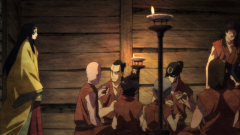
Zaganos eventually convinces his boss that overthrowing the sultan-led governments of their territories is the way to go, but Mahmut doesn’t have such an easy time out in the world. With Kiros and Abiriga in tow, he finds himself in a place called Liman, where the kulak is revealed to be Balaban’s younger brother. The poor guy has locked himself beneath the local water temple for fear of his older sibling, who wants his head for sheltering their traitor niece. This whole plotline would have been way more effective if we had known about their family for more than ten minutes before the gloves came off, but you know what they say about beating dead horses. Luckily, there’s some redemption for this story in the form of a conversation between Mahmut and Balaban, whose hunger for power and autonomy clashes with Mahmut’s loyalty to the country that demoted and effectively exiled him. Balaban offers the former Pasha a place in his Yenicheri (a force of 10,000 men hand-picked by the sultan himself), and brings up Turkiye’s unjust punishment to goad Mahmut into switching sides. With this meeting on the books, the Red Tiger manages to escape mere one-dimensionality, though the last third of the episode keeps him locked at two.

Here’s where things get silly. Eleanor (the woman who works for Imperial Minister Louis) makes an appearance at Balaban’s palace immediately after the arrival of Mahmut and company. She chides her apparent ally for letting the boy live, but Balaban, not being the type to follow orders, brushes her off. I would have preferred for this connection not to have been revealed for at least a week, since it removes the suspense from the political situation in Muzrak – another dead horse, I suppose. Mahmut, sensing that he needs to make a dash for freedom at the nearest opportunity, enlists the help of walking plot device Abiriga, who procures some Yenicheri uniforms for the boys. When the sultan’s troops are called to assemble, though, Balaban spots them and decides to heed Eleanor’s advice. Unfortunately for him, Abiriga single-handedly karate chops at least fifty of his goons into submission, and our heroes escape the city with nothing but a couple bruises. Earlier in the episode, too, Abiriga put his ear to the ground, did a quick number crunch, and calculated that there were 500 people inside the water temple. Ever been torn between insane martial arts prowess and supersonic hearing as a trait for your ideal guy? Get you a man who can do both!

Ballroom e Youkoso – 09 [Flower & Frame]

For the last month or so, Ballroom e Youkoso has been keenly interested in expanding and developing its cast of characters. Even with the introduction of the Tenpei Cup, most of the show’s dramatic moments have been rooted in something deeper than dance, be it feelings of inadequacy, a bitter sibling feud, or a budding attraction to a partner or competitor. This episode was a payoff for a lot of the conflict and struggle we’ve witnessed until this point, but it also functioned as a straightforward sports anime, and those aren’t necessarily my favorite. The constant crowd reactions, the special technique names, and the 20-minute runtime that covered five minutes of action all recalled a barrage of lesser series that Ballroom needn’t have imitated at this stage of the game. Luckily, this episode was concerned primarily with honoring Mako, whose transformation from timid duckling to blossoming rose kept the half hour afloat.

The particularly impressive thing about Tatara and Mako’s performance this week was that they rehearsed for only a few minutes before the finals started, and without a particular set of steps in mind. That’s just as well, because Sengoku’s assumption that the Quickstep would be the last hurdle was foiled by Marisa, who convinced the judge to pivot to the Waltz at the last minute. We still don’t know the precise cause of the animosity between these two – the smart money is on her displeasure with Sengoku coaching someone besides her son, but it’s not out of the realm of possibility that she’s his former coach, or if you want to get really soapy, an ex-lover (even if she’s ~15 years his senior, I could see it happening). Whatever the reason for their bickering, Sengoku ends up with egg on his face, but the brief practice session between his pupils pays big dividends when they hit the floor.

Last week I wrote about DanceSport couples being graded largely on the skill of their male halves, and this time we heard the same thing straight from the mouth of a judge. Tatara and Mako’s partner-centric performance, though, creates a difficult task for their evaluators, who are so mesmerized by Mako that they forget to observe her leader. The show’s limited animation makes it hard to decipher what part Tatara has in this captivating routine, so it falls back on phrases like “Throwaway Oversway from a Double Turning Lock” and “Same Foot Lunge to Right Leg Develope,” which might as well be wrestling terms for all I know. The constant crowd reactions clue us in to the originality and impressiveness of their performance, but they do a poor job of keeping us involved in the scene (even if I got a laugh from the comment that Tatara was “too bland” for Mako). Putting the peanut gallery aside, though, there were two major characters whose impressions of this scene really sold it for me.

The first was Hyodo, who knows just by looking that Mako has worked her ass off to achieve her silhouette. This was a particularly important observation for the show to make, because it tells us that her overwhelming appeal is due to her own effort, rather than yet another aspect of Tatara’s genius. There’s no doubt that he played a role in “making her bloom,” as she requested just moments earlier, because Mako thinks to herself during their routine that he’s providing a solid frame. But in the end, all eyes are on her, including Gaju’s, and it’s his stunned response to his sister’s waltz that matters more than anyone else’s. Ballroom chose to repeat and expand on a previous flashback in this episode, which established Mako as unwilling to express herself for fear of “getting in the way” of her irritable brother. By contrast, she comes alive in Tatara’s arms, not because he’s a better leader than Gaju, but because his biggest concern is that Mako shines. And shine she does – her brother can hardly believe that the radiant young woman on the dance floor is his former partner, and he’s probably kicking himself for failing to bring out this side of her. This is the biggest payoff the show has offered so far, but despite Tatara and Mako’s happiness at having danced so well, it’s not as though they’ve won the event. Gaju and Shizuku are up next, and the continued partnership of both couples is still on the line heading into the next episode. Whichever pair emerges with the Tenpei Cup in hand, though, Mako achieved a significant victory with her performance this week.

Shoukoku no Altair – 08 [Masquerade of Sincerity]

The conflict between realism and idealism became clearer than ever on this week’s Altair, with the show using precisely those terms to describe its own thematic underpinnings. Perhaps it’s due to the contrast with Kiros’ brash personality, but I thought Mahmut demonstrated some real patience and political savviness during his time in Venedik. He certainly came closer to camping with the realists than ever before, despite being known to Doge Lucio as “the Pasha who despises war.” That such a title would be a clear identifier tells us all we need to know about the strangeness of Mahmut’s allergy to conflict, at least in this world of uprisings and betrayals. As he continues to meet new people and encounter different perspectives, perhaps he’ll earn a more flattering reputation. “The Pasha who formerly despised war, but now understands that sometimes countries must fight to protect their own interests,” perhaps?

Mahmut is actually a Binbashu now, rather than a Pasha, which is a demotion I’d nearly forgotten until Doge Lucio made sure to mention it during their face-off. Lucio’s explanation for his betrayal of Phoinike is a technical one: Venedik deployed a fleet, as the treaty between the two nations required, but because it said nothing about the ships’ arrival, they were free to remain at sea while the Empire invaded and conquered their former ally. Mahmut bristles at this deception, and at the Doge’s willingness to form a new trade agreement with Balt-Rhein, but Lucio insists that going to war with the Empire wouldn’t have benefitted his people. As the two young men began to answer questions with questions, it became clear that their opinions regarding the political landscape of Centro were irreconcilable. Thankfully, this wasn’t another instance of Mahmut taking a hard-line stance and getting BTFO immediately afterwards – he later admitted to Kiros that his opponent’s views were justifiable, even if they left a bad taste in his mouth. I’d say that’s a good bit of progress, considering how slowly the game of international relations is mastered.

The rest of the episode deals with a plan, orchestrated by Captain Brega and a spice merchant named Mora, to frame Abiriga (who we met last week) for a crime he didn’t commit, thus exiling him from Venedik and freeing him to travel with Mahmut. I was surprised to learn that Abiriga wasn’t a member of Suleyman Bey’s spy network, though it wasn’t a shock to learn that Bey had tried to recruit him years earlier, given his status as an outsider. Abiriga’s refusal stemmed in part from loyalty to his adoptive country, whose citizens hold him in high regard; Brega calls him “highly trusted and accomplished,” which made me doubt the necessity of the cloak and dagger routine. If Venedik wants a good relationship with Turkiye, and Abiriga has the support of the people, why not make him an official emissary? Keeping it a secret allowed the conspirators to test Mahmut’s character (he passed, in a manner so silly that it doesn’t bear recounting), and to keep from “attracting unwanted attention,” but the whole thing felt like an M. Night Shyamalan film to me. The real goal must be to keep the Empire in the dark regarding a potential Turkiye/Venedik alliance, but Kiros has concerns of his own – with Abiriga being likely to pass information back home during their voyage, how much longer will Mahmut and company be able to travel undetected?

Ballroom e Youkoso – 08 [Reality]

Here are a few reasons why Hyodo Kiyoharu was the MVP of this week’s episode: he noticed Tatara’s fatigue and flat-footedness before the kid’s own coach. He kept his cool while everyone else was busy flinging petty insults or embroiling themselves in love pentagons, and provided his rival with both straight talk and sound advice. He watched his mom flirt unashamedly with a guy nearly twice her age, and somehow managed to retain his dignity. He managed to motivate someone as talented as Shizuku to dance her best with his mere presence. And he looked fly as hell with his sweater robe and crutch, even amidst a sea of tailcoats and bowties. If I were a judge at the Tenpei Cup, I’d call off the competition and just award Hyodo the trophy.

Unfortunately, I’m not qualified to evaluate ballroom dancing (or men’s fashion) – only to talk about Japanese cartoons. So despite Hyodo’s greatness, there’s one scene I really want to focus on this week, and that’s the moment when Sengoku instructs Tatara not to do the special Quickstep variation they’d been practicing for weeks. Even without seeing his pupil gasp for breath in the corner of the room just moments beforehand, Sengoku knows that Hyodo is right about his exhaustion. Tatara is already on the floor by the time he can speak with him, though, so Sengoku is forced to shout across the hall not to use their trump card (which would likely result in his collapse). What follows is dead silence, and eventually a shot of Tatara, who looks exhausted and embarrassed, but more than that, he looks crushed. He’s upset that his coach doesn’t believe in him, even though he’s shaking and sweating and barely maintaining his hold on his partner. This is a boy with prior self-image issues being told to alter his routine to account for his lack of experience and stamina; it’s no wonder he sobs and collapses in Sengoku’s arms after his neutered performance.

I’m glad that Ballroom continues to expose this side of Tatara, even if the results are sometimes hard to watch, because it makes him more human even as the shounen clichés pile around him. The Destined Rivals bit that he and Hyodo have going on is farfetched, though the show played it well this week by making Kiyoharu the voice of reason during an emotional scene. “Reality” is the title of this episode, and Tatara’s reality, as explained by his rival, is that he can’t possibly beat Gaju given his current lack of talent and conditioning. The solution is to allow Mako to outperform Shizuku, and that’s a plan I couldn’t be happier with, especially after two months of hearing that the man leads and the woman follows, the pair’s score is largely determined by the leader, etc. I don’t doubt the truth of those statements, since ballroom dancing is quite traditional, but when Mako asks Tatara to “make me bloom” at the episode’s end, it feels great to know that she’s allowing herself to command some attention for a change. That final line also carries with it a hint of romance, given the sensual connotation that blooming holds. Sengoku teased the two kids about a potential relationship midway through the proceedings this week, so I expect that their partnership may become a bit more complicated in the future.

Love is in the air for several other characters, as well, but Shizuku’s crush is the most interesting. She looked stunned after seeing Hyodo at the Tenpei Cup, perhaps for the first time since his hospitalization, which is a total reversal from her invulnerable attitude just hours earlier. Tatara tries to explain away Hyodo’s strategy as a plan to separate her from Gaju, but she still feels him slipping away, as she did back in episode two. Her resolve now is to impress her former partner, which is an okay development in my book. This is an unsanctioned event with nothing on the line for a seasoned pro like Shizuku, so what’s the harm in a little showmanship for the sake of the boy she likes? Besides, her desire to impress Kiyoharu is tied to her need to reach his skill level, and prove to upstarts like Tatara that you can’t waltz into this scene and start winning trophies left and right – pun very much intended.

Shoukoku no Altair – 6/7 [The Iron Chains/The Sinking City]

Shoukoku no Altair ran a double feature last Friday to reclaim some lost ground after its brief hiatus earlier this month. I’ll be covering both episodes here, but this post won’t be any longer than normal. Truthfully, although Altair moves through its plot at a rapid pace, it’s often a struggle for me to generate worthwhile commentary about the series, and its latest offerings are no exception. This week, I watched as Imperial forces utilized a two-pronged attack to conquer Phoinike, after which point Mahmut was smuggled from the city and rescued by a friendly ship, recovered from a life-threatening wound for nine days, arrived in Venedik, and was granted an audience with their leader. That’s a lot of stuff packed into 42 minutes, but the show is so matter-of-fact in its presentation that I haven’t a shred of desire to speculate about its characters, or what fates will befall them. “The Sinking City” ends with Mahmut getting straight to the point (that’s all anyone seems to do in this world) and quizzing Venedik’s leader about the betrayal of their former ally, but I doubt the show will do anything other than handwave the question and jump to the next story beat when it resumes.

One curious sequence from the first of these two episodes occurs during its opening minutes, when an Imperial ship helmed by unwilling soldiers begins to take on water. Immediately after this scene, there’s a shot of Glalat (the blond nobleman) sharpening his sword with a whetstone. The implication is that Glalat sank one of his own ships, predicting that the disgruntled men within his ranks would use that opportunity to escape and beg Phoinike for asylum. For his ploy to stay on track, Phoinike would then need to fall for this obvious bait and lower the chains that restrict entrance to the city, allowing Glalat’s ship to break into the bay, but only if a tailwind arrived to push it through precisely as it began its approach. This is some Death Note-tier planning, complete with a character furiously scribbling nautical calculations on a piece of parchment as the scene unfolds. Of course, the Empire’s strategy is successful, but what was intended to be a pulse-pounding miracle of a defeat for our heroes instead feels ridiculous. Implausibility isn’t the only issue here, however – the bigger problem is that we know so little about the Phoiniken characters that the events around them have no dramatic weight, despite all that we’ve heard about the city’s past invincibility.

The second episode was marginally better, despite feeling like it was playing in fast-forward for most of its length. Kiros got the best material, including a runner where he tried to feed Iskender multiple times before finally managing not to get squawked at. The kulak and the eagle are two of a kind, really, in that they’re both slow to trust; Kiros was immediately suspicious of Abiraga, the red-haired leader of the fleet that picked them up, even after he allowed Mahmut to recuperate in his room for more than a week. Kiros’ mistrust is likely misplaced, as we audience members know from the OP that Abiraga will eventually accompany Mahmut on his journey, but in the meantime, his smiling opacity lends his character a dash of intrigue. My guess is that he’s another kulak, and that we’ll get some backstory sooner rather than later, but I’d be happy to be wrong on one or both counts.

Ballroom e Youkoso – 07 [Tenpei Cup]

I spent the majority of the previous review breaking down a single scene, so let’s play catch-up for a bit. This episode features the Tenpei Cup, an annual event held by some rich dance enthusiast. Despite not being an official competition, the stakes are high: if the fledgling pair of Tatara and Mako can outplace Gaju and Shizuku (who are favored to win), Gaju will be forced to take back his sister as his partner. Thankfully, Sengoku has given his full support to his new student, having supplied him with a new tailcoat and a strategy to impress the head judge during the Quickstep round. It’s a relief that Sengoku has quit trying to embarrass and discourage the impressionable Tatara, who needs all the support he can get, given his lack of self-confidence.

Regarding that timid streak, this episode didn’t bring it across as well as the last one. During his previous phone call with Mako, we got a clear picture of how unworthy Tatara felt, both as a dancer and as a young man. This time, he was a simple scaredy-cat, begging his coach not to put him back on the floor after nearly every round, then finding his groove again once the dancing started. I get that the major story of Ballroom is Tatara’s journey to find himself, but we don’t need a miniature version of that arc every six minutes. The show even commented on this practice through Sengoku, who quickly became fed up with what he described as a “rollercoaster mentality.” It’s good that the writers aren’t totally clueless, I guess, but the show’s awareness of the problem doesn’t make it any less boring to watch.

Thankfully, the episode really picked up during its second half, especially after a dance floor collision between Tatara and Gaju. We never got a definitive answer on whether Tatara purposely engineered the crash, but after he watched Gaju and Shizuku steal the show during the second round, I’m choosing to believe that he made a conscious decision to level the playing field by drawing attention to himself. The waiting room confrontation that ensued was highly dramatic, with all the yelling, punching, and crying that you expect from shounen anime. I liked almost everything about it, though. Gaju is a very believable villain, whose insensitivity and tendency to belittle others read like those of a real high schooler. When Mako hits him and runs off crying, it’s at the perfect point in the conversation. My favorite part of the scene, though, came immediately afterward.

When Shizuku sees her teary-eyed competitor flee the scene and asks what all the fuss is about, it comes out that Tatara thinks there’s a chance that Mako will surpass her. At this point, I fully expected the older girl to berate Gaju for mistreating his totemo kawaii imouto~ and run off to make sure Mako was okay, at which point we’d get a scene where the girls talk about how boys are stupid. Instead, Shizuku walks right up to Tatara, gives him an icy stare, says, “Don’t underestimate me,” snaps his bowtie, and walks away. I think I’m in love. After receiving precisely zero speaking lines in last week’s script, Shizuku was due for her moment in the spotlight, and she certainly got it here. Part of me hopes that she still checked on Mako after she was through being a badass, but the version of the argument that we got was the best possible way the scene could have played out.

The story wraps with the introduction of Marisa Hyodo, mother of Tatara’s destined rival. Before she was revealed as a guest judge for the semifinals of the Tenpei Cup, we got a car scene between Marisa and Kiyoharu, who don’t seem to be the closest of parent-child duos. As we might expect from a superstar of the dance world, she works constantly and doesn’t see much of her son, but what’s worse is that she rationalizes her absence by declaring him the type who “likes being alone.” Ballroom is full of parents and authority figures who are less supportive than they ought to be, although I suppose it wouldn’t be anime if it weren’t. When the Hyodos appear at the very end of the episode, Sengoku looks like a kid who’s been caught with his hand in the proverbial cookie jar – does he have an agreement with Marisa not to train anyone except her son, or is there some history between them that we don’t know about? Guess we’ll find out next week.