3-gatsu no Lion – 28/29 [Small World…Hachiya]

Before I launch into things here, allow me to express my apologies for the double episode review. 3-gatsu is the type of show that ought to receive weekly coverage, but I’ve been busier than usual during the past month. Among my list of preoccupations was a marathon of the 3-gatsu manga, which I couldn’t stop myself from reading once the bullying arc began. Before I knew it, I was caught up, and the agonizing year-long wait for new material had begun. How great is it that there are still fifteen episodes left this season to help tide me over? I can’t wait to watch each one, and hopefully blog about them not too long after they’ve aired. (For anyone wondering how the manga compares to the show, I’d say it manages to be even more emotional despite the limitations of its format – I can’t recommend it enough.)

For several episodes now, Rei has been thinking about what kind of help he can offer to Hinata during this difficult period. He has a plan to support her financially, should that become necessary, and he’s made himself a constant presence in her life, keeping the promise he made by the river in “Ladybug Bush (Part 2).” But now he’s approaching the problem as directly as he can, by asking her to describe her school life little by little. Rei even uses his connection with Hina’s schoolmate (and crush) Takahashi to provide her with an escape route during her unbearable lunch hour. Though Takahashi is certainly doing her a favor by springing her from that oppressive environment, he misses the mark in another way. As the two of them play catch, his hard throws cause Hinata to yelp in pain, but he denies that the pitches were fast enough to warrant that response. He can’t understand that stinging sensation because he doesn’t share her perspective, the same way that those who minimize the negative effects of bullying don’t realize how damaging it is. Maybe I’m reading too far into the scene, but it seems like the show is presenting this solution to Hina’s isolation as a temporary, imperfect one.

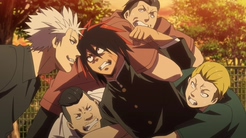
Of course, Takahashi does more to help than just injuring Hinata’s glove hand. He remembers Chiho, who once gave him half of her lunch during a school trip, which gives Hina an opportunity to talk about her. He also invites Takagi (the head bully) and her friends to play catch, only to intimidate them by using his full strength, sending a clear message that his friends aren’t to be messed with. But his involvement in their class backfires when the jealous Takagi (or one of her flunkies) scrawls an insulting message on the chalkboard, and their teacher sidesteps the issue by calling Hinata “uncooperative.” The look on her face at the end of “Letter” closely resembled one of Kyouko’s bitter facial expressions, which is a scary parallel to consider. Hina describes the anger she feels in the episode’s most striking segment, which featured violent colors splashed on a dark background, closely matching her desire to beat the bullies in her class to a pulp. Despite her bottled-up rage, though, the conclusion to this scene was more sad than anything else, as we learn that Chiho is now at a rehab center, having failed to attend her new school. For all that Hina has had to endure, she’s proven to be resilient, but the same treatment was enough to break her sweet friend.

Even Akari is a victim of this awful situation, facing feelings of inadequacy as a mother to her younger sisters, and dreading the inevitable parent-teacher conference that will be arranged if Hinata continues to keep her chin up. Though Rei managed to find the perfect words to reassure her several weeks ago, he’s so moved by her plight here that he loudly proclaims his support for her before God and several dog walkers. Akari charmingly accepts, which apparently causes the younger boy’s heart to thump, but it isn’t just his heart that responds; as Rei rides the train to his next shogi match, he recalls that seeing Akari smile against the sunset like that caused a bolt of desire to shoot through him. This poses a sizeable predicament for him, since he already cares very strongly for her younger sister, though not in an overtly romantic sense. It’s hardly a surprise that Rei would feel something for Akari – not only has she showered him with attention and care since they met, but she’s a beautiful woman with a highly desirable body. The natural way that this attraction was introduced came as a relief, since there are plenty of other series that would linger on the subject for too long. We’ll see how willing the show will be to explore it as the season progresses.

Rei is forced to shut down that line of thinking before his match with Hachiya, AKA the Irritated Prince of the East. All of his ticks, from tongue clicking to fast, aggressive play, really pulled me in during their showdown. 3-gatsu is generally good at making shogi interesting for those of us without any knowledge of the game, but it slipped a bit during the back half of its first season. For me, this was a return to form, but the most interesting thing about Rei and Hachiya’s match came after its conclusion, when Yanagihara and Smith declared them to be totally alike. Like Rei, I didn’t agree with that assessment one bit – at least, not at first. During their match, Rei assumes Hachi to be totally self-absorbed, because he doesn’t think about how his noise-making affects his opponents. But despite Rei’s willingness to consider the needs of others, especially in this arc, he does have a tendency to focus inwards, likely because of the isolation he experienced at school and in his second home. This intense introspection can make him blind to the feelings of others, especially Nikaidou, whose friendship he often takes for granted. There will be an even better example of this limited perspective in a few episodes, though, so I’ll put a pin in this theory until then.

Ballroom e Youkoso – 19/20 [Rival/Friend]

It seems that the closer Ballroom e Youkoso gets to the end of its run, the further it moves from my strike zone. The series’ wide-ranging cast is its greatest asset, so you’d think that an extended flashback exploring Akira and Chinatsu’s shared past would be a slam dunk, but these episodes left me cold. There are too many hurdles for the show to overcome, between a lack of expressive motion, inconsistent portrayals of skill and compatibility, superfluous dialogue, and poor scene transitions. Assuming I continue doing double-episode posts, I’ve only got two more to go, but I’m dreading the final review that lies beyond them. Takeuchi Tomo, the original creator, has given us the heads-up that the Ballroom anime may receive an original ending due to delays in the manga’s release schedule, which only adds to my apprehension. Then again, the show has been pretty faithful to its source and still ended up in this rut, so maybe some fresh material is just what it needs.

There was a minor controversy surrounding Ballroom’s 41st chapter (from which “Rival” draws) a while back. When it was first published in Monthly Shounen Magazine, it contained a page where Akira thought to herself, “What I love is something else.” She expresses a similar thought in this episode (though Amazon’s subs use “like” instead of “love”), a reference to her affection for Chinatsu, rather than the sport that binds them. However, when chapter 41 was included in a compiled volume of the Ballroom manga, that text was removed, probably because it suggests a same-sex attraction on Akira’s part. Coming into this episode, I was curious which way the show would lean, and to my pleasant surprise, they included the line. In fact, this episode was heavy with lesbian subtext, from Akira’s descriptions of heart-pounding excitement at being around Chinatsu, to her “embarrassment” at studying the nape of her neck, to her jealousy at the thought of anyone else teaming up with Chinatsu.

Now we know that Akira is gay (or at least bisexual), and that her attraction to her former partner has shaped their relationship coming into adolescence. We even delve into her psyche a bit, as she manipulates Chinatsu into dancing the boy’s part because she prefers her in a “male” role, and labels her feelings as “wretched.” Despite its success in telling their story, however, Ballroom fails to connect it to the larger picture of the current arc. Akira dances to be close to Chinatsu, not because of a particular love for competition; Tatara’s current goal is to become a better competitor by understanding what it means to lead. Those ideas don’t have much to do with one another, although you could argue that the show has lost sight of Tatara’s arc, as well. The show is constantly giving us mixed messages about both him and Chinatsu. Take Mine-san’s evaluation of the pair, for example: “They have childish faces, but their childishness has disappeared.” Hello?! How does this explain Chinatsu’s relentless mocking of Akira in this episode (which kind of undercut the emotional aspect of their backstory), or Tatara’s exasperating timidity?

That brings me to my next point, about the lack of consistency surrounding the show’s treatment of the Tatara/Chinatsu partnership. Just a couple weeks ago they were in the zone, flying through the early rounds of the competition, and using their clashing personalities to push each other to new heights. We even got that scene where Chinatsu was viscerally influenced by Tatara’s movement, so much so that it threatened to overtake her. Then we get to these episodes, and the entire peanut gallery is shit-talking them, Chinatsu is acting totally aloof, and they’re literally stepping on each other’s feet. Then we move to the slapstick second half of “Friend,” which features a scene where Hyodo sits on Tatara’s back and “separates his muscles” over his anguished cries, while Chinatsu and Akira nonchalantly eat bananas in the foreground… I’m cool with anime moving rapidly between different styles and tones, but only if they establish that versatility as a part of their DNA, and Ballroom has never been as wacky or felt as conflicted as it was here. The majority of this doubleheader’s appeal was lost on me, but hey, there’s only four episodes to go.

3-gatsu no Lion – 27 [Feelings/Confession]

This episode of 3-gatsu felt like a companion piece to the heart-wrenching drama of the previous week. In fact, the “Feelings” chapter from this installment, where Rei asks Hayashida-sensei for advice, was a direct continuation of the same chapter from last time. Until this point, I felt that the series had approached the subject of bullying very naturally, without lecturing or feeling like an after-school special. There was a bit of preachiness to Hayashida’s dialogue this week, though it would have been tough to avoid that sensation, based on the straightness with which Rei asks for “anti-bullying measures.” Listening to the teacher’s speech on the difficulties of dealing with bullying, one gets the sense that this chapter was a sort of soapbox moment for Umino-sensei. Given the overall strength of this arc so far, though, I’m willing to handwave its less subtle bits. Plus, I admire anyone who integrates the social issues they care about into their art, especially when the end product is actually good.

There were two elements of Rei and Hayashida-sensei’s conversation that made it a success on a level apart from “bullying is a tough nut to crack.” The first was the humor, which came as a relief for me, since Shaft’s brand of comedy doesn’t always find its way to my funny bone. I credit a lot of the laughs to the keyboard track that starts around 1:40, and again at 7:30. Combine its playful Wurlitzer melody with some goofy voice acting and inventive visual gags (Hayashida turning into a wooden statue springs to mind), and you can generate a lighthearted tone that balances the chapter’s heavier moments. The second, more significant element was the show’s flirtation with the Rei/Hinata pairing, as seen through Hayashida-sensei’s eyes. In my last 3-gatsu post, I mentioned that the two characters are quite suited for one another, but that was in regards to their temperaments and personal histories. The three year difference between Rei and Hina makes it difficult to think of them as romantic partners, and Honey and Clover was famous for its couple-related curveballs, so I don’t want to make any serious predictions at this stage. Hayashida is certainly convinced that Rei has a crush, though, if his disappearance into the rushing river of adolescence is anything to go by.

I appreciate that “Confession” continued to explore the effects of Hinata’s bullying on other members of the Kawamoto family. Akari carries one of the heaviest burdens in the 3-gatsu universe, having acted as a mother to her sisters since the age of 17, and for this to be added to her plate must be nearly unbearable. She feels even worse after comparing her own defensive, questioning response to Someji’s reassuring one, which isn’t an observation that a lot of other series would make. Poor Akari – she declares herself “no good” because of her failure to comfort her baby sister, but she’s the most traditionally “good” character the show has to offer. Thankfully, Rei draws an inspired parallel between Hina’s courage and the values with which Akari raised her, and gives her a much happier reason to cry. Even though Rei made such a bold commitment to Hinata last week, I think he actually demonstrated more growth here by attending to this subtler form of grief. Finding the perfect words like he did in this episode proves that Rei is on a path of real transformation, and I plan to accompany him until he reaches its end.

3-gatsu no Lion – 25/26 [June/Ladybug Bush/Feelings]

During the bizarre cold open of this makeshift two-parter, the thought flashed across my mind: are we getting one last bit of frivolity before the other shoe drops, or is wackiness the new normal for 3-gatsu? Over the last couple weeks, we’ve witnessed a lot of exaggerated behavior from characters like Hiyashida-sensei, Nikaidou, and even Rei himself, and as much as it pleases me to see everyone enjoying shogi and loving life, I’ve been waiting for the series to take a dramatic turn. I’ll even confess to experiencing a sinking feeling as Rei’s self-proclaimed rival engaged in his usual hysterics during “June,” wondering if the rest of this season was going to be more of the same. But if you’ve seen both of these episodes (which you almost certainly have, since this post is weeks overdue), you already know that my worrying was in vain. From the moment Akari opened that door to reveal her sister’s mismatched shoes and teary eyes, this show put me through an emotional wringer as powerful as anything from its first season. 3-gatsu, I’m sorry I ever doubted you.

Apart from the inherent injustice of Hinata’s circumstances, what makes her story particularly effective is how strongly Rei can relate to her. He’s been bullied for a good portion of his life, whether it was being labeled a robot on the class chalkboard, having a classmate refuse to sit next to him on a field trip, or getting cans full of rocks chucked at his head. As a quiet, introverted kid, made more quiet and introverted by the death of his biological family, Rei was a perfect target for bullying by exclusion. The show even refreshes our memory on the subject just before telling Hina’s story, so it’s easy to identify her withdrawal at home as a symptom of bullying. When the truth finally comes out, Rei is horrified to realize that the pain he once felt is now being visited upon someone who has always supported him. And when Hinata bolts from her house, filled with shame and self-loathing, there’s no question of who will follow. The only thing he manages to say before sprinting after her is, “I will.”

Bullying in Japan is often characterized by its intensity, and the scope with which it’s carried out. Entire classrooms can ally themselves against individuals in the name of conformity, and even teachers may be complicit, as they are in this case. Though Hinata’s sensei refuses to acknowledge the abuse occurring just under her nose, kind-hearted Hina could never abandon a friend, so she sits with Chiho during lunch and sticks up for her in class. But Chiho eventually changes schools, and the bullies shift their sights to the closest remaining target. After Hinata recounts all of this to her family, she begs through her sobs for Akari to tell her what she ought to have done to save her friend. But later, as she confesses her fear and sorrow to Rei on that bench by the river, she starts on the long journey of putting herself back together. With big Ghibli tears dripping down her face, she raises her voice and screams in defiance of her classmates, teachers, and culture that what she did was right.

That was the moment where I lost all control. How could Hinata, who never goes anywhere without a smile, be reduced to this scared and angry state? How could the incompetents running that school allow any of this to happen? The girls who stole her shoes could work their whole lives and still fail to pay for the hurt they caused her. I was furious – but Rei, despite all the bullying he’s endured, had a different reaction. His promise to Hinata, to stay with her and to spend the rest of his life paying her back for her kindness, closely resembled a marriage proposal, and his commitment felt just as strong. He even got down on one knee before making his big declaration, which I’m sure was a conscious decision on Umino-sensei’s part. When Rei described the feeling of being saved by Hina’s courage, it struck me that both of these characters are uniquely positioned to help the other. Hinata’s good nature allows her to extend warmth to people who dwell in dark places, and Rei’s familiarity with that darkness enables him to lead others out of it. This episode, more than any other, has convinced me of their suitedness for one another, and of my love for this series. May it continue for years to come.


Some other thoughts about these episodes:

– Though Rei’s initial reaction by the river is one of dedication and compassion, he later thinks to himself that he wants to rip Hina’s tormentors limb from limb. Episode 26 even closes with him wracking his brain for a way to improve her situation, so we haven’t reached the end of this story yet.
– The symbolism behind the ladybug in “Ladybug Bush (Part 3)” was a stumper for me, perhaps because of the language barrier. I did a little Googling, and it turns out that aside from the general superstition of ladybugs bringing good luck, they can also represent impending happiness, or the idea that one’s troubles have come to an end. Hinata would welcome either possibility, I’m sure.
– Someji’s commendation of his granddaughter’s courage warmed my heart (and what a fantastic lesson for little Momo), but even more moving were the contents of the dinner that Akari prepared for her little sister: deep-fried chicken, potato salad, and cream stew, all of Hinata’s favorite foods. The fictional moments that touch me most are always the ones where people are good to each other.

Ballroom e Youkoso – 17/18 [Performer/Competitor No. 13]

It’s a good thing I didn’t go back to single episode reviews, as I promised last time, because these two didn’t leave me with a whole lot to talk about. Much of “Performer” was spent bringing Tatara and Chinatsu back together after their spat from the previous installment, but since I didn’t buy into that conflict in the first place, it ended up feeling like more of a hangout episode (with plenty of fanservice and shipping to boot). We got some uncommon character pairings, too, like Chinatsu/Mako and Tatara/Shizuku, the latter of which is a rarity these days. And while these sorts of cast shake-ups might have delighted me a couple months ago, they seemed rather utilitarian here, given the need for our main couple’s big breakup to be reversed. Thankfully, the chill-inducing conclusion to “Competitor No. 13” justified the show’s clumsier machinations – but we’ll get to that soon enough.

Ballroom e Youkoso has devoted what seems like a dozen monologues to the ideas that 1) Tatara is a poor leader, and 2) he and Chinatsu aren’t a good fit. There’s a glaring issue with this constant hammering of the same couple points, and it’s one I’ve tried not to mention too often, since it’s such a widely repeated criticism of the show. Maybe this episode was the straw that broke the camel’s back, though, because I’m compelled to bring it up: the dancing direction isn’t strong enough to communicate the same messages. We hear it verbally, but we rarely see Tatara failing as a leader. What we see are a lot of still shots, anguished expressions, and reactions from judges or crowd members. Moreover, Ballroom hasn’t properly shown its audience what successful leadership looks like in motion. We’ve just been trained to equate confidence with skill, and as anybody who’s ever played a sport knows, they’re not the same at all.

Without the choreography necessary to convey Tatara’s failures, the show falls back on dialogue to destroy and rebuild his new partnership. A lot of Chinatsu’s grief seems to stem from jealousy, which comes to the surface after she learns about the past Tatara/Mako partnership. I felt really proud of Mako for keeping her patience with Chinatsu, even after the older girl implied that dancers with consistent partners led breezy, carefree lives. Mako’s maturity aside, however, this scene boiled down to Tatara’s leadership being verbally praised, and Chinatsu deciding to give him a second chance as a result. The Tatara/Shizuku scene involved even more lip service, but was somehow less convincing – if Tatara is capable of impressing a veteran like Shizuku, why is his lack of leading ability constantly being harped on? As this scene played out, with one of Japan’s best amateur dancers calling him “a mystery,” I couldn’t help but think that Tatara has always been portrayed as an open book.

Alright, that’s enough criticism of the show’s visuals. As important as they ought to be in a show about ballroom dancing, the characters are the main attraction, and they really came through in the second of these two episodes. Being in a competitive setting once again, Tatara and Chinatsu really seemed to be click, despite their occasional bickering. The appearance of the dancers’ family members was a lot of fun, as well, especially Mine-san’s wife and child, from whom he kept his continued dancing a secret. But the thing that really sold me on the start of this arc was the final scene, where Tatara’s intensity started to overtake Chinatsu, represented both by smoke and by blood cells entering her body. Ballroom pulled out a couple of neat dance sequences for the start of the Metropolitan tournament, but taken alone, those wouldn’t have been enough to convince me of Chinatsu’s sensation. This show tends to hit a home run whenever it uses visual metaphors this way, so I’m glad it went back to that well. It’s no small task to convince your audience that someone as stubborn as Chinatsu would give control to another person, but the creative team took a good first step with this episode.

3-gatsu no Lion – 24 [Chaos/Kumakura]

Ask the average 3-gatsu fan who embodies the heart and soul of the show, and they’re likely to say Momo, the precocious preschool-aged sister in the Kawamoto trio. Another popular pick would be Hinata, whose sensitivity and unflagging support for Rei make her an invaluable member of the cast. Yet despite their big fanbase and importance in balancing the series’ tone, we hardly got a glimpse of them in the last episode, and they were nowhere to be found in this one. Though I haven’t read the manga, I’ve heard that Hinata will be the focus of a big arc in the near future, so I guess Umino-sensei is saving the ever-popular sisters for that moment. In the meantime, we got to reconnect with plenty of familiar faces in this episode, including Nikaidou, Smith, Gotou, and Kyouko. How nice to be reunited with friends!

I talked a lot last week about Yanagihara, who became one of the show’s most captivating characters practically overnight, and he cemented that feeling for me in “Chaos.” The man really commands a room, shutting down Rei and Nikaidou’s antics and forcing others to accommodate his need for space as the Meijin title match continues. Many other pros tolerate the eccentricities of their fellow shogi players, but Yanagihara puts the game above all else – including people, one suspects. Not even Gotou, whose imposing frame and viper’s tongue cause people to tread carefully around him, can phase the old master as he studies the Souya/Kumakura match. Still, there’s a chill in the air during their scene together, with mournful strings blaring in the background as they size each other up. Based on Rei’s dislike for Gotou (who is sleeping with his adopted sister), one might assume this tragic background track is meant to foreshadow a conflict between the prodigy and his most hated opponent. It seems to me, though, that Yanagihara and Gotou will be the ones sitting across the board from one another before too long. Their personalities and schools of thought are too different not to clash with shogi as a metaphor.

Contrary to my prediction about the Meijin match, Kumakura managed to take it to a seventh and final game. Given the way Souya checkmates him to protect his title, however, it’s safe to say there’s still a sizeable skill gap between the two. I was impressed by the way the show handled this scene: the match commentator and nearly every pro in the shogi hall couldn’t make sense of the move, but after thinking for a while, Kumakura gracefully admitted defeat, stunning nearly everyone. Apart from the two men engaged in combat, only Yanagihara realized it was mate in 17 moves, and only after playing it out did the truth become obvious to everyone else. 3-gatsu isn’t exactly a top-shelf psychological anime, but I’m always intrigued by the way it portrays its 9-dan players as existing on another plane of reality. Souya typically looks so fragile that a strong gust might blow him to pieces, but the wind in his world blows where he commands it. The show keeps giving us peeks into Shimada’s home, where the former challenger appears to be playing along with the current TV broadcast, never leaving his house or contacting anyone. If getting swept 4-0 can do this much damage to a man, how much anguish must Kumakura be experiencing, having tasted victory only to get blown back by Souya’s superhuman foresight?

Even with such a pivotal match taking place this early in the season, the highlight of this episode was what we learned about Gotou after he left the shogi hall. Rei’s biggest problem with the man isn’t just that he’s sleeping with Kyouko, but that he’s having an affair with her, and for anime-only fans, that fact has stained our perception of his character… until now. In a very tender hospital scene, the show reveals that his wife Misako is in a coma, and that the skincare products Kyouko bought for him were intended for her. Kyouko knows this, and asks if she ought to accompany him during his visit, but despite their continued intimacy, Gotou doesn’t want a lover’s comfort while visiting the woman he married. The show generates nothing for pity for these characters here, including Kyouko, whose feelings of loneliness and paternal abandonment drive her to show up at Gotou’s apartment later that night. She sweet-talks her way in, overriding his protests in a brief moment of levity, but the mood becomes sorrowful again as Kyouko observes his physical and emotional exhaustion. Forced to put her selfishness aside, she finds that she can’t get angry with him, which leaves her with only their shared pain to consider. This type of emotional gut punch is one of the things I love most about 3-gatsu, but deep down I’m waiting for the moment when Rei must contemplate his own pain and loss once again, since that’s what drew me to this show in the first place.

3-gatsu no Lion – 23 [Setting Sun/Ramune]

When 3-gatsu no Lion first aired in the fall of 2016, there was a heated controversy among manga fans about the appropriateness of Shaft’s adaptation. The show was undeniably faithful to its parent material in terms of story, but its abstract visuals and quirky mood shifts gave it a different flavor than its predecessor. Although Umino-sensei personally requested that Shaft handle the TV series, the decision was met with resistance by part of her fanbase, some of whom swore off the anime completely. Happily, I approached 3-gatsu last year with no prior expectations to weigh me down, and it became one of my favorite series in recent memory, and a virtual lock for my top 10 list in a couple months. Despite my love for the work, I opted not to read the manga during the offseason (a self-imposed restriction I’ll be sure to lift one day), so these blog posts will be written without knowledge of future events. I also want to say a quick thank you to Mario, who has graciously allowed me to continue where his coverage of the story left off six months ago. Cheers, mate!

After the previous season concluded on such a hopeful note, I was curious about which version of Rei we’d get in this opening episode: sadsack Rei or social Rei. Despite his clear growth leading up to this point, 3-gatsu hasn’t been afraid to isolate its main character as he struggles to break free of his anxiety and depression. The show opted to continue where its hopeful season finale left off, though, so we got to spend a delightful half hour with a friendly, optimistic Rei. Seeing him in a teaching role within the new Shogi Science Club was really satisfying – some of the best teachers are driven to give to others the type of care they never received, which I sensed from him in this opening scene. His style of instruction was gentle, but occasionally urgent, as if knowing just when Noguchi (the mustachioed senpai of the club) needed a push to continue with his frustrating shogi training. I really enjoyed the back-and-forth between these two, since Noguchi is much more mature than Rei, but maintains a willing attitude as a student for the benefit of his new friend. Their relationship isn’t just a one-way street, either, with the elder boy walking Rei through the process of creating homemade ramune candy, which he eagerly brought back to the Kawamoto household to share with the girls.

The lack of screen time given to Akari, Hinata, and Momo was a little disappointing, but the majority of this cast is interesting enough to have entire episodes structed around them. This one cut between the club’s viewing of the Meijin title match, the match itself, and the private musings of two legendary figures, who I’ll talk about in a bit. The current Meijin, Souya, is an unstoppable force in the shogi world, but it’s his opponent who dominated their scenes together. We only got a glimpse of Kumakura Kengo last season, but we received much more than that here, as he positively devoured the sweets that were brought to him during the match. The peculiar shots of delicate cakes being crushed, all set to a heavy electric guitar riff, were about as Shaft-y as you can get in a scene featuring two adult men eating. This was the one spot where the show’s visual presentation was distracting for me, but it was certainly a memorable way to convey Kumakura’s strength and intensity. Stern-faced and looming in stature, Kumakura appears to present a difficult obstacle for the Meijin, but given Souya’s place as 3-gatsu’s “final boss,” I doubt he’ll struggle too long before putting away his challenger.

The first of the two legends I mentioned earlier is Jinguuji Takanori, the chairman of the Japan Shogi Association. We’re already familiar with the fun-loving, responsibility-shirking chairman from his multiple appearances in the previous season, but his character took on a different dimension in his conversations here. The man sitting across from him was Yanagihara Sakutarou, whose name I only found by Googling, since it wasn’t mentioned in the episode. I really appreciated that 3-gatsu went for naturalism during his first appearance, rather than putting a title card on screen to inform us of his name, date of birth, JSA rank, blood type, and favorite foods. From the dialogue between these two men, we learn that Yanagihara is set to face Souya in a future tournament, where even the reigning shogi champ will occupy the role of challenger. Yanagihara is nearing 60, but his wry sense of humor is very much intact; though he confesses to fearing the Meijin, his tone verges on disrespectful as he describes Souya’s talent. The chairman even labels his playstyle as “mocking,” an accusation which his friend protests only half-heartedly. Based on their playful, layered conversation, I’m already looking forward to the moment when Yanagihara steps into the ring to face his destined opponent.

Ballroom e Youkoso – 15/16 [Taking the Reins/Four-legged]

Boy, this was really a Tale of Two Ballrooms. One of these episodes was almost certainly outsourced, based on the visual inconsistencies that extended even to key poses, but handled its character moments dutifully. The other looked markedly better than most of this show’s recent offerings, but rushed through so much material that its conclusion had hardly any impact. I suppose it’s a good thing I watched them together, since they make up for each other’s weaknesses, but episode 16’s abrupt finish left a sour taste in my mouth to end the doubleheader. A word of warning before you read any further: this is going to be one of those reviews were I make reference to the Ballroom manga more than once, and the eternal anime buzzword “pacing” will probably make an appearance before too long. If that sounds like something you can tolerate, at least for a few more paragraphs, then let’s unpack these episodes together.

My favorite part of “Taking the Reins” was the introduction of Kugimiya, who made an excellent transition from page to screen. He’s a blunt, imposing figure, whose tall stature and thin eyes make him a good aesthetic foil for Tatara. They’re opposites in the way they approach dance, as well; Kugimiya speaks harshly to his partner (who he’s nicknamed “Banshee”), and considers the strength of a couple’s leader to be of paramount importance. When Tatara objects to that philosophy, Kugimiya uses his undeniable skill to toss Tatara (occupying the female role) around like a ragdoll. Even Kugimiya’s theme, with its schizophrenic bassline and backwards piano, is brash and off-putting – the anime staff did an A+ job with his character. Off-putting though he may be, he’s right about how important the leader’s role is in ballroom dance, a fact that Hyodo’s mother Marisa reiterates more clearly than ever before. As Tatara’s new coach, it’s her job to make her pupil take a more active role in his routines, but it won’t be easy given his typically passive attitude.

Tatara’s old coach makes an appearance in this episode, as well, with Sengoku’s return to Japan after a month-long timeskip. The kids attend Japan’s International Dance Championships and watch as he and Hongo place third on the world stage, a feat which leaves Tatara in awe of his former mentor. After sharing a few laughs throughout the day, teacher and student have a nice moment together when Tatara works up the nerve to call him “sensei” for the first (and probably last) time. I thought it was swell of Ballroom to acknowledge the influence Sengoku has had on his old student’s development, especially because its newly-heightened narrative pace risks leaving some characters behind. Sengoku could have been a little more sentimental about it in the moment, but he had some encouraging words for Tatara during their classic train station farewell, so I’m happy. If there’s one criticism I’d level at this scene, it’s that it played a bit like a final goodbye, but it shouldn’t have, since I doubt this is the last time they’ll see one another. And speaking of scenes that don’t feel right…

Here’s a tip for all you aspiring storyboard artists out there: USE THE MANGA PANELS WHEN PLANNING YOUR ANIME. The beauty of series with existing source material is that some of the work is already done for you, and comics in particular lay things out really nicely. You can deviate from the manga, of course, but since anime is presented to the viewer at a fixed tempo, it’s important to note panels that indicate the passage of time, and use a similar device in your adaptation. Elaborate on them, do a montage, or throw a few stills on screen set to a throwaway piece of music – just make sure the episode is paced appropriately. Here’s what not to do: finish a scene with Marisa telling Tatara and Chinatsu that they can’t compete in a Grand Prix, fade to black, and transition immediately to the two of them on a train to the Grand Prix one month later. You might do this for humorous effect, but that’s not what Ballroom wanted to achieve here, and their omission of the manga’s dance training and end-of-school panels made the end of the episode feel super choppy.

The same problem carried over to the next episode, where Tatara’s obsession with a peculiar sensation he experienced while dancing led to his disqualification from the Grand Prix. He zoned out while sitting on the sidelines, you see, and when he came to, the competition was over. That’s what you might think, anyway, given that the anime only presents us with a shot of Chinatsu’s anguished look, then cuts straight to them in street clothes at a train station. Gone are her repeated attempts to rouse him, his slow return to reality, the call from another competitor asking if he should be on the dance floor, and the indication that the heat is still going on and they only missed it by a minute or so. The show was so preoccupied with showcasing its (admittedly cool) four-legged animation that it forgot how to sequence itself. I can only guess whether anime-only viewers found these scenes to be sloppy, but I know that similar transitions in other series have bothered me, even without knowing a thing about the original work.

There’s a whole half-episode of content left to discuss, but I don’t want this review to hit a thousand words, so I’m calling it here. Looks like I’ve still got plenty to say about Ballroom, so we probably ought to go back to single episode reviews. I’ll touch on whatever I missed from “Four-legged” in the next one.

Ballroom e Youkoso – 13/14 [Matchmaking/Coupled]

The unstoppable Anime Catch-up Train continues with a Ballroom doubleheader. These two episodes weren’t aired on the same day like 4 and 5 from the previous cour, but they might as well have been, given the way they complimented one another. Chinatsu has stolen not only the spotlight, but every bulb in the damn house at this point, but her peculiar personality needs explaining, and that’s what these episodes set out to do. For all the popularity that the tsundere trope enjoys, I’m glad that Ballroom decided to dive into Chinatsu’s background and explore what makes her tick, rather than carelessly dropping her into the cast and coasting on Japan’s love for girls who play hot-and-cold. If it hadn’t taken the necessary time to examine her character, her clashes with Tatara would be even more frustrating than they are now (even if the OP blatantly foreshadows them).

When I first read the Ballroom manga, I had a theory that Chinatsu was a lesbian. It might not be the most open-minded assumption in the history of fan theories, but there was at least some justification for it: her initial fangirling over Sengoku is revealed to be a smokescreen for her obsession with Hongo (his total babe of a partner), and her rivalry with Akira has the faintest hint of yuri undertones to it, given their history as dance partners. Because of the anime’s faithfulness to the manga, I was reminded of that past speculation when watching these episodes, but something else jumped out at me, too – Chinatsu’s desire to be normal. In a quiet scene where she’s doing a bit of spring cleaning, she appears torn between repairing and giving away a pair of dancing heels, but when her mom asks whether she’s thinking of getting back into the sport, she recoils at the notion. Similarly, she initially mocks and rejects Tatara for his interest in ballroom dance, but agrees to practice with him even before roping him into a scheme to humiliate Akira.

The thing about Chinatsu is that she suffers from role confusion. Having been forced into the leading position in her juniors partnership, where girls dance together, she tends to take the lead in other situations, as well – but only if she gets a clear signal that it’s okay. So when Tatara confidently admits to the class that he participates in ballroom dance competitions, she keeps her passion hidden; but when he nervously abandons a request for her to practice with him, she coolly agrees, and steers the flow of their waltz to boot. Chinatsu wants to be normal, but she knows that leading isn’t “normal” for women, neither on nor off the dance floor, which results in that signature hot/cold personality. Tatara isn’t exactly charmed by it, asking himself some variation of, “What is with this girl?” probably ten times over the course of these two episodes. This became exasperating after a while, but I can understand his bewilderment, since Chinatsu is so different than either of the other partners he’s had thus far.

The conflict between our resident redhead and her old partner Akira was beautifully set up, with Tatara caught in the crossfire at his new part-time job. Seeing him standing diligently at attention in his spiffy new uniform, even after his boss told him to take it down a notch, got an audible laugh from me. The atmosphere in the café became a lot frostier once Chinatsu walked in the door, though, as Akira pays her ex-leader a series of scathing backhanded compliments, all while asserting her superiority as a dancer and a woman. Although she looks like a high school boy’s dream, Akira is more than capable of going for the jugular, and in her rush to scrape together a rebuttal, Chinatsu declares that she and Tatara will partner up and defeat her at the Mikasa Cup. Despite their incompatibility, they perform well at a qualifying novice round, but first place is snatched from them by a pair of dancers under the tutelage of Marisa Hyodo, who appears just before the credits roll. Always the provocateur, she accuses Tatara of forcing Chinatsu to do all the work in their routine, cementing his dawning realization that he doesn’t know how to properly lead. From this point on, the series will be intensely focused on his journey to understand both the rigid requirements of ballroom dance, and the thoughts and feelings that drive his new partner. Without spoiling anything, I can reveal that it’ll be a long time before he manages either task, so I hope you’re strapped in for the ride.

Shoukoku no Altair – 11/12 [The Prince of Swords]

Well, this is awkward. I’m so behind on Altair that even a double episode review isn’t enough to get us caught up. Two months ago, I made the decision to discontinue my coverage of this series once it hit the halfway point, and even though episode 13 functions as the true conclusion to this arc, I’m content to finish things here. There’s no sense in laying out each of my issues with the show – you can read past reviews for that – but to put it broadly, the entire production feels hurried, and not just in terms of its breakneck narrative speed. There’s some good dramatic material in Altair’s story, but in the hands of a conservative director and an overworked studio, it rarely came alive for me. There was a big exception to that rule in one of these two episodes, though, so let’s talk about it… after refreshing ourselves on the details of the anime.

Several weeks ago, we left off with a plot to assassinate the sultans of the Turkiyean territories, who would all be in one place thanks to Prince Orhan and Aishe’s wedding. Now, word of this plan makes its way back to the Divan in Turkiye, who send a pro-sultanate representative to the ceremony. The envoy makes a pit stop at Balaban’s doorstep, however, and spills the beans regarding the trap waiting for him in Kuluch. Armed with this information, Balaban (and the other sultans) choose to march their armies to the wedding and conduct a preliminary strike against their would-be killers. But this leaves their territory undefended, and Zaganos quickly moves to seize control of their major cities. The show later frames this as a cause-and-effect scenario, and given Balaban’s blinding pride, it kind of is, but I do wonder what would have happened if he had refused to attend the wedding. The political fallout from that disrespect is nothing compared to the potential loss of your country, or even your life. Uzun, in particular, should have called in sick on invasion day – his only interest ought to be the completion of the trade route that would secure his nation’s financial independence from Turkiye.

All of that aside, “The Prince of Swords” gets good right at the end, when Orhan’s father goes back on his pact with Mahmut. Fearing for the safety of his people if the bloodthirsty Balaban breaks into the city, he attempts to kill Aishe and offer her head as a gift to him. Orhan, driven by love for his bride-to-be, kills his father to save her life. What makes this an especially remarkable move is that, earlier in the episode, he had learned that Aishe was in love with her uncle, and had no desire to be married. This is a character who was played strictly for laughs until this point, so when he came before his royal guard and confessed to the murder, decrying his father’s cowardice and proclaiming his own ascension to the throne, I got chills. Whoever provided Orhan’s voice did a fabulous job with this material – I almost looked to see who it was, but then decided I don’t want to associate that performance with any other characters. Even though I won’t be watching beyond these episodes, I hope that Orhan has some part to play in Turkiye’s post-rebellion landscape.

Speaking of the rebellion, most of the second episode is dedicated to the military struggle between Balaban’s forces and Mahmut’s. Though our heroes are outnumbered 4 to 1, Balaban brings only 5000 men into battle, not wanting to lessen the glory of his victory with superior numbers. This turns out to be his undoing, as Mahmut is able to eliminate most of his troops before luring the survivors into a narrow valley. It’s in this remote setting that Beyazit’s trump card from last month is finally put to use, as his musketeers use their revolutionary firepower to pierce the shields of Balaban’s strongest soldiers. As for the Red Tiger himself, he dies in his brother’s arms, despairing at the fact that the only person who truly loved him also helped to engineer his downfall. There were several flashbacks to younger versions of Balaban and Beyazit throughout these episodes, and while none of them particularly moved me, they did establish the two men as fated opponents, despite their affection for one another as children and young adults. Balaban was too big and too colorful a character for the rigid world of Rumeliana, so if he had to go, at least it was with a bit of nuance.

That’s it from me where Shoukoku no Altair is concerned. There’s still another cour to go, so if you’ve been enjoying the ride, I hope the show stays on course. The new fall season has produced a handful of worthwhile shows so far, so I’m itching to start blogging one of those instead. Whichever series that ends up being, I hope you’ll stick around as we transition to a new story and a new set of characters. Thanks for reading.