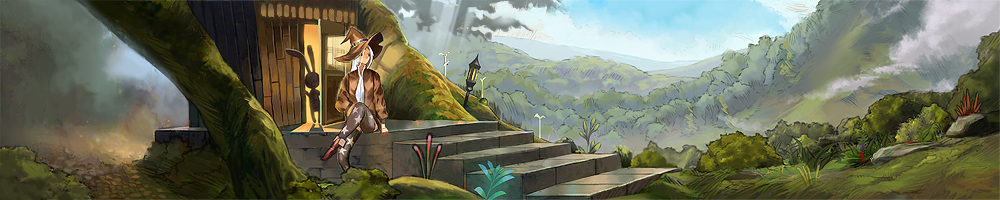
Sarai-ya Goyou – 03


What a wonderful episode. The danger with these slice of life series is to have them too much about nothing, or to not put any creativity in the scenarios that the characters find themselves in. This however was an episode that confronted Masa deeply, and it as well mirrored Yaichi’s past (at least, I assume that he’s the kid in the flashbacks, right?). The creators have chosen two wildly different ways to flesh out the two of them: Masa gets explored because we get to see exactly who he is: what motivates him, in what way he’s such a loser, et cetera. Yaichi on the other hand is being portrayed as dark and mysterious: the guy with a dark past who turned into a confident criminal, who mainly gets fleshed out by his words, instead of his actions. And who knows what can lie behind those words? Unlike Masa, this guy hides plenty of things.

I’m wondering about Matsu’s role in all of this. The side-characters all have their own great and subtle characterization. The thing is however that they’re probably going to have to make way in terms of development, in order to let Masa and Yaichi fully shine. The length is probably going to be the biggest issue for this series: did the creators put enough thought into making the best out of the length of this series? I’m having faith in Tomomi Mochizuki, however. He has experience with changing stories from their source-material, in order to make them fit the anime format perfectly (just look at Touka Gettan and Yami to Boushi to Hon no Tabibito, and I also refuse to believe that Porfy no Nagai Tabi was 100% faithful to its novels), and I’m really counting on him to put the same skills to work here.

In any case though, this episode was really well animated. It’s really series like this that use their animation to get the best out of the characters, bringing them to life. I’m in love with the saturated colours here, and especially that flashback looked beautiful.
Rating: ** (Excellent)

Durarara – 16


After the previous episode, I remember noting how this series hasn’t exactly delivered yet in its second episode. It’s like it was missing something. But yeah, after this episode I realize that it was just building up. This episode was much more like it. It’s here where the creators really start playing with what they’ve built up.

My guess was that the previous episodes were mostly trying to shed the remaining Baccano-roots that had somewhat grown after the first half. While you can very much tell that the first half of Durarara comes from the same creators as Baccano, with the second half you really can’t.

The mystery in this series is definitely interesting: it’s the kind that keeps huge secrets about its lead characters: it only drops a few hints here and there, but Mikado’s involvement with the Dollars was a complete surprise. Just as how even though we’ve known Anri for sixteen episodes now, we never knew that she could pull a freaking sword out of her arm!

The twist that everyone in the city is getting turned into a bunch of zombies is perhaps a bit lame, but I guess that it is an interesting twist for the series’ setting: it’s previously been established that Ikebukuro is full of life, and here this old spirit comes and turns everyone into a bunch of obedient and lifeless zombies.

It’s all going to depend on how the rest of the series will use this, because this episode was pretty damn tense with the way that the red eyed people made their appearance, answering a ton of questions about the plot in the progress, and fully explaining the point of the previous episode, and why the guy in the trench-coat was featured in the first place.
Rating: ** (Excellent)

Mobile Police Patlabor OVA 2 Review – 90/100


If you managed to watch the TV-series of Patlabor, I really urge you to also check out the Second OVa. It’s very much a direct sequel to the TV-series, and it’s got all of the charms that made it so memorable and timeless; all condensed in just 16 episodes, it’s in no way inferior to its already excellent predecessor.

It’s got the same formula: one really big arc, and a whole number of episodic stories. What stands out the most are these episodic stories, though. Especially because they’re everything that episodic stories should be. Instead of having dull and uninspired slice of life scenarios that have been done for ages, it always builds its episodes around a certain idea or concept that really tries to be fresh and original.

The result is a number of classic episodes that are up to par to the best episodes of the TV-series; my personal favourite being the episode about the serial-bomber, with the “driving-home”-episode on the second place. Every episode is well built up, and what makes them even better is how grounded in realism they are: some crazy and wacky stuff happens here, but the creators never forget to base it on its realistic characters and scenarios, rather than just being wacky and over the top all of the time. There are those rare series out there who should serve as an eample of how to do things right at their genre. Patlabor without a doubt belongs to them.

On top of that, it still has the classic element that makes any Patlabor installment worth watching: the cast. After finishing this OVA, I’ve now seen everything from the Patlabor franchise, which amounts to 70 episodes and 3 movies in total. After so much time, the cast has really grown into a lovable and memorable bunch of people.

Watching this OVA, I really have to say that it’s a shame that Mamoru Oshii doesn’t do TV-series and long OVAs anymore, because he really is brilliant at bringing these characters to life. It’s a bit of a shame that for the past years he’s gotten stuck at things like Musashi, because he really is a one-of-a-kind director.

Storytelling: 9/10 – Wonderfully built up, nice ideas, very varied.
Characters: 10/10 – Incredibly charming characterization that’s in no way inferior to the previous Patlabor installments.
Production-Values: 8/10 – Good and detailed, though not the best Patlabor has to offer.
Setting: 9/10 – One of the best mecha settings of the pre-Evangelion age: realistic, creative and believable, despite the strange scenarios that pop up once in a while.

Suggestions:
Patlabor – The Second Movie. The conclusion to the Patlabor-franchise. Do note that if I were to watch it today, that review would look completely different.
Ooedo Rocket
Rumiko Takahashi’s Rumic Theater

Rainbow – 04


Watching this series is seriously making me think again about what makes a good anime. I mean, especially now that I dropped Hakuouki, this series features the worst acting out of all the shows that I’m blogging at the moment. It’s way over the top, way too early, and full of cheese. And yet, I just can’t deny that out of every show that premiered this season, it’s actually the most intense to watch by far.

With these kinds of shows that have very obvious major flaws, it’s always a matter of trade-offs: how much you’ll enjoy these kinds of series depends on how much of the flaws you can stand, and the way in which the series in question actually makes up for it. It’s very similar to series as Shangri-La. It’s obvious that this series is no Sarai-ya Goyou or Yojou-han, but still. Out of all the series that feature bad or sub-par acting this season, this show makes up for it the most. The key to this series’ success in the long term is that it needs to continue to keep the balls in the air. As soon as the show starts dragging, my suspense of disbelief will break and it’ll turn into just another dull series.

This episode however, continued episode 2’s pacing and delivered yet again one heck of an atmosphere. Baremoto’s entrance in the sea of fire was cheesy, but despite that it had something really cool about him. This episode was all about teamwork, and the manly bonds between the group of lead characters.

Because seriously, despite the fact that this just isn’t Madhouse’s best staff at work, you can really see the strength of the manga author shine through. One by one, the characters are shedding their stereotypes. Mario at first was portrayed as your typical punk. Yet, the previous episode showed that he’s just a softie. Baremoto, at first introduced as your typical bookworm instead also has shed his stereotypical skin in this episode. I also wonder how Psycho Guard was in the manga: how much of that ridiculously overblown scumbag was present in the manga, and how much of it did the anime creators just make up to increase the tension?
Rating: ** (Excellent)

Senkou no Night Raid – 04


Ah, the spy genre. Where our lead characters have to take care of dangerous threats, international bombings, diplomatic turbulence… and obese felines who steal photographs.

So obviously this was a bit of a silly episode, but at least it gave us a bit of a chance to get to know the lead characters, which is also important. I would have preferred it if the creators just dumped that strange photograph subplot and just showed the characters as they are on their days off, but this episode had its charms.

On a side-note, at first I wasn’t that enthusiastic about it, but on second thought I’m beginning to like this series’ tour of the world with languages more and more. I now understand why it was impossible for the creators to find a good voice actor for the lead character: is there really someone who speaks fluent in Japanese, German, Chinese and Russian all at the same time? And who knows how many more languages are going to be featured? In any case, it shows that Shanghai is growing into the international metropolis that it is today. For the series’ faults, you can at least say that it’s not looking down on its setting. Or not in a way that I can see anyway.

Also, the animators choose the strangest places to use their budget at. Most of the times, filler episodes like this don’t receive much of a budget to play with. Take a look at how well that fat cat was animated; I’ve hardly ever seen cats animated this life-like in such a TV series. Also, the crowd shots in this episode are also really well done: you can see that the streets are alive with people, who may not all be moving, but all have their own designs. And then there also are these things as the food, and the camera that they used in this episode. All were really well drawn.
Rating: * (Good)

xxxHolic Rou – 01


Before watching this OVA, I had heard from people that xxxHolic Rou would be very confusing. But Bloody Nora, I never thought that it’d be this extreme! The non-manga readers who have yet to see this episode: STAY AWAY FROM THIS POST! MAJOR SPOILERS AHEAD.

Because of xxxHolic Shunmuki, I was expecting something Tsubasa-related as well. Instead, the Tsubasa-cast doesn’t make an appearance at all. Instead, we get a time-skip of who knows how many years, in which A TON has happened: Yuko is dead, and Watanuki has now taken her place. This episode asked a whole tidal wave of new questions: what the heck happened to Yuuko? What caused her to come back? Why did Doumeki’s name change? Why does it seem that Watanuki can’t leave the shop? And taht’s just the tip of the iceberg.

Even for xxxHolic’s standards, this episode was dark. Watanuki has changed a lot. The visual comedy around him and Doumeki is completely gone now. Instead, the jabs he takes to Watanuki are short and subtle. Also, this episode never left the shop: everything we see is from Watanuki’s perspective, who somehow doesn’t leave the shop. Doumeki also lost the wise-cracking part of him: he now really doesn’t fool with Watanuki anymore. He’s actually graduated university at this point.

I guess this episode was all about Yuuko’s… rebirth or something, but what got to me the most was that phone-call at the end of this episode. After all that build-up! After all that time that was spent on the relationship between Watanuki and Himawari to make them like the perfect couple… she actually ended up marrying someone different and the two have grown apart!

I must say, Clamp: you did it again. This episode really was amazing in its character-development. It’s such a stark contrast from what xxxHolic used to be. Including the time-skip was a brilliant idea.
Rating: *** (Awesome)

Uragiri wa Boku no Namae wo Shitteiru – 03


Whoa, the soundtrack for this series just continues to get better and better. that’s a very pleasant surprise for this series. Shougo Kaida seems to be very much a newbie composer, but something tells me that he’s someone to look out for.

The story so far has been a mix between cliches and interesting ideas, so it can still go anywhere. The biggest cliche in this episode was of course the lead character-deciding whether or not to join the organization of the other good guys. However, Yuki himself made up for it by showing that, while hey may be a bit of a wimp, that he does know how to take responsibility. In this episode he really showed that there’s no way that he would just go out on a flimsy adventure just for the sake of his family, and abandon the children around him. The creators also prepared a perfectly valid reason for him to change his mind in the next episode: the fact that he did not know that those monsters were after him. Compare that to 07-Ghost, in which the lead character at this point was randomly angsting and wandering around.

The big one-sided character for Uragiri meanwhile is Zess. This is the guy that needs the most work, and he’s going to need a lot of chemistry from the other characters to work out well, and his obsession is a bit overstated. Instead of talking things out, he instead just sends out blasts, and this guy seriously needs to grow a character.

This show is clearly no Night Head Genesis, I know that it lacks the many interesting ideas that that series had. Aside from Zess, the lack of originality right now is the series’ biggest flaw. But then again, who knows? So far the past three episodes have been solid, I’m hoping for the substance to come in the next number of episodes, as soon as we get to explore the characters.
Rating: * (Good)

Mobile Police Patlabor OVA Review – 85/100


Out of all of the pre-Evangelion mecha franchises, two stand out as my favourites: Votoms takes second place, but Patlabor even surpasses Ryousuke Takahashi’s epic for me. This OVA only reaffirms this.

Like the TV-series, the OVA that predated it by about a year has a bit of everything. Some episodes play out as a cop drama, there is the fun action-comedy, monster-science fiction, slice of life. Mamoru Oshii (yes, he directed this thing) shows a lot of different sides of him here. We of course have his trademark talking thriller arc (which of course was the best part of this OVA), but he also shows here that he’s terrific at all of those other areas.

The thing I liked best was how every episode was built up. One similarity between all of the episodes is that they always build up to some kind of punchline; everything is well calculated to make the optimal use of its time, preparing for these punchlines that, despite their wit, are all widely varied.

Standalone this is an excellent OVA. However, at the same time most of the stuff that it did here, it would do even better in the later instalments. The talking arc would be surpassed by the incredible second movie (which had this strange effect of becoming more and more memorable as time goes on), while the lighter episodes would be surpassed by some of the filler episodes of the television-series (as witty as they were, they just don’t match up to some of the classic episodes). Only the first episode really shows the franchise as its best, while the final episode is a bit of a disappointing conclusion.

As a compilation to introduce people to the world of Patlabor however, it’s excellent. The large format of 50 episodes will probably be a lot to swallow for people who don’t know a lot about the series, while the movies don’t bother to introduce the cast, which will also be confusing. This OVA is a perfect opportunity for people to get a taste of what the rest of the franchise is about. The brilliant characterization is definitely worth it.

Storytelling: 9/10 – Great balance. Excellent build-up and nice ideas. That would later be surpassed, though.
Characters: 9/10 – Absolutely lovable cast, excellent voice acting. Especially Goto is one of a kind.
Production-Values: 8/10 – Combination between still frames and really smooth animation.
Setting: 8/10 – You will need to watch the rest of the franchise in order to get the best out of this, as it only offers a quick overview of everything that’s going on.

Suggestions:
Mobile Police Patlabor (TV). (My advice is, that if you have the time, to watch this series in chronological order, instead of the disjointed one that I’ve been doing)
Jin Roh
Gosenzosama Banbanzai

Full Metal Alchemist – Brotherhood – 54


This show… just continues to get better doesn’t it? This yet again was an awesome episode, not to mention that it was also quite a sad one. It’s been a while since this series was this good at the drama-department, and that promises a lot of the rest of the finale.

With this we now also get why Envy got to be Envy. It’s again in the way he was created, however his desires go quite a bit deeper than with the other homunculi. For example for Gluttony and Sloth their personalities pretty much are defined by their name. Also Greed and Pride often remind us of what they’re called. I don’t actually get why Lust was called Lust to be honest, and Wrath seems to be excellent in hiding his wrath. Envy is different from all of them, though: alone he’s probably the weakest of all the homunculus, and instead needs a ton of human lives to actually be competent. Because he had this power he was continuously looking down upon humans, not even realizing that he was jealous of these creatures.

The death of Envy also closed off a chapter for Roy, who at that point had lost sight of his original goals. Now, I wonder to what kind of character-development that’s going to lead.

And as if this episode didn’t kick ass enough with the Armstrongs shining during the second half of the episode, there’s also the next episode, which will focus on something that I’ve been looking forward to for ages: Father versus Hohenheim. Bones, please continue to give more all of your future series the same kind of treatment that you’ve given FMA. Isn’t this so much better than just curring off potentially awesome stories after just 26 episodes?
Rating: *** (Awesome)

Giant Killing – 04


The first real match of the show, and the creators have really shown that they know how to write one. It’s not the kind of match that stands out in terms of technical excellence, like with Ookiku Furikabutte. Instead, they’re all focused on getting the best out of the characters. While it’s less hard to do, it still requires a lot of skills to make this not boring and predictable.

Tatsumi, Gino and Tatsumi proved to be an excellent combination for this series to work with. Murakoshi and that bald guy actually didn’t play a role at all here, even though they were featured so prominently in the first three episodes. If anything, the past four episodes have all been significantly different from each other, in terms of important characters and premise. That’s the sign of a well balanced and dynamic series.

This episode pushed Tsubaki’s character forward; it’s here where we get to know him. The title of “Giant Killing” also makes a bit more sense now, this very much is intended as a self-aware version of David and Goliath, and Tsubaki turned out to be the vital character in this, in how he performs the best when he’s put against huge odds.

There’s one thing that the creators need to watch out for, however. It’s a shounen-syndrome of “cheaters are losers”. Granted, it’s something that you more often see in American animation compared to the Japanese, but it still sticks out whenever the writers look down on the enemy teams by having them cheat, in order to make the protagonists look better. With this case, I could see that player as someone who would fake injury, but let’s not make a habit out of it, okay?
Rating: ** (Excellent)