Porfy no Nagai Tabi – 23


Today, an interesting look at a different angle at the usual anime-love triangle. All the ingredients are present: three childhood friends, two of them fall in love, the third one (who was in love as well) in turn breaks down and comes to hate the other two. This episode obviously had this predictability working against it, but the execution remains flawless.

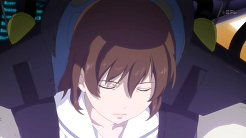
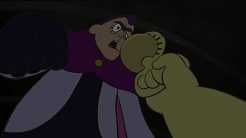
The episode starts with Porfy waking up, enjoying the most luxury he’s ever witnessed in his life. He’s already very friendly with the dogs. Maximilian is away at the moment, as he’s visiting his mother. Porfy then hears the sound of goats, and is immediately interested in them, as it was his job of taking care of the goats when he was still in Simitra. Porfy shows off his skills to Iralia’s father, but this does make him think of Mina again.

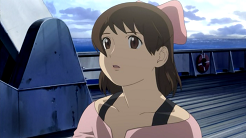
During breakfast, Maximilian suggest Porfy to stay at their place a little longer, since he and the others know a ot of people who might have seen Mina. Porfy decides to stay a little longer, and he’ll work on the farm as a means of thanks. That afternoon, Iralia goes to the city to shop, and Porfy goes along with her. They stop by the castle of the previous episode to look at the great view from there, and Iralia notes that her parents proposed at that place. Porfy then asks whether she’s going to propose to Maximilian as well, though she bluntly says that she’ll never marry him.

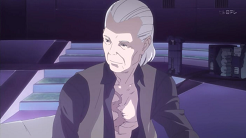
Then, near the mansion of the previous episode, the car breaks down. Porfy can fix it, but he doesn’t have his tools. He suggests to check at the mansion to see whether they’ve got a driver, but Iralia yet again bluntly refuses, and runs back home to get help. Porfy then realizes that he also needs a spanner, so he does go inside the mansion. The woman who lives there has apparently been spying on the two of them, because she locks Porfy up inside an old room because she suspect that he may have been planning against her with Iralia.

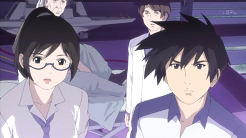
Porfy escaps through a well-hidden window, and then finds out that this woman used to be really close to Iralia. He tries to tell her to become friends again, though she yells at him to leave, and take the tools he needs. When Iralia gets back, she indeed reveals how the woman hated her for taking away the one she loved, and ever since they’ve both been avoiding each other. It’s because of this that Iralia refuses to marry Maximilian.

Maxmilian had no idea of this, and the episode ends as Porfy forces him and Iralia to go back and make up. I’m interested, because after the abandoned city, I know that not everything in this series is as it looks, especially if it needs a cliff-hanger.

Nijuu Mensou no Musume – 08


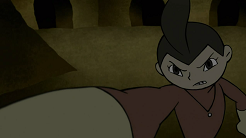
Boy, how well this series turned out. To think that even at episode eight, Chiko still hasn’t grown up to the version of her we keep seeing in the OP. Every part of this series suggests that the creators are continuously building up, and this building up is already starting to pay off.

The robot turns out to be a humanoid weapon, thereby introducing a supernatural element in this series rather forcefully. If I understood correctly, then the country Chiko lives in (I assume Japan) tried to develop humanoid weapons, though they were never able to be used in the war, because it ended before this technology could be perfected. The woman and robot we saw in the previous episode turn out to be the leftovers from this research: they’ve got superhuman powers but at the same time they seem to be suffering. I’m not sure what kind of torture their bodies go through.

But such a huge and lumpy robot was of course a perfect opponent for Chiko to handle on her own, since she herself was small and light. It forced her to take advantage of this. At one point, the animation style also changed completely, in a really messy kind. It’s interesting to consider how this isn’t the first anime to use this technique, and the fact that they’re used for major fight scenes (take for example the last episode of Macross Frontier, or the final episodes of Shion no Ou). But I do want to urge the creators to be consistent with this style, and not just have one such scene in the entire series. The reason why this worked so well in Shion no Ou was because the animation was building up for it.

Chiko’s future side-kick also surprised me. She’s further away from the spoiled brat than I imagined. As it turns out, she’s incredibly rich, and has to live with the future prospect of marrying at her eighteenth and living a boring life without having to do anything. As she’s really tomboyish, she seems to have convinced herself to live her life to the fullest while she still can, and so she came to overglorify anything that resembles cool adventures. Now I also understand why she’ll easily make friends with Chiko.

DNA² Review – 81/100


There aren’t many shounen romantic comedies that I’ve actually liked. Most of them end up dull, stereotypical, clichéd, uninspired, too much focused on moe, et cetera, et cetera. Though once in a while, one comes along that’s actually worth it. Examples of this are Magikano, Umisho and of course Mahou Tsukai Tai. Thankfully, DNA² managed to join this list.

Really, how often do you run into a harem where it’s at least made plausible that every single female falls in love with the loser male lead. Him being shot by a bullet that turns him into a mega-playboy may sound a bit far-fetched, but it works surprisingly well in this series. It makes sure for a couple of hilarious situations, and the love-triangles that emerge from it are actually worth it. There are no fillers, and the creators know exactly how to use their time and keep things interesting, with a plot that continues to get pushed forward.

Unfortunately, there’s a rather large downside to DNA²… The comedy is hilarious, the romance is rock-solid, but the action downright sucks. These action-scenes have a nasty tendency of getting in the way of what’s really important in this series, and the characters turn into super-saiyan wannabes with way too exaggerated power-ups. This anime especially falls flat on its face during the OVA that concludes this series. The comedy is entirely taken out, in favour of a more epic plot, but at the same time it also degrades into a boring cheese-fest, and the actual climax is downright disastrous. I could have tried to sugar-coat this, but you know when the creators are having a bad day when they’re reaching out to use the power of love as a plot device.

Nevertheless, DNA² is among the better shounen romantic comedies. Especially the first half is really worth watching, and many of its current counterparts can learn a lot from this series, for example comedic timing, proper build-up, the avoidance of stereotypes and a bit of wit.

Amatsuki – 10


I remember noting somewhere how an average episode of Real Drive feels like it’s much shorter than it actually is. The opposite is the case with Amatsuki. Seriously, I can hardly believe that this episode was just twenty minutes long. I could have sworn that this episode was much longer. I think this has to do with the fact that Amatsuki never gives its audience a time to catch a breath. When it’s done with one scene, it immediately thunders onto the next one without any signs of taking a break. And I think that that’s one of the reasons why this series turned out so awesome.

I must be crazy to follow such a series that spends so much time on its dialogues raw, but this episode was so worth it. The banter between Toki and Kuchiha is getting more hilarious with every episode, and the characters keep being a delight to watch, even though most of the dialogues get lost on me.

So, what I picked up:
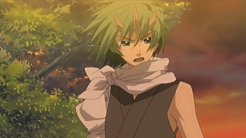
– The guy that was introduced in the previous episode turns out to be someone who an provide more information about the four gods in this world (or however Bonten, the princess, Teiten and the other one are called).
– In the end, this guy and Tsuruuno go to one place, while Toki and Kuchiha go to another place that could possibly be invested with Ayakashi. I’m assuming that they too are after the fox demon
– Bonten is meanwhile trying to figure out what happened to Tsuyukusa, as it seems that he’s got interest in the fox demon as well. The guy we saw him with in the last episode could know something about his whereabouts.
– In the end, Heihachi doesn’t turn out to be dead, just heavy beaten up. This series is very sneaky: for three episodes, it’s been suggesting this guy’s death: in this episode too, Bonten draws some kind of life-spirit out of him, and we can only guess what’s going to happen next.

Still, with this episode, I know for sure: my top-3 for this season consists out of Kaiba, Himitsu and Amatsuki. All three have a unique sense of storytelling and presentation that make them absolutely worth watching. But still, I need to remind myself to watch this episode subbed when it comes out.

Macross Frontier – 10


Definitely the best episode of Macross Frontier yet! While from the outside, this looked like a series with a huge story, the huge focus of Macross Frontier does remain its cast of characters, and of course this needs a bit of time to warm up. When such a character-focused series starts, you’ll also never know whether the creators will handle the character-development well, or fail to develop the series properly. It’s always a hit or miss with these kinds of series, but it seems like Macross Frontier is heading towards the hit.
Most episodes so far have been either mostly serious or mostly silly, but this is I think the first time that an attempt is made at a combination of both. The result works out really well. I think I’ve accepted by now that realism isn’t the strongest point of focus for this series, so the way Ranka eventually became famous is actually really well done. She saw her chance to play in a movie with some big names on it and grabbed it, cheered on by Alto who ended up playing the male lead due to his fame as a certain princess.

I do want to note, though, that the animation for this series is becoming a bit disappointing, considering its budget. And I don’t mean that this series doesn’t look gorgeous: the art is really pretty, but I keep having trouble taking screenshots, simply because the characters’ faces keep ending up distorted. Especially Ranka and Alto are guilty of this. Having a huge budget is okay, but that does not mean that the drawings are allowed to get sloppy. That’s the difference between the huge budget of Macross Frontier and Seirei no Moribito: Seirei no Moribito focused on solidness, while Macross Frontier is more aiming at creating a spectacle.

xxxHolic – 34


After the previous episode destroyed my suspense of disbelief, I just have to wonder why Watanuki never thought about contacting some kind of child welfare agency. The media were also portrayed as a bunch of idiots who blatantly use their own opinion. Thankfully though, this episode was much better than the previous one, and after the introduction it focused more on the relationship between Kohane and her mother than it was about “feel sorry for this little girl!!”

Overall, it was a nice conclusion, even though I’d have liked to see a bit more about how Kohane and her mother changed, but I guess that that’s left up to the viewer’s imagination. What especially caught my attention was how strong Kohane actually was, and how easily Watanuki seemed to think that he could just take care of Kohane for the rest of her childhood.

Still, this has been the weakest arc of the second season of xxxHolic, unfortunately. I still can’t quite figure out the point it was trying to make. It never really introduced new stuff, nor was it as thought-provoking or fun as the other episodes of this series. Let’s hope that Himawari’s arc won’t disappoint, after all the hype it’s gotten.

Edit: I’ve read now that manga-readers are angry at this arc, because the creators completely changed it. I must say that the parts that were changed were ironically not the ones that disappointed me in this story, and in a way, it makes sense to portray Kohane as a strong girl, who just needed the courage to stand up to her mother, instead of making her go to Yuuko and just ask for help.

Kurenai – 10


As this episode was mostly boring, I’m going to hijack most of this post for something completely different that caught my attention. I stumbled upon this post, referring to this piece of art, that rants against the lack of shading in the anime of the 21st century.

Ironically, it’s done by the same guy who posted those documentaries on fansubs. This means that there indeed is a lot of one-sided bias against today’s anime. The guy’s very selective about his examples: most of the images from the eighties are from OVAs, while the recent images are all from TV-series. Of course these have a bigger budget. There are enough anime from the eighties with cheap animation as well (Gundam, anyone?). The guy obviously is a narcissistic elitist, but I admit that he does have a point.

The fact remains that the shading in recent anime is usually minimal. I never really paid attention to it, but very rarely do I see a second shade-colour, let alone a third. I’m not going to deny that Hyper Future Vision looked absolutely gorgeous, with its distinctive art style, and it’s such a shame that today, so little anime try to experiment with shading a bit.

Of course, not every series needs shading. Porfy and Kaiba hardly have any shading at all, and yet they’re among the most visually pleasing series to currently air. But the fact does remain that creators could play so much with different kinds of shading, and you hardly see anything of it.

Nowadays, the trend seems to be incredibly detailed background art if you want to show off your budget. It would be interesting to see series break away from this trend, in order to focus more on different kinds of shading. There are of course exceptions here and there, but I do agree that things could be more varied, though I think I’m going to pay more attention to this in the future.

But indeed, there are enough exceptions and Otaking seems too stuck up to notice this. If he happens to read this entry through some strange reason, then I advice him to check out Shion no Ou. Obviously, the show had a small budget, but it’s the perfect example of a show that really tries to play with its own art style, and the best shots are absolutely gorgeous, with intricate shading, creative poses. It’s the perfect example of a visual feast that tries to think outside the box.

Anyway, a bit more about this episode of Kurenai: I guess my expectations worked against me for this time. For this series, I expected an action-packed finale, just like the first episode suggested. What we get is a Shinkurou who needs an entire episode to figure out that he wants to save Murasaki, wasting precious time for this series. This is especially aggravating since a similar series, Crystal Blaze, is about to finish with a huge finale that keeps building up speed, while Kurenai seems to slow down more and more as it goes on.

Himitsu ~The Revelation~ – 09


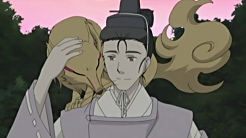
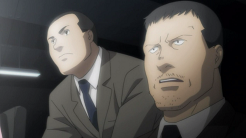
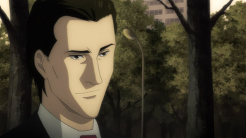
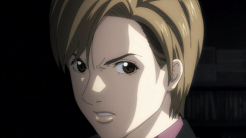
A few episodes ago, I remember noting how I’d like to see the focus of this series go away from Aoki a bit, because the other characters hardly got any attention because of him. It seems like the creators answered my prayers or something, because that’s exactly what the past two episodes have done. While the previous episode was a bit*cough* extreme, this episode gives interesting insight into Nanako, how her parents divorced when she was young, and she grew up without her father.

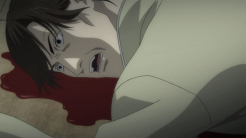
This episode deals with a serial-killer, who in the end turned out to be a regular salary man who killed off his victims in order to vent his frustrations about his job. The interesting part was his wife, though. We all see this case through the eyes of one of his victims, which turns out to be the father of said wife. He divorced his wife a few decades ago, and he didn’t see his daughter ever since, but when he learned that she got married, he wondered whether she married the right guy, so he went to investigate, and found blood-drenched coats in the guy’s garbage. He couldn’t face his daughter, so in the end he tried to calm down her husband, which got him stabbed in the back.

Nanako thinks that she understands the feelings of the daughter, but instead the daughter starts yelling at her, asking her to leave. It’s not like she forgot about her father, but rather she wanted to forget about him, while Nanako has never attempted to forget the loneliness of missing her father.

RD Sennou Chousashitsu – 09


Whoa, such a difference from the previous episodes. This episode takes all the focus away from Minamo, Haru and Holon, and instead focuses on Souta and especially his father. As it turns out, he’s a businessman, and he’s the chief of the unit that keeps the metal up and running. Perhaps this was already revealed in a previous episode, but I’m having enough trouble understanding this series as it is, and this episode was particularly dialogue-heavy.

Having said that, though, this episode was really good. It’s a bit like a social commentary, and how much people have become dependant of the metal. In this episode, it only goes down for a few minutes, and it’s already featured in the news, and the responsible one (Souta’s father) has been demoted. Again, it makes sense: today, more and more people become dependant on the internet.

So, if I understood things correctly: everything started with that red phenomenon, we saw in episode one. Kushima then probably oversaw the creation of the metal, based on that red phenomenon. I think that that’s where the whole issue of cyber-diving comes from, as it’s starting to look like the metal is an extension of the ocean, like how in this episode, a virus managed to reach the main database through the ocean.

Souta’s relationship with his father was a breath of fresh air in terms of having parents who are very busy with their jobs. Anime usually make a very big deal out of this, but Real Drive handled it subtly. Of course, when he was young, and his mother left to Australia to raise Minamo with her own mother, he was left all alone, and of course he felt sad, but over time, he began to accept the fact that his father is a busy man, and instead he decided to help him whenever he could. Quite a change from Production IG’s previous major anime: Ghost Hound, where Masayuki and his family totally grew away from each other.

I’m really surprised at how little hate there is in this series. So far, the only real evil intentions came from Kushima’s boss (who Souta turns out to be sleeping with O.o) and the hackers from episode four. And yet none of them feel like real villains, like you usually see in anime. Usually, anime add in a little grudge here and there, to spice things up a bit, but in Real Drive, most of the conflict comes from people’s own interpretations to how they should live.

I’m really loving this series more and more, simply because it’s one of these series that attempts to do something new and innovative. It’s series like this one that keep pushing anime further, instead of repeating the same harem over and over. Seriously, what is so great about watching ten different series in which a guy gets surrounded by five or six different girls with different distinctive personalities/stereotypes? I can understand why you want to watch such a series once or twice, but what’s the merit of watching virtually the same thing ten or more times after each other? What seems to be that hidden charm of series as To Love-ru and Kanokon that I can’t seem to understand, aside from the obvious fanservice? Is this the “anime as escapism” that people seem to be talking about lately?

Crystal Blaze – 09


Awesome episode! Only now I realize how similar this series is to Kurenai: we have Shinkurou taking care of Murasaki versus Shu, taking care of Sara. Manami and Ayaka are comparable to Shinkurou’s two neighbours, while Poririn and the tech-guy whose name I forgot are similar to Benika. In Kurenai, the bad guy is a family, obsessed over their own bloodline, while Crystal Blaze has a crazy scientist who’s obsessed over his own research. Both evil parties also have well-trained goons and spend the first 8 episodes, trying to track down the good party.

The big difference is that Crystal Blaze puts a lot of emphasis on storytelling, while the big focus of Kurenai is the dialogue. As a result, Crystal Blaze has a plot that continues to develop with lots of interesting twists and turns, and Kurenai is at its best when characters are just talking to each other. If I had to be honest, then I’d say that I like Crystal Blaze better, but that’s mostly because of how well it handled the beginning of its finale, when compared to Kurenai. I didn’t pay much attention to it when I watched the latest episode of Kurenai, but the fact remains that Kurenai’s wish to go back to his home one more time, even though they were discovered was stupid, while in the case of Crystal Blaze it was only a matter of time before they were found, plus Shu and the others couldn’t move anywhere because Sophia was turning into glass.

And I must say, that Sophia’s death was really built up well, and it turned out really touching. The second episode then wasted no time to give us a small gunfight, and I must say that it was quite an interesting idea to fool the enemy’s night-vision by turning up the heat to body-temperature. I’m not sure whether this actually works in real life as well, but it’s an interesting idea. On top of that, Akira’s gotten shot in his shoulder. With only three episodes left, I’m really curious to see where this one is planning to end.