And so, 2013 has nearly ended. It was an interesting year, in which a lot changed. The way I look at this blog has changed, and at the same time I have been making less posts. I just couldn’t keep up with 12 posts a week anymore, however I still have my passion for anime, especially the good ones.
Having said that though, 2013 is the worst year for anime since the past decade, and I’m afraid that I need to say this. The big problem lied in the amount of series that aired. Every season had its gems, however when you look beyond these gems, that’s where the problems lied: everything just looked the same, and there were lots of series that had potential, only to get bogged down by bad writing. This is the year I really realized that the way in which most anime are written is inherently flawed, with too few writers working on too many projects and people not really thinking about making anime whole conclusive stories that stay consistent. I’ve seen so many promising series this year that only ended up meh, when they could have been so much better, so it’s really a shame to see this.
As for the good stuff though, there thankfully were quite a few series that did catch my attention. Here are my highlights. Unfortunately Hajime no Ippo and White Album are not included because I’m really behind with them at this point.
Worst Series


Amnesia
There really were some stinkers this year that at first sight looked like they had potential. As much as I’d like to hand this award to Valvrave for pulling the rape-card from out of bloody nowhere, it had nothing on Amnesia. At first sight this looked to be an interesting mystery-series, however every single character save for one in the series was a total prick. The worst was the stalker one with the cage. I mean, did nobody on the production team stop to think “wait, this is completely stupid”?
Worst First Episode


Walkure Romanze
Oh god, there really was a lot of bad stuff this year, though most of the ones fell into the category of “so generic that they’re bad”. On top of that there also was the usual terrible incest, as well as the many, many shows that were simply thinly veiled fanservice. It was hard to just pick one that stood out, however I have to go with Wankure Romanze. It’s really here where the creators just gave up completely trying, treating their audience like a herd of lobotomised sheep. This episode really screamed “just whatever, I dunno. Have a horse that eats panties or something so we’ll at least get some viewership. I don’t care”.
Biggest disappointment


Yozakura Quartet – Hana no Uta
Despite being a big fan of the director and the OVA, I really don’t think that I’m going to be able to finish this series. Why? Because the story is just random fluff. Okay, I guess stuff happens aside from its horrible fourth episode and all, but when I really ask myself whether that’s interesting to watch for a full season… I have to answer no. Even though the animation is just completely fantastic… the rest just wasn’t.
Most Pleasant Surprise


Ore no Nounai Sentakushi ga, Gakuen Lovecome o Zenryoku de Jama Shiteiru
I was ready to immediately write this series off as the umpth light novel adaptation with a ridiculously long title and having it be nothing more than a glorified boob parade. And then the first episode aired, and it was actually the best thing that the creators could have done with such a horrible premise. The creators made this actually a really funny parody, and they kept it up for about seven episodes. I really did not expect that.
Funniest series


Yondemasuyo, Azazel-San
Oh, Azazel-san. You sure gave me quite some headaches this year. On one hand, you made me laugh harder than any other series this season, but on the other you had these completely tasteless episodes that tried way too hard to go for laughs with their shock value. Every episode we would hope that we’d strike gold, instead of literally poop. However, when you hit, you hit hard. The characters at their best are absolutely hysterical with their brand of sadistic humour and energy that very, very few series can match, and you had me nearly fall of my chair on multiple occasions.
Best Animation Studio


Production IG
This year, I was torn between Madhouse and Production IG. They really rose to high standards this year with many great series. The reason why I handed it to Production IG though, was because Madhouse has been too much into its own franchises: as amazing as Chihayafuru’s second season was, it was a sequel. Hajime no Ippo is great, however, it already has so many episodes. Hunter X Hunter too has been going on for ages: they played it way too safe. Production IG meanwhile went all out with Psycho Pass and Shingeki no Kyojin, they did something really bold with Kick Heart. Sure, they had their sequels, but they had a balance between old stuff and new stuff, which I didn’t notice that well in Madhouse’s case.
Most Promising Studio


Wit Studio
Every year I also hand out an award to a studio that’s either really new, or made a huge improvement over the past. With this year, it’s obvious that it would be Wit Studio, the subsidiary of Production IG. Next season they’re out on their own, and if Shingeki no Kyojin is any indication, then there is a lot of talent hiding amongst them, and I hope that they can follow Bee-Train’s example and become a good standalone studio in the future!
Best Action


Jojo’s Bizarre Adventure
It took the award last year, it also takes it this year. Jojo is just so wonderfully over the top and every episode was just loads of fun to watch. It really was everything that the shounen genre should be, and I can understand why it got so popular. However, it did have much more competition this year. Kill La Kill is a huge contender for next year’s award with the way that it’s going, and Shingeki no Kyojin also was really exciting to watch, from start to finish. I really had trouble with the award this year, as opposed to last year.
Best Horror


Aku no Hana
Pure psychological horror, but oh my god, this show was so effective in drawing me into its atmosphere. There was hardly any point at which I wasn’t at the edge of my seat, and that’s what I consider an amazing horror-series.
Best Background Art


Shingeki no Kyojin
This year, I want to give props to the incredible amount of polish that the creators put into the backgrounds of Attack on Titan. They really created a medieval-ish city and the amount of detail that went into it is astounding, and it looks consistently crisp. The creators obviously spent a lot of money on it, and it did pay off.
Best Animation


Yozakura Quartet – Hana no Uta
There were lots of really well animated series this season, a few too many, if you ask me personally, however Yozakura Quartet to me was the best, because of its focus on kinetic energy that was very visible in its movements. Its animation wasn’t just a bunch of money shots, the creators really cared about natural movements and interesting poses, they really wanted to create movement, and they did that better than any other series this season. It’s just a shame that the animation was the only thing noteworthy about this show.
Best-Looking Series


Kyousogiga
This award goes to the series that just looks incredibly good, regardless of animation. The artistic direction here is important, and Kyousogiga had that, and much, much more. For 10 episodes there were hardly any weak moments in the animation, and everything just looked gorgeous. Close seconds are Chihayafuru and From the New World, not to mention the trippy Jojo’s Bizarre Adventure and the gritty Aku no Hana (I don’t care: I loved how Aku no Hana looked, with its own unique and distinct style; so what if it wasn’t crisp).
Top 20 of 2013
#20: Teekyu


Wildcard: Teekyu is just something to sit behind, turn your brain off and enjoy the spectacle. Nothing special, but damn entertaining to see all of the things that the creators can throw to the screen in the span of only two minutes per episode.
#19: Yahari Ore no Seishun Love Comedy wa Machigatteiru


Light novel adaptations with really long titles had previously been notorious for being bad, lazy and incredibly contrived for fanservice. This year, there were two series that broke that trend. Noucome (resting at place 21 due to its rather bad ending), and Yahari Blahblah. This series starts off with the generic ingredients, but I don’t know. Along the way something happened that set itself apart from its contemporaries. The dialogue, it was actually cleverly written. It actually takes a deep look at its characters, and creates some thought-provoking drama out of that, rather than going with the usual cheese. The characters in this series all look like completely generic stereotypes, and yet they aren’t. This series could have tried even more though, and there are some stories that are a bit lacklustre compared to the others, placing this relatively low at this list.
#18: Yondemasuyo, Azazel-San


Yondemasuyo, Azazel-San’s sequel contained both the best, and the worst episodes of the season so far. The Moloch-episodes were obviously awesome, but a few other arcs were also comedic gold. And then there was the haemorrhoid arc. What on earth were the creators thinking? It’s a series with huge ups and downs, but its own brand of incredibly vile and sadistic comedy somehow worked for me.
#17: Kamisama no Inai Nichiyoubi


Kamisama no Inai Nichiyoubi is nothing really fancy, however it did create its own fascinating setting that it rolled with for thirteen episodes,. It did have a tendency to suddenly pull twists from out of absolutely nowhere, but it barely avoided those becoming Deus ex Machina, and it consistently asks questions about life and death with its strange portrayal of the undead. It could have been much more because the series just ends after a random arc has been resolved, however, the characters all made it very worth watching.
#16: Uchuu Kyoudai


Last year, I made the prediction that for 2013, this series again would have been a great contender for the number one spot, however, something happened along the way. The series remained a wonderful look at what it means to become an astronaut, it still was fascinating. The problem however, was the pacing. Things started to take forever to get going, and every episode on top of that started with like two minutes of recap. The creators were simply coasting on the manga to carry them through, and you couldn’t see the passion of the first fifty episodes any more. The creators made the mistake of going on for way too long, lessening the experience. It’s such a pity, because this series really stood out: it had characters in their thirties for once, and the synergy between them is just amazing. However you also need to learn to not overstay your welcome.
#15: Gatchaman Crowds


Anime is a great storytelling medium, but usually they really aren’t up to date with current events. Some shows nowadays still feature the Tokyo Tower as the highest building in Tokyo, for example. Gatchaman Crowds however, is about social media. It’s very clunky, but it portrays a setting in which saving the world is crowd-sourced: through the internet everyone contributes with stuff like saving the day and protecting the earth from aliens, and from that base setting it creates its storyline. The characters aren’t the most relatable, however they serve the purpose of exploring this setting. The pacing is ridiculously fast, but in the end they pulled it off with also quite a great ending to close off with.
#14: Samurai Flamenco


Samurai Flamenco, I’ll put you at number 14 for now. This can become much higher, or much lower next year. The series started off really well with a sortof realistic view on this idiot who wanted to play a superhero. And then episode seven happened, and it was awesome, but afterwards it just kept getting more and more ridiculous, to the point where we are now just watching a completely different series. It’s really a bizarre series and at this point it really could go anywhere. I do have to give props for having the balls to actually try what it did though.
#13: Silver Spoon


Silver Spoon: a meticulously planned out look at what farming life is. It has lovable characters, it’s fun to watch, but at the same time it also doesn’t shy away from the realities of farming: that animals are killed in the process, in order to make a living. It shows both sides of the picture, and never really leaves a moment or episode wasted, and it’s filled with interesting trivia. Not to mention that it made me hungry on a regular basis.
#12: Uchoten Kazoku


Uchoten Kazoku is a look at Japanese folklore,in a modern coat. It tells about tanuki and crows, and how they can transform into stuff, and it contains all sorts of obscure cultural references surrounding their legends. It really taught me quite a few new things through its airtime, and that’s always a plus. The best thing about this series is its dialogue: cleverly written and it manages to develop the characters in a unique and engaging way. It does lose a bit of steam near the end, but it remains witty and unpredictable.
#11: Kill La Kill
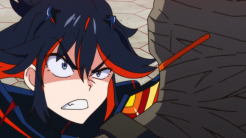

Kill La Kill’s storyline is nothing special, however it manages to present itself in such a way that it doesn’t become boring. Its formulaic, but never formulaic enough to get tedious, the characters are simple, but not one-dimensional enough to get boring. It’s all carefully planned out for the action to just keep you entertained from beginning to end. Hiroyuki Imaishi is a great director, and you can see Studio Trigger having a ton of fun making the most over the top action sequences that are all still very varied and interesting to watch. Not to mention that soundtrack. That really makes the series even more exciting.
#10: Hunter X Hunter


My stance on the series remains: I did not like sitting through a year and a half of material that I had already seen. I’m sorry, but that was really tedious, even though the Greed Island was much better than the Nippon Animation version. Finally though, the Chimera Ant arc stepped into new material. At this point I’m really behind, however even though the arc took incredibly long to build up, I just reached the point at which it really started to deliver. Finally I can appreciate this series for the very intelligent shounen series that it was meant to be, and it indeed blows generic stuff like Naruto and Bleach completely out of the water.
#9: Rozen Maiden


The third season of Rozen Maiden, but really: this new instalment is completely different from the previous two TV-series. It’s written perfectly over its airtime, starting off small and ending big. The first half really mostly just takes place in one room, with most of the characters absent, being dedicated to some really personal character-development for the ones who did get the focus. It pushed all of its characters to a different direction, and definitely was a worthy addition to the Rozen Maiden franchise.
#8: Zetsuen no Tempest


Tempest’s second half perhaps was a bit less sharp than its first half, but it still was just complete gold in terms of its script, and how it played with its storyline to throw all kinds of logic-based holes and loops. This really was a great example of a world-shattering conflict being solved by logic, with force playing just the role of assistant. The characters also got through their own share of development that this series also cleverly made use of and all of that resulted into an incredibly fun watch. The biggest reason why this one ended up slightly behind the others is its slightly lackluster ending.
#7: Shingeki no Kyojin


All series from #8 are incredibly close to each other. They all were amazing to watch. The reason why Shingeki no Kyojin lost out was because of its inconclusive ending: no resolution whatsoever, leading to one heck of a cliff-hanger. Up to that point we got to witness an amazingly tense action-series that really managed to convince that yes, humanity is completely screwed. This series is incredibly good at putting humanity at the brink of destruction, and keeping the stakes just inches away from everything going to hell. This is fantastic for its atmosphere, and on top of that, it was easily the series with the best production values of the entire year: everything looked incredibly polished, and where these series usually skimp on the substance, this series had plenty of it. This is an action-series with brains.
#6: Psycho Pass


Psycho Pass, intelligent science fiction from Urobuchi Gen, and the second half really delivered, whereas the series that aired alongside it, Robotics;Notes, pretty much crashed and burned. What managed to keep it afloat was that it always knew where it was going, and it kept asking poignant questions about its setting and it actually continued to push its storyline forward in creative ways. The characters came to their rights, the animation was still solid, and everything concluded really well, so I was really pleased with this series.
#5: Jojo’s Bizarre Adventure


This series became something really amazing, putting most other shounen completely to shame with how much manly action the creators managed to put on the screen. It’s definitely not for everyone, and the excessive use of colours will disturb some, however I loved just how over the top this show got. There were so many moments that were just pure gold, and the creators really knew how to capture the essence of the manga, which delivered its action with completely ridiculous poses and massive amounts of manliness, while still keeping a straight face. The training arcs were really kept to a minimum, and the fights themselves all tried to be as creative as possible, both by making great use of the environment every fight was in, and some very creative powers. This really was my weekly fix of adrenaline, done incredibly well.
#4: Chihayafuru


After Shingeki no Kyojin, the second most polished series of the year. A show about Karuta, every single match looked crisp. Every single swipe made impact. The creators still managed to keep this up for in total 52 episodes. The most amazing thing about this series however, was its character development. Most series just pick one character to develop per episode. Oh no, not this series.. Every single episode developed as many characters as it possibly could a little. This means that hard-hitting development could really come out of absolutely nowhere. It’s only a shame that we still haven’t reached the ending, and we need to wait for a potential third season for everything to be resolved. And it already was a miracle that we got a second season.
#3: Aku no Hana

Aku no Hana is unlike any other anime ever made. The animation is completely rotoscoped, leading to continuous movements, that all are jerky, and amazing characters that say “screw it!” to every single convention. The pacing is incredibly slow, but it’s deliberately so: it’s entirely made to draw its audience into its atmosphere, and some of the best moments of the series are actually when little happens and you only can watch the eerie moments happening. It’s an amazing look at the darker sides of being a teenager, and the creators did an absolutely fantastic job of capturing the paranoia inside the main character. But yeah, they did choose to do it in a style that will turn off plenty of people. But that makes it even better: a series actually had the balls to be completely different in every single way from all other anime. That deserves to be commended.
#2: Kyousogiga

Kyousogiga is just a series that did everything right for me. It’s a whimsical story, inside its complete own world with its own set of rules, heavily infused in Buddhist and Shinto themes, and it got itself some consistently incredible animation with hardly any weak points. There is always something interesting going on on the screen and the characters are more expressive than any other series this year. Its storytelling is meant to be vague: you can see lots of unsaid stuff inbetween the lines and every single episode is different. It’s incredibly fun for all ages, and the conflict and resolution are finally something different than what we’re used to, due to the lack of villains. It’s one of those series in which all of its different parts come together wonderfully in every single episode: the animation, the music, the story, the characters, the themes. Everything fits perfectly.
#1: From the New World


For 2013, it was really difficult to choose my number one pick. Numbers 1, 2 and 3 were all incredible series that I enjoyed immensely, despite the lacklustre nature of the rest of the year. The reason Shin Sekai Yori, or From the New World, is my number one pick though, is because it had one of the best endings I have ever seen. I’m not sure if it’s in my top 5 favorite endings, but definitely my in my top 10. The series already was really good, with how it portrayed its characters its incredibly mature style of storytelling, and how it just did not shy away from anything (there really was some shocking material here that nearly broke my heart). It was incredibly intelligent in how it presented itself, even though some of its characters were quite naïve, and it used its animation brilliantly to create a consistently creepy atmosphere. It’s hard to watch because it’s completely different from traditional animation, and the camera often made things difficult to make out, but to people whose alley it was up at, it rewarded with an incredible finale. 2013 may have been the worst year in terms of anime in more than a decade, however these series still showed me that there are some very passionate, inspired and special people working in the industry. And ehre is to hoping that they will show more of themselves in 2014 and the years to come. I wish all of you a very happy new year, and I’ll see you in 2014.


