Classroom of the Elite – 07 [Nothing is as Dangerous as an Ignorant Friend; A Wise Enemy is to be Preferred]

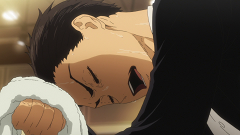
This is your usual pool episode, except that it’s not quite your usual pool episode. The pool activities and the peeping Tom operation serve as a surface for some subtler scheming, and set the conflicts from Class D to other classes into motion. I’m glad that Youkoso realizes the stupid nature of the “Operation: Peep on the Girls’ Dressing Room”. They would play up the absurdness of the operation, make it overly-dramatized with several “missions”, codenames, communicating in codes. My favorite moment has to be when Iku cries his manly tears for nearly abandoned his hope of a successful operation. If only they could give their all in academic pursuit as well. Another intentional but quite questionable approach, is the “male’s gaze” perspective that keep scanning on girls’ chests and their bikini for wayyy too long. Normally this is just an excuse for lazy fanservice but in this context, it has its merits because it fits really well to the peeping operation and their hormonal operators. This is one of the rare cases when I can argue that anime uses fan-service elements successfully, the kind of fanservice that fits to its theme and has deeper implications.

This episode also serves as a base to re-establish the tension between different classes, as in somewhat convenient fashion, all of the important figures from each class, and the student council president himself, appear all in one place – in a pool; or to be more exact, in front of the pool’s public bathrooms. The tension between Class-A and Class-C has been well hinted in previous episodes, and this time Class-D member (Sudo, of course) finds himself stuck in the middle of this whole conflict, both literally and figuratively. Horikita’s announcement in the diving board (I thought she would jump for sure) serves as the final declaration of how Class-D is willing to climb up rank, and force the others to take them seriously. At the moment Class-B has a friendly term with Class-D, but really what is Ichinose’s real motive?

But Horikita’s little event in that diving board is only in a service of distracting the other classes to save those stupid boys from getting caught, as Ayanokouji has pulled all the strings on a backstage to let the boys do what they want, but eliminate all the consequences in the process. It’s the only real reason that the anti-social Horikita decided to join them for a day in a pool after all. Amusing that this episode is the first time that we get to hear her voice over – to know her inner voice and the way she sees the world. While this girl Horikita is as dry as the Sahara Desert, it’s good to understand her inside a little bit more because unless we can identify the main cast as real people, we’d have a hard time rooting for them when conflict arises. Ultimately, this episode is exactly how a pool episode function: main characters gather around and have fun times together, splashing waters at each other (ohh, you poor thing, Sakura…) and at the end of the day, having a fond memory together as friends, something that both Horikita and Ayanokouji rarely aware of.

Fate/Apocrypha – 08[The Beginning of the War]

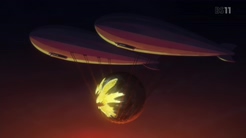
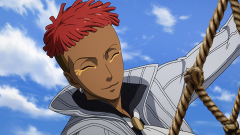
One of the particular things I like about Apocrypha is that out of the Fate franchise, this is the only Holy Grail War that is deserving of the title of War. Other grail wars are certainly flashy but by definition they are more battle royales with every man for himself. This on the other hand has armies with two sides each with their own generals. This is a genuine war and not a war in name only. Though while I say that the real deciding factor in this war is the servants with the Homunculi and Dragon tooth warriors being just pure cannon fodder. Another thing I like is that they have pretty much thrown away the whole “keep the war secret” rule which has always been a rather inconsequential rule. It has only ever been relevant in two places in the entire Fate series. One was with Shirou Emiya being a witness to the battle between Archer and Lancer in Fate/Stay Night. Remarkably the only civilian within the Fate universe to ever do so despite the kind of things that the servants get away with. The second time was when Fate/Zero’s caster summoned a monster in the river and gave the masters a reason to all gang up on him. Other than that despite servants having ridiculously flashy battles in open view, no one ever sees them and the damage is written off as gas explosions and the like. There are those assigned to cover it up but it really is silly that no one in Fuyuki manages to see any of this going on. In Apocrypha this rule is just chucked out the window because why bother with it. We got a giant flying fortress with a small war going on so screw the rules, he who dares, wins.

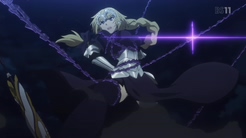
This was an alright episode of the show as we have an action packed battles between the servants. I really do love the exchanges between Chiron and Achilles, as well as Vlad and Karna but the fights themselves do feel lacking. I attribute this to a general lack of fight choreography as far too little do we see servants exchange blows. To often do we have close ups and explosions obscure the action and very little do we see servants deflect blows or land blows. We either get an exchange of laser beams or see a servant wind up an attack only to cut to after he has unleashed it. This is basically the shaky cam style of fight scenes where in exchange of good fight choreography the director just makes a series of fast paced edits which does give the impression of a intense fight sequence but often is too face paced and frantic for the viewer to follow. For me these scenes are just filler which is why I am not particularly fond of the Bourne series of movies. No matter how flashy and epic these fights appear, they cannot hold a candle to the Saber vs Lancer fight of Fate/Zero. I would even say they are inferior to the Illya Archer fight of the first Prisma Illya season.

We have our matchups, Vlad is facing off against Karna and while he has a home field advantage Karna is someone who could fight on par with GIlgamesh so there bout isn’t favorable to him. We did get a bit of backstory on Vlad but once again I am disappointed that it didn’t go into Vlad’s reason for fighting in this war. Chiron is facing off against Achilles which is a matchup made more interesting by their former relationship as master and student. Astolfo is taking on Semiramis and the hanging Gardens of Babylon in the air. Our last fight appears to be Shirou Kotomine taking on Fran in the woods after having decided to leave the garden as a kind of test of conviction. Shirou seems to be under the impression that if he can come back from the battlefield alive then this would mean that god approves of his mission and he can move forward without doubt. At the moment i can’t really think anything of Shirou as much like Sieg he’s playing a bit of an expected role. I have heard he gets more interesting later but at the moment his chemistry with his servant is dull and his general interactions just seem to speak of him having some genius master plan that no one can guess. He’s better than Sieg who I swear just kills interest just by appearing on screen. Well Mordred has landed on the scene and it looks like we are getting closer to that opening sequence we saw at the beginning of the series.

Made in Abyss – 07[The Unmovable Sovereign]

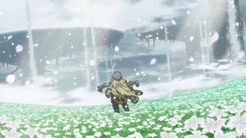
Well it’s official, Ozen is now my favorite character of this series. Big revelations today and one of the biggest is that Riko by all accounts should not be alive as the relic which protected her as a baby is revealed to have a different function. It can bring dead things back to life for a small period of time. Riko was originally a stillbirth which makes a lot of sense as her mother was diving into the abyss when she was pregnant with her. So of course the baby wouldn’t be able to handle the journey. However when Ozen threw her into the curse repealing relic she miraculously came back to life. Thus Ozen concludes that Riko was only temporarily brought back to life and that her life will end very shortly. I think Ozen is discounting something though as her experiments dealt with things long dead like a piece of meat. Riko has managed to grow up and life for quite a number of years so it’s possible that she will have a normal lifespan. Though Ozen did remark that all things brought back to life with the relic started moving towards the center of the abyss so it could very well be that if Riko reaches the bottom of the abyss that she would die.

Ozen also proves that she isn’t called unmovable as a matter of metaphor but her strength makes her quite immovable. She toed the line of becoming an antagonist but I felt during the episode that this was all some level of tough love. After all if Ozen really wanted to get rid of these kids then she would have done it before introducing them to Marluk. The fight itself did seems to be her testing them on a number of matters even if her methods were well…questionable. She tested out just how much punishment Regu could take but got too into it that she went fairly overboard. However even if his was excessively cruel she did teach them how an enemy would exploit their weaknesses. She turning Regu’s laser and pointing it at Riko definitely showed that Regu’s laser has too long a charge time and can be too easily misdirected. Ozen figured out that after firing it he would be out cold for two hours which certainly gives the laser a high price for it’s use. Ozen also showed that Regu’s arms can’t restrain everything and use them to help disarm him. So in the end this thing was her assessing their combat abilities and then deciding what training would be suitable for them.

Ozen is lot older than she looks as well as she helped mentor Riko’s mother when she was a small child. Looks like their relationship wasn’t as simple as being rivals and Ozen actually has a bit of a soft spot for her. Though she looks to have difficulty expressing it. I mean she dug up her friends grave just to verify whether there was a body inside which is rather excessive and tactless. Though with that Ozen denied her earlier claim and stated that Riko’s mother was indeed waiting for her lower in the abyss. It’s still up in the air as to whether this is a lie to give Riko motivation to continue. Ozen’s the mentor to get these kids in shape and she’s already thrown them into a kind of training I remember seeing in Full Metal Alchemist. Throwing them into the wilds and saying good luck. If I had to guess this would likely be training for for Riko than Regu as Ozen pointed out that the degree that he could protect Riko was limited so it looks like RIko is going to have to be more than the brains of the operation.

Kakegurui- 07[Refusing Woman]

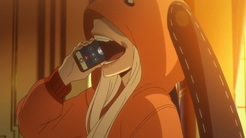
Today on Kakegurui, we see the end of the bet and well…that’s it. This post may have the same problem as my Attack on Titan posts in that I just don’t have a lot to say here because not a lot actually happened. Mary refused the student council president’s offer to join the student council and Yumeko got away from Midari’s bet unscathed. So this more or less has gone as usual besides Yumeko ending the bet in a draw instead of a win. All in order to deprive Midari of the satisfaction of losing the bet. yes unlike the other bets Midari rigged the game to lose rather than win. For she is batshit insane and only really gets a thrill out of life when in pain or agony. A masochist if you will and one insane enough to gouge her own eye out for losing a bet with the student council president. I guess we did learn a little about the president in that she doesn’t really see people as people and more as things to entertain or interest her. When inquiring to Midari about what the other side of an eyeball looks like she sort of reminded me of a messed up version Chitanda from Hyouka.

Though I don’t really find this to be fascinating as those that tend to treat themselves as some higher master race are often more ignorant than intelligent. It works as a way to get Yumeko to be the one to bring her down from her pedestal and knock this high handed attitude out of her but sadly I sincerely doubt this series will ever get to that point. As for Midari she has certainly stepped up from repulsive to absolutely vulgar. Looking over her character I can’t say she’s all that great and if she’s going to hang around then she’s going to have to need something more than her desperate masochism. Otherwise she will just be a one trick pony begging Yumeko for bets for the sake of comedy. She did accomplish one thing however and that was proving that Yumeko desires a fair bet. Yumeko doesn’t get off on a one sided bet, instead she always breaks down any cheats in order to turn a bet into an equal match. Both sides must have something to risk and seeing Midari hog all the risk for herself made her disgusted. Midari was the first antagonist to truly get Yumeko to hate her with a passion. Somewhat funny as now Midari is absolutely obsessed with her.

Katsugeki Touken Ranbu – 8 [Protect History]

This was perhaps the best week yet for Ranbu. There are no flashy fights or new enemies, but there is a lot of characterization and quiet moments. Lets jump in.

Ranbu starts this week right after the 1st Units victory of the unnamed Retrograde soldier. Honebami does some fawning over the units strength, before being told there is one more job left to do. Surprisingly they don’t mean more combat, but rather a humanitarian effort. Having completed their mission, the 1st Unit wants to help those affected by it. So they go around and buy some food, to hold a little soup kitchen sort of event. This was very unexpected, but very welcome. Our first unit, even the large scary one, has a heart. Unhappy with simply protecting the future, they decided to also protect the people. It’s purely character focused and I love it. Continuing this trend, the 2nd Unit has some character scenes as well, but none as good I fear.

We cut back to the Citadel, where Saniwa and our resident fox discuss the previous mission of the 2nd Unit. Apparently, they protected history by the thinnest of margins. Saniwa, being the terrible employer he is however, states they did more than he expected. Truly? Then why give them this job? Though this is all ok, as Kane has some ‘quality’ that makes up for all this. Once again, Saniwa is a terrible employer. During this conversation another emergency occurs, meaning our 2nd Unit is going to get another arc. Kane better get ready, because he has a job to do!

Speaking of Kane, he is having some confidence issues. We transition to him sitting by a river, contemplating their last mission. Apparently he has the same doubts I did, which is good to know. He has his doubts as to how history could possibly be saved with that fire, with all those dead. Its good that this is a reoccurring issue, rather than one off with him. As he considers this, Horikawa approaches, and the two set off. One by one they gather the members of the 2nd Unit, Kane asking them if they will fight once more with him. One by one we see the effects this loss had on the 2nd Unit, eventually reaching Tonbokiri.

There is a small scene with Mutsunokami losing his mind about being asked last, which went on for too long, but that is a minor gripe. It broke up the solemn, quiet moment, with some poor comedy, but it ends on a sweet note. Mutsunokami leaves a gift of Daifuku for Tonbokiri, his favorite food. In a much more subtle scene of sweet comedy, Tonbokiri reveals the mountain of Daifuku everyone else had left for him. It’s a good welcome back to the best character of the squad.

With the sunshine and lollipops of the gang getting back together though, the warning from Saniwa’s scene comes out. The 2nd Unit is summoned, once more into the breach! They are being sent out on another mission, running into the 1st Unit on their way out. By the 1st Units estimation, they are now prepared, but we will have to see.

All in all, a good episode. Quiet, lots of character moments, and the opening of a new arc. Disappointed we still don’t have an antagonist but I doubt we will be getting one at this point. Ranbu appears to like its villain of the week story, so let’s roll with it. So long as these character scenes continue, between the pretty combat scenes, Ranbu can end on a high note. I’m looking forward to see if that is the case.

See you next week!

Ballroom e Youkoso – 07 [Tenpei Cup]

I spent the majority of the previous review breaking down a single scene, so let’s play catch-up for a bit. This episode features the Tenpei Cup, an annual event held by some rich dance enthusiast. Despite not being an official competition, the stakes are high: if the fledgling pair of Tatara and Mako can outplace Gaju and Shizuku (who are favored to win), Gaju will be forced to take back his sister as his partner. Thankfully, Sengoku has given his full support to his new student, having supplied him with a new tailcoat and a strategy to impress the head judge during the Quickstep round. It’s a relief that Sengoku has quit trying to embarrass and discourage the impressionable Tatara, who needs all the support he can get, given his lack of self-confidence.

Regarding that timid streak, this episode didn’t bring it across as well as the last one. During his previous phone call with Mako, we got a clear picture of how unworthy Tatara felt, both as a dancer and as a young man. This time, he was a simple scaredy-cat, begging his coach not to put him back on the floor after nearly every round, then finding his groove again once the dancing started. I get that the major story of Ballroom is Tatara’s journey to find himself, but we don’t need a miniature version of that arc every six minutes. The show even commented on this practice through Sengoku, who quickly became fed up with what he described as a “rollercoaster mentality.” It’s good that the writers aren’t totally clueless, I guess, but the show’s awareness of the problem doesn’t make it any less boring to watch.

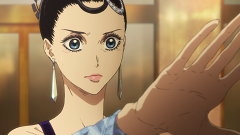
Thankfully, the episode really picked up during its second half, especially after a dance floor collision between Tatara and Gaju. We never got a definitive answer on whether Tatara purposely engineered the crash, but after he watched Gaju and Shizuku steal the show during the second round, I’m choosing to believe that he made a conscious decision to level the playing field by drawing attention to himself. The waiting room confrontation that ensued was highly dramatic, with all the yelling, punching, and crying that you expect from shounen anime. I liked almost everything about it, though. Gaju is a very believable villain, whose insensitivity and tendency to belittle others read like those of a real high schooler. When Mako hits him and runs off crying, it’s at the perfect point in the conversation. My favorite part of the scene, though, came immediately afterward.

When Shizuku sees her teary-eyed competitor flee the scene and asks what all the fuss is about, it comes out that Tatara thinks there’s a chance that Mako will surpass her. At this point, I fully expected the older girl to berate Gaju for mistreating his totemo kawaii imouto~ and run off to make sure Mako was okay, at which point we’d get a scene where the girls talk about how boys are stupid. Instead, Shizuku walks right up to Tatara, gives him an icy stare, says, “Don’t underestimate me,” snaps his bowtie, and walks away. I think I’m in love. After receiving precisely zero speaking lines in last week’s script, Shizuku was due for her moment in the spotlight, and she certainly got it here. Part of me hopes that she still checked on Mako after she was through being a badass, but the version of the argument that we got was the best possible way the scene could have played out.

The story wraps with the introduction of Marisa Hyodo, mother of Tatara’s destined rival. Before she was revealed as a guest judge for the semifinals of the Tenpei Cup, we got a car scene between Marisa and Kiyoharu, who don’t seem to be the closest of parent-child duos. As we might expect from a superstar of the dance world, she works constantly and doesn’t see much of her son, but what’s worse is that she rationalizes her absence by declaring him the type who “likes being alone.” Ballroom is full of parents and authority figures who are less supportive than they ought to be, although I suppose it wouldn’t be anime if it weren’t. When the Hyodos appear at the very end of the episode, Sengoku looks like a kid who’s been caught with his hand in the proverbial cookie jar – does he have an agreement with Marisa not to train anyone except her son, or is there some history between them that we don’t know about? Guess we’ll find out next week.

Princess Principal – 07 [Case 16 Loudly Laundry]

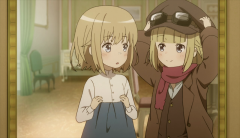
This week in Princess Principal … what exactly did I just watch? Suddenly spies do (steampunk) laundry and do business as well? Getting 231% raised in revenue and catch a thief in a process? That’s a bit of a stretch here. And who in the right mind would think it’s a good idea for a spy to step up and buy the business of a place she currently works undercover? She wants to get herself exposed of being a Princess? Phew. This episode is just as necessary to the main plot as the appendix in our body. Furthermore, it’s just dull. The only saving graces I can possibly take out from this episode are 1) their positive treatments to all the female casts: although all brought up in difficult backgrounds, girls can be good at their jobs – without men – and can control their own lives; and 2) the various precious facial reactions from Chise, and to a degree, Beatrice (geez, the moe factor eventually gets into me).

This week, the girls decide to join the laundry team in order to find the Poison Gas Jack (possibly a rip-off to Jack the Ripper), a terrorist whom they believe to be a military man. The plan is to find the uniforms that reacts to a pyridine test. Sound like a well-thought plan, right? Except that they have to go through hundreds of uniforms and there is a chance that the culprit doesn’t leave his own uniform for washing (you can always hand-wash your clothes, you know?); so guess what the show did? The spy girls bought off the place after learning about its debt and the culprit’s uniform was just accidently sent to the laundry service by some unnamed hero military men. Haizz, the more I talked about the plot the more painful I get so here’s the gist: this episode just feels sooo mundane and unrealistic at the same times and it betrays the fast, plot-driven tones Princess Principal has established so far. We don’t feel any tension regarding the actual case, we don’t feel excited because the action happens like… 10 seconds. Chise has a fair bit of interaction with the laundry leader, Marilla, but even that relationship feels half-baked at the end.

Chronologically, this is case16, which should be the second most recent (after last week’s case18) and there is a guy (the loan shark guy) that appears in both episodes. Funny that the only thing that connect him with the spies in both episodes is him being kicked in the butt by Dorothy, and Ange, respectively. Let’s see if he’d appear in later episodes but if he does, I suspect that he’d be the first one to make a connection about those girls who seem to be everywhere (he met 4 out of 5 girls already) and sell off the information to the Duke of Normandy. The part where our girls working together to repair all the steampunk laundry machines is warm that signal us that they’re all genuine people who care to help others (although why Beatrice is the only one who looks dirty?), but others than that, this episode is just unnecessary and the production isn’t that great with many off-models and the laundry girls’ designs are all uninspiring. Filler episode at its most head-scratching quality.

Re:Creators – 18 [All of Us Are Incomplete]

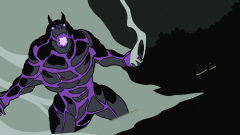
One of the major gripes I have with this series is its uneven presentation that has far too much exposition while lacking in the action department. In the eighteenth episode, it finally found its footing in balancing the exploratory themes of creativity, action scenes and comedic bits in a seamless transition as Re:Creators successfully sustain its momentum in its push towards the last few closing episodes. From Blitz’s defection to the hectic fight of Shou and the explosive entry of Charon, it did not let up in its twists nor epic moments of awesomeness. Of course, Yuuya’s creator gets the short end of the stick as his own creations decides to spoils his own flagship series in such a causal manner that is akin to Reiner’s underhanded reveal in Attack on Titan. It doesn’t stop there as even in its more fanservicey moments, it manage to say something about the nature of anime fans as Hikayu’s scandalous martial artist outfit shows how their willingness to accept ludicrous scenarios.

For once, talking with Magane doesn’t end in a reversal of causality that is detrimental for those on the receiving end. Sota, in particular, has matured quite a bit from being the otaku version of Inaho (Aldnoah.Zero) to having a backbone when conversing with the most twisted and manipulative creation of the show. Seeing him defends his dreams of becoming a creator makes him a far more likeable character than the secretive Sota of the mid-series. I’m quite curious in seeing what Sota drew in his own notebooks as it is obvious that it isn’t doodles of Altair or erotic stretches of Selesia (or it is?). In any case, the decision to release Hangaku back into Yuuya’s control and allow for Sota’s creations to translate into reality is really the surprise of episode. I doubt Magane did Sota a favour out of the goodness of her heart given her history of being a murderous troll. This moment of graciousness doesn’t redeem her lies and bloodshed in the slightest, but it does show the other side of the coin that is the fun-obsessed Magane.

With four episodes to go, it comes as no surprise that we have not reached the climax of Re:Creators just yet despite everything being literally lined up for Altair’s defeat. There is simply far too much time left in the series for that to happen and Charon still need to have his time in the spotlight. I find it perplexing that the three defecting creations didn’t bother to even inform the government forces of Charon and his massive robot. While Charon does have that menacing looking mech adorned in black and red accents, the combined arms of the other creations should be more than enough to bring down Altair and a Vogelchevalier clone. As one person on the internet once said, “one super fighting robot isn’t gonna make a difference”.  

Extra points for those who can figure who said that last line.

18if – 07 [And now There are none…]

This episode is one of the reason why I am glad that I’m still putting my faith on 18if, an episode that displays a complete different range of visual style, and a satisfying children’s story about friendship as a cherry on top. There’s a lot to love here, from the beautiful aesthetic that heavily influenced by the European stop-motion-like (it’s still hand-drawn though) animation, to the tale that inspired by children fairytale with more mature, political undertones and the song “And there were none” at the end nearly take my breath away. This freedom of creating wide range of visual-storytelling based on each directors’ own visions is 18if’s most appealing factor, and episode 7 is when that freedom works totally for the show’s benefits. This comes as no surprise that the director handling 18if this week is veteran Kouichi Chigita, a director who responsible for Last Exile; Brave Story and Full Metal Panic. Apart from a bit of obvious, shaky CG opening, the rest of the episode moves with ease with the stunning visual that pays homage to many other Western animations, but nonetheless is original enough to stand on its own.

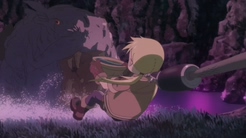
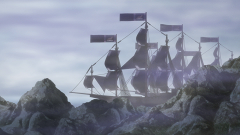
I’m not attempting to discuss about the actual plot of this beautiful episode (ala what all this means in the real life), as I believe the dreamy story we witnessed makes sense enough that trying to dig deeper into the plot kinda do its story a huge disservice. Instead, I will delve into the literacy inspirations this episode makes references from. The most obvious comparison would be The Little Prince, both because of those similar styles, but also they share the same kind of fairytale story and the same mature feeling those two manage to pull. Well, the main character, Pol, is a prince if there’s any more doubt. The character designs are decidedly simple that are reminiscent of stop-motion puppets and a fair bit remind me of Pixar’s characters of all things. The art designs are another highlight as 18if produces an enormous amount of standout backgrounds, from the peaceful forest, to the doomed city life to the creative kingdom designs. At one time the show reminds me greatly of Samurai Jack as you can see in one of the screenshots, and at other time the character designs, especially those who manipulated Pol, take a nod towards those villains in the Triplets of Belleville and our mains this week are another nod to the characters from the Wizard of Oz. Like I said, while this episode has huge inspirations, never at once I feel it as a rip-off, because those influences are in service of deepening its narrative and manage to bring the emotions across.

Then, the characters of Pol and Pot are heavily implied as a reference to Polpot, the infamous Khmer dictator and the Khmer Rouge and the even more infamous The Killing Fields. The way Pol eventually abandons his friendship, becomes heartless in the process and rules the Kingdom of massacre of innocent people, people died from hunger, totalitarian rules and the way he was just a puppet figure head all have very dark political undertones pointed towards that dark period of Cambodia. It’s also implied that Pot, his best friend, is executed for the crime of “treason”, the same crimes that the Khmer Rouge would use to kill intellectual people (more commonly known as “people with glasses”).

But all the metaphors and references are just a mere service to tell a story about a friendship between Pol (the Prince), his best friend Pot and the girl Nene, whom later become a Witch. And I would recommend you not to look so much into the deeper metaphors because the story is beautiful as it is, while at the same time tell us just enough about the Witch’s issues. It’s a rather tough trick to pull considering that the whole episode is from Pol’s (not the Witch’s) perspective; but we can really understand what make Nene drifting apart and come to hate the friendship that she used to love. The story literally goes all the phases of emotional progressions (the Five Passions: joy; pleasure, grief, anger, hate), while paralleling all the phases of their friendship from how the friendship is formed, how it comes to a genuine love and how everything just broken apart afterwards; how Pol comes to term with accepting the fault he made and how eventually Nene comes to forgive him about his misdeeds. It’s a story about growing up, all told in a form of dreamy fairytale that might not appear to make sense on the surface, but make total sense narratively.

Well, I’m intrigued to see what 18if will go from here. This episode alone receives a perfect 5/5 score from me and I’m not pressing to say that this episode is my favorite standalone episode of this season. As in the nature of 18if, this episode is a standalone story so everyone can watch it and see the stunning, simple yet elegant little story for yourself. Sometimes it’s nice to see something like this in an anime-landscape, which remind me again of the possibilities and the globalization anime medium is capable of.

Shoukoku no Altair – 05 [The City of the Lighthouse]

After a three-week break, Shoukoku no Altair returned today with an episode reminiscent more of its first three than its last. If you’ve been reading these posts for the last couple months, you’ll know that’s not a good thing, at least from where I’m sitting. We were awash in exposition and timeskips again this time around, and looking at the off-model characters scattered throughout the episode, I suspect it may have been outsourced (or else MAPPA is spread too thin with Kakegurui and Bahamut also airing this season). Still, the show’s weekly barrage of new characters, nations, and locales lends Altair a briskness that makes it easy to blog. You know the old saying: when the show’s too thin to analyze, suck it up and summarize.

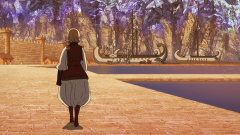
Actually, there was one theme at work in this episode that I felt was rather effective, and that’s the struggle between realism and idealism within Mahmut. When we first met him, he was tactless and naïve, despite his military status – he spoke without thinking, abandoned his city to help his friends on more than one occasion, and was regularly taken aback by the machinations of enemies and political rivals. His do-gooder streak remains, as we saw this week when he refused to leave Phoinike even after they declared war on the Empire, but he’s becoming more pragmatic and self-aware all the same. The decision to sail for Venedik and gain their support was motivated not by emotion or instinct, but by the fact that if Phoinike falls, the Empire will have Mahmut’s homeland of Turkiye surrounded. The former Pasha was also able to recognize a display of overconfidence in a friend, flashing back to his own trust in Ibrahim, who betrayed Turkiye just a month ago. I don’t expect that Mahmut will transform into a battle-hardened cynic before the series concludes, but the nuance is appreciated.

The man who will facilitate the aforementioned departure for Venedik is the newcomer Kiros, who you may have recognized as one of the riders flanking Mahmut during the opening theme. Kiros is another one of Zaganos’ spies, although his idea about what constitutes an effective disguise might make him ill-suited for the job. (Seriously, what’s with the Jack Sparrow cosplay?) His acquisition was handled by Suleyman Bey, who preyed on Kiros’ hatred of his politician father’s two-faced greed in order to bring him into the fold. This flashback was among the more interesting scenes of the episode, as it depicted the grittier side of espionage. Although Mahmut actively seeks out the company of intelligence gatherers, it might be a while before he gets his own hands dirty, so for now I’ll make do with the backstories of shadier men.

Konstantinos is the other significant character who made his debut this week. Though he appears friendly at first, he quickly reveals himself to be a dead ringer for Zaganos, who will use whatever (or whomever) is handy to achieve his ends. Konstantinos invites Mahmut to a government meeting in a fancy amphitheater, where the Phoiniken senators are set to debate whether they should allow the Balt-Rhein Empire to use their ports. Rather than allowing his guest to voice his opinion, however, it becomes clear that Konstantinos has only allowed Mahmut to attend the debate as a symbol of imperial defeat. With the support of both the people and his fellow senators, he declares war on the Empire, and what follows are a series of bloody conflicts along the wall that presently keeps them out. Altair’s politics are about as complicated as a mud pie, but its battles are much more interesting – Lady Lelederik is back, with a plan to scale Phoinike’s crystal cliff and infiltrate the city for the first time in 1800 years. Now it’s a race between her troops and the reinforcements Mahmut hopes to bring, and though the victor is all but assured, the contest may be compelling yet.