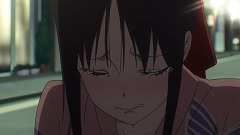

Dororo – 10 [The story of Tahomaru]

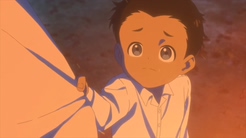
Welcome to Dororo’s week of brotherly love! This episode, if the title wasn’t obvious, we look at Tahomaru and his relationship with various characters. Lets dive in!

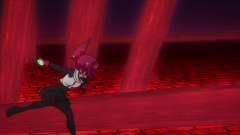
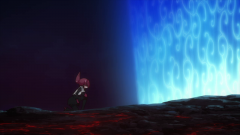
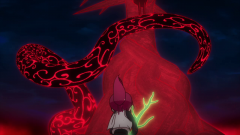
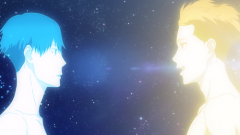
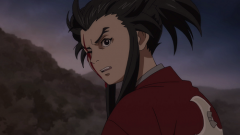
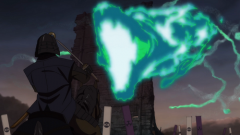
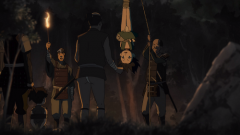
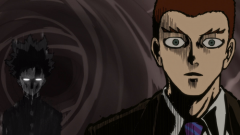
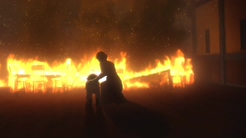
Production wise, Dororo stepped it up a bit this week. As always, the direction and shot composition is it’s strong point. Doing a great job of conveying emotion. The surprise for me was the animation department, as Dororo really wanted to make a good impression for Tahomaru. His battle with the demon, along with the flowing of the water as it came down on them, was visually interesting. Take for instance the scene of Hyogo throwing the villagers to safety. It wasn’t huge, like Mob Psycho always goes, but it fit Dororo’s subtler style and stood out in the moment. Sure, it rarely wow’s me, but the landscapes are beautiful and do a good job of building up the world. Still, enough about Dororo’s animation, I talk on that every week. Onto the spoilers!

Continue reading “Dororo – 10 [The story of Tahomaru]”

Kaguya-sama wa Kokurasetai – 09

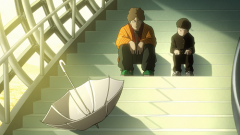
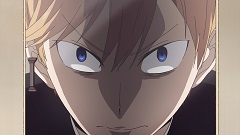
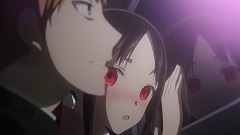
I, uh, wasn’t crazy about this episode of Kaguya-sama. As the end of the decade approaches, I’ve been thinking about my favorite anime of the last ten years, and I was originally hopeful that Kaguya would be able to hang with rom-coms like Ore Monogatari and Gekkan Shoujo Nozaki-kun on that list. Unfortunately, the second half of the show (so far) hasn’t appealed to me like the first part did. My main gripe with this particular episode was that it pushed some of its characters outside their established behavioral boundaries. It never happened without justification, but some of the reasoning it provided felt inadequate, especially in the last of these three chapters. Since all three of them led into each other, with Kaguya’s sickness as the core focus, the whole package was kind of soured. Let me just skip to the third segment and explain what I mean here.

When Shirogane visits a sick-in-bed Kaguya, he discovers that she has transformed into a half-delirious infant (something he’d hoped to see during the Concentration game in part two). Her design is amended accordingly, with downturned eyes and two-tone irises, as opposed to the sharper, more colorful expression she typically wears. She’s on the floor, searching for fireworks in a mess of her own making, and has to be mothered back into bed by Hayasaka (who’s in disguise as a gaijin maid). Aoi Koga even does her best Konomi Kohara impression to give her character the same sense of innocence that Fujiwara carries. It’s actually Hayasaka who provides the explanation for Kaguya’s current state: since her mind is always working at full capacity, her ego is particularly vulnerable to her id during periods of illness. Yes, the show actually trots out Freud’s model of the psyche to explain a character’s sudden witlessness, but this isn’t immersion-breaking by itself. Kaguya-sama has been dropping psychological terms into its script since the beginning.

The real problem stems from the show’s attempt to have it both ways, with a sudden seriousness taking hold when Kaguya explains that she can only manipulate people to express her feelings. We get a clear look at the Shinomiya motto during this scene, which hangs ominously on the wall and instructs family members not to love or rely on anyone. This maxim can be glimpsed in the hallway leading to Kaguya’s room several times before her admission, so it’s nice that the show primed us for that moment, but given the infantilized version of her character on screen just minutes beforehand, the whole segment feels inappropriately sincere. Everything that follows (Kaguya’s dominant id pulling Shirogane into bed with her, then kicking him out when she wakes up in her right mind) feels like the usual anime rom-com bullshit. Kaguya’s past fantasy about the Shirogane family accepting her was a much funnier and less direct way of detailing her oppressive home life, for my money – everything to do with her sickness was all over the place.

Chapters one and two from this week didn’t hold much appeal for me, either. This writeup has already been negative enough, but for the sake of completion, I’ll say a few words about them. In the first segment, there was too much shouting for me. Fujiwara screaming about the kleptomaniac thunder god, Kaguya’s maniacal switching of the president’s phone battery (complete with off-tempo clock sounds for some reason), and Shirogane’s war cry as he pedaled his bike through the rain grated on my nerves before I ever got to the third chapter. It was too much intensity for too little payoff. As for the memory game in the middle, it was fine. Notably, we got to see Fujiwara at her most devious, utilizing multiple rigged decks of cards to win the honor of visiting a sick Kaguya. She’s played to win before (think back to the banned word game), but this was a new side of her that felt natural, especially given her sheepish reactions to being caught. Alright, I’m off my soapbox for this week.
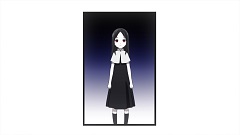
Paranoia Agent – 6/7 [Fear of a Direct Hit/MHz] – Throwback Thursday

Hello everyone to the catch up Paranoia Agent! First off, apologies for being late. Work was killer Thursday and really impacted writing this. No excuses though, on to the show! This week Paranoia Agent might as well have slipped LSD into my drink, because we get weird. Lets jump in!

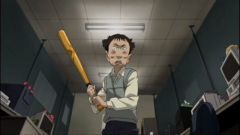
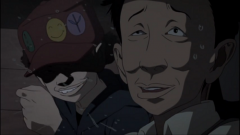
Right off the bat, Paranoia Agent gets weird with these two episodes. Even from a production standpoint, there are a lot of interesting decisions made. For instance the use of the fish-eye lense when talking to Kozuka, even though its an animation, really nailed the tension for his character. There were also a number of message-filled decisions with some character actions. Such as when Maniwa and the Chief were discussing having run out of ideas, and it being time for new ones. The Chief’s box of matches is empty, while Maniwa’s modern lighter was filled up and ready to go. A clear symbolic message of who has good, right ideas, and a differing method. On top of all of this, Paranoia Agent got weird near the end of episode 7 with the Old Mans sequence. Painting a very clear picture of Maniwa’s degrading mental health. Fantastic stuff all around, really.

Continue reading “Paranoia Agent – 6/7 [Fear of a Direct Hit/MHz] – Throwback Thursday”

Kaze ga Tsuyoku Fuiteiru – 19/20 [The Moment of Release/Even If I Break]

Another day, another double feature catch up from my vacation, this time on Kaze Fui. This week we watch 5 of our 10 boys run the Ekiden, in one of the most emotional jogs I have ever witnessed. Lets jump in!

Right off the bat, I have to say, Kaze Fui made me tear up. I can’t say I outright cried, because I am emotionally dead. But Kaze Fui made a fantastic try and busting through that, in both episodes. Prince, Musa, Jota, Joji and Shindo all hit me in different ways, and really showed my earlier concerns were misplaced. I made mention in earlier posts that I had concerns about pacing, about how a single race could take up 4-5 episodes. I now see how. Each section has become a deeply personal exploration of a character who has been built up over 2 cours. This legwork, this built up story, is a rock solid foundation for this finale I find. I only have a single complaint of both episodes, which we will get to later. For now though, let’s dive into the episodes themselves.

Continue reading “Kaze ga Tsuyoku Fuiteiru – 19/20 [The Moment of Release/Even If I Break]”

Dororo – 8/9 [The story of Saru/The story of the Mercilessness]

Hello everyone, welcome back to Dororo! Thanks again for understanding about my vacation, as we head into this weeks double feature. This time Dororo makes a friend, we get their backstory and a ‘he’ turns out to be a ‘she’. Lets jump in!

As always, lets start off with the animation and actual production of these two episodes. Animation wise Dororo continues to be a series of highs and lows. Often during its fights, like with the giant centipede, it can look great. Smooth motion and clear choreography. Other times though, outside of these fights, it can be very limited and often just unappealing. This isn’t to say Dororo looks bad though, as its direction at least is always very good. It has a clear focus on its cinematography. This can be seen most obviously in this weeks episode 9, with little actual animation, but fantastic coloring and camera-work. It engages the eye in a very different way from say, Mob Psycho 100’s bombastic animation and almost blinding rainbow of colors. As I have described in previous posts, Dororo is an exercise in minimalism I feel. But now, onto actual spoilers!

Continue reading “Dororo – 8/9 [The story of Saru/The story of the Mercilessness]”

Kouya no Kotobuki Hikoutai – 08 [The Great Airship Robbery]

Kotobuki pulls off another solid episode this week, as it surprises me in many ways. For the first time, the Kotobuki Squad faces a defeat, but by some incredible stretch they manage to get out of the situation magnificently. While the characters motion still feels awkward and off-putting at times – characters designs suffer the most when the show frames characters in profile, and when Johnny shows off his inhuman skills – Kotobuki more than makes up by its CG aerial combat craft, and exciting heist story this week. The episode represents the best the wild west tone of Kotobuki as a whole. It starts out pretty simple, our team has to protect “the golden fish” (noted that in Kotobuki’s world, real fish is as rare and precious as Swiss watch). The thieves, however, have a better idea. Instead of just stealing the fish, they hijack the Hagoromo ship, and demand Isao to resign or else they’d crash the ship to the town. Honestly I didn’t see that coming at all, and these enemies prove to be more and more formidable, almost army-like status.

But the plan to counterattack from our girls prove to be pretty entertaining, as well. This robbery is a chance to flesh out ship’s supporting casts, this time Johnny, who is revealed as a veteran shooter, and Ririko, who might or might not be Johnny’s ex-wife, that they claim back the ship with style (a bit over the top but hey, so do all the Western movies). The problem doesn’t stop there though, as the ship’s control is badly damaged and there’s explosions on board. Hence the Kotobuki has to fight a way to shoot the ship down safely before Isao’s air jets, for safety reason, destroy the ship themselves. While this episode is pretty thin on paper, we can still draw out two deeper plot threads going forward. First, it’s still unclear what the enemy’s objective is. It’s clear that they’re skilled, and they’re disciplined unlike normal air pirates. Second, while the rest of the team has their reasons to pilot (case in point this week, Reona wanted to protect the orphanage), Kirie doesn’t seem to have one. From what we know about her, she learned to flight from the old man and she loves to flight with all her heart. Is there any need for a reason to be up in the air at all?

Mob Psycho 100 S2 – 8/9 [Even Then ~Continue Forward~/Show Me What You’ve Got ~Band Together~]

Hello everyone to a double feature of Mob Psycho 100 this week! I have returned from my vacation and its time for some catch-up. This time Mob Psycho goes from 0 to ??? faster than a bullet and we meet our big bad. Lets jump in!

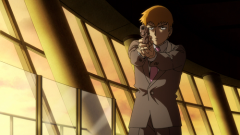
Starting off, as always, lets talk animation and visuals. Mob Psycho is without a doubt one of the best looking series of the season, and probably the year. It’s all so expressive, from the faces to the wild activity on screen. I find it almost impossible to look away while Mob Psycho is on screen. Combine that with it’s willingness to dive into completely different mediums and styles, and its a feast for the eyes. Always changing for whatever works best for the scene instead of feeling constricted by its art style. Simply put, Mob Psycho looks fantastic. As far as the actual story goes, I am going to tackle this two-parter one episode at a time. Delving into 8 and then 9. Really, I think I got lucky with the vacation, as it meant I didn’t have to wait on that cliffhanger. And remember, spoilers after the break!

Continue reading “Mob Psycho 100 S2 – 8/9 [Even Then ~Continue Forward~/Show Me What You’ve Got ~Band Together~]”

Kaguya-sama wa Kokurasetai – 08

Kaguya-sama hit a low point for me last week, so I was hoping this episode would be more my speed, and that wish was granted with the adaptations of three fun chapters. One used the introduction of a new character to prey on Kaguya’s unmet desires, one was a narration-heavy dive into academic life at Shuchiin Academy, and one featured Ishigami in his best and most sympathetic role so far. The aforementioned “new character” is Shirogane’s little sister Kei, who made a previous appearance from the neck down, but only came into focus this week. Kaguya is fascinated by the traits she shares with the president, but I was mostly hypnotized by the ornate ribbon she wears in her hair. It’s a cute look, but its extravagance makes Kei feel like a calculating girl. That’s something she might sense about Kaguya, as well, given the nervousness she felt around her. Kaguya was certainly up to her usual scheming ways during this chapter, wondering how she might strike up a relationship with the younger girl to better approach her brother, but her thought process betrays a deeper motivation: Kaguya is “starving for familial love.” Though she has Hayasaka to confide in, I don’t think we’ve seen or learned anything about her parents. The scene she dreams up where the Shirogane family accepts her as one of their own is quite sad when you consider where that dream comes from.

The middle chapter was much sunnier in tone, despite the way it put our main characters through the academic wringer. A fair number of the recent stories involving both Kaguya and Shirogane have ended with one silently acknowledging their feelings for the other, but they were much more combative here. With exams coming up fast, they both lie through their teeth about their level of preparation for the tests, probably hoping to lure the other one into a false sense of security (as well as make their victory seem that much more impressive). Fujiwara has been the show’s wild card from the very first episode, but this segment was perhaps the clearest indicator of that status thus far. Kaguya and Shirogane’s deceptions have the slippery-voiced narrator calling them out left and right, but he can’t say a negative word about the pink-haired crowd favorite, whose smarts aren’t sufficient to spot her friends’ lies. It might have been nice to get an outside perspective on exam season from a couple side characters, but Fujiwara already provides a nice contrast to the two egomaniacs, neither of whom end up winning or losing with humility (not inwardly, at least).

Though the last chapter wasn’t my favorite, it provided some essential context-via-backstory for Ishigami, who was once a frequently-truant middle schooler. This lessened interaction with his peers probably set the stage for his current image as a gloomy geek, which not even a spot on the student council has managed to cure. The show pulls a neat trick by placing the events of this story during the lead-up to the exams that conclude the previous segment, allowing us to glimpse a more serious side of the students’ preparation. Ishigami isn’t lacking in wits, just motivation, and it’s Kaguya (of all people) who spurs him to avoid being held back a year by subpar test scores. His usual fear of her harshness gives way to appreciation, especially once she sticks up for him in a library scene that may be the launching point for something more in their relationship. Shirogane once thought of Kaguya as cold and unapproachable, so I don’t see any reason why Ishigami’s trepidation couldn’t give way to affection. Kaguya seems unlikely to set her sights anywhere other than the president, but a one-sided crush from the treasurer’s end looks a bit more likely after this episode.

Winter 2019 Summary – Week 6-8

Again, sorry for my lack of coverage for this column, but doing these weekly summaries make me realize more clearly than ever how quickly time passes. Feel just like yesterday that we just started this season, and now it has come way past midway point. Anime this season offers a wide range of offerings. Mob Psycho 100 had many stunning episodes, Boogiepop keeps up with its unpredictability by releasing a whole batch of 4 episodes. I’m slightly disappointed at Promised Neverland, however, as it somehow becomes less and less thrilling as the story goes on. The 4 other shows that I will feature below, still have their own appeal that keep me come back every week. The next season might be an heavyweight, but I’m perfectly happy with the current wealth this season has been offering.

Endro! (ep06-08)

Endro spends the last three episodes to flesh out the characters outside of their heroes’ group, to a varying degree of success. First, loli Devil Lord is my waifu of the season so it’s a delight to see more of her, cute facial expressions (and there are heaps of it) and whatnot. It’s a good little episode since it shows how much she steers away from her supposed evil role, and learning to accept companionship even if her friends are the ones destined to destroy her. I do have a feeling that the Devil Lord vs the Heroes fight is too repeated at this point, but everything else is a delight. The same could be said for Princess, whose assigned role is to love Yuusha unconditionally and she pushes it to the max. I enjoy how she getting close to other members because those scenes, as repeated and predictable as they tend to be, spark a solid chemistry between her and each member. That is why the latest episode fares as its worst effort. Staggering a rescue mission is nice and all, but her plan becomes a bit too much in my opinion. There’s still some solid gags (like how the faked Demon Lord’s underclassmen are more powerful than the actual one). This is the show where it constantly pokes fun at the “roles” everyone supposed to play, so the segment where they play exactly like their roles doesn’t really speak well to me.

Continue reading “Winter 2019 Summary – Week 6-8”

Boogiepop wa Warawanai (2019) – 14 [Overdrive: The King of Distortion 1]

This is often the case for a series that is fragment and non-linear like Boogiepop, the beginning is often its weakest part. Not only because it has no real beginning, therefore no real “introduction”, it has to create the right kind of mood that represents the overall tone of an entire arc. Moreover, the lack of “big catalyst” also makes it hard for viewers to fully engage with what unfold on screen. The very first episode of Boogiebop suffers hard from that (by hindsight, that premiere is amongst Boogiepop’s worst episode so far). To say all that leads to my next point: this first episode of the new arc “The King of Distortion” is a successful opener. It feels a bit meandering at first, mostly because it shifts back and forth between side characters that we know next to nothing about them, but as soon as the paranormal event kicks in, everything starts to fall into place. Like the premiere episode of “Boogiepop Doesn’t Laugh” arc, it begins through Takeda – Miyashita’s boyfriend – point of view. That fact alone gives me a good chuckle because despite appeared as serious as he is, his role is always that of a bystander. He has no real relation to the main events, therefore he’s more like a springboard for viewers before we jump into the event. Chronologically, this arc is appropriately happens right after that first arc, as many members from that cast comes back in a big way in this episode.

Everything in this episode revolves around the twisted statue that represents very well the very nature of distortion (I see it more as a walking naked woman but it’s just me). From what we gathered, it’s a “failed” project from millionaire called Teratsuki. There are some interesting nitpicks with that piece of information alone. The reason it’s “failed” isn’t because of its incompleteness, it is because Teratsuki dies mysteriously at the age of 56 and no one have a clue on the intention or even what to do with the Moon Temple architecture. Even his life was complicated before his death, he was a success in almost every field he was in (strongly indicated that he’s already evolved), and he was the person that Scarecrow investigated before he met Nagi in “Boogiepop at Dawn” arc. Precisely because people don’t know what to do with it, they make an exhibition out of it, and it attracts fair share of people lining up to get in. That Moon Temple in itself a mysterious identity, and we follow a whole range of different characters as they line up: A kid who encounters the King of Distortion in the image of Teratsuki himself (and based on what he said he’s a just-born), a random guy named Habara who meets the archery boy Tanaka, and a random girl named Michimoto who is having a fight with her date. I’m not even sure if they will become something important later on.

The one the is important, however, Niitoki, one of the surviving member after the climax of the first arc. First she sees her crush Takeda, then she pursuits Boogiepop and finally gets transferred back to the time she regretted the most – the Manticore event. The moment where the paranormal event kicks in remain one of the most breath-taking moments Boogiepop pulls up to date. As the doors closing the visitors turned into statues. Seriously, this is something that falls more in line with Ikuhara than most other anime, but I’m glad that Boogiepop goes there. Niitoki is taken back to meet Saotome, and I’m pretty sure there’s some hidden feeling, something much more about her own psyche than meets the eyes here. What is it about him (and not Manticore or her crush Takeda), that she feels regret the most? At the same time we have a look to another random security guard who appears to not be able to confess his love to the girl he likes. And even the King of Distortion himself. How was he born? It’s clear that he takes shape into whatever things people perceive him to be, but does he, like Imaginator before him, want to “evolve” human in some ways? Making them facing their own guilt past isn’t the bad way, after all, but to what extend he’s going to “fix” people? Boogiepop sets up a pretty intriguing first episode, one that again speaks to its adolescent theme, and one where Boogiepop themselves appears actively. Hopefully this arc also gives more justice to Miyashita, so far is sadly just a cardboard character with no real depth yet.