Fire Punch Manga Review – The Wondrously Absurd Trainwreck

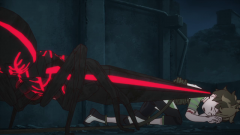
Once upon a time I listed Fire Punch as a manga to take a look at during one of of manga Spotlights and back then Fire Punch was a manga with a pretty basic revenge plot that had some interesting quirks. Now Fire Punch is a completed manga with 83 chapter story spanning 8 volumes and what that story become is something I don’t think anyone could have predicted. Let me lay out the basic rundown by saying that Fire Punch is set in a world which is filled with snow and an environment so harsh that people struggle to survive. In this world certain individuals are born with “Blessings” which are some kind of supernatural ability and our protagonist Agni and his sister is gifted with the power of regeneration. Both essentially can heal from any wound and regrow limbs though the sister has a slower regeneration rate. The village which they live in has decided to use this ability to produce a near limitless supply of food by the Agni chopping his arms off to use as meet. He does so willingly and despite circumstances lives rather happily with his sister. However a group attack the village and a man with the power to shoot flames out of his hands that will never go out unless the target is dead, burns his village to the ground, killing the Agni’s sister and leaving him burning alive. However his regenerate manages to make it that the fire never truly kills him and he becomes a man constantly burning alive. With time he comes to bear the pain and use his new status as a source of strength to seek out the one that killed his sister.

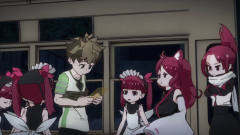
Now what I stated here isn’t really anything that groundbreaking and while there are some odd elements we do still have a standard revenge plot. But it is at this point where I will go into spoiler territory as to discuss just what happens after this as I think that I cannot really express my feelings about this story without going into detail so if you have any intention of reading this I would suggest stopping here and doing so. But if you don’t really care to read this manga then continue reading this post and you may change your mind. So what I have stated so far has been straightforward but the game changer is when Agni confronts the target of his revenge, Domu and during the fight we are are given one of the most jarring character introductions in manga. During the fight we are shown panels of a girl named Togata speaking directly to the reader in documentary style. She’s a movie buff, a girl whose spend hundreds of years alive and finds everything boring besides movies. Unfortunately someone burned down her house and her collection of movies which has caused her to lose her will to live. However upon hearing of a man constantly on fire she decides to seek him out, in order to film him and create a brand new movie. Togata manages to not only find but save Agni after his humiliating defeat at the hands of Domu but then starts grooming him to become an action star for her new movie. To put things quite frankly, Togata is completely and absolutely insane which causes the narrative to turn from predictability to utter chaos.

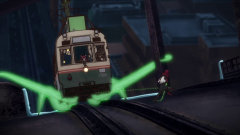
How does one even put into context just what this story becomes? Almost a game of the author working to pull as many things out of left field to throw the reader off balance as possible. We have a man declaring to two people that he has decided their new job will be to have sex with two dogs. We have a man on fire seemly playing in the water with a girl carrying a severed head. We have Agni defeat an enemy, only for her to lose her memory which cause both of them to go into a nearby house where she then tries on a bunch of outfits to see Agni’s opinion. Halfway through the story the main villain who supposedly caused the destruction of the entire world and plans to rebirth it, declare that her primary motivation was because she wants mankind to create a new Star Wars movie for her to watch. It is completely ridiculous and yet through all this the story somehow remains engrossing and even progaint at times. It’s hard for me to look at Fire Punch and call it a good manga. Interesting, unique, and addressing fascinating issues yes. Good? hmmm…The pacing tends to be jumpy and you hit climaxes and anticlimaxes with sudden immediacy. It’s hard to get a grasp of an overarching goal or even a plot and while characters have some degree of interesting traits but a tendency to act randomly. It’s tone can be slapstick and shift to dire dark straits within moments. Most of minor antagonists are ridiculously cartoonishly evil to a comical degree. However despite all this one can see that the mangaka can pull these story elements off well but it’s just that the story he has chosen has kind of run away from him. There is a few pages of the manga which were dedicated to a joke where Togata was driving a truck and was repeatedly getting attacked which has minimal dialogue and is one of the funnest scenes of slapstick in manga I have seen in a long time. There is also a scene of Domu discussing with Agni about the need for righteous education which was excellent. When looking at things, the mangaka’s next work ChainSaw Man does a much better job of juggling his strengths and looks to be a stronger story than this one. Yet…there is something distinctly fascinating about Fire Punch.

Film seems to be a primary theme of the story as a whole as it influences many of the characters. Togata is the obvious example but may of the characters have motivations tied to film. Our main villain’s motivation for a new Star Wars movie is one and as silly as it sounds I think many of us could go to absurd lengths if it meant getting more of a show we loved. Domu who acted as main antagonist for a time reveals that his actions were in service of his god whom he watched a video of him fighting demons and he later came to realise that his god was from a B-movie that Togata claims was a piece of utter crap. Upon being asked about Heaven, Togata claims that it is a cinema, something which Agni takes very to heart. Even the main character Agni is influenced by movies as he claims that most of his life he has been acting and is pushed to act more by Togata. Throughout the story he begins to try to act in a manner that he would believe the protagonist of a movie would act only to find that his real feelings push him towards something more nefarious. People build a religion around him based on a boy that saw him like an action hero which turns into a cult of desperation. The utter hopelessness of Agni who has long gone insane and just wants to die, constantly being told to live by those he cares about. Nihilism runs through the story with peoples gods being fake illusions to avert their eyes from the most certain death of the world and Agni’s once righteous crusade being revealed to be something more selfish and personal that breaks him down into a sad shell of a man. This manga is a mess really but there is something honestly genuine about it that I think makes for a interesting read and I can be sure it will never get an anime adaption. It’s not a manga for everyone or even many people but upon finishing it I found it rather cathartic and it’s given me hope that the Mangaka can really take ChainSaw Man to interesting places. Well…provided that he doesn’t go completely insane.

On a completely unrelated note I would like to give a call out to Spy X Family. A brand new series with just two chapters out so far but I have a feeling this one might turn out to be something quite special. I wouldn’t see surprised to see an anime adaption in a few years time.

Some Quick First Impressions: Hitoribocchi no Marumaru Seikatsu, Mix: Meisei Story and Kimetsu no Yaiba

Hitoribocchi no Marumaru Seikatsu

Short Synopsis: A socially anxious girl must befriend all of her new classmates to win back the love of her former best friend.

Mario’s review:
UNBEARABLE PROTAGONIST, ACT II

Hitoribocchi is dull, Hitoribocchi is boring. Unlike Lenlo below I have a good relationship with the SoL genre, and even then I wouldn’t recommend this show. The main girl makes up the biggest issue for me as her social anxieties makes her act and behave like a 5-year-old kid. This one reminds me a bit of Slow Start last year with the same level of stupidity and dumb her down for the sake of making her cute. Her making friend feels way too easy, her anxiety plays mostly for laugh and I’m pretty sure I have seen all these familiar beats before. Look, if you’re a middle school girl, how about you act like one and not drawing plans to get rid of the society? This isn’t kawaii, this is just plain dumb.
Potential: THERE’S A CINNAMON ROLL WE ALL HAVE TO PROTECT

Lenlo’s review:
Hitoribocchi’s biggest problem, for me, is that it’s a Slice of Life. It’s simply not a genre I enjoy. By about 8 minutes in, I felt like I should be at the end, such is how it drags. That is most likely just my aversion to the genre though. As far as content, Hitoribocchi is basically a more wholesome version of Watamote. Both are school Slice of Lifes about an anti-social girl fitting in. The issue is though, just like Watamote, I was bored out of my mind. Maybe it’s the setting, maybe I just can’t enjoy a school-life centered drama anymore. I am not sure. Either way, from what I watched if you enjoy Slice of Life, you will enjoy Hitoribocchi, if only because your enjoyment will be inverse to my dislike of it. That’s typically how the trend on Slice of Life goes for me.
Potential: 10% if you’re me, 80% if you like Slice of Life.


Mix: Meisei Story

Short Synopsis: A pair of talented baseball-playing brothers rejoin their middle school team for another mediocre season.

Wooper’s review:
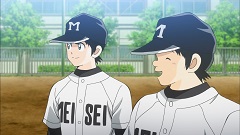
I mentioned it in our season preview, but Cross Game is my favorite anime, so it’s impossible for me to judge Mix (which is from the same author) without any bias creeping in. Just looking at the simple designs of these characters makes me want to smile, reminiscent as they are of Adachi’s other works. And it’s not just audiences that might be attached to other series of his – Mix itself makes its connection to Touch very clear, using an extended flashback at the start to link Meisei High’s past glory to its present mediocrity. Even Mix’s narrator is a character from Touch, and there’s a bit of fourth wall-breaking when the two main characters acknowledge her presence from within the story. This level of narration, the character introduction cards, and the VCR-mimicking scene transitions are all potential stumbling blocks for new viewers, I suspect. Mix is playing with its format a bit, rather than going for 100% naturalism as might benefit such a slow-moving anime. Despite these modern flourishes, though, Mix’s character work is old-fashioned in the best way, making the establishment of their personalities its number one priority. The male siblings at the heart of the story share an easy-going demeanor, but one is a tad rougher around the edges, which will likely be brought to the forefront when their coach’s favoritism starts hurting the team. There’s a bit of a mystery at play in their relationship, as well, which I won’t address for the sake of any newcomers. I’m quite eager to watch the next episode (if only to see the series’ glorious OP again), but I’ll bump my score down a bit to account for its uneventful first episode and odd scene transitions.
Potential: 70%

Lenlo’s review:
As Wooper correctly anticipates, there are a few issues for a new viewer who doesn’t know the original story to get over. Personally, I am not a huge fan of the extreme amount of narration. Yet at the same time it gives the series a very… old feeling, while still having the modern production. Take the character designs for instance, though it has a modern coat of paint, it’s all very late 80’s early 90’s, really making it stand out from other series. As Wooper said, Mix also goes out of its way to establish its characters clearly and early just like the oldies. I quite liked these two leads because of this, I think they will be able to play off of each other well. The whole sibling bond/rivalry going along with their differing personalities. I am also always one for a good sports anime, and the time period of the original story made a lot of good ones. Basically, I think Mix has a promising start and I look forward to seeing where it goes. As someone who has no idea about the original work, it pulled me in.
Potential: 60%


Kimetsu no Yaiba

Short Synopsis: A kid comes home to find out that the entire family has been killed and his little sister has turned into a Demon.

Lenlo’s review:
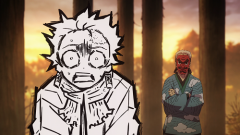
Well, I suppose we know where Ufotable’s fraudulent taxes went, because Yaiba looks great. A treat to watch. This is the only aspect of Yaiba that wowed me in this first episode though. While the world was interesting, the premise itself a classic shounen, we didn’t get much more than that. The protagonist is a bit of a wet blanket and there really aren’t any rules yet established. However if Yaiba can take this first episode and run with it? Expand on the world, and grow the lead? Then I think it can be a great shounen series. All the pieces are there after all. An end goal, a mysterious final boss/demon, a weak character growing strong and plenty of room for good fights. Yaiba just needs to take this framework and start filling it in, and I am willing to give them the benefit of the doubt on this one.
Potential: 75%

Mario’s review:
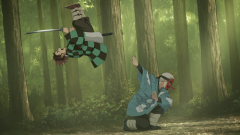
I’ll be honest that prior to watching this episode I don’t have that high of an expectation towards Yaiba. Shonen Jump golden egg and ufotable aren’t something that attract me personally, but the premiere proves to be a worthwhile watch all around. If I have one small nitpick over the presentation, it’s the large amount of narration that nearly threaten to overwhelm the story. It does add a sense of novelty that other action shows usually lack, though. Right at the first episode, Yaiba successfully tells an engaging premise where Demon element fuses naturally to the world. Then it nails it on giving us 3 compelling characters, each stand out in their own ways and set up very well the journey ahead. The visual, in addition, is gorgeous. This episode doesn’t have much of bombastic action sequences, but based on how crips the characters move and how pretty everything looks, be it the background or the character designs, there’s a lot to like here. This could prove to be one of the highlights of this Spring season.
Potential: 70%

Some Quick First Impressions: Ultraman, Konoyo no Hate de Koi o Utau Shoujo YU-NO and Fruits Basket (2019)

Ultraman

Short Synopsis: A superpowered space officer and his son are called to save the Earth from a familiar-looking villain.

Lenlo’s review:
Having never seen the original series, I had no idea what to expect going into this one. But I must say, I was pleasantly surprised. The CGI was off putting at first, but Ultraman really commits to it and by the end, I barely even noticed it. I was all in, and it looks just enough like the cheesey live action of original Super Sentai series for me to enjoy it. On top of that, the story itself actually appears to be quite new to the genre! Instead of being episodic, this is more like a coming of age Western super hero story, like Spiderman. There definitely appears to be some influences from there to my eyes. That it follows the original series as a sequel of sorts also plays in its favor, as Ultraman isn’t forced into the originals mold, its free to be its own thing. The series could easily take a turn from this, the actual city and interiors showing some cracks in the facade, but from what I saw in the first episode, Ultraman is a Netflix series worth your time.
Potential: 60%

Wooper’s review:
I think I’ve been spoiled by Polygon Pictures’ 3D anime offerings, because series like Ronja and Seikaisuru Kado looked much better than this. Ultraman moves slightly away from the traditional influences of those series and edges towards more sophisticated lighting and shading, plus more CG involvement in its background art. This pays some dividends, as in the bit ripped straight from Spiderman where Shinjiro tests his powers on the roof. His weightless leaps from building to building are given some life by the way he gels with the sunlit scenery, which is great. There’s much more to be disappointed in, though; the oppressively geometric layout of every single interior scene, the total lack of environmental damage from massive impacts, and the photographed trees that appeared as glorified sprites were especially ugly. On top of that, we have CG anime’s usual stumbling blocks of stuttering pan shots and Botoxed facial expressions to yank us out of the story. Speaking of story, Ultraman 2019 is another superhero tale that promises to comment on power, morality, and human potential in the same way hundreds of others have done in the past. The characters might have been able to carry the half-baked setup if not for Shinjiro, the sort of MC who ponders how many “points” he’d score by rescuing a cute girl from a trio of delinquents. That girl also happens to be a pop idol, who will almost assuredly become his girlfriend because wouldn’t that be awesome? It’s a shame the “next generation” feeling is so prevalent here, because Shinjiro’s father (the original Ultraman) is a fabled Adult Protagonist, despite being a wet blanket himself. Pretty disappointed with this one on the whole, especially since Kenji Kamiyama’s name is attached (hopefully he’s putting all his effort into next year’s Stand Alone Complex sequel).
Potential: 15%


Konoyo no Hate de Koi o Utau Shoujo YU-NO

Short Synopsis: A high school boy whose father just disappeared still goes to school, meets girls with big boobs before gets transported to an alternate timeline.

Lenlo’s review:
Let’s see, mystery transfer student, CHECK. A load of established harem members, CHECK. Weird McGuffin with no explanation, CHECK, and a clearly evil authority figure, CHECK. Hmm… yup, from my diagnosis YU-NO has a clear case of the “Tropes”. While normally not fatal, and occasionally beneficial in a series, I fear this is an advanced case. All originality has been used for a singular perverted MC gag that wasn’t even funny. I fear there is little to be done for the series but to sit back and watch the train wreck. If you like watching something die a slow and inglorious death, YU-NO might be for you. However if you value your time, my recommendation is to avoid like the plague, so you might be spared the terrible affliction.
Potential: 0%

Mario’s review:
UNBEARABLE PROTAGONIST, ACT 1

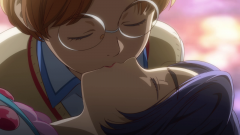
Yu-no is, in a word, a throwback anime. There are many tropes and styles of humor that bring you right back to the 90s aesthetic that you don’t see often today, at least not to this extreme. Right at the first bit of dialogue, “panty” and “something hard” are thrown to our faces, and it’s getting worse from there. Just look at the screenshot to see the level of unabashed foolishness Yu-no contains. It also has a typical issue when anime tries to adapt a Visual Novel material: it introduces way too many characters before the main plot kicks in and to be frank, none of them is that interesting. Worst among them is the titular naked girl who kisses this horny MC and vanishes into thin air like an acid version of beautiful mermaid. The bad guy screams “villain” from Day 1, and like Steins;Gate 0, his evil seed is a whole bunch of crap. And then we have the lead who has a bit of hormonal issue (or is his own words: is he in that day of the month already?). The hook is solid, though, but with the ensemble cast this cringy, and the humor this dated, Yuno, you know, isn’t worth your time.
Potential: 10%


Fruits Basket (2019)

Short Synopsis: Girl meets several boys in their home and decides to stay there with them.

Mario’s review:
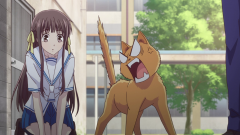
Overall it’s decent start that we have here. The strongest component in this episode is how the show fleshes out all the characters just about enough, especially the main girl with her own struggles and personality. The visual department, however, is sadly unremarkable. It looks “old”, not due to its intention, but more because of its lack of polishment (the worst bit is the distracting CG smoke). The story, while goes through many shoujo tropes (the Prince type, her friends), still remain quite solid because each character has their own voice and there’s much more opportunity to flesh out these characters. It’s true that Fruit Basket is much more interesting when it focuses one characters’ drama, not romance. Another thing that could tamper this adaptation is the pacing, given at one point (where her tent is buried under the snow) passes so quickly and abruptly. For now, I have my reservation regarding the production, but given the strong material it has, there’s still heaps to look forward to.
Potential: 65%

Lenlo’s review:
Let’s cut right to the chase here, its Fruits Basket. Most of you should already know what you are getting into. It’s been almost 20 years since the original afterall. That it’s getting a remake after so long, and is already a successful established series, tells you all you need to know. For myself, my only experience is with the English dubs, and so beyond this first episode I am going to be waiting for those myself. Can never get enough Laura Bailey. For those who don’t know what’s up, Fruits Basket is one of the landmark rom-coms of the late-90’s/early-00’s. As someone who largely despises the genre, it is one of the only series in it I look back on fondly. It’s filled with tropes and stereotypes abound, though an argument could be made that Fruits Basket helped establish them. I have often wondered, because of this, if that fondness was just nostalgia. Well this first episode made me realize it wasn’t, at least not totally. There is a mystery established behind all of the romance and jokes that pushes the story forward, so it doesn’t have to rely purely on the romance. I will still have to wait and see how much I have changed since my youth, but I feel comfortable saying I will enjoy this one.
Potential: 50%

Mob Psycho 100 S2 Anime Review – 87/100

Upon finishing this series, the only question on my mind was how many animators did Bones sacrifice on ONE’s altar to achieve this. Following their prior season, Mob Psycho 100 Season 2 continues Bones adaptation of webcomic and manga author ONE’s 4th work, Mob Psycho 100. ONE has also authored the critically acclaimed One Punch Man series, redrawn for Shonen Jump by Yusuke Murata, and was later also adapted to anime by Studio Madhouse. Both were fantastic, and both pushed the envelope in terms of animation for TV anime. Following these up was no easy task. And yet, somehow, some way, Studio Bones did just that. They created an anime that you can find, almost in its entirety, on Sakugabooru. A blog dedicated to beautiful animation. But is there any substance, any depth, to what that animation portrays? Let’s find out.

Welcome to Mob Psycho 100 S2, lets jump in!

Continue reading “Mob Psycho 100 S2 Anime Review – 87/100”

Paranoia Agent – 11 [No Entry] – Throwback Thursday

And so Paranoia Agent gets back on its weird tracks! This week week see what’s happened with Maniwa and the chief, Shounen Bat gets one upped and Kon get’s a little weird again. Lets jump in!

I have to say, this was a unique episode. All of Paranoia Agent’s episodes are unique in some way, but that’s not going to stop me from pointing it out each week. This time, Kon give’s us a closer look into Shounen Bat himself, which is a very welcome surprise. I made a point last week of explaining my worries with the series. That it was moving away from the characters and towards Shounen Bat, when he had no character of his own. That there wasn’t a clear plot to actually end in the first place. Kon apparently realized this, knowing from the start if the setup is anything to go by. This week give’s me that characterization, that sort of plot hook, that I so desperately wanted last week. So credit where credit is do, Kon has assuaged one of my biggest worries. But what about the actual content?

Continue reading “Paranoia Agent – 11 [No Entry] – Throwback Thursday”

Yakusoku no Neverland – 12[150146]

So this series ends, or to put it more appropriately is put on temporary hold. A second season has been announced to follow much to the surprise of no one. But this episode acts as a good climax to the first arc of the story along with the thematic end of Isabella’s character arc. Of course this also marks the end of Promised Neverlands best arc which makes the announcement of a second season to be met by myself with rather lukewarm yays. What is to come after this arc isn’t what i would call bad but it is a downgrade when the story loses an antagonist like Isabella and the tension that the farm brought. The kids are still in danger but that danger seems much further away when their circumstances have switched from certain death to potential death. It’s up for debate whether an anime adaption could improve these chapters but I think I will sign off here as I just have other things to get though.

Yes yes, I lied about Phil. It’s sort have been a meme that the manga community suspected him so much due to him constantly appearing in the background which lead to him being regarded as some secret mastermind. In reality he really was just another kid, a fairly clever kid but no more a mastermind but rather just situationally aware. I do at least like how things have resolved with Isabella with her final confrontation with the children not turning into a battle of brawn but her appealing one last time to their emotions. Isabella has always been a psychological opponent so it makes sense that her last moments were like a metaphor for children leaving the coup. With her last action to hide evidence of the kids escape and to go back to the children with her most certain death awaiting her. In her final moments with her hair down almost feels like the first time she was ever able to truly be herself around them. Couple this with the flashback and reveal that she was Ray’s biological mother as thanks to fetus memories Ray learned a song from Isabella while he was in the womb.

Okay, I still think the whole fetus memory plot point is remarkably dumb and it does seem like the main reason it went with that instead of a more logical reason is for this twist and this twist alone. I think something like a birthmark would have been better to showcase this twist however. Isabella is the character I cared most about during this whole show so it’s nice to see her get some development when she about to say farewell forever. It leads her to becoming someone whose more understandable in her actions even if it doesn’t negate her wrongdoings in her job. You can make arguments that she didn’t have a choice and that she did the best she could within the limits of what the world would allow. I would argue that she traded her humanity for survival and when you look at things in perspective was never truly happy with her circumstances. She was so preoccupied with staying alive that she forget the reason why she did so. Tragic but evil deeds done remain evil, she still threw children to the guillotine to ensure her own survival.

I am having a debate with myself over reviewing this series as it is by general policy that I forgo a review if a second season is announced. As I feel that a series should be judged by everything that it puts on the table rather than a teaser. Still if I was to give my thoughts on how I felt about this series it would be that it is well directed, animated and features a great soundtrack but the story is a bit of a one trick pony. I stated before that when it came to the manga I began to lose interest once I completed the first arc but here I began to lose interest much faster which my response to each new episode turned to indifference. Again I reiterate that the series itself isn’t bad but it is a story that depends heavily on not knowing what comes next. If you do know what comes next then you know all the misdirection and suddenly the show becomes a showcase of fakeouts. Take note that despite the bleak setting that only two people actually died during this series. Connie in episode one and Krone in episode eight.(And I suppose Norman if you consider that “death” to be legitimate) Not saying we needed to see a massacre here but I feel it betrays the intent of the majority of the tone when you show that the only ones in danger are those whom are disposable plotwise.
Of course as the writer of Higurashi and Umineko put it, stories can be enjoyed twice but the fault with Neverland is that it depends so heavily on that first time experience that upon rewatch there really isn’t much to see. The characters are fine but the story almost is a waiting game to the eventual escape and in watching this anime I came to see how one note that approach is. I honestly can say the only character I truly cared about was Isabella and would you look at that, she’s gone from the story forever. An argument can be made that a story doesn’t require rewatchability in order to be considered great and indeed there are plenty of mystery stories that make for fantastic first time reads but diminish upon rereads. But I think that for something to be regarded as a classic is a quality that make you want to see it again and again, even when you know how it ends. A quality which for all the advantages it has, Neverland lacks.

Kaguya-sama wa Kokurasetai Review – 84/100

Anime draws on many different media types in its endless search for properties to adapt, but manga is still the king of the bunch. And why not? It’s a distinctly Japanese art form, their main demographics have significant overlap, and manga’s panel-based layout means that some of the anime staff’s work is already done. Plenty of adaptations stick very closely to their manga counterparts (hopefully out of respect for the original), but some receive bold reinterpretations. Kaguya-sama doesn’t go quite that far, but under the guidance of director Mamoru Hatakeyama, it does manage to take on a life beyond that of its source material. Hatakeyama’s work on screwball comedies with Studio Shaft near the start of the decade gave him an eye for tricky camera positioning and outrageous character expressions. Since the show came to a conclusion several days ago, I’ve been skimming the manga and noticing the ways in which he embellished scenes by making full use of the student council room, where at least half the anime takes place. This is probably why that environment is rendered using cel-shaded 3D models, since it would allow extra freedom in deciding which angle of the room to capture.

Kaguya-sama’s move to television works to its benefit in plenty of other ways, as well. Its comic timing is terrific – I vividly remember the moment when a dump truck unloaded a towering pile of flowers directly onto Kaguya’s head. The slow, quiet manner in which the petals piled around her sold not just that scene, but a whole seven-minute segment. Things get loud when they need to, as well, with each battle of wits between Kaguya and Shirogane feeling more critical than the next. The show’s use of bright red and blue backgrounds (representing the two main characters) and urgent string accompaniments pushes their mental matches to absurd heights, only to bring them crashing down when fan favorite Fujiwara unwittingly interferes. Special mention must also be made of the series’ stellar casting, which put newcomer Aoi Koga in the lead role and reaped immense rewards as a result. Her blend of haughtiness and vulnerability made Kaguya my favorite character by a mile, but the other student council members had great actors behind them, as well. Even Ishigami, who I wasn’t originally fond of, found his stride once Ryouta Suzuki embraced the bitter, world-weary nerd at the heart of his character.
All these elements made Kaguya-sama successful as a comedy, but director Hatakeyama’s experience with drama paid off as well. Having headed up the masterful Shouwa Genroku Rakugo Shinjuu, he clearly knows how to frame more serious material. The two-part finale “I Can’t Hear the Fireworks,” which dug deep into Kaguya’s isolation and sorrow, is all the evidence one might require to support that claim. The moments when she reunites with her friends and realizes the depth of her affection for Shirogane are among the most heart-stopping in recent romcom history. Towering though that achievement may be, though, the blending of comedy and romance in simpler scenes also carried a kernel of drama, which was crucial in constructing a plausible on-screen relationship. Tropes like shared umbrellas and backseat bicycle rides felt more satisfying in Kaguya-sama than in other series, since Shirogane and Kaguya’s famed intellects gave way to their passion at just the right moments. Not all of these scenes were perfect – I had my reservations about a couple chapters near the end of the show’s run – but the hit-to-miss ratio favored the former by a sizable margin.

So what’s the final verdict? That’s up to each viewer to decide individually, but mine is quite positive. The comedy is clever and visually inventive, the romance is cute, and the dramatic conclusion alone is worth the price of entry. In fact, the series was so good out of the gate that my expectations went soaring for the second half, which didn’t always meet them. Still, I enjoyed my time with Kaguya-sama, and if you like shows that skillfully walk the line between silliness and sweetness, I think you will, too. It might not be on par with the Kare Kanos or Toradoras of anime, but it’s a thoughtfully-directed romantic comedy that ought to be watched by fans of the genre.

Mob Psycho 100 S2 – 13 [Boss Fight ~The Final Light~]

Hello one and all, to the finale of Mob Psycho 100 Season 2! This week Suzuki explodes, Mob grows up and Serizawa gets a haircut. I hope your ready for a contrary opinion, now lets jump in!

I want to preface my mixed reception with this, Mob Psycho’s animation is insane. It looks fantastic in every way, knocking everything else out of the park. BONES clearly cared a lot about this series, because the animators really got to flex their own styles and do what they wanted. From the interesting camera angles and tracking shots as they flew through the sky, to the unique animation that often popped up. Simply put, I don’t believe Mob Psycho’s animation is something that be contested. From digital effects to uncommon mediums, it really made the most of what it means to be “animated”. I caught myself mid “whoa” multiple times this episode. It’s interesting to, because this is more tame (for Mob Psycho at least) than Episode 5’s insanity, yet still fantastic. Showing that BONES doesn’t need a dreamscape to go all out. Sadly, it wasn’t all perfection this week.

Continue reading “Mob Psycho 100 S2 – 13 [Boss Fight ~The Final Light~]”

Kaguya-sama wa Kokurasetai – 12

And so we reach the end of Kaguya-sama’s twelve episode run. There’s no word of a second season yet, but given the original’s enthusiastic reception, I have to imagine that one will come. (We ought to get an OVA at the very least – otaku have come to expect them when shelling out for pricey Blu-ray boxes.) A sequel may be even more likely when we consider the strength of the first series’ conclusion, and this one definitely ended on a good note, following up on both the emotional promise and the more light-hearted elements of the previous episode. Kaguya’s newly created Twitter account and the Metropolitan Ramen Kings both played a role in her jailbreak, just as sickly Kaguya’s fixation on fireworks pointed to a deeper, more personal issue. The show’s reuse of seemingly minor elements is a big bonus for me, since it adds to the feeling that everything on screen has been put there for a purpose. Even when I didn’t care for them at first, the payoff was typically somewhere around the corner. Kaguya-sama’s standalone chapters were some of my favorites in this one cour run, but a little bit of continuity goes a long way in authenticating the show’s world.

The bulk of this final episode was dedicated to “I Can’t Hear the Fireworks,” putting a cap on the post-credits scene from episode 11. Of all the things to love about this two-parter, my favorite is the contrast between the reasons for Kaguya’s lack of hearing. In the past, she was forbidden from attending festivals or fireworks displays, so she could only watch from her bedroom window as they burst into view without sound. She sees the fireworks through a window in the present, as well, but this time she’s together with her friends and her first love, and it’s the furious beating of her heart that drowns out all other noise. These different contexts give the chapter a poetic flavor, as we witness how universal things like friendship and romance can prove so impactful in one girl’s life.

Kaguya might have stayed confined to her room and missed making a valuable memory if not for Hayasaka’s encouragement and the help of the student council members (including Fujiwara, who opted to skip her Spain trip in favor of attending the festival with her friend). In fact, she was originally so heartbroken that she wished she’d never gotten close to them, so it wouldn’t hurt quite as much when she was forbidden from seeing them. The series depicted that pain through multiple shots of Kaguya’s tear-stained face, as well as more experimental live action cuts of black windblown strands (representing the veil of hair with which she protects her eyes). When these sorrowful images eventually gave way to anticipation and wonder, there was a feeling of catharsis that most anime series couldn’t hope to match.

Of course, Kaguya-sama wouldn’t be a romcom without an eventual return to the status quo, and one last contest in the council room serves as the series’ parting note. It’s a chapter that focuses on spring cleaning, to boot, as if to polish and dust the show of excess sentimentality. Nevertheless, there’s a sense that Kaguya herself has changed a bit. Although Shirogane is preoccupied by the scale of his actions on that festival night, his crush is desperate to say “thank you” for those same efforts. Try she does, but even after ejecting Ishigami and Fujiwara from the room, she’s still foiled by a misunderstanding that causes the president to flee the scene in embarrassment. It’s worth noting that she chases after him, though, a gutsy impulse that she never could have acted on a year ago. Shirogane is still terribly self-conscious, and Kaguya is still learning how to process her new feelings, so their continued separation makes sense. But at least they’re headed in the same direction, with good friends to support them on their journey, and plenty of time before high school ends to grow closer together.

Paranoia Agent – 10 [Mellow Maromi] – Throwback Thursday

Welcome everyone to the most enjoyable episode of Paranoia Agent in a while. This week we get a peek into the anime industry, Shounen Bat appears once more and our death count skyrockets. Lets jump in!

Starting off, I not only have to but want to talk about the animation. Paranoia Agent got very inventive this week, wowing me multiple times. It really embraced the focus on the animation industry to have some fun with its eldritch premise. There are two instances of this I specifically want to mention. The first comes right at the start, by cutting to the various stages of the animation process. Complete, to Genga, to Storyboard it was an interesting look and really set the focus for the episode early. The second, and much more impressive, was about mid-way through, as Saruta is basically reverse animated. Losing his color, his line-work getting rougher and rougher. It was simultaneously beautiful and horrifying, fitting Paranoia Agent’s unique brand of horror. This is exactly what I have wanted these past few episodes, so its good to see the series return to form.

Continue reading “Paranoia Agent – 10 [Mellow Maromi] – Throwback Thursday”