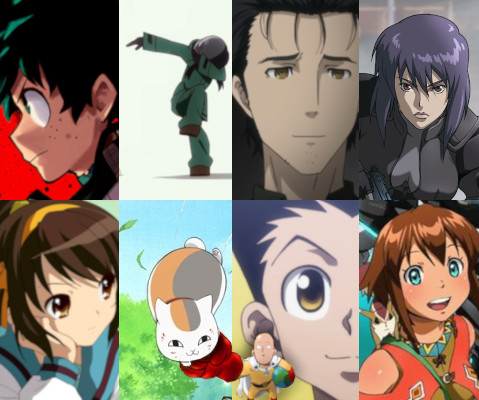
Summer Season 2019 Preview

Wooper: The sun is shining, the temperature is rising, and the anime just keeps on coming. It’s time for our quarterly season preview, which we’ve trimmed down so it can look its best for the summer. Unlike previous editions, we won’t be examining every new show in this post. Instead, we’ve picked the 16 most promising and/or popular shows to preview (though there’s a bit of fodder near the start), and kept the rest confined to the poll down below. We’re still planning to give our thoughts on every summer series during First Impressions week, but when it comes to the season preview, we want to highlight the good stuff – or at least the stuff that won’t make you wonder why you’re an anime fan.

Most seasons have just a few great titles concentrated at the top, and this one is unlikely to be an exception. What’s interesting about this particular summer, though, is that the three most anticipated non-sequels are all action or adventure series. Two of them are big shounen properties, which our authors tend to have mixed opinions on, but these appear to have some serious promise. Will this be the miracle season where we all agree on what’s top tier, or will a handful of underdogs steal the spotlight once July gets underway? We’ll find out in a few weeks, but for now, let’s run down what might be worth your watch this summer.

What will you be watching this Fall?


Kengan Ashura

Studio: Larx Entertainment
Director: Seiji Kishi
Series composer: Makoto Uezu
Source: Web Manga

Mario: Another Netflix original offering and this show looks and tastes like Baki from last year, with the trailer focusing solely on their fights. Moreover, it’s an entirely CG show that sadly doesn’t look that polished. While all these are enough for me to discard this show, there’s one saving grace from the show that holds me back. The key here is the director Seiji Kishi, who directed popular hits like Angel Beats, Assassination Classroom, and MY TYPE OF SHOWS such as Humanity Has Declined, Tsuki ga Kirei and Asobi Asobase. That being said, apart from Assassination Classroom, this is the first anime where he ventures over to shounen action-centric material, and the fact that this is his first full CG project doesn’t spark much confidence. I don’t know. I grow mixed on the Netflix model when it comes to how they handle their original anime. It’s true that they have larger budgets and allow more creative freedom, but for me they aim for more mainstream tastes. Stuff like Baki, this one or Ultraman last season aim for specific fanbases, and their more flashy titles: Carole & Tuesday, Little Witch Academia, Violet Evergarden are products of famed directors/studios producing something weaker than their true talents. Maybe just like last season’s work by Kenji Kamiyama (Ultraman), this one will come and go with a weak splash before vanishing altogether.


Arifureta Shokugyou de Sekai Saikyou

Studio: Asread, White Fox
Director: Kinji Yoshimoto
Series composer: Shoichi Sato
Source: Light Novel

Wooper: I managed to sprint through a few chapters of the Arifureta manga before I had to bail out. It’s based on a light novel, but assuming the manga’s story and characters are the same, the author must have been playing isekai bingo when he conceptualized the series. The MC is an Average Gamer who somehow attracts the attention of the school idol, and is therefore hated by all the handsome, athletic bros in his class. One day, when their bullying gets particularly vicious, he wishes they’d all get transported to a parallel world – and that’s exactly what happens. Video game logic sets in pretty quickly, everybody starts dungeon crawling, and eventually the nice guy protagonist is betrayed by one of his classmates and loses an arm. Last year’s Shield Hero was insulting enough; I don’t need to read any further to recognize this as one of its clones. Really, the only reason I previewed this was to look back and say “I told you so” when its defenders get to the penultimate episode and realize it was a waste of time. Not even White Fox, who usually do good work with fantasy series, can save this premise. In summary, if you’re thinking about watching this, don’t.

Continue reading “Summer Season 2019 Preview”

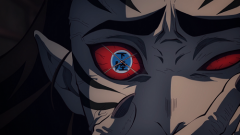
Kimetsu no Yaiba – 10 [Together Forever]

Welcome to another week of Kimetsu no Yaiba, where we finish up another little arc. This time we get a lot of monologues and some brutal deaths closed out by some wholesome Nezuko. Let’s dive in!

Like always, Yaiba looked nice this week. Some may complain about CGI and such, but I think Yaiba is pulling it off quite well. It’s still obvious but Ufotable is leaning into it. In particular I enjoy the smoke effects and such, they work without being to campy. However Yaiba’s big problem this week in my opinion were the monologues. They really hurt the pacing, cutting between moments of action. Combined with last week, it feels to me like they could have combined most of the two into one. Cutting out a lot of the spurious dialogue for the same net result. Because what surrounds it is good fun mostly, I can look past it for the most part. However it does show that Yaiba isn’t free of all the usual Shounen tropes. That said, onto the contentious meat of the episode.

Continue reading “Kimetsu no Yaiba – 10 [Together Forever]”

Mix – 10 [Just a Walk]

Love is in the air for seemingly every teenage character in Mix’s growing cast, and with no baseball game to distract them, this episode is entirely dedicated to complicating the show’s relationship chart. Even the cold open is a miniature romantic farce, with minor characters Nishimura and Arisa deluding themselves into viewing a conversation between their rivals as something sinister. Arisa proves far more adept at this deception, especially when you factor in the cluelessness of every male character to make it on screen before the OP. Honestly, I don’t remember the names of all Otomi’s would-be suitors, but when [Touma’s friend] and [Otomi’s classmate] came sliding down the hill and into an already crowded scene, I was kind of apprehensive. Sure, I got a chuckle out of the various characters’ desperation and exhaustion, but this felt like the opener to a lightweight episode – or so I thought. Thankfully, “Just a Walk” ended up being one of Mix’s best episodes yet, and it’s all thanks to Haruka Oyama.

Until this point, Haruka hadn’t done much except fill the role of girl next door, but this episode gave her much more to do than that. It’s not as though this episode changes her proximity to the main characters’ house, or makes her any less attractive to Souichiro and Nan-chan (who’ve been frequenting the ramen place where she works part-time). But it does give her a lot more personality, and reveals her past acquaintance with Touma, who she met at a funeral at age three. Turns out she’s got a killer memory, having recalled their encounter from all those years ago – and she likes how he’s grown up. This sheds new light on her cryptic question to Otomi several episodes ago: “Are you worried?” Haruka was feeling her out even then, probably suspecting their shared crush on Touma, and now she’s making her move. Her method of sending him an invitation he can’t refuse was too cute, to the point that I started laughing when Touma automatically greeted her with the go-ahead phrase “good morning,” and she responded with a salute. Their date poses a problem for the hapless kid, as he understands the significance of Sou’s sudden ramen addiction, but after falling into her trap, what choice does he have?

Instead of getting sappy, Mix maintains its wry sense of humor even as the two go out; Touma’s impatience with their multiple train rides leads him to make several comments about the “walk” they were supposed to take. Said walk is mostly uneventful, but the show threads together Haruka’s admission of recognition with a separate funeral story, which depicts three year old Touma as a cheerful kid who had trouble processing his mom’s passing. This detail launched me back to a related one from early in the episode, where Touma remarked to his stepmother that Sou and Otomi were “depressed and unsociable” when he first met them. Connecting these dots was my favorite part of this week’s Mix, as they indicate that Touma still may not have grieved for his mother’s death. To have held on to the idea that two children mourning the loss of a parent were “unsociable” paints a picture of repression, at least in my view. Suddenly Touma’s isolated outbursts on the baseball field make a bit more sense, as well… I really do love Adachi’s character writing, and episodes like this one are great vehicles for it. Now, if only I knew how many more episodes we could expect before the show takes a hiatus.

Sarazanmai – 09 [I Want to Connect, But I Can’t Express It]

Well, I definitely didn’t see all this coming. Sarazanmai comes back in a big way, at least for me, now that every plot thread starts to go in the same direction. We have Kazuki, Toi and Leo are all losing someone dear to them and trying to get a Dish of Hope so they can revive that person. Before I get into the details, I consider both the prologue and epilogue this week as Sarazanmai’s highlights, as each segment showcases different side of this show that tell you a lot about its identity. The prologue is the most playful (read: bizarre) segment except maybe for “getting the shards out of zombie’s butt” part, where Sara slips the freeze-Kappi out to the street and he literally gets broken in pieces. It’s bizarre and it’s wonderful. The epilogue goes in opposite direction and serves as Sarazanmai’s most tender moments. Not only the sad piano tune does its job, the use of montage the constantly swifts between their memory together and their current situation pretty much brings the emotions forward.

The rest of the episode is no slouch either. While I’m one of those who lament the fact that Ikuhara’s ambition is too great for a 1-cour series, one of the strength of having only 11 episodes is that the plot is much tighter and has more purpose than his longer series. This week, for example, not only one, but three characters, are having someone close slipping away from them, although it’s hard for me to draw more parallel regarding their relationships. While Reo & Mabu and Toi & Chikai relationships go in dark places, the way Kazuki feels about Enta is in totally different light. It would make much more sense if Entai was the one saving Kazuki. By no mean, what I just said meant to be a criticism, more like an observation, given Kazuki is a MAIN main character. With Enta is in his (death)bed, it’s time for him to re-examine how much Enta meant to him and comes to learn Enta’s affection. At the same time, Keppi is revived (or more like, reanimated) and he also revives Enta (in a way) in his kappa form, although the clock is literally ticking here. Kazuki also has a chance to truly talks to his brother for the first time. Those are nice developments, albeit predictable moves to get Kazuki into the centre of conflicts.

Because the other threads aren’t that straight-forward. I must say that even now I don’t really buy the Otter vs Kappa war and I’m glad that it isn’t really the focus of Sarazanmai. In fact, this episode gives some reasons for me to care about Mabu and Reo. Reo has been struggling with the feeling he has for  the new Mabu (love or desire), one who has similar appearances yet behaves like a stranger. But the interesting twist happens when the red-eye otter intimating himself as Reo to suck out the “desire” from Mabu. The fake-Reo inserts that he’s the “desire” inside Reo, more as an implication that Reo’s love for Mabu is all about desire and obsession. The other interesting angle is that Reo keeps rejecting the current-Mabu. What if it wasn’t Mabu but Reo’s own perspective change? In any case this thread weaves tightly the the “connection” theme and to the main overarching narrative. And speaking of that, the fact that both Otter King and Keppi have the same red eyes strike me as odd. Maybe they are more similar than you would think.

Lastly, the title of this week could apply to any character in Sazaranmai, but it fits best to Chikai. The one big lesson we learn this week about him: he’s an bad egg all the way and he’s incapable of loving someone, save maybe for Toi. It’s this dark and tormented relationship between Toi and Chikai is where Sarazanmai shines the brightest. From Chikai’s point of view, he knows that he’s using Toi, but he does it anyway. “You’re a little too good to be my little brother!” pretty much sums up their chemistry. Toi is desperately following him around and even protecting him, while it becomes clearer and clearer that Toi is walking down the dark path. Sarazanmai raises a red flag right there where Chikai shoots his subordinate to cover his track. Would he do the same to Toi, when Toi is not needed anymore? Maybe. While the flashback and his final remark “Connection is just a pain” and his cash might appear that he was intended to get out for good with Toi, his resentful delivery tells me otherwise. For Chikai, only the bad survives and my take is that with Toi’s unshaken devotion to him, it’s only a matter of time before he self-destructs and kills Toi instead. That’s all beside the point now, though. With the final Dish of Hope that served as the new MacGuffin, the last two episodes are going to be thrilling, and I would expect – unpredictable.

Serial Experiments Lain – 6 [Kids] – Throwback Thursday

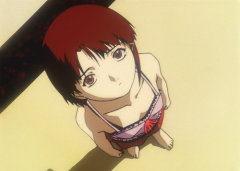
Welcome one and all, though its a day late and no longer Thursday, to the episode where Lain truly begins. I think. Really, I am not sure anymore, but this week Lain becomes a God, her room becomes a cave cave and dresses nice for once. Lets dive in!

Now normally I open these up with the production aspect, but you know what I think at this point. Lain is a very static show visually, that has more interesting shot composition and visuals than it does animation. Instead I want to ask a question about how every episode starts. That same street, that same line of “Present day, present time”. Is this supposed mean that Lain is occurring right now? Under our very noses, without society noticing? Grand events playing out while the wider world is unaware? Its the only explanation I can think of, at least that’s positive. Because Lain generally overlays a speech of some kind over it. Whatevers related to the episode. It could just be part of an extended OP, with no greater purpose. But that would be disappointing after what the series has shown thus far.

Continue reading “Serial Experiments Lain – 6 [Kids] – Throwback Thursday”

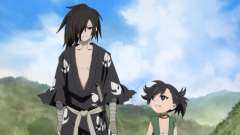
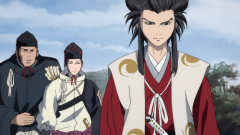
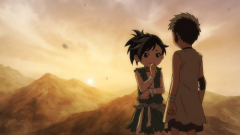
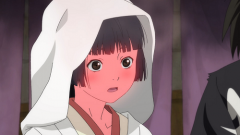
Dororo – 21 [The story of breaking the cycle of suffering]

Welcome all to what is the beginning of the end for Dororo. Tahomaru and Hyakki meet once more, war begins and things start to get complicated. Let’s dive in!

Starting off, production felt very lazy for the most part this week. The last 5-6 minutes or so was great. The fight was a lot of fun to look at. So much so that it almost seems to me that Tahomaru is the sign for good animation. Other than that though Dororo was just… boring. There were a lot of still pans and cutaways. Reused footage from previous episodes and odd framing. Similar to OPM Season 2 really, where faces would be cut off by the top of the screen. The only movement being the occasional hand gesture on a still screen. Had the last 5-6 minutes not happened, this episode would be a wash. As is, the only part really worth watching is that section. As everything else is setup that, really, we were already were aware of. Enough ribbing though, let’s get into the meat.

Continue reading “Dororo – 21 [The story of breaking the cycle of suffering]”

Mix – 08-09 [My Brother/Big News, Right?]

We may have entered the high school phase of Mix’s story, but the show is still having fun at every opportunity. The opening of episode 8 celebrates the Japanese tradition of glancing up women’s skirts when the wind blows, while a terribly misused ska song plays in the background. Institutionalized sexism has never been so appealing! Then there are the references to a past incident where Coach Oyama saved Nan-chan’s life, with both men pensively staring through rain-soaked windows at different points in the day. In any other series these thoughtful moments would set up a lengthy flashback, but Mix just cuts away and laughs at our expectation that the trope would be fulfilled. Even the main story of these episodes – the practice game against Toushu High – is dotted with the ridiculous banter of the pitchers’ younger sisters. The show is certainly enjoying itself, but it often feels as though it’s winking at us. Be it the show’s self-referential nature or its tendency to speak directly to the audience, these moments run counter to its natural dialogue and simple design work (in one man’s opinion, anyway).

Talking about the practice match versus Toushu, it’s a chance meeting that creates that possibility (as is often the case in life). The new sibling pair of Arisa and Hiroki Mita both find themselves at a family restaurant with Souichiro, where the proud Arisa introduces her brother the star pitcher to Sou. The younger sister is only interested in making herself look impressive by proximity, but she ends up instigating a rivalry between Hiroki and Touma once their game gets going. Mix draws some very clear parallels between the two boys, the biggest of which is their tremendous talent even as first year high schoolers. Hiroki managed to lead his team to the quarterfinals of the Koushien as a freshman, and though he’s older now, Touma matches him pitch for pitch once he enters the game. Toushu is the third or fourth school that Mix has raised as a potential opponent for Meisei, but the similarities between their pitchers puts Toushu first in my mind. After this game, Touma’s spot as the starting pitcher is all but assured, though I don’t know if his first year of high school will be the one that the series ultimately focuses on.

The younger Tachibana’s ascension is big news for nearly every character in the show, as the title of episode 9 would lead us to believe. It’s a seismic event for every baseball player in the cast, and a matter of pride for Otomi, who has all the faith in the world in her stepbrother. Even their father, who dreads the extra visits from Touma’s alcohol-jacking coach after such a performance, is impacted. Despite all these changes, however, the fact remains that Meisei lost the game, and their youngest pitcher isn’t happy about it. After the game, he sulkily regrets the netting that prevented Hiroki from confronting a disrespectful spectator, as a violent act would have disqualified him from the summer tournament. Otomi beats him about the head with a bucket for that remark, then ditches him to accompany her class heartthrob to the hospital. It’s here that the show returns to a type of comedy that I love: understated humor meant to mask displeasure. Touma turns to his pet dog, bucket now in hand, and remarks that even if he takes a larger-than-average dump, they’ll be covered. Hopefully you’ll pardon the extensive recap of a minute-long scene, but boy, did Mix manage to impress me right as this episode ended. The next one ought to give us a little break from baseball, so let’s hope the show’s pleasant subtlety carries over!

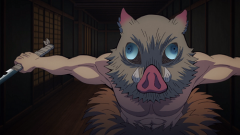
Kimetsu no Yaiba – 9 [Temari Demon and Arrow Demon]

Welcome one and all to what I would describe as the first concerning episode of Kimetsu no Yaiba! This time we have a lot of reused footage, a beautiful muscle bound woman and a fun fight. Lets dive in!

Starting off, repeating sequences aside, Production is the one area Yaiba had no issues in. It looks fantastic. Yeah, sure, the CGI was noticeable. You could tell when Tanjiro’s face became a static 3D model and such. But the actual movement in those sequences looked fantastic. Using the full environment, holding the shot as Tanjiro jumps off the wall and twists around the screen. It all looked very fluid, however noticeable the change in medium was. The water effects also continue to impress. The stark blue, and thick black lines really make it stand out beautifully on screen. All in all I loved it. Before jumping into spoilers this week though, I want to thank commenter Revokkin, for correcting me on Yaiba’s composer. As it turns out Go Shiina is also responsible for the music with Yuki Kaijura. So we have to thank them both for this great OST.

Continue reading “Kimetsu no Yaiba – 9 [Temari Demon and Arrow Demon]”

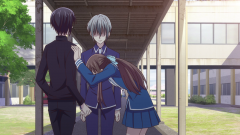
Fruits Basket (2019) – 09 [Yuki Was My First Love]

I think I’m not alone when saying that these last two episodes of Fruits Basket aren’t their best material. With the announcement that Fruits Basket is going to have 3 seasons, I can understand why. Episode 8 for instance is where Fruits Basket padded out its material too thin, with all the familiar narrative beats that we already experienced in episode 5 (when Tohru went back to her relative), with a much lesser effect. Episode 9 has different issues, that is in the name of the newcomer Haru. Just to be frank Haru character isn’t that interesting. While I’m not going too far to say that he’s a reverse Kaguya, he does have some similar traits. The way his affection lies towards Yuki (as the episode title clearly shows) is… obsessive just like that of Kaguya, and I don’t think I need another character who involved in constant catfight with Kyou. His most distinctive trait seems to be light/dark Haru, where light Haru is a absent-minded, oddball Haru and dark Haru (triggered by Kyou) is a crazy, hot-tempered Haru, and sadly I don’t find either of these remotely interesting.

There’s one character development that Fruits Basket nails it about his character, however, and that is his flashback towards Yuki. As the original Zodiac tale goes, Haru had always felt shame about the story of Rat using him to finish first in the race, to the point that he harbors a hatred to Yuki, even without seeing him. When he meets Yuki for the first time (and exploded all his insecurity to him), he realizes that Yuki shares the same pain he does, to a larger extend. It fits what we know about Yuki’s character, and it’s sad to see him suffers that loneliness even when he was a kid.

Sadly, that’s the only highpoint I can give to this episode. “Repetitive” is the main issue I have here. At this point the chemistry between the lead trio is solid, but it needs to break its current status quo. There’s only so much if seeing them enjoying their everyday life with Tohru being happy of being housewife and the other two engage in a constant juvenile fights. Speaking of the former, I found the early scene where Tohru buying groceries alone while the two boys waiting outside, doing nothing extremely dated and overtly traditional, which reminds me again how old this source material is. Speaking of the latter, I grow a bit tired of Kyou and Yuki fighting nonsense. Tohru’s character doesn’t fare any better as despite she has a solid character arc, her behaviours, or more like, her humbleness and her oblivion towards others’ feelings, don’t do Fruits Basket much justice. I would love to see the show tries more than just maintaining its status quo.

Carole & Tuesday – 08 [All the Young Dudes]

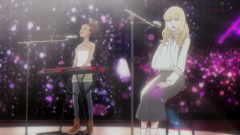
A rather straightforward episode that details on the duo’s journey to American Idol Mars Brightest, this week feels like those competitive singing shows we normally watch on TV with a colorful set of oddballs. As such, this episode’s main appeal lies less in narrative strengths but more about music and the fun when these music redefy its singers’ traits. But let’s focus first on the (little) narrative this episode has. It’s obvious from day 1 that Carole & Tuesday will eventually face Angela in the final, a sort of showdown between fame vs rookie, artificial music vs genuine one. This episode makes one significant step into that direction, as Angela “acknowledges” the duo’s talent by flat-out says she dislikes their music. It’s fun to see Angela acts like a total jerk towards her new manager (subtlety about her bitchiness is out of the window but hey, it’s fun to watch) and I suppose she will have to go through a phase where she accepts this new hapless manager and deals with her “Mama” issue (who we find out in one of her pic was a man years ago). But that is for future development. For now, Angela will show her true power in the next episode.

I’m still a bit split on the way this Mars Brightest functions, as a nit-picking note. Choosing 8 talents out of thousands just based on single short performance isn’t credible, at all (there’s no way an actual musical contest work like that to begin with). What’s fun is that these 8 contestants do bring out their unique personality just based on their appearances alone. Add to that we have these songs and styles that constantly bring out different side of them, and well-composed music on top of it. Take the three performances this week, for example. Fire Brothers are old deaf twins but still manage to bring fire, quite literally, with their meTAL GROAning. The social network sensational Pyotr’s performance makes it clear that he’s serious about this contest, even if he normally brush it off. And finally, and most interestingly, OG Bulldog, appeared as ex-gangster, does a hybrid opera-rap that takes everyone, real listeners included, by surprise. The show smartly uses a typical hip-hop beat and lets it run wild before OG Bulldog sings the first verse. The weird hybrid makes it my favorite performance out of the four.

Unlike the audition stage in which the judges are too plain (Wooper pointed that out in his post), these three judges nail their assigned “roles”: a strict Catherine, a fashionable Benito and an AI judge Shakti (an interesting twist). I’m actually agree with the judge regarding Carole & Tuesday performance, that they are the plainest. And this is one of the many issues I have with the show so far. Not only the titular characters are the least development ones, they are given too much “special treatment” from the show, that their singing can win people over (it doesn’t with me. Too plain). There’s also Cybelle, one of the contestant, who has a yuri affection to Tuesday. I suppose she’s going to be some sort of the duo’s sidekick in the future. At this point, I’m pretty much loose hope that Carole & Tuesday as a ambitious show. It doesn’t have the aspiration that Shinichiro Watanabe usually brings, but taken as a popular mainstream show it’s still enjoyable week after week.