Mirai (2018) Movie Review – 81/100

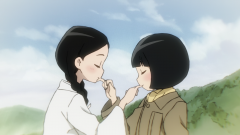
Watching Mirai, there are two observations that spring right up to my mind: Mirai is Hosoda’s most grounded, personal film and it plays out completely different from what I expected based from the promotional materials. My feeling is confirmed when I later learned that Hosoda based the concept from watching his own children’s react, and that his daugher is indeed named Mirai. The film centres around the 3 to 4-year-old Kun and details how he cope with the appearance of his younger sister, Mirai. While the PVs play as if this is an escapist adventure in the vein of Peter Pan between Kun and Mirai the teenage version, Mirai is instead an episodic film where Kun meets various family members in different timelines and come to learn some “life” lessons. Its more realistic setting and its small-scale family drama are a stark different from his more fantastical (and messy) previous works, but it should relate well with kids and moreover with parents who have experienced these before. To put it better, Mirai is a perfect family-oriented feature that respect the child’s point of view with all the mature sentiments behind it.

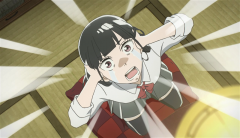
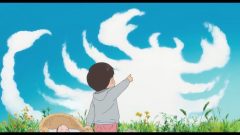
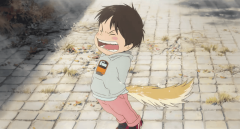
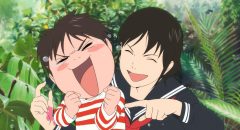
Mirai’s episodic segments all share the same formula: Kun is dissatisfied with how the baby sister takes all the attention from his parents, he throws a tantrum, he’s miraculously thrown into another timeline where his relatives live and he grows a bit in the process before transport back home. If it sounds a bit like a gimmick, it doesn’t because all Kun’s issues are very believable for the kid his age. Children always feel left out when their “prince” status fall apart with the appearance of some annoying baby. Mirai really nails it when it exaggerates Kun’s outburst with comical distorted face that can only be done effectively in this medium. The film also understands the kid’s imaginative mindset. Kun’s at the age where everything seems possible, where dog can talk and act like a prince, where his Mama is just as messy as him when she was young, where Mirai appears as a high school girl.

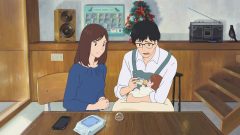
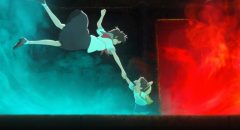
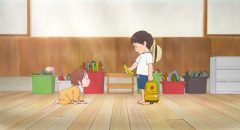
It helps that the episodic segments feel like true adventures with many different settings. There’s a sense of wonder everywhere, and the production has a chance to stretch their muscles by breathing life and details to these different era. In one instance Kun is lost in a Hell-like train station, the art appropriately goes impressionist and nightmarish. In other instance (and the only time where it happens in the present), Miral the high-schooler, along with Kun and their dog in human form have to find a way to take down the dolls (Hinamatsuri) to save Mirai from “late marriage”. These moments like this not only help the members of this family bonding deeper, it also helps Kun to appreciate his family more, especially to his younger sister who he seen at nothing but a burden. If I have one minor nitpick, it is that I find the segment where he meets his great-grandpa a bit far-fetched since he doesn’t even meet the old man in real life. But in Mirai’s defense, it’s actually one of the most meaningful story in the film so  well, it’s deserved to be there after all. There’s also some moments where the film take on adult’s perspective. Especially the time where the father has to do real houseworks for the first time, thus he learns how he had been slacking on helping his wife all these years. These instances ring so true here.

But the most impressive thing Mirai pull off is how all these stories add up to paint the same family bond theme. It’s like different branches of the same tree – an apt metaphor for this film given the film frames these stories as threads connected by the grand tree that transcends multiple generations. It’s an ode to the family where every family member’s life sounds just as wonderful and epic like famous figures; where every action, every decision connect and interweave that result in the present-us just as we are now. The settings themselves have a lot of personality in Mirai, especially their house with multiple levels and see-through glass and big garden that easily triggers any kid’s imagination. You can also spot some of Hosoda’s directional trademarks like his lateral camera movement that detail members (usually the father) doing housework in a nice flow of time. There isn’t a lot of dynamic animation, but the character animation is top-notch, especially when the film deals with children expressions since they have much more movements than the adults. The most stand-out sequence for me is the one where there’s only visual storytelling about his great-grandfather and his running challenge. Just seeing how that scene play out brings tears down my eyes. It’s powerful precisely because it keeps the moment “small”.

After a string of movies that entirely focus on grand, fantastic story, I understand why some of you might be let down by this small-scope film. It’s a film with almost no real ambition but I beg to differ on that. Here’s where I like to compare Hosoda with Shinkai’s previous inputs. While Shinkai’s latest expands his scope and finds himself in tune with the general audience’s appeal, Hosoda limits his scope to the theme that he knows most; and cares the most. And that is perfectly fine. Every auteur has at least one personal film in which they disregard any artistic or financial merit and just make something that meant the most to them at the time. It’s the small cozy real-world brush that makes Mirai so enjoyable, relatable and feel almost like home.
Fate/Extra Last Encore Anime Review – 40/100

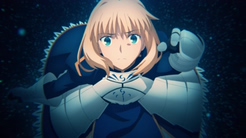
To many the Fate series is daunting with its numerous incarnations and spinoffs and here in the year of many a Fate adaption we get another one by Studio Shaft which was first thought to adapt the story of the PSP game Fate/Extra. Fate/Extra could basically be considered Fate with a sci-fi twist as this entire series takes place in a virtual reality where a massive Holy Grail War is taking place. The protagonist Hakuno and his Saber Servant must advance up seven Floors while defeating the servant and master that guards each floor to reach the Holy Grail at the top. The scenario itself certainly feels like that of a video game but this anime is not actually an adaption of the PSP game but instead an alternate retelling/sequel to that game. Despite claims from the writer that this anime could be experienced blind, the story itself does require context from the game to understand the story as a whole.

I will say that the story of this anime does sound good on paper and I am sure if you read summaries on each episode you would find yourself interested as the events of this anime do sound exciting, at least on paper. However the execution is botched heavily as the story was essentially a novel written by the author and handed over to be adapted into a anime screenplay. It’s source trappings remain in the show as Fate/Extra is an anime that prefers to tell you it’s story rather than show you it. There is an unforgivable amount of exposition and characters are not developed enough to make such copious amount of exposition interesting. The main character is essentially characterised as having no personality besides a vague anger which makes him a poor foil to the heroine of the series who mainly acts as fanservice. The massive amount of dialogue and Shaft being the animation studio has had people referring to this anime as Fatemonogatari which certainly seems like an apt comparison. The show is mainly dialogue and the battles between servants and masters on each floor all feel uninvolving and anticlimactic. Not helped when each fight either boils down to the protagonists trying harder or pulling out some previously unmentioned dues ex machina. I will say that Shaft make the show quite visually striking and there is some legitimately beautiful aspects like the illustration of the servant master duos in the episode endings. However the animation isn’t as strong as some other Fate entries and this series can take a bit too many of Shafts quirks as an anime studio.

The show follows a fairly formulaic pattern which makes the show feel vacuous as it continues to progress but the characters on screen remain machines for exposition or meaningless dialogue. What is likely intended to be the driving force of the series is the mystery behind what is actually happening as the story itself is very stingy on the details of what is actually happening causing many a viewer to just think “What?” which is the intention of the author but sadly backfired. Anytime you feel you are beginning to understand just what is happening in this show, it throws another curve ball and leaves you trying to figure it out all over again. Once pieced together the story becomes more straightforward but instead of being a rewarding experience to puzzle out it just becomes a reason why the viewer becomes so disconnected to the events on screen as we can’t engage if we are too busy trying to get to grips with what the plot even is. Upon its conclusion it just feels empty and meaningless, providing nothing of worth nor entertainment. Music didn’t leave much of an impression either. Overall there does feel to be a story under all this which could have made for a pretty good anime but the execution of it’s ideas where botched to the point that it just feels soulless and vacant , lacking anything which makes it recommendable besides finding out where that girl who looks exactly like Saber but in a red dress came from. Even then playing the Fate/Extra game would be a better experience even if that too isn’t perfect. So I pray…for Fate/Extra CCC to be localised for that certainly seems like it would beat out both the previous game and the anime. So get on it Marvelous or Xseed.

Darling in the Franxx Anime Review – 57/100

In following anime seasons it can be quite an experience to follow a show as it airs as the hype and rollercoaster of reactions can be entertainment in its own right. In that regard Darling in the Franxx was a hell of a ride as week by week peoples feelings for it ran hot and cold. An odd aspect of this show which I found troublesome is that I was never quite sure how to evaluate it. For example, if you were to ask me if I enjoyed Darling in the Franxx I would have to say yes, week by week it certainly was an enjoyable watch at least up until it’s final four episodes. But at any point of this series if you asked me if I recommended it then that would be met with a solid “Hmm..I wonder”. Because this show is a mess. There are sudden tonal shifts as it jolts from lighthearted comedy to dead serious drama. At times it can be a grim as Evangelion and at others it can be as ludicrous as Kill La Kill. Sometimes it can have a great episode and other times it can have a trainwreck of an episode. Sometimes it decides to take it’s time and others it moves the plot along at lightspeed.

Developments can be forced and others can be decently thought out. Suddenly stakes are raised only to be negated on episode later. Interesting Ideas can be brought to the board only to be thrown aside. It even starts with joking double entendres with stupid fanservice while portraying a tale about child soldiers in a dystopian regime. This is a confused mess of a series that didn’t know where it was going nor what it was trying to accomplish which results in a storyline which feels like it’s reaching for the stars with the right hand while attaching weights with the left. Do I like Darling in the Franxx? Honestly with the bad taste the final few episodes left me which I would be inclined to say no but there was a point where I legitimately thought this series could turn itself around and become something to be remembered.

The story would be familiar to who’s familiar about the Mecha Genre as it is about a bunch of teenagers who pilot giant robots to fight off some unknown monsters. What made Franxx stand out initially was its focus on sexuality with the male and female pairings to control robots and on the dark insinuations of the dystopian society that these children lived in. However as the series continued it eventually scrapped all this and became a derivative of many a Trigger/Gainax anime before it. The characters can be enjoyable and likeable provided the plot doesn’t force them into a hateable position for the sake of drama with the titular character Zero Two acting as poster girl for the series. If there is one thing that likely carried the series in its weaker moments it’s likely this cast of characters as while not particularly deep, they still proved likeable and relatable enough to care about their circumstances.

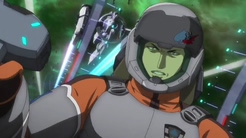
The opening is alright with the general soundtrack being passable. Animation wise it could be quite impressive with the show forgoing CGI mecha and instead having 2D drawn mecha. The action set pieces can be a spectacle. Ultimately this is a show that some might enjoy up until it’s final few episodes wherein I would find it could leave them disappointed or disgruntled. It’s a series that shouts a lot but says nothing. One which is a rollercoaster of emotions that when it ends makes you question if you really had fun with it. A deeply flawed series which I cannot completely dismiss as garbage yet cannot praise as well. When all is said and done, Darling in the Franxx just left me empty, apathetic as the finale unfolded and I was left watching credits. I would say the best metaphor for this series is that it is like scoffing down junk food. While eating it’s tasty and satisfying but as you run out you find yourself sick of it and feeling the pains of your digestive system. Left wondering why you bothered eating it in the first place.

Hisone to Masotan (2018 Spring) Review – 73/100

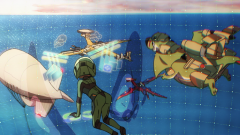
Coming off as one of my most anticipated anime out of this last Spring Season, based solely on staffs involved alone – after all, an original anime written by Mari Okada and produced by Bones (which I regarded as one of the best anime studio working right now) – I can’t help but feel let down towards how HisoMaso progresses and wraps up. It’s a show with many highlights, mind you, as I consider the production as one of the best of the year so far: simple yet expressive character designs, stunning backgrounds and crisp animation. All you could ask for really. It has some interesting ideas, but that precisely pains me even more that the world-building just doesn’t support the ideas HisoMaso has.

To begin with, let’s address my main issues regarding this production. Unlike other anime shows which bring themselves down by treading the same tired path, HisoMaso is a show with many fresh concepts. I would applaud anyone who can think of the idea of them inside the dragons and piloting (note: not riding) as a military fighter jet. It’s a wonderful and whimsical mix concept that fit into the easy-going tone and the simple character designs. In fact, the first few episodes still carry this concept forward due to the fact that it never takes itself seriously. That’s when the issue arises when we need something more substantial when the appeal wears out, and it becomes increasingly frustrated to see the plot progresses without any backup. As an example, the show introduces the whole “ritual” concerning the whole giant dragon which “wakes up” every 82 years. It opens a whole new can of worms regarding the whole village who dedicated themselves solely for this event and even the process of it all. Equally under-developed and underwhelmed is the anastomosis bit, which for me is the prime example of creating conflicts solely for the sake if conflicts. As it stands, HisoMaso often feels like a first draft on a novel, many wonderful ideas but all of them are half-baked because the creators just don’t spend enough time to think this through.

The half-baked approach spread into the characters themselves. These girls have many quirks that distinct them to the rest of the cast, but at the end of the day there simply isn’t much development for them, or the development feel calculated and forced. Take Kinutsugai and Hitomi, the D-pilots who appear at the poster and the ED, HisoMaso just doesn’t know what to do with them. Same thing regarding the dragons, which feel more like mascots. The main lead Hisone embraces what could be the worst tendency of HisoMaso’s attempt of developing characters. Like the show, she tends to tell us out loud what her issues are, and like the show she tends to make rather weird decisions. Many of her conflicts are raised and solved within an episode, as a result the development doesn’t feel earned.

Speaking about making weird decisions, I can’t still put my fingers on the central message of HisoMaso. In some ways, Mari Osada underlines the struggles of working women in Japanese society, as they have to choose between career and family. Having Hisone and Hoshino fall in love that could potentially cause negative impact on piloting the dragons is part of that strategy. But how do they deal with it? By having the entire army unit work on “make them fall in love then crush their love apart”. That’s mean-spirited to the point of stupidity. On that note, they didn’t resolve the love’s conflict thoroughly either. Second, HisoMaso marks the relationship between the dragons and their pilots, as we see in how Hoshino struggling as she considers herself “a pilot” – not dragon caretaker; and we see the theme reflected by the titular characters. But the problem with its is the way Hisone regards her dragon. She considers Masotan as someone who see the specialness in her, and piloting dragon is something that make her worthwhile, as a result in episode 3 we have something as obscure as her demanding Masotan to “take responsibility” because he picked her. That level of dependence repeats later on, when Hisone argues with another girl solely about a boy. This questionable treatment to women is unacceptable, especially with a show about adult women written by an adult woman. As a result, HisoMaso become the first show from 2018 that receive a minus (-) mark from me.

But what HisoMaso makes up for the under-cooked story is the sheer power of visual presentation. Everything looks great, the characters are on the simple design, but that’s exactly why the studio can go wild on their facial expressions and characters movement. What it’s lack from the character depth is replaced by their mannerism, in which each character moves differently and has different tones. The background designs are simply gorgeous with bright color palette, and the animation are crisp and a feast to an eye. If you don’t mind the lack of deeper layer, HisoMaso’s aesthetic alone would serve as a visual treat. Indeed, at top of my mind only the recent FLCL’s production is on the same level with this show for the first half of this 2018 calendar year.

So yeah, HisoMaso is a show with many highs and lows. Its visual strength is amongst the best of the industry right now, and it’s an easy watch all around with some emotional resonance. The lack of a well thought-out world, however, hurts the show since it’s crumble as it moves along. It’s still a show worth checking out, but don’t delve too deeply into it.

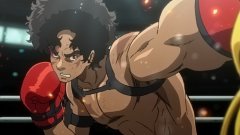
Megalo Box – 70/100

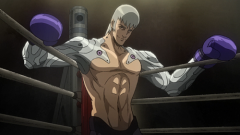
Ah boxing, the quintessential manly man sport of beating each other unconscious. In anime, the sport was first forged in the fires of Ashita no Joe, and some would say later perfected by Hajime no Ippo. Both fantastic series in their own right. Both filled to the brim with epic clashes of wills, phenomenal characters and some of the best fight scenes in anime. Some would probably count Megalo Box among them, near the top of sports anime. I am not one of them. For you see, Megalo Box is not a boxing manly mans sports anime. Megalo Box is a character drama. With boxing.

Lets jump in!

Continue reading “Megalo Box – 70/100”

Legends of the Galactic Heroes Die Neue These Anime Review – 80/100

This is a remake of a series made way back when which is one of the most highly acclaimed anime in the medium. It is of legendary status but you would be hard pressed to recommend it as to many the barrier of entry is too high to consider. A 110 episode OVA with dated animation and art is hardly an appealing show looking from the outside. Thus we have Die Neue These, a remake which takes the story of LOGH and sticks closer to the original source material of the novels. Acting as a small offering of what makes this series so highly regarded. LOGH is a story set in the future that plays out like actual history, for the stage is grand and the cast is huge. It is about a war between the Free Planets Alliance and the Goldenbaum Dynasty, one being a democracy while the other a autocracy. The series explores these two systems exposing the ideals and flaws of both as while there are large space battles, the true worth of this series is the great amount of politics that surround this war. Even though the story was made over thirty years ago, it’s messages still ring true today making it excellent food for thought.

The series mainly follows the two heroes representing each side, with Yang Wenli being the believer of democracy and a man who seeks a easier life but is pulled time and time again into historic battles due to his talent for strategic combat. Reinhard is the young upstart of the empire who wishes to rise through the ranks to reform the heavily corrupt society of the class system of the empire. The story can be a bit erratic as it jumps forward in time and it can be hard keeping track of the large cast of character which just seems to expand infinitely. The space battle remain the weaker aspect of the series and from word of mouth it appears the strategy employed is only base level tactics. There is also a common factor of highly incompetent people in high positions that gets reused time and time again as justification for the actions of the plot though not necessarily unrealistic. Also is the factor this is very much only a tenth of the full story of LOGH and when this show reaches its final minutes you may not even realize that it has concluded for the story just cuts off like someone slamming a book shut while you were in the middle of a chapter. There is plans for movies to continue the story but you will be left hanging quite a bit if you don’t intend to watch the original OVA.

Presentation wise aside from some rather odd character designs this series is leaps and bounds over it’s older counterpart. Thus I can conclude that this series is the prefect means to recommend this series to a newer fan of anime to encourage them to check out some of the older greats the medium has to offer. Even after all this time this series remains a standout tale within animation and one anime fans should at least attempt to watch in their lifetime. It loses points for being only a part of a story which has barely begun but for those seeking something that’s away from high schools and teenagers with more mature themes then LOGH is right up your alley. Perhaps even sparking an interest in shows of a bygone era.

Hinamatsuri (2018 Spring) Review – 79/100

Comedy anime doesn’t always yell out confidence, so imagine our hype when there’s one that been on everyone’s lips since the manga come out, Hinamatsuri. The show starts with simple premise: a girl with supernatural power unexpectedly drops into the house of a yakuza, hilarity ensues. This concept sums up very well the source humors of Hinamatsuri. We have seemingly stock characters at first, put them into some bizarre situations where they are out of their comfort zone, and observe how they react. As such, Hinamatsuri is at its best when it turns these absurd events into unpredictably directions; and when the show uses these absurd elements to flesh out the characters. It’s so succeed in giving hearts to the characters that, for me, it stops being a laugh-out-loud show somewhere in the middle and now in the end, I’m not quite certain if I still consider Hinamatsuri a comedy show.

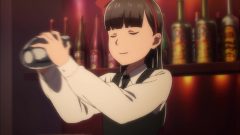
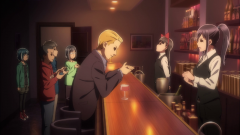
But stop being an all-out comedy show isn’t a bad thing at all. One of Hinamatsuri’s best assets has always been a strong and memorable cast, especially from the younger ones. Hitomi and Anzu, in particular, make one hell of an impression. They embrace these two qualities I mentioned earlier, not only it’s hilarious to see how these girls behave when they’re thrown out of their elements, but also throughout those bizzare events our girls have matured right before our eyes. We have the always kind-hearted girl Hitomi finds herself making cocktails in an adult bar (and eventually come to love that job); to the bratty Anzu finds the meaning of responsibility and home in homeless group. Some segments just are down right heart-warming that they ring sad and sweet in equal measure. Even a proper drama show can hardly do that right, let’s alone a comedy one like this.

Other characters still manage to make an impact just from the little segments they’re in. The trick is that they all have different voices and add different energy to the show. It’s no coincidence that Hinamatsuri is fond of introducing new characters, even late in the game. Being said that, the central relationship between Nitta and Hina isn’t as well-developed as say, the developments of their side characters. At the end of the journey, when Nitta thinks about their journey so far, it just hits me that we haven’t really invested to them much. If we’re looking for a parental bond we’re set to be disappointed. If we’re seeking for a buddy bond, it was underwhelming too. Their relationship is some kind in the middle, where they can easily ditch each other but there’s still something that bring them back together.

In term of visual execution, feel does a pretty decent job of transferring the essence of the manga to this adaptation. The visual hits its mark whenever it embraces the quirky visual that only Hinamatsuri can do. I’m talking about whenever these girls doing their supernatural power, or when Hina just floating around in the air in the middle of a conversation. That brings me to another complaint. By design, this whole season is about these “gifted” girls accustomed themselves to the new, ordinary world. As a result, there’s simply not enough crazy, wild fights. This lack of truly over-the-top superpower hurts the show’s chance, as Hinamatsuri has a knack of bringing whimsical humor by their visual. Secondly, the lack of these supernatural power means that the show’s more content for traditional slice-of-life shenanigans, which in truth countless number of anime shows doing the same thing.

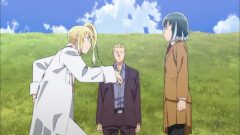
In term of segments, I noticed that the anime adaptation change the order from the manga, which I think work for the show’s benefit. We have more direct continuation from Anzu and Hitomi, for example, and so far I can see the love from the creators to make this show as memorable as possible. Only one plot thread I feel rather weak and uninteresting in general is the Nitta’s yakuza part, which rank amongst my least favorite segments. Hina has become more active in the second arc, despite my early criticism that she might not hold her own. This series, as entertaining, whimsical and surprisingly heartfelt as it might be, might never seen the day of life for another season. While personally I’m not over-excited about this show, it still remains a solid offering. The show that has its own voice and visual quirks. That alone make it a far better show than your average anime crop.

Fate/Stay Night Heaven’s Feel – I Prestige Flower Anime Review – 90/100

We have seen an influx of Fate adaptations over the last year and sadly each has proven to be disappointing except for a cooking slice of life short series which is weirdly better than it has any right to be. This movie was the last of the Fate adaptations that I needed to see but sadly remained out of my reach due to screenings being nowhere near where I live. So I waited and now with the Blu-ray release I can finally experience it and by god it’s perfect. This is only the first of three movies covering the Heaven’s Feel route of the original visual novel. As for what that means to the uninformed, the original first visual novel of Fate/Stay night was a choose your own adventure style game where the story could turn out one of three completely different ways. The first path where Saber is the main heroine is called Fate, was adapted by Studio Deen in 2006 but while the only adaption of this route it is considered lackluster. The second route is called Unlimited Bladeworks where Rin is the main heroine and has been adapted by Deen into a movie and again by Ufotable into a TV series. This movie is the very first adaption of the previously unadapted third route called Heaven’s Feel where Sakura is the main heroine and more or less is the grand finale of the original game. When compared to the other two routes Heaven’s Feel is generally considered darker in tone and quite a few consider it the closest thing to a true sequel to Fate/Zero. Take that statement with a grain of salt however as it certainly isn’t intended to be a sequel but rather a conclusion to the original game. As a long time fan of the series I was curious as to how Ufotable would handle the adaptation and if this first movie is an example of what the full trilogy will be I would consider it a prefect adaption. Not only did this first movie cover the important points of the beginning of the route but actually improved the pacing and story with extra scenes.

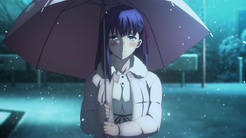
In the visual novel it was briefly mentioned how Sakura started to come to Shirou’s house to help out but Ufotable actually shows it right from the start which I feel was a great introduction for her. The expanded action scenes and original scenes of things that happened outside of Shirou’s perspective really added much needed context to the story while giving justice to characters whom in the visual novel were sent off less ceremoniously. If there is a character that truly benefited from the animated adaptation it’s most definitely true Assassin. It’s nice to see a master who uses an Assassin class servant as they were intended to be used and despite being an antagonist you could always see how under powered he was when compared the powerhouses that are other servants. The animation really shows Assassins fighting style of avoiding direct confrontation and relying on traps and tricks to catch servants off guard. Even Shinji was given more context which made him more understandable though obviously still not likeable. The small nods to Fate/Zero help continuity better than the original story did as of course Zero was originally made after it. Animation of course was fantastic as this is indeed Ufotable with a movie budget and clearly no expenses were spared in making this thing as gorgeous as humanly possible. The fight scenes are absolute works of art and exhilarating to behold. Soundtrack was also quite excellent and despite my misgivings with Yuki Kajura I found this soundtrack quite effective and only remembered it was Yuki’s work when the choir jumped in at the opening credits. Through admittedly I wasn’t quite paying attention to the soundtrack but that in itself is a sign of grown from Kajura as her soundtracks had a tendency of stealing attention away from a scene whereas here the soundtrack worked more in tandem with the visuals.

Out of the original three routes, Heaven’s Feel is considered the darkest story and for good reason. As dark as Fate/Zero? Not certain if it’s that level but we are dealing with some pretty heavy stuff here. For one it’s clear that this version of the Holy Grail war has far more collateral damage than any other. It was said in the background that accidents where happening and people were dying in the background of other series but here it’s gotten to the level of being a massive concern. The people of Fuyuki know that something is going on and more and more incidents are happening. Shirou’s friends are no exception to this as even they are victims of the war. On top of which we got this mysterious creature floating around draining people into comas and the movie certainly shows how eerie this thing is as well as how dangerous. With Sakura being the main heroine as well we glimpse the abuse she has to endure at her home. This is a pretty heavy story for both the servants and the masters with bleak prospects to come.
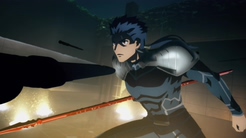
The movie of course isn’t without flaw. It assumes you have at least seen the Unlimited Bladeworks adaptation and makes no effort to ease in newcomers as it quickly montages things previously covered. Small references to Fate/Zero have been added by Ufotable too so some knowledge of that can help. Despite efforts to improve the pacing of the story there are points of this movie which feel rather slow and rely on it’s atmosphere and soundtrack to carry it. The CGI while well done can be distractingly noticeable at times such as the scene between Lancer and Assassin on the truck. I would even go so far to say that maybe Ufotable over polished it. Also indeed this is a film for Fate fans so those who couldn’t get invested in previous iterations most likely won’t find anything here to change their mind. Naturally as well this film is only one third of a story so it doesn’t end conclusively and only is one part of a story. But for a Fate fan such as myself I loved it and thought it was the best it could ever be. If the other two movies are as good as this we could very well see the Fate anime to call Fate/Zero’s undisputed position of best Fate Adaption into question.

Violet Evergarden (2018 Winter) Review – 76/100

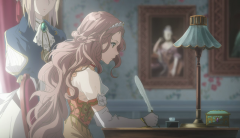
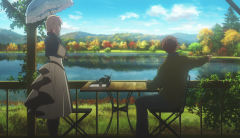
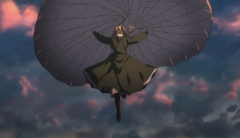
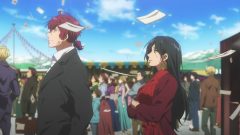
Violet Evergarden’s existence has surely been a public one. Acclaimed before everyone lick a taste of it (it was awarded for grand prize in the fifth Kyoto Animation Award’s novel category in 2014 – read, KyoAni awards), it goes without saying that Violet Evergarden is one of the most anticipated show of the sparse Winter 2018 season. As with my first impression, I left the show feeling a bit torn about it. On one hand, the production is top notch and when the show hits right, it sweeps you right away. On the other hand, I don’t buy much of Violet’s central conflicts and the show has a tendency to go over-soapiness and try to explain too much, which I never fond of. To be fair, Violet Evergarden has never known for its subtlety, its intend is always to pull as many punch as possible. Violet Evergarden, therefore, is at its strongest when it uses Violet as an observer, to put her as a background for characters with their own struggles have to finds ways to overcome. When she stays in the spotlight, however, the amount of predictable development and cheesy moments always overwhelm the show’s own emotions.
Let’s begin our journey with the way KyoAni adapts these Light Novels into anime form. The Light Novels start with Violet as an already established Memory Doll, and makes it ambiguous as to whether Violet is a robot or a human. Throughout many encounters with clients should we learn more about the violent pass of Violet, and her super-soldier self. To put it another way the Light Novels uses her more as a reporter with set personality. In the anime version however, KyoAni decides to shift the focus to the whole character arc of Violet. Make her vulnerable at first, and then build her character gradually. I appreciate the intention (in fact about half of their episodes are original material. Impressive), since anime medium works different than written form so it’s always a wise move to modify the content, so it’d fit with the visual medium; BUT I’m not sure if these changes improve the narrative. The thing is, Violet as a central narrative is a boring lead and she’s utterly unrelatable. She doesn’t possess any personality traits and repetitive responses get pale really, really fast.
But to build Violet the character from ground zero also means that when she changes, the changes will be massive. Violet is suppose to be a robot, at least in terms of narrative sense. Everyone regards her as a killing machine, she sees herself as someone’s royal dog, the show visualizes her as a bleeding doll, and the novel purposely frames her as a robot, anything but a human. It’s also the show’s narrative that Violet needs to learn these emotions in order to truly become a full-fledged human. There are some neat ideas behind it, namely the way she realizes the bad deeds she has done in the past. When she doesn’t realize, it’s okay to live on, but when she does, the fact that she ends many people’s lives comes back to hurt her. Relying on someone else to live (in this case, Gilbert), is as sad and unbalanced as it might get, and her own arc has to do with her coming to terms with the fact that Gilbert is no longer there for her and raise independent on her own. It comes to episode 8 and 9 which feature one huge flashback to the day Gilbert died and Violet experiencing her grieving process. While I personally feel this flashback a huge waste of time given we don’t learn anything new, it feels like a complete arc for Violet. That is the reason why the real climax in the end doesn’t do much to me since we already see her arc done in previous episodes.

Violet Evergarden’s best parts are the standalone episodes where Violet doing her jobs – reciting or writing letters for their clients. At heart, these letters represent the desire to connect between people, they represent all those raw feelings that can’t be said out loud, and Violet is in middle of its own trying to translate those feelings into written words, and learn about emotions in the process. All these little stories, from a playwright making a new children-play, to the sick mother write future letters for her daughter, to write love letters from the heirs of two nations, each of them adds more layer to the concept of ghostwriting and her job of connecting the hearts of people together and most of them give a satisfying emotion to their story. The best episodes amongst them are episode 10 (sick mother and her daughter) and episode 7 (playwright).

The production by and large is impressive with detailed character designs (it’s one rare production where all the background characters are fully portraited with their own costumes and figures), consistent animation and striking background designs. Each story where Violet performs her jobs has different kind of settings, and Violet Evergarden really gives it their own on breathing life to those places. The lighting, however, doesn’t give the show a justice here. All interior scenes feel too dark, for one thing, and the way Violet Evergarden uses their focus lenses which make the centre of focus detailed and the rest blurred) hurts the show more than support it. It’s one of the case where I consider they over-playing with post-production. Such a shame since it feels like they don’t have enough confidence to their raw production.

As for characters, it pains me to say that the supporting cast doesn’t reach their full potential either. There are many anime original characters, and most of them have their own episodes to shine. But Hodgins and Cattleya are surprisingly underdeveloped despite appear almost in all episodes. Gilbert is just a vessel for Violet’s personal growth and the appearance of Dietfried in the end doesn’t leave much impact either. There is a hint of the aftermath of postwar era, which I somewhat enjoy but I don’t feel that it reaches its full potential. And all the drama is over-blown, which kind of bang me hard in the head.

All in all, Violet Evergarden is a roller coaster of emotions, in more ways than one. It either sweeps you away with its grandeur approach, or it doesn’t (like myself). The central development is a conventional and predictable one, and the show’s best moments are the ones where they move away from Violet as the central conflict. Despite my grumpy it’s still a solid made and worth watching at least one, if only for the beautiful CG-animated mechanical hands of Violet.

A Place Further than the Universe (Winter 2018) Review – 77/100

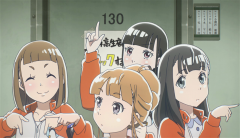
Cute girls doing cute things is a genre that been done to death at this point. Even within this Winter 2018 we had been overloaded with big eyes fluffy face girls doing a lot of different things of interest. It takes a standout concept or a deeper narrative to make one stand out from this crowded pack. Enters Universe, an original show from Madhouse that has both of these. The show’s concept, after all, is about a group of high school girls making their trip to Antarctica, also known as the place further than the universe. Universe isn’t without its issues, the pacing in particular takes the girls way too long until they reach the destination. But to its defense this show is always more about the journey than the destination. It’s about experience life to the fullest and make friends who share the same interest in the process. The “friendship” bits can be contrived at times, but even with me (who isn’t that enthusiastic about it) realizes that the drama in this series is done quite well, as it always gives a satisfying emotional response to the conflicts it creates.

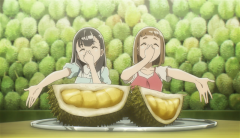
If there is one thing that I’m sure this show will be remembered for years to come, it’s the concept. Touring oversea isn’t that difficult nowadays compare to say, 20, 30 years ago, but a trip to Antarctica? Really? High school girls you say? What’s there to see in that icy place? How the hell do they get in there? Money? Lots of questions bound to come up upon hearing this premise and I’m happy to say that Universe never glosses over those issues, but instead approach them with a thoroughly research. Every stage of the trip is planned carefully, they never make light comments about high-school girls going for such harsh trip and indeed, they point out many times how extreme this trip can be. The expedition ship and the Antarctica place are so detailed that it’s easy to see the staffs made the same trip for their own research. It’s a joy to watch and know more about this little unheard place, to the point sometimes I feel this show is an advertisement for Antarctica (well, I’m sold). Moreover, a show that gives a detailed treatment to Singapore is always a plus (and I love durian!!).

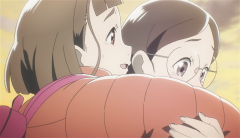
What Universe also sells us is the way they frame this trip as a self-discovery, as a way to embrace the youth to their heart’s content. Mari, the show’s protagonist, is the perfect character for this trip. She worries about how she steps out of her comfort zone, and this trip makes a life-changing event, not necessary in terms of the specialty of Antarctica, but more about maturity. It also helps that the girls’ goal to reach the South Pole is much more than just “follow your own dreams”. Shirase is a girl that had her Mother disappeared in that very place, and it’s one of her resolve to go there just to be closer to her Mom. There’s also Hina who takes high school off but wants to experience something before college and most importantly, there’s Yuzuki, an idol who gets caught up with this trip and just tag along because she wants to travel with her new friends. And those make this trip a bit richer because doesn’t matter their own intention is, it’s the experience that they share together is the most important factor.

The girls make up a great central cast for us to follow. All 4 of the girls have different personalities, they have their own goals and their own backstories, and they have their own voices. Shirase, for example, is a no-nonsense but extremely unstable girl, whereas Mari is cheerful and acts like the emotional force of the group. Hina, my favorite character, has a wise (and bullying) side of her and Yuzuki somehow feels much more relatable through the way she loathes her “star” identity. Moreover, they bounce off extremely well and it’s a blast just to see the four girls interacting with each other. But most important of all, each of them has their own arc to overcome, and while some it I felt were made for the sake of creating conflict (in other words, unnatural), they always have a satisfying ending that elevate the shortcomings of the conflicts.

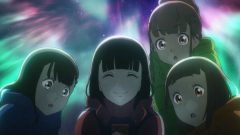
While the main theme is about self-discovery, I was a bit surprised to find out most of the show’s episodic conflicts are about the notion of friendships. Mari’s drama with her best friend, Megumi, for example, cuts unexpectedly but it cuts deep, mind you. Or Yuzuki’s little drama about “When will we know if we are friends” or Hina’s past issues with her secondary school friends. As a whole, I find the concentration to friendships theme a bit overplayed. Granted, their friendships in a nutshell are interesting ones. They haven’t known each other for so long and apart from this trip, they have very different lives. Yet Universe argues that as long as they share something together – be it getting seasick, eating a thousand-year-old snow corn or enjoying a view of mystical Southern light– they will always have a special place in each other’s heart.

The character designs and the production in general are in the more conservative side, but taken as a whole it fulfils its jobs nicely. There is a large amount of insert songs – most of them pretty heart-warming- so the music of Universe is solid overall. The pacing remains its biggest issue, as it takes until the end of episode 9 for the crew to finally takes their feet onto Antarctica icy ground. They could do it much better if they cut a bit of a transit section (Singapore and Australia, as well as on a ship section – another 2 episodes). Ultimately, Universe is a journey itself. It remains a feel-good show with relatable message of enjoying youth to the fullest and the girls make the most of their time on-screen. Certainly amongst the top tier of its cute girls pack.