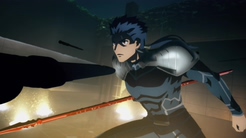
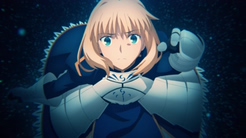
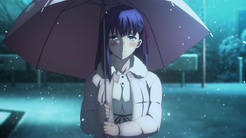
Violet Evergarden (2018 Winter) Review – 76/100

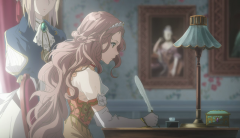
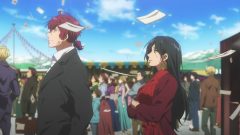
Violet Evergarden’s existence has surely been a public one. Acclaimed before everyone lick a taste of it (it was awarded for grand prize in the fifth Kyoto Animation Award’s novel category in 2014 – read, KyoAni awards), it goes without saying that Violet Evergarden is one of the most anticipated show of the sparse Winter 2018 season. As with my first impression, I left the show feeling a bit torn about it. On one hand, the production is top notch and when the show hits right, it sweeps you right away. On the other hand, I don’t buy much of Violet’s central conflicts and the show has a tendency to go over-soapiness and try to explain too much, which I never fond of. To be fair, Violet Evergarden has never known for its subtlety, its intend is always to pull as many punch as possible. Violet Evergarden, therefore, is at its strongest when it uses Violet as an observer, to put her as a background for characters with their own struggles have to finds ways to overcome. When she stays in the spotlight, however, the amount of predictable development and cheesy moments always overwhelm the show’s own emotions.

Let’s begin our journey with the way KyoAni adapts these Light Novels into anime form. The Light Novels start with Violet as an already established Memory Doll, and makes it ambiguous as to whether Violet is a robot or a human. Throughout many encounters with clients should we learn more about the violent pass of Violet, and her super-soldier self. To put it another way the Light Novels uses her more as a reporter with set personality. In the anime version however, KyoAni decides to shift the focus to the whole character arc of Violet. Make her vulnerable at first, and then build her character gradually. I appreciate the intention (in fact about half of their episodes are original material. Impressive), since anime medium works different than written form so it’s always a wise move to modify the content, so it’d fit with the visual medium; BUT I’m not sure if these changes improve the narrative. The thing is, Violet as a central narrative is a boring lead and she’s utterly unrelatable. She doesn’t possess any personality traits and repetitive responses get pale really, really fast.

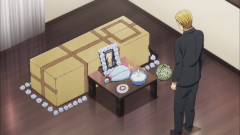
But to build Violet the character from ground zero also means that when she changes, the changes will be massive. Violet is suppose to be a robot, at least in terms of narrative sense. Everyone regards her as a killing machine, she sees herself as someone’s royal dog, the show visualizes her as a bleeding doll, and the novel purposely frames her as a robot, anything but a human. It’s also the show’s narrative that Violet needs to learn these emotions in order to truly become a full-fledged human. There are some neat ideas behind it, namely the way she realizes the bad deeds she has done in the past. When she doesn’t realize, it’s okay to live on, but when she does, the fact that she ends many people’s lives comes back to hurt her. Relying on someone else to live (in this case, Gilbert), is as sad and unbalanced as it might get, and her own arc has to do with her coming to terms with the fact that Gilbert is no longer there for her and raise independent on her own. It comes to episode 8 and 9 which feature one huge flashback to the day Gilbert died and Violet experiencing her grieving process. While I personally feel this flashback a huge waste of time given we don’t learn anything new, it feels like a complete arc for Violet. That is the reason why the real climax in the end doesn’t do much to me since we already see her arc done in previous episodes.

Violet Evergarden’s best parts are the standalone episodes where Violet doing her jobs – reciting or writing letters for their clients. At heart, these letters represent the desire to connect between people, they represent all those raw feelings that can’t be said out loud, and Violet is in middle of its own trying to translate those feelings into written words, and learn about emotions in the process. All these little stories, from a playwright making a new children-play, to the sick mother write future letters for her daughter, to write love letters from the heirs of two nations, each of them adds more layer to the concept of ghostwriting and her job of connecting the hearts of people together and most of them give a satisfying emotion to their story. The best episodes amongst them are episode 10 (sick mother and her daughter) and episode 7 (playwright).

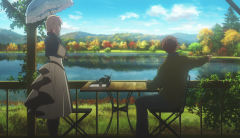
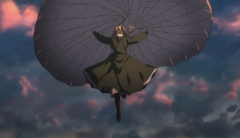
The production by and large is impressive with detailed character designs (it’s one rare production where all the background characters are fully portraited with their own costumes and figures), consistent animation and striking background designs. Each story where Violet performs her jobs has different kind of settings, and Violet Evergarden really gives it their own on breathing life to those places. The lighting, however, doesn’t give the show a justice here. All interior scenes feel too dark, for one thing, and the way Violet Evergarden uses their focus lenses which make the centre of focus detailed and the rest blurred) hurts the show more than support it. It’s one of the case where I consider they over-playing with post-production. Such a shame since it feels like they don’t have enough confidence to their raw production.

As for characters, it pains me to say that the supporting cast doesn’t reach their full potential either. There are many anime original characters, and most of them have their own episodes to shine. But Hodgins and Cattleya are surprisingly underdeveloped despite appear almost in all episodes. Gilbert is just a vessel for Violet’s personal growth and the appearance of Dietfried in the end doesn’t leave much impact either. There is a hint of the aftermath of postwar era, which I somewhat enjoy but I don’t feel that it reaches its full potential. And all the drama is over-blown, which kind of bang me hard in the head.

All in all, Violet Evergarden is a roller coaster of emotions, in more ways than one. It either sweeps you away with its grandeur approach, or it doesn’t (like myself). The central development is a conventional and predictable one, and the show’s best moments are the ones where they move away from Violet as the central conflict. Despite my grumpy it’s still a solid made and worth watching at least one, if only for the beautiful CG-animated mechanical hands of Violet.

A Place Further than the Universe (Winter 2018) Review – 77/100

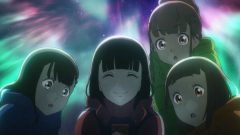
Cute girls doing cute things is a genre that been done to death at this point. Even within this Winter 2018 we had been overloaded with big eyes fluffy face girls doing a lot of different things of interest. It takes a standout concept or a deeper narrative to make one stand out from this crowded pack. Enters Universe, an original show from Madhouse that has both of these. The show’s concept, after all, is about a group of high school girls making their trip to Antarctica, also known as the place further than the universe. Universe isn’t without its issues, the pacing in particular takes the girls way too long until they reach the destination. But to its defense this show is always more about the journey than the destination. It’s about experience life to the fullest and make friends who share the same interest in the process. The “friendship” bits can be contrived at times, but even with me (who isn’t that enthusiastic about it) realizes that the drama in this series is done quite well, as it always gives a satisfying emotional response to the conflicts it creates.

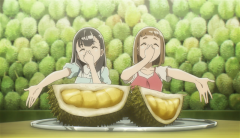
If there is one thing that I’m sure this show will be remembered for years to come, it’s the concept. Touring oversea isn’t that difficult nowadays compare to say, 20, 30 years ago, but a trip to Antarctica? Really? High school girls you say? What’s there to see in that icy place? How the hell do they get in there? Money? Lots of questions bound to come up upon hearing this premise and I’m happy to say that Universe never glosses over those issues, but instead approach them with a thoroughly research. Every stage of the trip is planned carefully, they never make light comments about high-school girls going for such harsh trip and indeed, they point out many times how extreme this trip can be. The expedition ship and the Antarctica place are so detailed that it’s easy to see the staffs made the same trip for their own research. It’s a joy to watch and know more about this little unheard place, to the point sometimes I feel this show is an advertisement for Antarctica (well, I’m sold). Moreover, a show that gives a detailed treatment to Singapore is always a plus (and I love durian!!).

What Universe also sells us is the way they frame this trip as a self-discovery, as a way to embrace the youth to their heart’s content. Mari, the show’s protagonist, is the perfect character for this trip. She worries about how she steps out of her comfort zone, and this trip makes a life-changing event, not necessary in terms of the specialty of Antarctica, but more about maturity. It also helps that the girls’ goal to reach the South Pole is much more than just “follow your own dreams”. Shirase is a girl that had her Mother disappeared in that very place, and it’s one of her resolve to go there just to be closer to her Mom. There’s also Hina who takes high school off but wants to experience something before college and most importantly, there’s Yuzuki, an idol who gets caught up with this trip and just tag along because she wants to travel with her new friends. And those make this trip a bit richer because doesn’t matter their own intention is, it’s the experience that they share together is the most important factor.

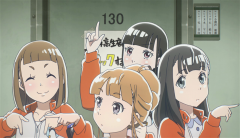
The girls make up a great central cast for us to follow. All 4 of the girls have different personalities, they have their own goals and their own backstories, and they have their own voices. Shirase, for example, is a no-nonsense but extremely unstable girl, whereas Mari is cheerful and acts like the emotional force of the group. Hina, my favorite character, has a wise (and bullying) side of her and Yuzuki somehow feels much more relatable through the way she loathes her “star” identity. Moreover, they bounce off extremely well and it’s a blast just to see the four girls interacting with each other. But most important of all, each of them has their own arc to overcome, and while some it I felt were made for the sake of creating conflict (in other words, unnatural), they always have a satisfying ending that elevate the shortcomings of the conflicts.

While the main theme is about self-discovery, I was a bit surprised to find out most of the show’s episodic conflicts are about the notion of friendships. Mari’s drama with her best friend, Megumi, for example, cuts unexpectedly but it cuts deep, mind you. Or Yuzuki’s little drama about “When will we know if we are friends” or Hina’s past issues with her secondary school friends. As a whole, I find the concentration to friendships theme a bit overplayed. Granted, their friendships in a nutshell are interesting ones. They haven’t known each other for so long and apart from this trip, they have very different lives. Yet Universe argues that as long as they share something together – be it getting seasick, eating a thousand-year-old snow corn or enjoying a view of mystical Southern light– they will always have a special place in each other’s heart.
The character designs and the production in general are in the more conservative side, but taken as a whole it fulfils its jobs nicely. There is a large amount of insert songs – most of them pretty heart-warming- so the music of Universe is solid overall. The pacing remains its biggest issue, as it takes until the end of episode 9 for the crew to finally takes their feet onto Antarctica icy ground. They could do it much better if they cut a bit of a transit section (Singapore and Australia, as well as on a ship section – another 2 episodes). Ultimately, Universe is a journey itself. It remains a feel-good show with relatable message of enjoying youth to the fullest and the girls make the most of their time on-screen. Certainly amongst the top tier of its cute girls pack.

After the Rain (2018 Winter) Review – 89/100

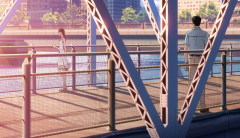
I suppose that most of us, even the perministic ones, enter After the Rain (Ameagari) with some reservations. After all, the premise about a crush from an 18-year-old girl to the store manager who is nearly 30 years senior raises a lot of red flags here. Yet the show handles this tricky premise with deep insight and offers us two of the more well written characters out there. Originally billed as a romantic drama, the last third of Ameagari steers away from any romantic tension to deliver something more profound. It explores the complexity of human emotion by examining the unlikely relationship between two individuals with broken dreams and how they influence each other to reach back their goals. While I’d love for the conclusion to be more impactful (the ending suggests their relationship is like… ahem… after the rain: fleeting, soft, momentary – I’d prefer for more storming here), this show remains one of the most intimate, sensitive – and ultimately – complex portrayal of bonding, and human relationship. This solid material is further elevated by the understated and strong visual storytelling, aesthetically pleasing visual presentation and color palette and one of the best soundtrack in recent years. Ameagari is pretty much excellent as a whole package.

Any decent romance story has to start with well-grounded and relatable main leads, and Ameagari offers us two characters that worth caring for. Both Tachibana and Kondou are complex characters, especially Kondou who first appears as a goofy likable old man, but through the course of its run, their personality, and their own dreams are revealed slowly. Behind their composure, there lies a huge disappointment of their current lives, and as we know them better, we learn that they have left behind the path they used to treasure the most – Tachibana with her injury that prevents her from running track again and Kondou with his passion for Japanese literature – and gradually lose the essence of who they really are, becomes a shell that has no more dream or desire (in one of the show’s most clever symbolism: he touches the shell of a cicada while speaking that lines).

Meanwhile, Ameagari follows mostly through the point of view of Tachibana. While the show’s never shy from exploring Kondou’s inner thoughts (and what poetic thoughts this guy has), we follow Tachibana mostly through visual cues: her gestures, her “sparkling moments”, the looks from her eyes. Why this difference in treatment? By giving Kondou an inner voice, we become certain that his feeling for Tachibana isn’t romantic or sexual interest, but more about how her reminds him of his own youth and his current lifeless life. For Tachibana, it’s more about fleeting first crush and the show more than nails it underlining those feelings with sensitivity of how first crush is like. As you can guess from the title, rain is the show’s motifs here, and it chronicles the progression of this romance, from gentle, quiet rains in the beginning, then “she comes like a rain” in the middle and bright in the end like a love after the rain.

The main selling point of Ameagari is undoubtedly the amazing chemistry between Tachibana and Kondou. Their back-and-forth exchanges always spark with so much dynamic that every time those two together, they’re bounce to have special moments together – a praise that you won’t hear me say often, especially in anime medium. We have The Confession, The Hug, the Kiss, The Final Confrontation… These moments are the highlights of not only this season, but for my money for the entire 2018 year. They’re impactful. They’re powerful. They’re just perfect. But even in those slower moments, whenever Tachibana and Kondou are seen together, they deliver a natural and positive influence on each other.
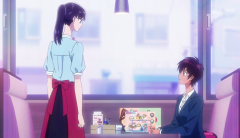

The supporting cast help expanding the lives of our two characters, although in retrospect, they still leave a lot to be desire. Chief among them is the inclusion of Kase in one particular episode that leaves a sour taste in the mouth for most of us, but what bad is the way he reverts back to background character and we never learn much about him again. Tachibana best friend, Haruka, receives more attention in the second half and she provides a welcomed conflict to Tachibana’s current crisis, but it feels unfocused when we have a section about her and the ex-captain of the football club (it’s as important as the second copy of the second will). Kondou’s long-lost friend Chihiro, on the other hand, provides an excellent supporting role by the way he counters Kondou about his writing’s passion or reflects further to the path of life that Kondou left behind.

The visual presentation of Ameagari furthers elevate this sensitive love story and makes it a total feast to the eyes. I admit that I didn’t have a high opinion to Wit Studio, mostly because the production approach in Attack of Titan was my least favorite, but I have totally changed my mind with this subtle yet gorgeous visual styles of Ameagari. The reason I bring up Wit studio in particular is because they have their own “make-up animation” team, which is a team who apply special effects to certain important scenes and they sure did the job marvelously here with downright impressive visual palette and strong direction. The soundtracks are simply mesmerizing. They not only bring out the best emotionally from these moments, listen to them alone can transfer you right back to these certain scenes. I could totally picture Tachibana in the rain, or moment when Kondou sees himself in his teen self or the moment they hug each other. I also enjoy the way the show leaves their characters a space to breathe. There are many wordless sections just to record simple daily activities of Tachibana, like when she misses a bus, walks to the train station or when she offers a stranger to walk them with her umbrella.

In conclusion, I know the word “done right” can justify anything but Ameagari is a glaring example of a show that done right in every aspect, from its concerning romance premise, to its visual approach and the way it handles the developments of these characters. What makes it raise above everything else this last season is that, all these excellent components are all in the service of its theme. As a result Ameagari feels like a complete product with no real weakness, as the same time delivers special relationship that reminds us once again about the complexity of our own emotions.

Spring 2018 Anime Coverage

The Spring First Impression period has finally come to an end, which personally I regard it as a mixed bag.  This season has one of the most crowded titles in terms of quantity, having around 50 plus airing anime of all kinds and we previewed about 34 new shows . This huge amount doesn’t necessarily translate into better quality, however. We have handful of solid shows, a sea of mediocre and trashy shows and little to no middle ground. I gave 0% potential more than any previous seasons (do I become too harsh on anime or was anime a mistake?). In addition, as most of you already knew, we’re trying something new this season by gathering together and making the first (and hopefully not the only) podcast since the five of us, current writers, came into this site.

Anyways, without further ado, here’s our schedule for the 2018 Spring Season:

Aidan: Legend of Galactic Heroes – Die Neue These, Full Metal Panic Invisible Story, Wotakoi, Darling in the FranXX (carry-over)

Mario: Golden Kamuy, Hisone to Misotan, Hinamatsuri
Lenlo: Steins;Gate 0, Megalo Box

I’m also here to bring you one sad news. From this season onwards, Wooper will step down as a site writer. This is a great loss for us (and you’ll be missed, Wooper), but expect him to be around the chatbox as well as (hopefully) helping us out with the first impression.

With this, let’s the 2018 Spring Season truly begins.

Some Quick First Impressions – Wotaku ni Koi wa Muzukashii, Hisone to Maso-tan, Full Metal Panic Invisible Victory and Dorei-ku The Animation

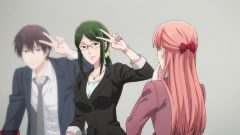
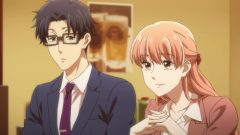
Wotaku ni Koi wa Muzukashii

Short Synopsis: Two childhood friends-turned-coworkers decide to start dating after bonding over their nerdy hobbies.

Aidan’s review

Well they added more original scenes to the manga but it fit and helped the story flow better and while this could be considered pandering to my demographic, I ultimately enjoyed the hell out of it. I stated before that 3D Kanojo was the idealisation of love while Wotaku is the more realistic version and that certainly is still true. The dialogue of this show feels real and the characters talk like people talk. Sure there is comedic posturing and some exaggeration but damn do the conversations just flow naturally. No beating around the bush either as our two mains get together by episodes end in what may be considered spontaneous and a bit too businesslike. I found it actually better that way. There is no bombastic orchestra nor emotional crying or doves flying in the air with dramatic lighting while flowers fall on the stage. The male lead lays down how he could make for a good boyfriend and the two decide to try it out. Which is fine, as the two do get along fantastic together and that could very easily blossom into love. The comedy was on point, the cast is good and it’s generally fluffy. Of course being an adult nearing his thirties who is a Anime and Game Otaku and works in a office space could be influencing my opinion somewhat.

Potential: 75%


Wooper’s review

I’ve seen a lot of talk about this show pandering to a specific subculture, what with the “otaku and fujoshi together 4ever” romance at its core. As a result, I went into this thing with the mildest of expectations, and found that they were unnecessarily low. Wotakoi obviously has its sights set on a niche audience, but it isn’t insulting about it. There are no women tripping over themselves to get with the male lead, and the show doesn’t glamorize or excuse pop culture obsession – rather, it’s a source of shame for the female MC. She’s pretty, a little ditzy, and cheerily superficial, which is refreshing for a woman in anime. Her blossoming friendship with her cosplaying boss gives me some hope that she’ll learn to be more accepting, both of herself and others, without needing to be educated or tamed by her new boyfriend. As a matter of fact, I’m much more interested in how her mindset will change than I am in her relationship with The Most Dapper Otaku in the World. The scene where those two get together is the main source of my disappointment in this premiere – the show looks decent, and I like the characters well enough, but the dispassionate way they decide to start dating left me with no interest in their romance. It happened right at the tail end of the episode, so it might be some kind of fake out, but given that Wotakoi is billed as a romcom, I doubt that’ll be the case. The show seems good enough to follow week by week, but if no legitimate sense of attraction surfaces within a few episodes, I might have to bail.

Potential: 50%


Hisone to Maso-tan

Short Synopsis: A woman is chosen to pilot a living Dragon

Aidan’s review

I wasn’t quite sure what I would get when I started this show but it certainly was a lot more comedic than I was expecting. So far any potential dark aspects are nowhere to be seen  and it’s a fairly lighthearted show to match it’s cutesy visuals. I quite like the main character and her general talkativeness as I am reminded of my own inner thoughts when pushed into a project haphazardly at work. We got a kooky cast of characters and the general premise of a transforming dragon in the army is a good one. It’s still up in the air as to what the actually plot will be but for so far it’s looking quite strong.

Potential: 80%


Mario’s review

As they say, save the best for last huh? This one literally was the last show I checked out during this First Impression period, with high expectation to boost, and it turned out even better than I had expected. There’s so much to like about this show. The style for example, is simple with clear and soft layout, but it works well in service for this show. Contrary to the simple designs, the characters are expressive and the animation is very consistent and dynamic. The concept of dragons being an airplane, with pilot is inside the dragon is a whimsical, if a bit nonsensical, premise and I am glad that in this first episode not only the show doesn’t take it too seriously, they sell well on the whole concept. The main girl, Hisone, is your typical Mari Osada’s creation here- meaning she has a tendency to say her mind a bit too much, but I do relate to her issues and hell, I already love the pairing between her and the dragon here. This one is, for my money, the best premiere of this Spring Season.

Potential: 90%


Full Metal Panic Invisible Victory

Short Synopsis: The fourth season of the Full Metal Panic Series

Aidan’s review

Well baring a opening scene where the pacing felt a bit too fast, this was a strong return to form. The skipped volume 6 which is a shame as it had some good Tessa moments but otherwise the relationship between Chidori and Sousuke was great. Seeing them hold hands as they both walked to her apartment and be affectionite with each other felt it was a long time coming. Of course we do have some interesting developments in how Chidora has to accept that she really can’t live a normal life anymore as well as the fact that no matter how much of a goof Sousuke is, he really has killed people. Sousuke himself seems to be regretting the loss of his school life as well and Chidori’s newfound caution of him certainly could throw him off balance. Little in the way of action but the ending episode cliffhanger is certainly promising. Xebec certainly seems to be emulating the animation style of KyoAni’s while they were doing Second Raid and so far it looks good. Still up for debate if they can keep the quality for the full series and especially during  action sequences but we shall see. Lastly I find the Japanese voices hard to adjust to due to my first experience watching being in English dub. Basically if you are a Full Metal Panic Fan, check this out.

Potential: 80%


Dorei-ku The Animation

Short Synopsis: A girl finds out about a device that allow you to enslave anyone

Aidan’s review

I guess the big question is that if such a device existed, who in their right mind would use it? Sure it allows you to dominate someone else with the device but at the same time holds the risk of anyone subjecting you to eternal servitude. In that case it would be a hard sell because if a girl tried to convince me to stick in some weird device into my mouth my first and last instinct would be no. Of course since the characters in this show are naturally stupid, they stick the device in. All these characters are terrible and unlikable. The games themselves aren’t so much mind games cause the author isn’t smart enough to come up with genuine smart strategy. The animation is bear bones and while the anime cut out quite a bit of the stupid nasty stuff in the manga, it still can’t save what is already a fairly trash story. Avoid this one.

Potential: 0%


Mario’s review

The segment in the first few minutes pretty much sets an overall tone to this series: a silly card game where the girl loses, the guy then requests to have sex with her in which she has to obey. This is a show that is more interested to exploit the twisted desire of enslave someone (in a fetish form) than it has anything grounded to say. So for anyone who think this show is a depiction of BDSM fetish, there isn’t much about it at all, given it gives the same “descend to darkness through desire” vibe as Kakegurui and Liar Game, although with much lesser impact. Sexual assault, assholeness, misogyny pops up everywhere. The duel isn’t remotely exciting since only one of them aware of the SCM device, hence they obviously have an handicap over the opponent. The main leads, if we can call them that, are characters that we don’t care one iota for because they are unlikable, and their chemistry isn’t even functional. It might be just me but this kind of trashy pulpy show that tries hard to sound smart always turn me off the most. Avoid it.

Potential: 0%

Spring 2018 Anime First Impressions Podcast

For the first time in a very long while, the writers of Star Crossed Anime Blog have assembled together from over five different timezone and participate in a podcast that gives our first impressions of the Spring 2018 anime season.

The intro for this episode is from the intro theme for Ragnarok Online 2 by Yoko Kanno. The outro for this episode is Deja Vu by Dave Rodgers.

Anime Discussed In This First Impressions: Persona 5, Legend of the Galactic Heroes, Wotakoi Love Is Hard For Otaku, Hisone to Maso-tan, Golden Kamuy, Magical Girl Site,  Hinamatsuri, Megalo Box, Steins Gate 0, My Hero Academia 3, Tokyo Ghoul re, Sword Art Online Alternative Gun Gale Online, Full Metal Panic Invisible Victory, Lupin III: Part V

Edited by HelghastKillzone

Some Quick First Impressions: Steins;Gate 0, Last Period -Owarinaki Rasen no Monogatari- and Butlers ~Chitose Momotose Monogatari~

Steins;Gate 0

Short Synopsis: An alternate timeline where Okabe never concluded Steins;Gate

Aidan’s review

If you are a fan of Steins;Gate, then you are watching this so it’s wonder if a impression is even needed. But regardless we can say this is a very strong start for the series, in fact it feels just the same as when you left it despite the new director. There is at least issues that this episode was spent mostly recapping the situation so that the audience is up to speed and characters have gone through a redesign which may annoy people. In particular Mayuri seems to have gone up a few cup sizes between Steins;Gate and now. But this is a first episode that recaptures the spirit of the original and in particular Okabe’s PTSD scenes was masterfully done. Of course what comes after this could go any way but having played the game I feel Steins;Gate fans will be satisfied if it is adapted well.

Potential: 90%


Lenlo’s Review:

I’m in. I’ve been ready for this since Steins;Gate ep 23 B aired years ago. Recap aside, since it was necessary with how long we have had between seasons, Kenichi Kawamura knocked it out of the park with this first episode. Okabe is suitably muted and depressed, the soundtrack is on point and Steins;Gate 0 is wasting no time getting us involved in the plot. There are some stylistic differences that may bug some people, like how every girl went up a few cup sizes since the first Steins;Gate, but overall it just feels like the original in every way that matters. I am ready for the darkest timeline Kenichi, don’t let me down.

Potential: 95%


Last Period -Owarinaki Rasen no Monogatari-

Short Synopsis: a gang of heroes (known as Periods) finds out that their beloved branch office has been closed so they have to work cheaply to support the office.

Lenlo’s Review:

Last Period knows exactly what it is, a bright, sugary monster of the week show. We even have our own version of Team Rocket to cause fun, solvable hijinks every week. Last Period is the kind of anime you can sit down and watch and just relax. There’s no big message, no great symbolism or theme. It’s just a simple show for simple folk and it works. The thing about shows like this though, you either lovem or you hatem. If your looking for something to sit down at after a day at work or school and just want to enjoy to anime, you could do a lot worse than Last Period.

Potential: 50%


Mario’s review

Generic is all I can utter here. This show intends to be a parody of sort of RPG-styled fantasy shows, but I’m hard pressed to regard it as parody since it’s weak on humors. I appreciate how the characters themselves point out tropes and cliches, but they do nothing but acknowledge and embrace these tropes. This “doesn’t take itself seriously” nature also means that the story is random at most, characters fight without much purpose, thus the show feels significantly lightweight, like a short OVA spoofs you would see from popular shows. Characters are lame and the production values are on the lackluster side. Not worth your time is my final verdict.

Potential: 0%


Butlers ~Chitose Momotose Monogatari~

Short Synopsis: A guy is on a mission to find his missing sister.

Lenlo’s Review:

Every season we get a “Cute Girls doing Cute Things” show. Whether it be cat girls, horse girls, maid girls, or whatever Keijo was. However in its quest for equality, Butlers is breaking ground in a “new”, “unique” genre called “Beautiful Men doing Beautiful Things”. We have the whole cast. The Shota jail-bait, the Androgynous Aloof one, the Cocky Jerk one and even the emotionally dead main character with no reason to actually be there. Truly cutting edge. There’s only one problem with Butlers. That Ouran Host Club did it already and did it better. Butlers is a mish mash, trying to be the new Ouran Host Club, while missing everything that made Host Club even mildly interesting. With how great this season is so far, my only recommendation for Butlers is Skip It and if you need your Shojo fix, rewatch/checkout Ouran Host Club.

Potential: 0%


Mario’s review

People can call this an overambitious premiere with that final hook, for me it’s just an incompetent show that makes up the plot as it goes so that they can cram in as many hot boys as humanly possible. This episode we have about ten to dozen boys introduced, none of them carry any distinctive feature (and curiously enough, one of them named Akira Tachibana. I sure have missed her). That lack of personality extends to our main character, J, who most of the time feels like he doesn’t belong to this world. Towards the end we find out the reason but the issues still remain that it’s boring. The pacing sucks big time as we see him spend majority of the time doing activities as a president of student council and how the hell these activities have anything to do with the main plot of him being a “butler” trying to find his dear sister? It’s the show that can’t decide what it wants to be and thus, it doesn’t belong anywhere in this present world.

Potential: 0%

Some Quick First Impressions: Rokuhoudou Yotsuiro Biyori, Shiyan Pin Jiating and Sword Art Online Alternative: Gun Gale Online

Rokuhoudou Yotsuiro Biyori

Short Synopsis: An office worker finds a cafe full of hot guys

Aidan’s review
Oh sure. There is definitely a cafe in the middle of a Japanese city with a prefect scenic view, a staff full of hot guys who are passionate about their work despite being paid diddly squat, the sells five star food and to top it off is mostly quiet and deserted. Certainly this cafe isn’t the product of pure wish fulfillment and pandering to a female audience. Alright the obvious lengths this show goes to ignore that it’s premise is utterly unrealistic aside this is a decently watchable show. Considering I generally tap out on these kinds of shows due to having no interest whatsoever, I at least found I was able to watch it and not be too bored. But honestly how the hell was that guy able to randomly pick up some kid to help out a woman? Attempt that in real life regardless of your looks and I am certain first response would involve the police. The story is nothing new seeing as it has no real story and is just about people coming to this cafe to chill out. I say for those who take a liking to these kinds of shows this could be something worthwhile but otherwise I say this isn’t really worth your time.

Potential: 10%


Mario’s review

Shows about hot boys are my eternal nemesis, plus the fact that Rokuhoudou sets in a cafe that provides good food and give people good time and I’m certain stepping in that it isn’t the show for me. It’s a healing show and not a terrible one all things considered, but one where I personally can’t connect to on an personal level. The four guys are all archetypal characters and they’re just way too perfect in the way that make them unreal. The shop has a nice kind of atmosphere, but again, when the food, the coffee, the sweet and the service are all top-notch, it’s hard to take it at face value. For those who – similar to the appeal of this titular cafe – prefer a relaxing and comforting time, this might be a good breather. Strangely enough, healing anime is one of my favorite genre, but this type of healing doesn’t attract me at all. Not one bit.

Potential: 0% or Not one bit


Shiyan Pin Jiating

Short Synopsis: A dysfunctional family of mutants goes out for a meal.

Wooper’s review

A lot of modern anime cut corners by using CG animation for complex objects or heavy scenes. Shiyan Pin Jiating takes a more honest route – it cuts corners by including fewer frames than any other spring series. Part of that is its shorter runtime, but based on what I saw in those 15 minutes, full-length episodes wouldn’t prevent it from looking cheap. Even the simplest actions, like a sigh or the wave of a hand, are jerky and unnatural. There’s a fair bit of hitching during dialogue-heavy scenes, as well, where characters take pauses that don’t fit the conversation. A premiere this technically deficient needs to excel elsewhere to make up for its shortcomings, and while I wouldn’t say this show really excels in any department, it has one redeeming quality: its character designs. This is a show about siblings who functioned as their parents’ science experiments, so the way their quirks are physically portrayed is important, and this episode delivered with a nice blend of cute and strange designs. The half-dog older brother best exemplifies what I’m talking about, but Spider Girl and Ms. Photosynthesis are plenty charming, as well. The family drama in this premiere was boring and badly-acted, so if you’re looking for something meaningful I’d dodge this one, but if you care more about nice-looking characters than anything else, you might dig it.

Potential: 10%


Mario’s review

Shiyan Pin Jiating is another output from our neighbor China, so your first instinct should be approach it with caution. This looks a bit promising than the other Chinese titles, consider that the core members have some sort of characteristics… at least on paper. In practice though, I’m still not convinced about this cast. Each of them has their own unique personality and features, yes, and the core concept about the band of misfits try to live a normal life as a family has some potential, but so far I see little chemistry between them. We follow these siblings’ antics through the eye of the only “normal” character – a la straight man’s trope, and its fault is that it focuses too much on him that the other characters don’t have time to interact with each other. Might be that’s the show’s point, but when it tries for more serious tone, the manner lacks subtlety and fails miserably. The production is lackluster, with some off-model moments despite being shorter than normal-length episode and speaking of that, was that just my screen or they change the aspect ratio towards the end? If so, why? It serves no purpose whatsoever. Still feel a long way until Chinese products can get my seal of approval, it appears.

Potential: 20%


Sword Art Online Alternative: Gun Gale Online

Short Synopsis: Teams battle with guns in a Sword Art Online game.

Lenlo’s Review:

One might think that, with SAO in its name, SAO Alt would have all the same problems as its prodigal parent. However there is a key difference between SAO and SAO Alt. Namely, the writers. This more than anything else gives me hope for SAO Alt. We replace Jesus-kun with LLENN who treads a fine line between cute and dangerous, who is also the avatar of a soft-spoken housewife and has an actual personality. We replace screaming and meaningless stats with 20 minutes of careful planning and well explained tactics. And most of all, since this isn’t a death game, characters are allowed to fail and lose, because its not permanent. It all comes together to make me, for once excluding the Mothers Rosaria arc, care for SAO. So far, one episode in, SAO Alt is what I wanted the original SAO to be. An anime about gaming, with characters who game and actual rules that need to be followed. The only thing that makes me even a little nervous about it, is the SAO in the name.

Potential: 70%


Mario’s review

I am not much a fan of the original SAO. For me it got dull fast after the first arc, so I came to this Alternative with mild expectation. Turned out I enjoy this Alternative version with gun and shit way better than the original. This episode reminds me the fun of planning out, using all sort of strategies in FPS games, in particular. LLEN is a fun main lead to follow, both because of her remarks and because she walks the fine line between moe girl and badass (something that 3Hz studio is specialize of, previously handled Flip Flappers and Princess Principal). I’m not entirely sold on the dynamic between her and M yet, mostly because all they talk is about strategy, but I expect that there will be more members joining this team and let’s see what is the overarching arc of this series. Maybe this spin-off will focus more on real-life vs game aspect and I’m all on it if that’s the case. Production-wise this one is pretty solid: nice sound editing (the bullets blasting around never sound better) and when it counts, the animation is a delight to watch. I’ll be down to watch few more episodes of this, mostly because I can’t get enough of LLEN cutey pink outfit in a freaking battlefield.

Potential: 50%

Some Quick First Impressions – Golden Kamuy, Piano no Mori (TV) and Juushinki Pandora

Golden Kamuy

Short Synopsis: An unlikely duo decides to hunt down a treasure map that is tattooed on prisoners backs.

Aidan’s review

Speaking of premise only this show wins a lot of points. Set in the 1900’s, in the northern snowy wilds of Hokkaido with a story that pulls no punches with gore and violence and not a teenager in sight. The two main characters work well and the dark implications of them hunting down people in order to kill and skin them is certainly morally questionable and interesting. This first episode sets up the main goal of the plot well and for the most part is executed well to boot. So I would be giving this 90 to 100 percent potential if not for one thing. One giant glaring fly in the ointment. Those bloody cgi bears. I don’t know what the director was thinking but he decided to make the bears in this series look photorealistic. So while looking objectively the animation of the bear was fine, the way it was made to look photorealistic is one of the most jarring things I have ever seen. I did a double take every time one of these bears was on screen. They are laughably, utterly out of place. And yes this was an intentional choice by the director because he wanted them to look alien and scary. Gunning for the uncanny valley effect. As this episode showed a perfectly decent CGI wolf. You may be thinking that it’s only an issue for this episode but from what I hear this series will have a lot of furry animals and definitely more bears. So that Director better change his tune on how he wants to portray them. But yes, ignore the giant CGI abominations and this show is one to keep an eye on.

Potential: 80%


Lenlo’s Review:

A good treasure hunt story is always welcome, and Golden Kamuy has started strong. Not only do our leads have to find the treasure, they have to hunt down the maps themselves. I love the premise of the map being tattooed on people. It forces conflict into what otherwise could have been a serene trek through the mountains. Our leads work well together, though Asirpa seems emotionally stunted, though her hard-line morals should prove interesting. Sugimoto also plays the brash soldier who can’t leave the war behind well. Aside from the CGI bear, which was just terrible, the actual designs are good to. Overall, I am happy with Golden Kamuy and it did enough in the first episode to make me stick with it for a while.


Potential: 70%


Piano no Mori (TV)

Short Synopsis: Two young music lovers bond over a mysterious piano in a nearby forest that only one of them can play.

Mario’s review

In preparation for this show, I actually watched the 2007 movie version so I have some kind of prior knowledge, as well as expectation, for this TV series version. So far it’s a smooth ride, but there are still some worries I have for the show, especially when it comes to production aspect. Fukushima Gainax certainly isn’t the studio that shouts confidence given they have no track record whatsoever and indeed some of its issues can be seen here. The character designs are unremarkable, the series looks quite stiff as a whole and most unappealing factor, the awkward and obvious CG animation during the piano playing scenes. Story-wise, it progresses with confident and this premiere already laid out many important seeds between Kai, the new kid and the teacher. We know just about enough about these characters so that we have a reason to care, at the same time there’s still much more room for development. Even though I feel the show sacrifices Shuuhei’s personality (he comes off a bit weak compare to the movie counterpart), I do feel the amount of developments we have is balanced and well-planted. Only other thing I’m worried about is how far this show will adapt considering its 1-cour length. Based on the first few minutes I guess they will adapt the manga until these kids grow up, which mean they will have to burn a lot of material to get there. Not necessary a bad thing if it’s done right, though.

Potential: 70%


Wooper’s review

Piano no Mori is a charming, unassuming piece of work. Based on a manga that’s nearly 20 years old, it could almost be described as quaint – after all, there aren’t any superpowers, it isn’t set in a high school, and nobody is trapped in a video game. In lieu of all that, the series focuses on a couple of elementary school kids who love the piano, one of whom has the mysterious ability to play a broken one that was abandoned in the forest (okay, I guess there are superpowers). They quickly become friends, but their music teacher takes a much stronger shine to forest boy, which I assume will be the genesis of whatever conflict develops between them. This premiere had the look of a kids show, but that’s not a bad thing; given that the characters start as children, it’s appropriate that we see their world the same way they would. I’d describe the series as expressive, even during the CG piano-playing scenes, which I found to be perfectly appropriate. They exist only to depict the performance aspect of the show as accurately as possible, and they do a nice job of it. My one gripe comes from a small passage in the middle of the episode, which glosses over an important day at school in favor of going right back into the forest for more bonding between the two main kids. This decision was so jarring that it has me worried about the rest of the series, which may try to cram too many volumes’ worth of story into just 12 episodes. Without having seen the 2007 movie that Mario mentioned above, I’d say that’s a safer bet than the TV version, but this should still be one of the better offerings this season.

Potential: 60%


Juushinki Pandora

Short Synopsis: An exiled scientist does science-y things and fights against a biomechanical mutant crab.

Wooper’s review

When animating a story with a silly premise like this one, where a worldwide evolution field causes plants and animals to fuse with artificial intelligence, every aspect of its production needs to be rock solid so people can take it seriously. In the case of Juushinki Pandora, every aspect of its production is laughably bad. The dialogue is mostly technobabble, featuring such gems as, “Hyperdrive is now in overdrive mode” – try saying that five times fast without dying of shame. The show is visually unappealing on every level, from its human cast to its mech and monster designs. Stupid anime hair abounds, and the combat scenes are plagued with jerky CG models that lumber weightlessly through vomit-colored backgrounds (a few of which were computerized themselves). As for the characters as individuals, they’re void of all personality. The show tries to establish a tenuous bond between its brilliant scientist MC and his younger sister, but can’t manage it without the help of a “family contract,” which is constantly brought up as a reminder that even though they argue a lot, they’re still a family. Everybody else pilots a robot and talks incomprehensibly about some shit you can’t understand because nothing that’s happening on screen makes sense. But hey, the show has a cat with a mustache and some lady with big tits, plus it’s a NETFLIX ORIGINAL SERIES (HOLY SHIT), so you’d better watch it, you anime-loving, streaming service-obeying drone.

Potential: None whatsoever


Mario’s review

Farewell comrade Conrad, you deserve better.

In case you wonder who the hell Conrad is, he’s the side character that died even before we hear his voice, let alone knowing what he looked like and what his favorite food was, yet his name is the only name I remembered after watching this show. That should tell you plenty about the level of quality of this blah-blah-blah Pandora. “Disaster” is the word that totally sums up how I feel about this show, as it has nothing that I could recommend on. Characters, like I said, are bunch of cardboard models with weird hairdo that have no personality whatsoever. Worst of all is our main character who love to experiment random things (including his food), speaking in incomprehensive terms and run around his base naked. And did I mention that he has a little sister who watches over him (naked)? He’s so bad that he makes a generic imouto character feel like an angel in comparison. The production is pretty crap as well. Nothing interesting going on with just robots fighting and spilling acid aimlessly and the story grabs me like a fly sting – which is to say nothing. I’m running out of lame remarks so let’s me just wrap it up by saying: this show is garbage.

Potential: 0%

Kokkoku – 35/100

There are lots of bad anime out there, for one reason or another. Whether it be stilted animation, terrible writing or bad direction, a good portion of each season is simply not worth it. Kokkoku is not a bad anime. It is something much worse. Kokkoku is a mediocre anime. Bad ones get talked about, jokes pop up, they become lessons on what not to do in the future. Mediocre anime however simply get forgotten. Kokkoku, for all the promise it started with, will not be a cult classic. It won’t get sub-standard fan-fiction or people arguing on whether its amazing or terrible. No, the best it will get is a review on a couple random blogs that few people will ever read.

Lets jump in!

Continue reading “Kokkoku – 35/100”