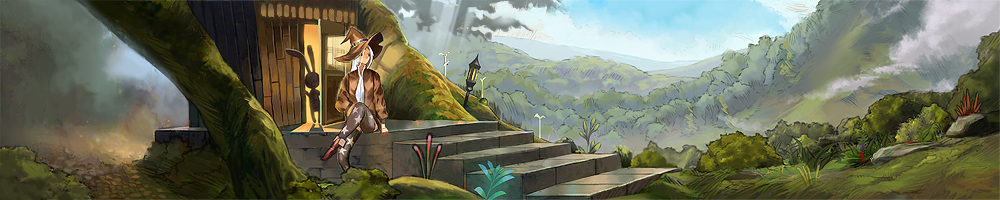


 Fans of the fifteenth episode of Rahxephon can rejoice: its director, Mitsuo Iso has embarked on a new project called Dennou Coil. Having done the animation for major Ghibli-movies such as Porco Rosso, Ocean Waves and Only Yesterday as well, this guy had the potential to create a masterpiece. Thankfully, he actually pulled it off, and many consider this series as one of the best of the entire year.
The thing that’ll probably immediately catch your attention when you start to watch this series is the immense amount of creativity that’s put into the series. It takes place in about twenty years, where a cyber-world exists that people can only see if they’re wearing special glasses already is something you don’t think of quite easily, but Mitsuo Iso created a world that consists out of much, much more than just that. The first half of the series carefully builds this up, and makes sure that the viewer has been accustomed to the many sides of the setting, only for this series to really get fired off with the second half, and the final quarter of the series has some incredibly emotionally charged climaxes.
To make this even better, Dennou Coil has amazing production-values, second to only Seirei no Moribito. What you usually see with series is how their first few episodes have amazing animation, only to switch to a lazier animation-style after a few episodes, but Dennou Coil is different. The animation is of a consistent high quality, and there are no signs of outsourcing at all. The character-designs may look simple, but the animation and integration with CG make them look beautiful.
The characters may not be among the best points of this series, but they do work effectively when they have to, due to the careful building-up of the storyline. One point of critique would be that most of the side-characters could have gotten more development. Daiichi, Denpa, Fumie and Kyoko are wonderful characters, but if feels like they weren’t used to their full potential, and their roles became smaller and smaller as the series went on.
One thing that irked me, but will probably have little effect to those who plan to marathon the series is the overabundance of recap-episodes. In total, there’ve been three of them for a 28-episode series. The final episode could also have been a bit less rushed. Finally, there are three episodes in the middle of the series (11, 12 and 13), which I guess were meant to flesh out the world of Dennou Coil a bit, and they’re excellent standalone episodes, but they really feel out of place with the rest of the series, and only throw in more potential that unfortunately had to be ignored in the end.
Apart from this, though, we’ve got ourselves a masterpiece here. It’s one of the highlights of the year, and apart from Kaze no Shoujo Emily, it’s the most consistently good series of 2007 for me. It’s anime like these that show that even stories focused at children can be awesome nonetheless.]]>
Fans of the fifteenth episode of Rahxephon can rejoice: its director, Mitsuo Iso has embarked on a new project called Dennou Coil. Having done the animation for major Ghibli-movies such as Porco Rosso, Ocean Waves and Only Yesterday as well, this guy had the potential to create a masterpiece. Thankfully, he actually pulled it off, and many consider this series as one of the best of the entire year.
The thing that’ll probably immediately catch your attention when you start to watch this series is the immense amount of creativity that’s put into the series. It takes place in about twenty years, where a cyber-world exists that people can only see if they’re wearing special glasses already is something you don’t think of quite easily, but Mitsuo Iso created a world that consists out of much, much more than just that. The first half of the series carefully builds this up, and makes sure that the viewer has been accustomed to the many sides of the setting, only for this series to really get fired off with the second half, and the final quarter of the series has some incredibly emotionally charged climaxes.
To make this even better, Dennou Coil has amazing production-values, second to only Seirei no Moribito. What you usually see with series is how their first few episodes have amazing animation, only to switch to a lazier animation-style after a few episodes, but Dennou Coil is different. The animation is of a consistent high quality, and there are no signs of outsourcing at all. The character-designs may look simple, but the animation and integration with CG make them look beautiful.
The characters may not be among the best points of this series, but they do work effectively when they have to, due to the careful building-up of the storyline. One point of critique would be that most of the side-characters could have gotten more development. Daiichi, Denpa, Fumie and Kyoko are wonderful characters, but if feels like they weren’t used to their full potential, and their roles became smaller and smaller as the series went on.
One thing that irked me, but will probably have little effect to those who plan to marathon the series is the overabundance of recap-episodes. In total, there’ve been three of them for a 28-episode series. The final episode could also have been a bit less rushed. Finally, there are three episodes in the middle of the series (11, 12 and 13), which I guess were meant to flesh out the world of Dennou Coil a bit, and they’re excellent standalone episodes, but they really feel out of place with the rest of the series, and only throw in more potential that unfortunately had to be ignored in the end.
Apart from this, though, we’ve got ourselves a masterpiece here. It’s one of the highlights of the year, and apart from Kaze no Shoujo Emily, it’s the most consistently good series of 2007 for me. It’s anime like these that show that even stories focused at children can be awesome nonetheless.]]>
Category: Anime Reviews
Porco Rosso Review – 88/100


 In contradiction to most other anime-fans (at least, that’s what I suspect), I’m not necessarily a Japanophile, and I don’t really regard the Japanese culture as the “best culture ever”; it’s just that these guys are so damn good at storytelling. That’s why I love it when an anime takes place in a country other than Japan. Because of this, I love the fact that for this movie, Hayao took up his roots of when he was still working for Nippon Animation, and combined this with his love for airplanes and his huge imagination.
The result is a beautiful depiction of southern Italy around the ages of World War One, and possibly the most unique out of all Ghibli-movies and it’s got a combination of drama and comedy that puts My Neighbour the Yamadas and Pom Poko to shame. While the amount of details that went into this movie isn’t as impressive as, say, My Neibour Totoro or Kiki’s Delivery-service, it makes up for this with some addictive storytelling and some awesome side-characters. You just can’t help but love the pirates and their antics.
Also, for once I’m glad that the main character doesn’t ruin the movie. Porco himself may not be the best character of the bunch, but yet he’s fresh and original, and a major leap away from the usual protagonists you see in anime, being a war veteran that turned into a pig and all. The real problem with Porco Rosso is that it’s got a few clichés here and there, though, that serve to keep the movie on track. A notable exception, however, is the ending.
With my reviews of the Ghibli-movies, I’ve often paid little to no attention to the production-values. Heck they’re awesome, what else did you expect? Still, I do want to mention that Porco Rosso has probably the best soundtrack of all Ghibli-movies. Like no other in Hisaishi Joe’s repertoire, it sets the mood for the Italian setting perfectly.
As I’ve now seen all of the major Ghibli-movies, I just don’t think I can really label one as the best of the bunch. My Neighbour Totoro was really nostalgic, Kiki’s Delivery-Service and Spirited Away were wonderful tales of growing up, and The Cat Returns and Porco Rosso combined great, intriguing and very different stories with a quirky nature and excellent characterizations. All I can say is that these five stood out for me as the most memorable, and they should be a definite recommendation to any anime-fan.]]>
In contradiction to most other anime-fans (at least, that’s what I suspect), I’m not necessarily a Japanophile, and I don’t really regard the Japanese culture as the “best culture ever”; it’s just that these guys are so damn good at storytelling. That’s why I love it when an anime takes place in a country other than Japan. Because of this, I love the fact that for this movie, Hayao took up his roots of when he was still working for Nippon Animation, and combined this with his love for airplanes and his huge imagination.
The result is a beautiful depiction of southern Italy around the ages of World War One, and possibly the most unique out of all Ghibli-movies and it’s got a combination of drama and comedy that puts My Neighbour the Yamadas and Pom Poko to shame. While the amount of details that went into this movie isn’t as impressive as, say, My Neibour Totoro or Kiki’s Delivery-service, it makes up for this with some addictive storytelling and some awesome side-characters. You just can’t help but love the pirates and their antics.
Also, for once I’m glad that the main character doesn’t ruin the movie. Porco himself may not be the best character of the bunch, but yet he’s fresh and original, and a major leap away from the usual protagonists you see in anime, being a war veteran that turned into a pig and all. The real problem with Porco Rosso is that it’s got a few clichés here and there, though, that serve to keep the movie on track. A notable exception, however, is the ending.
With my reviews of the Ghibli-movies, I’ve often paid little to no attention to the production-values. Heck they’re awesome, what else did you expect? Still, I do want to mention that Porco Rosso has probably the best soundtrack of all Ghibli-movies. Like no other in Hisaishi Joe’s repertoire, it sets the mood for the Italian setting perfectly.
As I’ve now seen all of the major Ghibli-movies, I just don’t think I can really label one as the best of the bunch. My Neighbour Totoro was really nostalgic, Kiki’s Delivery-Service and Spirited Away were wonderful tales of growing up, and The Cat Returns and Porco Rosso combined great, intriguing and very different stories with a quirky nature and excellent characterizations. All I can say is that these five stood out for me as the most memorable, and they should be a definite recommendation to any anime-fan.]]>
My Neighbour Totoro Review – 89/100


 Most of Ghibli’s works are for all ages, but there’s always one demographic that stands out for each movie, often related to the ages of the protagonists: Kiki’s Delivery-Service, for example, is for middle-schoolers, Princess Mononoke and Ocean Waves are for high-schoolers, while Only Yesterday is for the adults. My Neighbour Totoro completes this picture by being aimed at little children, and really, it’s one of Ghibli’s finest productions.
Even if you’re not a chid of ten years old, you’ll love the nostalgic feeling that this movie creates. A lot of screen-time is spent on the two main characters (two sisters of about four and ten years old), just playing with each other and having fun, just like all children are supposed to. A major theme also is children’s fantasies, and I’m sure that everyone would have loved to meet the strange creatures portrayed in this movie when they were young.
The reason why I like My Neighbour Totoro so much is that out of all the Ghibli-movies I’ve seen, this one’s the most perfectly paced so far. Princess Mononoke, Kiki’s delivery-service and Nausicaa, for example, were great in their own ways, but their climaxes were rushed; Takahata’s movies went on for too long and Spirited Away’s second half didn’t live up to the first one, but not with My Neighbour Totoro! The first half of the movie builds the characters and setting up perfectly, and once we got to know them, the second half kicks in and the fun begins as Totoro himself comes in action. The climax itself doesn’t feel forced at all, and yet I couldn’t help but shed a tear at what happened, and the movie ends at just the right time.
But yeah, My Neighbour Totoro shares the same flaw as Kiki’s Delivery-service: the pacing may feel perfect, but I feel that there’s so much more potential left in the concept. It’s a shame that only a movie of an hour and a half could be made out of it, and this movie could have easily been extended to a 13-episode television-series, there are so many characters that could have been fleshed out and delved into. But then again, one of the charms of this movie is how it’s so simple, yet effective.
Obviously, if you expected an action-movie like Mononoke or Laputa then you should stay away from this movie. My Neighbour Totoro feels much more like the non-Miyazaki-movies of Studio Ghibli, but with a perfect integration between the realistic and the fantasy-elements. As usual, the graphics and music are excellent, but you wouldn’t expect any different from a Hayao Miyazaki-movie. Anyway, with this, I’ve seen nearly all of the major Ghibli’s movies. There’s only one of them left, and I’ve got some high expectations of it.]]>
Most of Ghibli’s works are for all ages, but there’s always one demographic that stands out for each movie, often related to the ages of the protagonists: Kiki’s Delivery-Service, for example, is for middle-schoolers, Princess Mononoke and Ocean Waves are for high-schoolers, while Only Yesterday is for the adults. My Neighbour Totoro completes this picture by being aimed at little children, and really, it’s one of Ghibli’s finest productions.
Even if you’re not a chid of ten years old, you’ll love the nostalgic feeling that this movie creates. A lot of screen-time is spent on the two main characters (two sisters of about four and ten years old), just playing with each other and having fun, just like all children are supposed to. A major theme also is children’s fantasies, and I’m sure that everyone would have loved to meet the strange creatures portrayed in this movie when they were young.
The reason why I like My Neighbour Totoro so much is that out of all the Ghibli-movies I’ve seen, this one’s the most perfectly paced so far. Princess Mononoke, Kiki’s delivery-service and Nausicaa, for example, were great in their own ways, but their climaxes were rushed; Takahata’s movies went on for too long and Spirited Away’s second half didn’t live up to the first one, but not with My Neighbour Totoro! The first half of the movie builds the characters and setting up perfectly, and once we got to know them, the second half kicks in and the fun begins as Totoro himself comes in action. The climax itself doesn’t feel forced at all, and yet I couldn’t help but shed a tear at what happened, and the movie ends at just the right time.
But yeah, My Neighbour Totoro shares the same flaw as Kiki’s Delivery-service: the pacing may feel perfect, but I feel that there’s so much more potential left in the concept. It’s a shame that only a movie of an hour and a half could be made out of it, and this movie could have easily been extended to a 13-episode television-series, there are so many characters that could have been fleshed out and delved into. But then again, one of the charms of this movie is how it’s so simple, yet effective.
Obviously, if you expected an action-movie like Mononoke or Laputa then you should stay away from this movie. My Neighbour Totoro feels much more like the non-Miyazaki-movies of Studio Ghibli, but with a perfect integration between the realistic and the fantasy-elements. As usual, the graphics and music are excellent, but you wouldn’t expect any different from a Hayao Miyazaki-movie. Anyway, with this, I’ve seen nearly all of the major Ghibli’s movies. There’s only one of them left, and I’ve got some high expectations of it.]]>
Princess Mononoke Review – 84/100


 If you want to know why Hayao Miyazaki is famous for his environmentalist movies, then you should watch Mononoke Hime, as the struggle between humans and nature forms a huge focus in this movie. This is the movie that ranks for many people as the best movie that came from Studio Ghibli. While I don’t share the same views, this does remain a worthy addition to their repertoire.
The setting of Princess Mononoke has actually quite some similarities with Nausicaä: humans need space, forest doesn’t like it and fights back, humans fight back and come to hate the forest and an ever-increasing cycle continues, until of course, the main character appears. The only change is that while Nausicaä took place in the future, Mononoke Hime is set in a past-like world, in which the industrial revolution has just begun.
If I had to compare the two settings, then I’d say that Nausicaä wins in terms of creativity. On the other hand though, Mononoke isn’t held back by a manga that went on for too long to make a proper movie about it. Most of the major characters and parties are fleshed out pretty nicely, and the major villain walks into an excellent line between good and evil. You can see why she’s doing the things she does, even though they’re morally unacceptable at times. One thing that also adds to the movie’s value is that there are many different parties that all have their own reasons to fight and be involved with the story, both on the human and forest-side. The side-characters are really the ones who make his movie shine.
And yes, there we go again: the same can’t be said for our two lovely main characters, like in most other action-anime that start a bunch of teenagers. A lot of predictability in the movie comes from the two of them, especially the male one. While most characters aren’t really good or evil, the two of them are clearly meant to be on the good side, and I blame them for the rather Disney-ish ending. This really is a mainstream movies: both in the good, and in the bad ways. Be also aware that near the ending, a few inconsistencies in the storyline appear, though to delve in them would be a bit spoilerific.
And while the setting may be less creative than other of Miyazaki’s movies, that doesn’t mean that there isn’t any creativity at all. For Mononoke Hime, Hayao created a fascinating world, especially the iron-factory where the women have basically become equal to the men is something I’ve never seen delivered in such a believable way, especially considering the time in which the movie is set. You can clearly see that Hayao is a huge feminist as well.
I finally understand why Ghibli has become such a big name. Hayao Miyazaki knows exactly what it takes to make a movie mainstream, and yet creative and good. While a few things had to be sacrificed for this (most importantly, the rather dull male lead and the cute and mysterious girl that is the female lead), this turned into a worthy movie. While the animation isn’t as revolutionary new as the movies that he produced in the 1980s (apart from perhaps the few elements of CG), they still look as beautiful as ever, with quite a nice musical score added to it.]]>
If you want to know why Hayao Miyazaki is famous for his environmentalist movies, then you should watch Mononoke Hime, as the struggle between humans and nature forms a huge focus in this movie. This is the movie that ranks for many people as the best movie that came from Studio Ghibli. While I don’t share the same views, this does remain a worthy addition to their repertoire.
The setting of Princess Mononoke has actually quite some similarities with Nausicaä: humans need space, forest doesn’t like it and fights back, humans fight back and come to hate the forest and an ever-increasing cycle continues, until of course, the main character appears. The only change is that while Nausicaä took place in the future, Mononoke Hime is set in a past-like world, in which the industrial revolution has just begun.
If I had to compare the two settings, then I’d say that Nausicaä wins in terms of creativity. On the other hand though, Mononoke isn’t held back by a manga that went on for too long to make a proper movie about it. Most of the major characters and parties are fleshed out pretty nicely, and the major villain walks into an excellent line between good and evil. You can see why she’s doing the things she does, even though they’re morally unacceptable at times. One thing that also adds to the movie’s value is that there are many different parties that all have their own reasons to fight and be involved with the story, both on the human and forest-side. The side-characters are really the ones who make his movie shine.
And yes, there we go again: the same can’t be said for our two lovely main characters, like in most other action-anime that start a bunch of teenagers. A lot of predictability in the movie comes from the two of them, especially the male one. While most characters aren’t really good or evil, the two of them are clearly meant to be on the good side, and I blame them for the rather Disney-ish ending. This really is a mainstream movies: both in the good, and in the bad ways. Be also aware that near the ending, a few inconsistencies in the storyline appear, though to delve in them would be a bit spoilerific.
And while the setting may be less creative than other of Miyazaki’s movies, that doesn’t mean that there isn’t any creativity at all. For Mononoke Hime, Hayao created a fascinating world, especially the iron-factory where the women have basically become equal to the men is something I’ve never seen delivered in such a believable way, especially considering the time in which the movie is set. You can clearly see that Hayao is a huge feminist as well.
I finally understand why Ghibli has become such a big name. Hayao Miyazaki knows exactly what it takes to make a movie mainstream, and yet creative and good. While a few things had to be sacrificed for this (most importantly, the rather dull male lead and the cute and mysterious girl that is the female lead), this turned into a worthy movie. While the animation isn’t as revolutionary new as the movies that he produced in the 1980s (apart from perhaps the few elements of CG), they still look as beautiful as ever, with quite a nice musical score added to it.]]>
Kiki's Delivery Service Review – 88/100


 Hayao Miyazaki may not be as good at realism as his good friend Isao Takahata, but for that he makes up with an excellent sense of storytelling. While Takahata’s movies often consist out of random sketches that don’t really have much to do with each other, Miyazaki creates wonderful coherent stories, that make full use of their airtime, and so far, Kiki’s Delivery-service is one of the best examples of this.
While the concept of a small witch who runs a delivery-service may sound boring, it’s everything but that. Kiki is probably one of the most likable characters that I’ve seen in a Ghibli-movie, and this movie makes sure we see all sides of her, whenever she’s happy, sad, cheerful, determined or down-hearted; she turns into a wonderful character. The themes range from the airplanes, which sort-of became Hayao’s signature, to independence and accepting the different sides of people. This is another gem that’s right for every age that ha the guts to admit to like cute characters.
One downside of this movie is basically the opposite of what you’d expect from a Takahata-movie: it’s too short. I feel like there’s so much more potential left in this story, even though the length is nearly two hours. There are many side-characters that could have easily gotten more development, and Hayao could easily have created more interesting jobs for Kiki to do.
The dialogue for this movie is great and life-like, though some of the plot-twists feel a bit forced. I’m especially referring to the climax, which got introduced in a Deus ex Machina-like way. Also, this being a Ghibli-movie and all, I don’t think I have to elaborate much on the graphics: they rock, especially for a movie that was produced in 1989, the same can be said for the soundtrack.
While I admit that Howl’s Moving Castle had its issues, and Nausicaa may have been a bit too preachy, the other movies from Miyazaki so far have been really excellent. While Kiki’s Delivery Service wasn’t as imaginative as Laputa or Spirited Away, it makes up with an addictive storytelling that really should be regarded as an example.]]>
Hayao Miyazaki may not be as good at realism as his good friend Isao Takahata, but for that he makes up with an excellent sense of storytelling. While Takahata’s movies often consist out of random sketches that don’t really have much to do with each other, Miyazaki creates wonderful coherent stories, that make full use of their airtime, and so far, Kiki’s Delivery-service is one of the best examples of this.
While the concept of a small witch who runs a delivery-service may sound boring, it’s everything but that. Kiki is probably one of the most likable characters that I’ve seen in a Ghibli-movie, and this movie makes sure we see all sides of her, whenever she’s happy, sad, cheerful, determined or down-hearted; she turns into a wonderful character. The themes range from the airplanes, which sort-of became Hayao’s signature, to independence and accepting the different sides of people. This is another gem that’s right for every age that ha the guts to admit to like cute characters.
One downside of this movie is basically the opposite of what you’d expect from a Takahata-movie: it’s too short. I feel like there’s so much more potential left in this story, even though the length is nearly two hours. There are many side-characters that could have easily gotten more development, and Hayao could easily have created more interesting jobs for Kiki to do.
The dialogue for this movie is great and life-like, though some of the plot-twists feel a bit forced. I’m especially referring to the climax, which got introduced in a Deus ex Machina-like way. Also, this being a Ghibli-movie and all, I don’t think I have to elaborate much on the graphics: they rock, especially for a movie that was produced in 1989, the same can be said for the soundtrack.
While I admit that Howl’s Moving Castle had its issues, and Nausicaa may have been a bit too preachy, the other movies from Miyazaki so far have been really excellent. While Kiki’s Delivery Service wasn’t as imaginative as Laputa or Spirited Away, it makes up with an addictive storytelling that really should be regarded as an example.]]>
Laputa: Castle in the Sky Review – 83/100


 For as far as I know, I’ve seen all of the major Ghibli-movies now, apart from the ones directed by Hayao Miyazaki. First up is Laputa: Castle in the Sky, and finally I understand why Studio Ghibli because such a big name in anime. This is the anime that inspired movies such as Steamboy and Giniro no Kami no Agito, but most importantly, even Vision of Escaflowne (one of my favourite series) shows hints that the creators were avid fans of this movie.
The amount of creativity that Hayao put into the fantasy-setting is astonishingly original. From the mining town where the story starts to the castle of Laputa itself, it’s the setting of this movie that really draws you in. The cast of side-characters also never feels out of place, and they’re the ones who make this movie really come alive. Being produced in 1986 (before I was actually born), I can imagine that this movie must have been revolutionary.
Alas, I wish I could call this movie a masterpiece all the way, though unfortunately things aren’t that simple. For one thing, some parts of this movie didn’t quite age well. Twenty years ago, the idea of a young boy, meeting a mysterious girl who happens to be the queen of an ancient race may have sounded exciting, but I’ve seen this concept being abused a few too many times. Especially the main male character proves to be just unable to carry the weight of the movie as it goes on, and all he does is go from one nearly impossible heroic deed to the other. Much like Steamboy, actually.
I’m also surprised to say this about a Ghibli-movie, but there’s a bit too many action in this one. There’s especially an abundance of grand explosions and random destruction. What surprised me even more is how Hayao hardly used this. When a wooden bridge for mine-carts gets destroyed, it just disappears from the screen. You don’t see angry miners who complain about how they have to fix the damage that was done to their constructions, the movie just acts like nothing happened. When someone falls through a roof, nobody even bothers to fix it. I just can’t help but feel disappointed when this comes from a studio that’s so good at realism.
Overall, I wouldn’t call this the best movie of Studio Ghibli. Spirited Away and The Cat Returns were both just better than what I saw here, but that doesn’t mean that Laputa isn’t one big success, especially considering the time when it came out, and there’s no denying to the influence it had on modern-day anime. With visually stunning animation and a terrific soundtrack, but most importantly a huge amount of imagination, this really is a movie that needs to be seen, despite all of the flaws that it has.]]>
For as far as I know, I’ve seen all of the major Ghibli-movies now, apart from the ones directed by Hayao Miyazaki. First up is Laputa: Castle in the Sky, and finally I understand why Studio Ghibli because such a big name in anime. This is the anime that inspired movies such as Steamboy and Giniro no Kami no Agito, but most importantly, even Vision of Escaflowne (one of my favourite series) shows hints that the creators were avid fans of this movie.
The amount of creativity that Hayao put into the fantasy-setting is astonishingly original. From the mining town where the story starts to the castle of Laputa itself, it’s the setting of this movie that really draws you in. The cast of side-characters also never feels out of place, and they’re the ones who make this movie really come alive. Being produced in 1986 (before I was actually born), I can imagine that this movie must have been revolutionary.
Alas, I wish I could call this movie a masterpiece all the way, though unfortunately things aren’t that simple. For one thing, some parts of this movie didn’t quite age well. Twenty years ago, the idea of a young boy, meeting a mysterious girl who happens to be the queen of an ancient race may have sounded exciting, but I’ve seen this concept being abused a few too many times. Especially the main male character proves to be just unable to carry the weight of the movie as it goes on, and all he does is go from one nearly impossible heroic deed to the other. Much like Steamboy, actually.
I’m also surprised to say this about a Ghibli-movie, but there’s a bit too many action in this one. There’s especially an abundance of grand explosions and random destruction. What surprised me even more is how Hayao hardly used this. When a wooden bridge for mine-carts gets destroyed, it just disappears from the screen. You don’t see angry miners who complain about how they have to fix the damage that was done to their constructions, the movie just acts like nothing happened. When someone falls through a roof, nobody even bothers to fix it. I just can’t help but feel disappointed when this comes from a studio that’s so good at realism.
Overall, I wouldn’t call this the best movie of Studio Ghibli. Spirited Away and The Cat Returns were both just better than what I saw here, but that doesn’t mean that Laputa isn’t one big success, especially considering the time when it came out, and there’s no denying to the influence it had on modern-day anime. With visually stunning animation and a terrific soundtrack, but most importantly a huge amount of imagination, this really is a movie that needs to be seen, despite all of the flaws that it has.]]>
The Cat Returns Review – 86/100


 To be honest, for the past few weeks, I’ve been watching the various Ghibli-movies and while I admit that I haven’t touched the rumoured best of the bunch yet, I’ve yet to understand why people consider them as legends. At the moment, I see them more as a bunch of movie-makers who excel at realism, just like how Shaft excels in strange art-styles. The Ghibli-movies I’ve seen thus far are great, but I’ve seen many other studios with equally good or even better productions, and I’ve also yet to see a bit of really addictive storytelling mixed with their movies. Luckily, The Cat Returns changed this opinion, and showed me that Ghibli is good at more than just realism.
I went in this movie, expecting something like Sprited Away. A girl gets taken to the cat world, and needs to get out. Well, up till here, the stories match, though that’s also exactly where the similarities end. Instead, this turned into a light-hearted shoujo-adventure, with several playful jabs at despotisms. The setting is smaller than you’d expect, and it’s refreshing to see a movie that doesn’t try to be as epic as possible.
Yet, despite this, The Cat Returns actually has the above-mentioned addictive storytelling for me. This is probably the shortest major Ghibli-movie out there, with the length of just over an hour, and because of that, the pacing is a tad faster than the others. Haru, the main character, is interesting and fun to watch, the major side-characters are delightful and creative and the chemistry between the characters is genuine and excellent.
The short length is also a bad point, though. Especially the antagonists could have been more fleshed out and they seem just a bit too silly. While I believe that the creators were well aware of this problem, and I suspect that it was their intention in the beginning, I think that the scenes would have turned out even better if the evil king and his minions would have gotten a bit more development. I do appreciate how this movie managed to give an identity to the different guards that accompany the king. You rarely see that in anime.
The director for this movie is Morita Hiroyuki, the director of Bokura no and who successfully rewrote the final half of the manga into a true masterpiece, and The Cat Returns really shows the same creativity in its story. While you won’t get any of the grand plot twists of the former, you will get an addictive pacing that never turns dull and is varied enough to keep you interested. The guy is really talented at this, and for this movie, he was actually supervised by Hayao Miyazaki. If this movie took itself a bit more seriously, it would have been an epic one, but for now I’ll call this a fun and innocent way to spend an hour.]]>
To be honest, for the past few weeks, I’ve been watching the various Ghibli-movies and while I admit that I haven’t touched the rumoured best of the bunch yet, I’ve yet to understand why people consider them as legends. At the moment, I see them more as a bunch of movie-makers who excel at realism, just like how Shaft excels in strange art-styles. The Ghibli-movies I’ve seen thus far are great, but I’ve seen many other studios with equally good or even better productions, and I’ve also yet to see a bit of really addictive storytelling mixed with their movies. Luckily, The Cat Returns changed this opinion, and showed me that Ghibli is good at more than just realism.
I went in this movie, expecting something like Sprited Away. A girl gets taken to the cat world, and needs to get out. Well, up till here, the stories match, though that’s also exactly where the similarities end. Instead, this turned into a light-hearted shoujo-adventure, with several playful jabs at despotisms. The setting is smaller than you’d expect, and it’s refreshing to see a movie that doesn’t try to be as epic as possible.
Yet, despite this, The Cat Returns actually has the above-mentioned addictive storytelling for me. This is probably the shortest major Ghibli-movie out there, with the length of just over an hour, and because of that, the pacing is a tad faster than the others. Haru, the main character, is interesting and fun to watch, the major side-characters are delightful and creative and the chemistry between the characters is genuine and excellent.
The short length is also a bad point, though. Especially the antagonists could have been more fleshed out and they seem just a bit too silly. While I believe that the creators were well aware of this problem, and I suspect that it was their intention in the beginning, I think that the scenes would have turned out even better if the evil king and his minions would have gotten a bit more development. I do appreciate how this movie managed to give an identity to the different guards that accompany the king. You rarely see that in anime.
The director for this movie is Morita Hiroyuki, the director of Bokura no and who successfully rewrote the final half of the manga into a true masterpiece, and The Cat Returns really shows the same creativity in its story. While you won’t get any of the grand plot twists of the former, you will get an addictive pacing that never turns dull and is varied enough to keep you interested. The guy is really talented at this, and for this movie, he was actually supervised by Hayao Miyazaki. If this movie took itself a bit more seriously, it would have been an epic one, but for now I’ll call this a fun and innocent way to spend an hour.]]>
Whisper of the Heart Review – 84/100


 After watching some various Takahata-movies, I’m glad to see a Ghibli-production that does know to keep a slow, yet addictive pacing. Whisper of the Heart, or Mimi wo Sumebasa tells the story of the twelve-year old daughter of a librarian, as she meets the boy she falls in love with. Just like how Ocean Waves was an example of a high-school romance with a male main character done right, Whisper of the Heart is how a romance-story with a female lead should be.
This also remains a Ghibli-movie, and the amount of detail that has been put in both the animation and the script is top-notch, and the degree of realism is excellent, as expected. The characters also speak with voices that match their ages, instead of a thirty-year old voice-actress trying to do it. When they start singing, they really sound like the singing-voices of average people, when compared to other anime where characters suddenly turn out to have the signing abilities of a J-Pop idol in similar situations.
The story is quite simple, and not as intriguing as Ocean Waves, though it’s enough to make you connect with the characters. The first half introduces them and their relationships, while in the second half the love story between the two main characters gets developed. Basically, if you liked Ocean Waves, you’ll like this one. It’s a nice movie to watch and relax, with still enough going on to keep you interested.
Regarding the flaws, at one point, there’s a side-story about two side-characters that just disappears from the screen without getting resolved at all. It’s strange, because I would have liked to see how it developed. Another thing that Ocean Waves did better than this movie is the character-development. Sure, the characters change, but it’s nowhere near as interesting as the time-skip we saw in Ocean Waves. Be also aware that the main character remains a twelve-year old girl, and she will feel annoying at times.
Still, Whisper of the Heart makes up for this by being more than just a romance-story, where a lot of time is also spent on a cat statue named Baron and some fantasy-sequences where Hayao Miyazaki worked on. Overall though, both are movies worth the watch for anyone who doesn’t need testosterones every fifteen seconds.]]>
After watching some various Takahata-movies, I’m glad to see a Ghibli-production that does know to keep a slow, yet addictive pacing. Whisper of the Heart, or Mimi wo Sumebasa tells the story of the twelve-year old daughter of a librarian, as she meets the boy she falls in love with. Just like how Ocean Waves was an example of a high-school romance with a male main character done right, Whisper of the Heart is how a romance-story with a female lead should be.
This also remains a Ghibli-movie, and the amount of detail that has been put in both the animation and the script is top-notch, and the degree of realism is excellent, as expected. The characters also speak with voices that match their ages, instead of a thirty-year old voice-actress trying to do it. When they start singing, they really sound like the singing-voices of average people, when compared to other anime where characters suddenly turn out to have the signing abilities of a J-Pop idol in similar situations.
The story is quite simple, and not as intriguing as Ocean Waves, though it’s enough to make you connect with the characters. The first half introduces them and their relationships, while in the second half the love story between the two main characters gets developed. Basically, if you liked Ocean Waves, you’ll like this one. It’s a nice movie to watch and relax, with still enough going on to keep you interested.
Regarding the flaws, at one point, there’s a side-story about two side-characters that just disappears from the screen without getting resolved at all. It’s strange, because I would have liked to see how it developed. Another thing that Ocean Waves did better than this movie is the character-development. Sure, the characters change, but it’s nowhere near as interesting as the time-skip we saw in Ocean Waves. Be also aware that the main character remains a twelve-year old girl, and she will feel annoying at times.
Still, Whisper of the Heart makes up for this by being more than just a romance-story, where a lot of time is also spent on a cat statue named Baron and some fantasy-sequences where Hayao Miyazaki worked on. Overall though, both are movies worth the watch for anyone who doesn’t need testosterones every fifteen seconds.]]>
My Neighbours the Yamadas Review – 73/100


 This may be me, who hasn’t looked in the right places, but one thing I’ve noticed after checking out various anime movies is that there are nearly no good comedies among them. Most of them are dramas or thrillers, but I’ve yet to see a truly funny movie, despite how the movie-format seems perfect for this, as there’s less chance that the creators will run out of jokes to use when compared to tv-series.
My Neighbours The Yamadas is probably one of the funniest movies I’ve seen in anime, but still the comedic value is nowhere near that of series like Gintama, Excel Saga and Pani Poni Dash, to just name a few examples. Basically, it follows the everyday life of the Yamada-family, portrayed in a quirky way. Isao Takahata is the director, and indeed there’s lots of realism in this movie, and just like Only Yesterday, you’ll be able to find lots of scenes to identify to.
Unfortunately, this movie may have the good elements of a Takahata-movie, it also has the bad ones. Yet again, it goes on for too long, and yet again, I’ve seen no reason to emotionally connect with the characters. For some reason, I just couldn’t get myself to care about the characters. Those who saw Only Yesterday might recall ten minutes, being devoted to a character eating a pineapple; My Neighbours the Yamada’s does this with a banana. It’s realistic, I know; but I just can’t call it exciting.
One thing that also immediately falls to your attention when you look at the screenshots is the unusual art style. It might be a bit awkward at first, but it does work well enough. The animation is better than you’d think, and what you’d expect from a movie. There are also a few Miyazaki-influences here and there, where the surrealistic undertones start to take over and the characters get carried away in their imagination. The music isn’t anything special, though. It’s just simple, and what you can hear on an average tv-series as well.
I know I’ve been encouraging realism a lot in my latest reviews, but realism alone doesn’t make a good movie. Seirei no Moribito understood this, and it created an excellent atmosphere that sparkled with realism and yet had more than enough tension to make you care about the characters. Random antics of a family are fun and al, but the lack of a point becomes more obtrusive as I think about it. Studio Ghibli may have created a lot of memorable gems, for me, this isn’t one of them. If you want to see the antics of ordinary families, a better choice would be to check out Rumiko Takahashi’s Rumic Theatre.]]>
This may be me, who hasn’t looked in the right places, but one thing I’ve noticed after checking out various anime movies is that there are nearly no good comedies among them. Most of them are dramas or thrillers, but I’ve yet to see a truly funny movie, despite how the movie-format seems perfect for this, as there’s less chance that the creators will run out of jokes to use when compared to tv-series.
My Neighbours The Yamadas is probably one of the funniest movies I’ve seen in anime, but still the comedic value is nowhere near that of series like Gintama, Excel Saga and Pani Poni Dash, to just name a few examples. Basically, it follows the everyday life of the Yamada-family, portrayed in a quirky way. Isao Takahata is the director, and indeed there’s lots of realism in this movie, and just like Only Yesterday, you’ll be able to find lots of scenes to identify to.
Unfortunately, this movie may have the good elements of a Takahata-movie, it also has the bad ones. Yet again, it goes on for too long, and yet again, I’ve seen no reason to emotionally connect with the characters. For some reason, I just couldn’t get myself to care about the characters. Those who saw Only Yesterday might recall ten minutes, being devoted to a character eating a pineapple; My Neighbours the Yamada’s does this with a banana. It’s realistic, I know; but I just can’t call it exciting.
One thing that also immediately falls to your attention when you look at the screenshots is the unusual art style. It might be a bit awkward at first, but it does work well enough. The animation is better than you’d think, and what you’d expect from a movie. There are also a few Miyazaki-influences here and there, where the surrealistic undertones start to take over and the characters get carried away in their imagination. The music isn’t anything special, though. It’s just simple, and what you can hear on an average tv-series as well.
I know I’ve been encouraging realism a lot in my latest reviews, but realism alone doesn’t make a good movie. Seirei no Moribito understood this, and it created an excellent atmosphere that sparkled with realism and yet had more than enough tension to make you care about the characters. Random antics of a family are fun and al, but the lack of a point becomes more obtrusive as I think about it. Studio Ghibli may have created a lot of memorable gems, for me, this isn’t one of them. If you want to see the antics of ordinary families, a better choice would be to check out Rumiko Takahashi’s Rumic Theatre.]]>
Baccano! Review – 93/100


 Anyone who tries the first episode of Baccano! will immediately notice one thing: the immensely huge cast of characters. I could be wrong, but this can very well be the 13-episoded series with the biggest amount of characters ever. While it’s incredibly hard to make a story with so many characters that stretches over three different timelines come together, the creators of Baccano! actually pull this off. And how!
Basically, Baccano! combines immortal alchemists with the American Mafia in 1930. It works quite well, because there are so many different characters, they just have to go beyond the clichés in order to prevent characters who look too much like each other. This results in the quirky thieves of Isaac and Miria, the psychotic Ladd and the charming Luck. While it’s of course impossible for the character to reach the same level of depth as, say, Toward the Terra, but the creators did manage to give every important character (if I had to guess, there’s about thirty of them) an identity, a clearly defined role, a small piece of development and an actual personality.
And I haven’t even started talking about the story yet. Basically, it goes from a completely incomprehensible first episode to a captivating mystery-series, where all the threads of the huge amount of side-stories end up resolved at the end of the final episode. It furthermore tells the story of three, sometimes even four, related timelines right through each other. Because of this, the creators are able to plan the climaxes really well, and they turn into one huge success, with a near-perfect combination between comedy, drama and action. I really mean it when I say that Baccano! has some of the best writing of the entire year.
In terms of production-values, this series also shines. Especially the character-designs: not only do the creators manage to give every one of the about thirty important characters a unique look, they manage to actually do this for even the unimportant and side-characters (if I had to guess, there are about eighty of them). The animation may not look crisp, but it’s detailed, never giving off a feeling of still-frame abuse. The soundtrack consists out of a bunch of catchy Jazz-tunes, which makes me wonder why not more anime turn to this, as it works great to give action-scenes a bit of a quirky touch.
Regarding the bad points, there aren’t really any true flaws about this series, apart from the sacrifices that had to be made for the good points. The first episode is basically one huge puzzle, and only later in the series will things start to make sense. The characters individually aren’t very special either. It’s only when they are combined with others that they become special and interesting.
Overall, there need to be more anime like Baccano! It’s not often when you run into a series that’s as well-written as this one. It’s a definite recommendation from me, provided that you can take a few gory scenes that pop up once in a while.]]>
Anyone who tries the first episode of Baccano! will immediately notice one thing: the immensely huge cast of characters. I could be wrong, but this can very well be the 13-episoded series with the biggest amount of characters ever. While it’s incredibly hard to make a story with so many characters that stretches over three different timelines come together, the creators of Baccano! actually pull this off. And how!
Basically, Baccano! combines immortal alchemists with the American Mafia in 1930. It works quite well, because there are so many different characters, they just have to go beyond the clichés in order to prevent characters who look too much like each other. This results in the quirky thieves of Isaac and Miria, the psychotic Ladd and the charming Luck. While it’s of course impossible for the character to reach the same level of depth as, say, Toward the Terra, but the creators did manage to give every important character (if I had to guess, there’s about thirty of them) an identity, a clearly defined role, a small piece of development and an actual personality.
And I haven’t even started talking about the story yet. Basically, it goes from a completely incomprehensible first episode to a captivating mystery-series, where all the threads of the huge amount of side-stories end up resolved at the end of the final episode. It furthermore tells the story of three, sometimes even four, related timelines right through each other. Because of this, the creators are able to plan the climaxes really well, and they turn into one huge success, with a near-perfect combination between comedy, drama and action. I really mean it when I say that Baccano! has some of the best writing of the entire year.
In terms of production-values, this series also shines. Especially the character-designs: not only do the creators manage to give every one of the about thirty important characters a unique look, they manage to actually do this for even the unimportant and side-characters (if I had to guess, there are about eighty of them). The animation may not look crisp, but it’s detailed, never giving off a feeling of still-frame abuse. The soundtrack consists out of a bunch of catchy Jazz-tunes, which makes me wonder why not more anime turn to this, as it works great to give action-scenes a bit of a quirky touch.
Regarding the bad points, there aren’t really any true flaws about this series, apart from the sacrifices that had to be made for the good points. The first episode is basically one huge puzzle, and only later in the series will things start to make sense. The characters individually aren’t very special either. It’s only when they are combined with others that they become special and interesting.
Overall, there need to be more anime like Baccano! It’s not often when you run into a series that’s as well-written as this one. It’s a definite recommendation from me, provided that you can take a few gory scenes that pop up once in a while.]]>