

Shoukoku no Altair – 02 [The Citadel City]

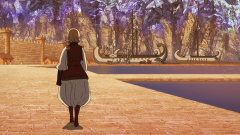
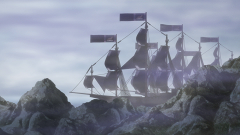
After last week’s runaway locomotive of an episode, I had hoped that Shokoku no Altair would find a lower narrative gear during its second offering. That dream remains unrealized, however, as the show continues to introduce settings and push its plot without giving its cast much time to breathe. The first two episodes thus far share a similar structure: Mahmut attends court and learns of a conflict that puts Turkiye at risk, objects to his rival Zaganos’ plans, is shot down, runs off to fix things himself, and stumbles upon a conspiracy orchestrated by the Empire. Altair’s premiere had a fun festival scene that introduced Ibrahim and Shara, at least, but this time all we got were a couple of clumsy flashbacks before being thrown into another dispute between Turkiye and the opposing Imperial forces.

On one side of this dispute is Zaganos Pasha, who is almost too eager to ride for the Turkiyean territory of Hisar and quell what seems to be an uprising there. While most of the primary characters have been playing with their cards face up, Zaganos Pasha is someone whose motives were in question after a single appearance. His thirst for war seemed to hint at an alliance with the enemy, but this episode revealed that he and Imperial Minister Louis (who was behind the whole thing once again) were on different pages regarding the plot in Hisar. Time will tell if Zaganos is a simple foil for Mahmut, or whether his military aspirations are more deeply rooted.

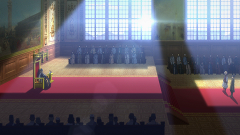
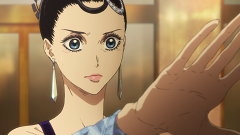
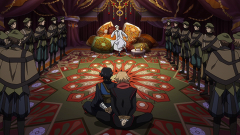
If there’s still hope that Zaganos will reveal himself to be more than a puppy-kicking villain, the same can’t be said for Louis, whose lack of a twirl-able mustache is a big missed opportunity.  Whenever there’s an establishing shot of the castle where Louis confers with the Emperor, a comically evil piece of organ music starts up, just in case you were unsure who the bad guys were. I had high hopes for the Emperor at first, but his awareness of Louis’ schemes was more concrete this time around, which robs their scenes of any potential complexity. Much more interesting is Lady Lelederik, whose brief introduction revealed her cooperation with Louis to be tenuous at best. I’m no expert on monarchical titles, but I expect this new Duchess to trump the Minister in the coming weeks.

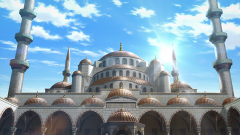
It occurred to me during this episode that Altair’s score is distinctly western, despite being set in an alternate version of the Ottoman Empire. The string section alternates between bombastic and mournful, but they’re nearly always audible, even during some of the characters’ inner monologues. We only get a break from this sameness during the dance scenes, where the music is cheerier and more varied, but not quite Turkish or even Middle Eastern, at least not to my untrained ears. (Feel free to call me out in the comments if I’m off base here.) Altair’s backgrounds and buildings look authentic, but its unremarkable music may be contributing to my lack of engagement with the series. Its ending theme, though, meshes traditional and pop music to create an entrancing beat for which I always stick around – that’s one department where Altair never lets me down.

Shoukoku no Altair – 01 [The Golden Eagle General]

As a fan of both historical fantasy and MAPPA, the studio behind this series, I had high hopes for Shoukoku no Altair coming into this premiere. Its Middle Eastern setting and young, eager protagonist make it a dead ringer for Arslan Senki, the first season of which I enjoyed. Arslan was a bit dry, and its battle scenes were riddled with CG elements, but it also had the disadvantage of being produced by Liden Films. My thinking was that with a more trustworthy animation house behind it, Altair had a shot at being the complete package.

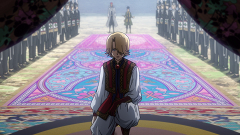
The going is still early, but after one episode, my expectations have been appropriately tempered. Altair is a distinctly average show from a visual perspective, with most of its flair coming from the ornate Turkish outfits and architecture (Turkiyean, to use the show’s vocab), rather than its composition or sense of movement. I haven’t done much more than skim through the first chapter of the manga for this one, but it would surprise me if the art were this standard in its original form. Seeing how much material was crammed into these 22 minutes, though, makes me think that the episode director had a lot more on his mind than making the show look pretty.

Despite only introducing a handful of characters in its first outing (with plenty more to come if the OP is any indication), Altair feels jam-packed with content. I’ve seen it written that the show will likely burn through its first couple arcs to get to the good stuff, and if that’s the case, we ought to be rewarded down the line. For now, though, we’re relying on flashbacks, rooftop statements of purpose, and narrated exposition to learn about the world of Rumeliana. Turkiye is a small fish in a much larger pond, and until all the major players have been introduced, I don’t expect this style of delivery to change.

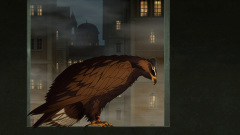
The most significant player in this story is Tugril Mahmut Pasha, “Pasha” being a title for Turkiyean generals. As the youngest person ever to join that distinguished assembly, he’s clearly being set up as a prodigy. His mother is dead, and he’s so inexperienced with women that he opts to sleep on the roof when he finds one in his bed, so he’s ticking all the normal boxes as far as anime protagonists go. Mahmut discovers a plot by the neighboring Balt-Rhein Empire to frame Turkiye for the assassination of their Prime Minister, who is given the name “Franz” in one of the silliest World War I references ever. Our hero conveniently overhears the name of the conspirator from a band of assassins, sets his army of eagles on them, reveals the identity of the traitor to the Emperor of the opposing nation, and saves the day. If that sounds like a lot of material for a first episode, that’s because it is, and that’s without the handful of characters and plot points I’ve neglected to mention. Still, Altair makes itself easy to follow, even as it moves rapidly through its material.

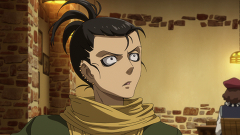
The person that interests me the most is Zaganos Pasha, a young general who wants war with the Empire despite their superior numbers, and with whom Mahmut immediately clashes. There’s a possibility that he’s feeding information to Louis, the Imperial conspirator, to achieve his goal, but his level-headed demeanor makes it hard to predict whether that’s truly the case. The Emperor of Balt-Rhein is also a bit of a question mark – his refusal to listen to all of Mahmut’s testimony indicates prior knowledge of Louis’ plot, but there’s no confirmation that he orchestrated the whole thing. Hopefully these characters, along with those who have yet to be introduced, will lend a bit of spice to a show that could really use it.

Ballroom e Youkoso – 01 [Welcome to Ogasawara Dance Studio]

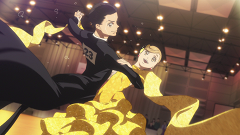
Much of the conversation leading up to the premiere of Ballroom e Youkoso has focused on its English distribution. Amazon, who continue to wade deeper into the anime marketplace, snapped up the series to headline their Anime Strike channel, and plenty of digital ink has been spilled about how its double paywall spells doom for the future of legal streaming. The first episode of Ballroom also had its worldwide debut on Twitch, where a live audience of thousands welcomed its delayed subtitles with KappaPride emotes, copypasta, and an obsession with the size of the characters’ necks. But let’s put all this aside for a moment and ask ourselves: did Production I.G. succeed in preserving the appeal of the manga in its journey from page to screen?

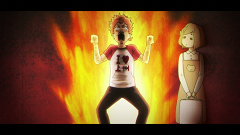
For me, the answer is “pretty much.” Ballroom is a plucky, well-paced series in manga form, and I.G. kept things rolling during the first episode, as well. They had to cut a few corners to get there, however, and one of them cost me some attachment to Fujita, our middle school protagonist. The manga presents him as a willing participant in his first group lesson, having been inspired by a professional dancer named Sengoku, who rescues him from a trio of bullies. The animated version of the story keeps Sengoku’s role the same, but omits the group lesson, and skips straight to a coerced partnership with Shizuku, his schoolmate and newfound crush. As a result, it was much harder for me to swallow the idea that Fujita wanted to go pro by the end of the episode, or that he’d lose track of time and practice the box step for what must have been twelve hours straight.

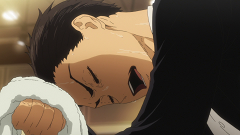
Luckily, the rest of Ballroom’s characters more than pull their weight. Sengoku initially appears to be a good-natured role model, but after witnessing Fujita’s sudden insistence on becoming a professional dancer, he seamlessly transforms into a drill sergeant with a chip on his shoulder. Similarly, Shizuku is suspicious of her temporary partner’s motives, and asks him directly whether he’s just a pervert looking for kicks. It’s only after he demonstrates some proficiency at a beginning technique that she gives him the time of day. This prickly behavior lets us know that ballroom dancing is no walk in the park, and that experienced dancers won’t take kindly to upstarts who haven’t put in the hours. Hopefully, the series will permit Fujita to struggle for as long as possible, and give us a glimpse at the mental fortitude necessary to compete even at the amateur level.

Perhaps the most worrisome thing about this premiere was the lack of any one expressive dance scene. Production I.G. has done some great work on Haikyuu!!, and given the visual similarities between that series and Ballroom, I assume that it’s being handled by the same team. My expectations were high coming into the episode, but even during the scene where Fujita gawked at a dance competition on DVD, there were low-detail models, panning stills, and even what looked like CG dancers in a couple spots. On the plus side, the character designs are strong, even if they’re not identical to the manga, and they’re expressive enough to cover for the holes in the animation department. Still, the first major burst of painstakingly-drawn dance choreography should be a treat to behold.

All in all, this was a good start to an adaptation of a manga that certainly deserved one. I’m already looking forward to the next episode, and to covering the series from week to week.