Sound! Euphonium 2 – 04 [Awakening Oboe]

This week Sound Eupho goes full-blown drama, exploring the struggles from Yoroizuka towards Nozomi. As a result, this episode is the show’s most emotional resonance, but at the same time is the show’s most straight-forwards in terms of plot. What you see is what you get, but the drama is resolved so well that I’m pretty happy with how all this played out.

It’s interesting to note that for how much the show set up this little drama, the conflict reaches its peak from something completely incidental, at first glance. Nozomi, upon hearing about Yoroizuka’s oboe criticism, decides to see her… to say hi, that’s enough to swell Yoroizuka’s emotions up and explode like a torrential rain. This turn of events might seem a bit randomly at first, but take a closer look and you can see their situation has been in a crumble ground that it’s a matter of time for that relationship to collapse on themselves. Before going to Yoroizuka’s point of view, let me raise this: people might think that Nozomi doesn’t really consider Yoroizuka as her friend because after she quit, they cut off their communication, which is something a close friend wouldn’t have done. Yeah, Nozomi might be a bit insensitive but truthfully, she did all that because that’s who she is. Who would blame her for that? She said that she didn’t tell Yoroizuka she quit because she didn’t want to drag her friend into the whole mess, which for me is fair enough.

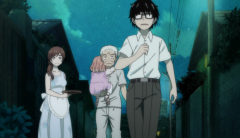
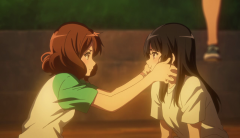
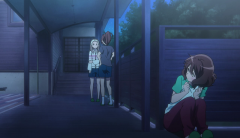
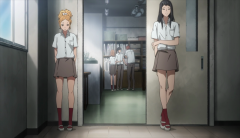
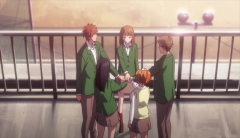
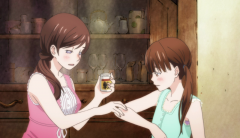
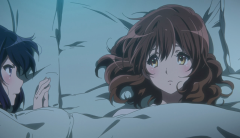
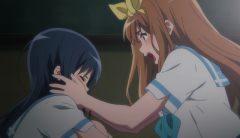
In fact, it’s Yoroizuka who had a problem and the show highlights her issues quite effectively. Since Nozomi left the band without telling her, she felt left out. Nozomi had always been a precious friend to her, being the one who introduced her to play instrument. Yoroizuka fears that facing Nozomi again, she’d be rejected and that feeling keep boiling up inside her to the point that she gets sick just from listening to Nozomi’s sound. That is indeed scary when one’s too dependent on their relationship to others. For around a year she has been playing music for Nozomi and therefore overlooked Yuuko’s friendship and her enjoyment to the band. The visual alone conveys many feelings by the way they frame the characters, like how the show underlines Yoroizuka’s fragile emotions by displays her shutting herself up, literally, under the desk; or when Yuuko tears fall into her face (sharing the pain) and later when Yuuko literally knocks some sense out of her and raising her up to the bright sunlight. The drama sure is overloaded but the visual language is still as sensitive as ever. I have to give Yuuko an extra praise since this season she’s growing to be a very carefully constructed character (despite being very unlikable in first season) and I’m glad that she and Natsuki returning to tease one another again.

But the last five minutes of the show, right after the drama ended is when Sound Eupho returns to its dense storytelling. Asuka again proved to be a genius in pointing out the worst in people by commenting that Yoroizuka’s obsession to Nozomi is due to the fear of being alone, and afterwards making friend with Yuuko as an insurance, to which Kumiko completely disagrees. Asuka has been the most complex character of the series and the scariest thing about her is even when she’s putting up a front, she always makes sense. I doubt that her decision not to allow Nozomi back to the band is only because of Yoroizuka (well, mostly but hardly the only reasons). What she says might not be what she truly feels and I love to see how the show manages to crack into her true personality. Overall, while I think going for heightened drama is not the strongest suit (that would be the show’s emphasis on little moments) and the conflict was resolved a bit too quickly for my taste, it’s still a very well-executed episode. At least now we can move on to the Kansai competition and it’s time to give more spotlights to other members of the cast. Give me more Reina please!!
3-gatsu no Lion – 03 [Harunobu – Beyond the Night Sky]

Another week, another touching little stories from Rei and his friends. Still follow the same structure as previous 2 weeks, we have the first half of Rei competing against Harunobu, his lifelong rivalry (or so that guy thought), and the remaining half of Rei visiting the three sisters on the last day of Obon festival. Unlike last week where we had the first segment to illustrate Rei’s ordinary professional shogi life, this week’s first section actually has a bit of context behind it. Actually, we have A LOT of context here. We have a whole flashback on the very first time they played together as a kid, narrated by the older Rei now that feel wholeheartedly personal. While the last episode framed Harunobu as a noisy and a bit annoying kid, this week shed a lot of new lights into his characters. He was, and still is, never a match for Rei’s shogi skills, but his determination to fight till the very end is something that feels resonant to Rei. I like how the show keeps cutting back to the flying balloons, and Shaft keeps focus on liquid-dropping motifs (be it big tears that like in manga, sweating, or bubbles on cold drink). The show successfully parallels that kid’s match with the current match in order to show us that the determination, the pure joy of facing off each other would never change, and will continue to be for the rest of their careers. It then turns out that Harunobu has been ill and in the hospital since he was a kid, that adds depth to this characters now that we realize his enthusiasm is not something that easily gained, considering his sickness.

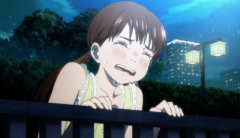
When Rei meets up with the sisters that night, it’s a last day of the Obon festival. On that day, they bid farewell to the deceased ancestors and hope they will be safe in the afterlife. From the look of it I guess the sister’s grandma and mother had been passed away for 2,3 years. Long enough to not overly depressed by it and can carry on the ritual like usual, but soon enough to still feel sad and melancholy. For Rei, he lost his parents from way too long that he eventually shut his emotion off and forget about them in order to carry on. Now I see the connection between him and the sisters and why the sisters treat him like their family. Losing parental figures sure is tough and they eventually share the same pains of losing someone closed to them. But it becomes a habit that when we’re together, we smile and keep looking ahead, and hold that grief feeling to ourselves. That’s why Hinata walks off to the bridge and then outbursts hold so much emotions. She’s always an emotional honest character and carry the weight that burdened on her shoulder is too much for her. At least she can cry her heart out and that is something Rei needs to learn too.

After each viewing, I eventually check out the manga up to where the show had covered to see how closely the adaptation is, and for that Shaft has been followed quite faithfully to the source material. There are many important scenes that they actually adapted literally frame-by-frame from the manga. I previously said that I enjoy the Shaft’s editing for this series, and this episode again show their strengths towards editing: not that smooth editing but quick, sharp cuts to the motifs of the shows: last few weeks we have water bubbling and this week we have quick cuts to the flying balloons or the sun. In addition, there are some Shaft-ness moments that basically remind us this is Shaft’s products. Yes, we have some head tilts and I love to see some Nozomu-sensei imitations here but ultimately, they do it just about enough, without distracting the story. The sound design also deserves a special mention that feel lively, and that soaring scores really bring out the sadness and sorrow without again never really stand out. Great stuffs. Overall, Shaft have been given this show an excellent treatment.

But if I have to compare the manga and the show right now, I feel the manga fare better for me, which is strange because I consider Shaft adapting the manga quite effectively. So why is that? For me, the manga achieves something really simple but direct and honest, and that’s freaking hard to do. Take a scene where Akari explains about the cucumber and eggplant as the “horses” to bring the ancestors to their former homes and backs; while in the anime it feels like she’s giving information for us to process, in the manga I actually feel the sadness behind the talk. Chica Umino is ultimately a character’s writer, as opposed to say Gen Urobochi who famously known for his theme-ridden story and his world-building, or Mari Okada for her heightened drama (I don’t know why I bring up those two honestly, they aren’t even mangaka. Must be Freudian slip). Well, when a mangaka includes the character’s name into the chapters it means that those characters are her privilege and she really cares about her characters. Those characters were given more depth with such honesty that it never feels forced or calculated. I have gotten to the stage where I don’t pretty much care about great plots, shows with deep meaning or profound theme, all I care is characters that feel like real people that I feel invested to, and to witness how they grow overtime. I can safely say that 3-gatsu no Lion achieves that, and that alone is good enough for me to keep recommending this show.

Flip Flappers – 03 [Pure XLR]

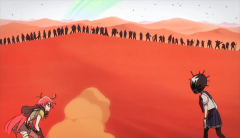
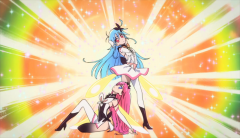
Flip Flappers again raises the bar of what is expected of them, as this week the show goes even much trippier than the previous two weeks, and much darker too. They break out even their own formula, starting this episode right in the middle of desert wasteland. While this episode certainly reminds you a lot of other shows (to namelist: Mad Max, Fist of the North Stars, a bit of Star Wars, the fights of FLCL, the transformation of Sailor Moons (with fairy wings), the Super Saiyan powered-up, and whole other real life, historical references that I will discuss later), it still maintains its own personalities, runs its own beats, being busy with its own aesthetic and as a result Flip Flappers just gets weirder and more awesome. This is hand down its best episode so far.

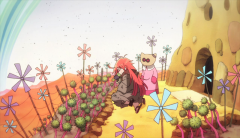
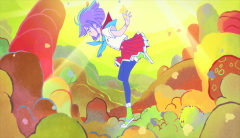
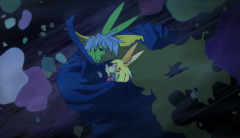
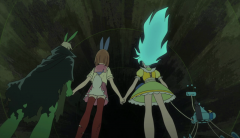
In this episode, Flip Flappers decides to go to new direction. Instead of half-Cocona in her daily school, half-Pure Illusion worlds, they jump straight into the middle of Pure Illusions world. I love how things just got escalated very quickly in this episode in terms of plot, and because we have no idea about that world, the show freely twists our expectations of what about to come. We first follow Papika as she was abducted by the rare race with pumpkin-like faces. We see them as a potential threat for Papika until we see how they live an old but civilized, peaceful lives. Then, Mad Max-style gang of bandits attack the village and take their water. Their biggest, bad-assed guy challenged Papika and it all turned out that they’re no match for her. Then revealed their boss who is none other than Cocona, in mask. Then when that fight between two girls are done, we learned that Cocona has been manipulated by the girl in black. Then they nearly lose their lives to beat that monster, just so the other group comes in and kills it in 3 seconds. And the three people in that other group are just some pawns for something much bigger. You get what I mean? Flip Flappers keeps … well… flipping our expectations around that except from knowing Cocona and Papika will be alright, we can’t never tell for sure what going to happen. Everyone is not what they seem (clued in Cocona’s obaa-chan here, her detached response gives me a chill, I wouldn’t be surprised if she turns out to be some sorts of villain), and everything is not what it seems; they are the only rules of Flip Flappers.

Apart from its aesthetic which is already mesmerizing and overwhelming, the amount of symbolisms here in Flap Flappers is just way toooo much. But that’s why I love it. As one of our reader pointed out before, Uexekull is a reference to Jakob von Uexküll, a biologist who actually influenced some areas of philosophy like Phenomenology (study of the structures of experience and consciousness), which is kind of related to Pure Illusion experience. The chanting of Asclepius from the other organization is come from the god of healing Asclepius in Greek mythology, which also appropriate since Cocona was in that place that resembling strongly to the ruined Greek buildings, but I’m still not sure why they use that reference though. The antagonist girl, who I don’t know where the show inspires of, clearly symbolizes something lustful, decay and manipulation. The robot TT392 proves again to be the most human character that we’re all can related to well, as he spiraled out of control when seeing naked girls and basically was volunteered to be the sexiest girl’s servant at all cost. At least I know that what I would do too. And there is one thing you should learn for the next Pure Illusion trip Cocona and Papika: make the hole on the ground, that’d save you a lot of trouble.

I have mentioned last week that I think Cocona and Papika both the represent the dual side of girlhood. Well, I still stand by that because the theme of duality is still going strong here. Cocona was manipulated to fight against Papika because she’s unsure about her shelf, she wants to break out from that shelf (the feeling of wanting to punch Papika). Moreover, sexuality theme again popped up here, last week it was to control your desire, this week lust is hindered everywhere, from that infamous dark scene, to the fact that the fragment is located in Cocona’s thigh; and isn’t it the girl’s transformations represent their ultimate purity? Also, their hair change to other’s counterpart colors after transformation, and their transformation names Pure Blade/ Pure Barrier support that duality theme as well, as do you see any fighter without either blade or shield? Also, it is interesting to note that the FlipFlap organization is designed as some kind of broken down lab sciences, while with the other organization, it looks like a cultish group. Kinda huge leap from the groups that share the same objectives don’t you think?

Here’s one of my theory about the nature of Pure Illusions. It might represent the state of mind, the characteristics of one particular characters. In the first episode it’s Cocona’s version, as a result we have a winter snowy landscape (because she’s coldhearted), no people around (because she’s lonely). In the second episode it’s Uexkull’s, so the girls transform into bunnies, the colors are overloaded (indicates that it isn’t human visions). If we follow that sense then this episode is from the characteristic of Papika, which kind of make sense because of her hotheaded nature (desert), her outgoing traits (this is the first Pure Illusion world that we have other people, other races, and more spectacularly they are not one but 3 races), and the red desert that align with her hair colors is a dead giveaway. But I agree that this is kind of stretching the idea and somehow if they have indeed done it that way then I feel they are limited to themselves. The fun here in Flip Flappers is to sit back and enjoy the imaginary washes over you, and you just keep your eyes peeled and follow their sense of madness logic because you know it gonna be a fun ride.  I have fastened my seatbelt, now take me to wherever you want to go, Flip Flappers!!!
Sound! Euphonium 2 – 03 [Troubled Nocturnes]
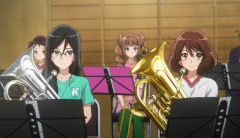
This week, we follow an almost 24 hours of Kumiko practicing music, Kumiko interacting with other members, Kumiko having a sleepless night in a band camp, and that’s basically it. In a very Sound Eupho’s way of storytelling, there seems to be not much going on, but this episode actually lays a lot of groundworks for the future drama of this season. This is essentially a set-up episode, but boy; does the execution shine through that make me completely hooked.

First, let me talk about Kumiko as a protagonist first. The show tells the story squarely through the point of view of Kumiko. It literally means that she appears in almost every moment of the show. We follow her every step, we see what she sees, we hear what she thinks. It’s actually a huge burden on her character, because if she’s not interesting enough, we will have a hard time getting on with her behaviors and thus could potentially bring the show down. Moreover, unlike most main characters in that situation who usually drive the plot themselves, Kumiko is passive. She was dragged to join the musical band, and then got swept away by the enthusiasm of the band. She’s even insensitive with the feeling from her surrounding, like she flat out rejected Shuichi (her childhood friend who also plays on the band), or never seems to comprehend Reina’s thoughts. Yet I believe she carries her roles very well. She has that cynical side of her, and her flat delivery (kudos to the voice actress here) both reflects really well her personality, and somehow adds charm to her character. She’s not a perfect person and that precisely why she’s believable in a way actual people behave.

Most of the drama this episode heads towards Yoroizuka’s issues (an emotionless girl). Although everyone agrees that her oboe skills are excellent, she can’t express herself very well. That problem echoed her confessions to Kuniko last week: that she doesn’t know why she keep competing, even though she’s clearly not enjoy playing anymore. In addition, when Kumiko confronts the always-scary Asuna, it is then revealed that the main reason Asuna refused Nozomi from coming back was because of Yoroizuka. She gets sick when hearing Nozomi’s sound and she can’t seem to operate when Nozomi is around. I suspect this was because of Nozomi’s very promise (to win a competition in high school) that put Yoroizuka in a trance, but I’m sure we’ll know the answer in next episodes. The message here is clear: Yoroizuka needs to open herself up in front of Nozomi, that coming event will both decide if Nozomi gonna be back to the band, and Yoroizuka’s solo performances issues. Neat tricks, Sound Eupho! Suddenly everything tied up to a neat package.

Upon seeing Niiyama (the female instructor) together with Taki-sensei, Reina, feeling insecure, couldn’t stop herself to ask for their relationship. This is for me the only clumsy part in this episode, as it feels very forced the way Reina stormed through everything to ask Taki about his affairs. Again, Kumiko is the one who get the real info dump: Taki had been married but his wife passed away sometimes ago. Taki almost gave up on music after that, but eventually he decided to teach music in this high school. Remember last week when he mentioned with a smile that he has no family right now so he spends most of his times for works? This competition training is a way for him to get his head out of his trauma. That’s a good character’s development and I’m amused to see how the show develops this little drama to its full extend. But please don’t make Reina confessing her affection to him. I just dislike it if the show goes to that path.

From last season, the question of pushing the band into competitive level has been addressed many times (pushing the band into competitive level means that those who play music just for pleasure will be left out. Hard but true), in this season again those questions become a central theme: Is competition fair at all? Do the players really enjoy competition? Kumiko receives different opinions from her peers, they are after all depend on each player’s perspectives. Yoroizuka explains that competition is to unfair, because all the hard works are being judged by something intangible: gold; silver; bronze; ranking, and playing competition is a pain for her. Later, when she asks Yuko (a girl who adored Kaori) that very same questions, she argues that trying to become better is worth more than doing nothing (like last year’s drama), but the competition assigns superiority (I like how she described it!) means that most of the time the end results justify the mean. Lastly, Reina says that she likes competitions and only winners get to say that judging music using ranking is worthless, because if losers say that they are nothing more than, well, sore losers. Those arguments all make sense and I’m glad that the show goes that far to explore different angles from the girls. This is a very solid Sound Eupho episode because they successfully plant all the drama seeds for this season, now let wait and see for all those seeds to blossom.

Orange Review – 73/100

What would you do if you receive letters from your future-self saying that you can change your future? That’s exactly what Naho experienced as she obtains ones from herself 10 years later that urge her to look after her new friend and prevent him from committing suicide. The premise, I agree, is hardly anything groundbreaking, but it functions well as a romantic drama anime. And orange is exactly that: a romantic drama anime. We have tons of romance developing between the leads Naho and Kakeru, and even more time focusing on the depression of Kakeru and the group’s attempt to save him.

The very central theme of orange is the sense of regret. Kakeru always feels regrets over his mother suicides, blaming himself for what happened and the thought of continue to live on proved to be too much for him. Moreover, it’s the adult counterpart that hold that same sense of regrets and griefs towards what they could do in the past for Kakeru. If they were more attentive, they could’ve realized his inner struggles. If they helped him out when he needed the most, chances were, he could’ve survived. Should’ve known better. It’s that regret sense that carry the weight in Naho’s, and eventually Suwa’s and the rest of the group’s actions and make their efforts feel grounded and genuine.

But that’s not to say that their efforts were executed flawlessly. The show’s at its best when the group confronts Kakeru to say out loud his issues, to really share his troubles to his dear friends. Kakeru always puts up a mask in order to cover his troubles, mostly because he believes he could drag the group down, and partly because he fears that he’d be rejected. By making him to be honest to himself, he knows that he can rely on his friends and that’s what save him in this new timeline. But orange feels forced whenever the group tries to recreate a perfect happy time for Kakeru; be it their fireworks night, his birthday, their relay match. Although those moments come from good intention, I can’t help but feel uneasy the way the group manipulates the outcomes so that little Kakeru always feel happy. Is it fair for the guy to receive too much without give anything away? Is that selfless love that you protect your loved ones from being hurt really the best possible outcomes? Hell, NO.

Although Kakeru and Naho share some good romantic moments together, it is Suwa who become the show’s best character. He’s in a complex situation since he decides to support the leads all the way, despite his own feeling for Naho. Sound cliché I know, but what make his character works is that Suwa is an observant, sensitive and highly emotional intelligent than the rest of the group. On the other end of the spectrum, Ueda is really a bad-written character. Orange clearly doesn’t think too highly of her, so the show frames her in a biased and negative light, it’s sad because whenever she appears on screen, she becomes a sore thumb to an otherwise solid cast. The rest of the cast share a natural, lively and effortless chemistry, but they are not the deepest bunch of characters you will ever witness. In fact, in the second half, the amount of time spent on the group trying to help Kakeru overwhelms their own character’s development.

In terms of production values, orange remains a very strange shoujo adaptation. The show has an above-standard quality in terms of direction. The director Hiroshi Hamasaki (who most famous for his Steins;Gate) elevates the show by his sensitive directing, which many scenes convey smartly the emotions the show want to make. The show, on the other hand, was done on a shoestring budget, as a result in a middle part the production values took a huge downfall, the characters are often off-model and those insignificant parts are treated equally messy and off-putting to the point that it brings the whole production down. This is a shame because this is a kind of budget that orange doesn’t deserve to have.

Despite a huge leap in quality, orange at least ends in high note, as the conclusion successfully ties up loose end and gives up a satisfying emotional ride. With the main theme about trying your best in order to have none regrets, it’s more about the ride, how to get there rather than the results, yet I have a feeling that orange focuses too much on the outcomes. To say all that, the ending was executed fairly well that I’ll complain no more. Overall, despite the huge decline in terms of production values in the middle part, and some thematic issues, orange is what it is- a solid entry of shoujo romance drama anime. Anyone who expect more from it will end up being disappointed.

3-gatsu no Lion – 02 [Akari – Beyond the Bridge]

I’ve read some wonderful articles about Akiyuki Shinbo’s role at Shaft and let me lay this out for you. Anime fans seem to love/hate him for all the wrong reasons. Because his name always pop up in almost Shaft’s shows, together with Shaft’s very distinctive styles (to put it very mildly), anime viewers have often mistaken him as being a sole lead director of Shaft. Well, far from it. If you really take notice, more often than not in Shaft shows there are two directors: Shinbo and someone else. Usually that someone else is the main director, and Shinbo, well, if I can put his role more accurately, he’s more like an artistic supervisor than an actual director. Since he took his role in Shaft back in 2004, his main roles have been tutoring the young staffs to bring their own visual styles, and ensuring that every Shaft’s shows are consistently weird. After all, being distinctively and consistently weird means that they have a brand. Shaft’s brand. All that lead to two things. First, Shinbo has always been a director, but in that sense, he has directed Shaft the studio than really directed any Shaft’s show. Second, he didn’t solely direct any shows because he couldn’t; considering all his commitments. Prior to the airing of 3-gatsu no Lion, I originally thought the show’s going to be his first sole effort in director chair, but then I checked again and apparently Kenjirou Okada is a co-director. So, that means they repeat the circle again. Well, c’est la vie.

Now on to the actual episode itself, it seems like 3-gatsu no Lion formula is one half of Rei and his shogi life, and the other half about him having great time with the sisters. Contrast to last week’s lack-of-dialogue first half when we followed Rei gets on the train to compete with his adoptive father, this first half is loud and sometimes silly with many eccentric shogi players. Those characters might lighten up the screen a bit, but they are far from the show’s best moments. Actually, I think it is intentional to introduce those high-energy shogi players. They are here to contrast with Rei’s loneliness, almost emptied living space and as a result they kind of spark a little life into the guy. Judging from that I think those parts work as a whole but there are still some tonal imbalances between this first half and the rest. We were witnessed to the real shogi match and while I have no idea about shogi, the show did a great job of NOT creating any tension towards this match, but instead show the match as Rei’s professional everyday life. The reason why this guy Issa wanted to win so badly is conveyed very well and that shed a new light into his character. That’s what I love about this show’s writing. Through little moments or little details that we gather, we can understand more about their personalities. Many of those characters already feel like human.

The shogi senpais drag Kei to Misaki bar where Akari works and this is where the two parts connected. From last week we already know that Akari helps her grandpa to set up shop in the morning, now we get to learn her day job. Akari looks just gorgeous here but her natural gestures towards Kei and her friendly attitudes towards the senpais make her really feel like a different person. Through her story we get to know that the first time Akari met Kei, he was drunk and was dumped by the other upperclassmen. Rei’s now living alone all by himself so that makes him an easy target for those guys to play around with him. At least things could’ve been worse I suppose. If there is one thing that I really like about Shaft’s adaptation to this manga, it is their editing. They are not smooth per se but each cut they make, they highlight very well the theme of the show. The motif of water bubbling, ice bubbling, and papers flying up all represent his isolations and the feeling he hide inside that keep boiling over the surface.

In the second part, Rei joins the three sisters preparing for the Obon festival. It is a Japanese 3-days custom to remember the ancestors of one’s family because it is believed that on those 3 days the spirits of them will revisit their former households. This custom of course fit very well with the show. We learned that Rei’s parents passed away, so did the three sisters’ mother ad grandma (I’m not sure about the father though). The Obon festival, without saying, is the one event that they want to forget. Rei did forget about the time right after his parents deceased, and I totally understand that. At those time he felt like he’s floating (which again match up with the motif), saw the world around him in black and white (kudos to Shaft’s visual art style again), and felt lost. Those three sisters are something reminiscent of the family he would’ve have.

For now, just two episodes, the show already establishes a solid fundamental emotional core. 3-gatsu no Lion maintains its very confident pacing. Shaft’s aesthetic visual styles actually strengthen the show right now, reinforce the emotions without become too distracting. The show follows slowly to the manga (2 episodes for 4 chapters? This will be a long ride indeed). I know so far the show’s not perfect, but there’s no denying that just in 2 episodes, 3-gatsu no Lion is already a poignant little beast.

Flip Flappers – 02 [Pure Converter]

While I admit that I was impressed with the first episode of Flip Flappers, I had my worries as well. With a show that relies heavily on wild visuals, on their own brand of logic and very loose sense on plot, it walks a really tightrope to hold everything together for a full core season, and when it falls it’ll fall hard. Being said that I would never have imagined that this second episode plays out almost the same formula with the first, and ends up even more remarkable.

The ambitious relationship between the leads Cocona and Papika is one aspect that I found rather intriguing. I know this is the most bizarre comparison you will ever see but the duo’s relationship reminds me a lot of the two women in the classic movie Persona by Ingmar Bergman. In that movie, the strange bond between the two women keeps involving into something twisted and destructive, and then the movie implied that the two leads are part of the same person, like an actress put on some other persona on herself to escape the reality. Now, I’m not imply that Cocona and Paprika are one person (it would be boring if they are), but looking at them thematically, they might as well represent the dual sides of girlhood. For once, they are extremely contrasted each other in terms of personality: Cocona is timid but secure, Papika is playful and head-on. Granted, mismatch duo has been done a million times before but the thing about this couple is they never seem mismatched, instead they function like two sides of the same coin. Then we have Pure Illusion which basically mean the two have to tuning together in order to go to that fantasy world. Lastly, this second episode intentionally draws the parallel line with the first when this time, this is Papika who powered up and saved Cocona. Those two make up a great pair and I think that ambition creates a strange but poignant chemistry between them that I can’t quite put my finger on, but I’m enjoying it all the more.

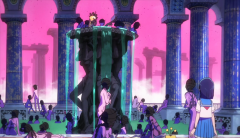
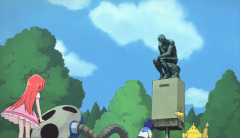
While people often highlight the second part when the girls travel to that other worlds as Flip Flappers’ highpoint, this is the first part on Cocona’s schoolday that I’m more impressed. If you think of the second part as an acid dream, the first part functions as Cocona’s lucid dream. After all, the first thing we witness in this episode was Cocona waking up from her bed. And by that I don’t mean she’s literally in her dream state the whole episode, but rather the show follows her dream logic. Supporting characters pop in and out like ghosts (especially the yellow-hair girl Yayaka and the art-club girl who weren’t even introduced). Again there is that sense of isolation: Except from the bus scene and the class sequence, most of the time there are just the leads and no one else. And finally, that weird mascot character: Uxekull. Uxekull’s strangely afraid of Papika (played mostly for laugh though), and then get sucked under the Thinking Man statue (because WHY THE HELL NOT?), so the girls going down there as well to get him back. Well, this time it seems like they were put in another Pure Illusion that heavily influenced by Uxekull’s mind: the girls transform into bunnies and have an urge to gnaw on hard things. Now, you can take that as an “instinct vs. reason” or as a sexual innuendo all you like, I’m not going that far. Then Cocona got sucked in that giant washing machine, pulled off to the cage that descended to hellfire (not unlike the hellfire in Utena, indeed I think this gem share many similarities to Utena) and was rescued in time by Papika. Uxekull’s version in that world looks whimsical and bravery at best so I don’t mind having him around every now and then. Only every now and then.

For anyone who simply watch Flip Flappers for its visuals, there’s still a lot to love here. Optical illusion references are everywhere in the first episode (right in the very first image of the first episode). The animation again is fluid and character’s movements in particular is in top-notch. I even enjoy the character’s designs myself as I see them very expressive. References to fairy tales are all there as well, from Papika’s dress to ‘disguise’ as a new student, to that otherworldly fantasy world, to the catchy ending theme. The overload of colors work for the show’s benefit too, as it displays the colorful fantasy worlds that both invited and twisted at the same time.

After those 2 episodes, the plot was still pretty much kept in the dark. But what do we have so far? Papika has tuned in with other girls before, but apparently, they’re all failed, but what happen to them? There was a brief scene of unconscious girl in the first episode, but whether she’s dead or not is unknown to us. The leads have to go that Pure Illusions world in order to retrieve fragments that can grant true wish (another fairy tale’s reference), but for what purpose? Dr. Salt has mentioned they do that to liberate Pure Illusion, of course it sounds very vague and he seems to use the girls for his own purpose here. The other staffs, on the other hand, seem nice enough. Judging from the OD, that girl Yayaka and the twin from first episode will play some roles here, and I’m waiting to see whether the picture that the girls see building up to anything in the future. The thing is there’s not much info for us to work with, but in a way, it is what makes this show so special. With this type of show, if it makes too much sense, it will loose its sparks so here’s hoping that the show has what it takes to continue to surprise us for 12 episodes.

Sound! Euphonium 2 – 02 [Hesitation Flute]

It certainly is weird to cover the second season of a show that wasn’t originally covered here, but I do it anyway because the last season was among my favorite anime out of 2015 (not in my top 5 though). For anyone who will sigh when you heard the words ”KyoAni” and “musical band” together, no, this isn’t another K-On. While K-On focuses more about the band’s members having fun time together, Sound Euphonium takes musical seriously (too seriously!) and explore the huge band members interacting to each other. Contrary to the usual complains about things happen really slowly in Sound Euphonium, I consider it a very dense show. The show might feel slow in terms of plot, but they are rich in character’s interactions, in little character’s movements and in terms of the whole production values. Everything is gorgeous to look at and there are many things that you could take out of just by seeing those characters conversing. This is KyoAni at their most confident and while I don’t consider this show their best works (the top 2 of course are Haruhi and Clannad), the show certainly comes at their near-best, and this doesn’t come lightly considering my long affection for KyoAni.

The second season picks up right when the first one finished. Having won the qualifying tournament, the band aims to reach the National stage. But the drama between the senior class that happened one year ago that resulted in most of them quit (and which we always heard of but never know what exactly happened) keeps bubbling up the surface. Nozomi is among the most noticeable player to quit. She was the president among the group of Minami Middle School concert band. When she getting to high school however, the upperclassmen basically ignored practices and new members that bring frustration to them and cause a big stir between the members. Now, when the band is getting much better and preparing to compete in National stage, Nozomi wants to come back. It doesn’t go well though as Asuka flat-out declines. Our Kumiko has a chance to talk to Nozomi and she now decides to discuss with Asuka about that.

Last week, we were treated with a double-length first episode and I consider it one of the best episode in Sound Euphonium (along with one of the best first episode this season). The great productions and great cast are all there, but moreover they approach the story with confident pacing, to the point that 45 minutes long feels like 15-minutes episode. The second episode though, we were witnessed the usual pitfall for slice-of-life school settings show: a pool/beach episode. As much as I still love the interactions of the cast, and there were some great conversations between Kumiko and Nozomi, I could’ve prefer much better if the setting were someplace else. As far as I concern the cast goes to pool don’t add much to the plot, except knowing the fact that Reina’s chest is still growing because her swimsuit is tight. This was by far not a very good Sound Euphonium moments.

But thank god, aside from the pool settings, everything else rocks. This is the show that enjoys its little moments more than a bombastic over-the-top climax. There are so much of that little moments that really convey the mood of the scene. Take for example, when Nozomi and Kumiko talking about how she quit last year; her sad, melancholic tone was contrasted by the activities of young kids taking showers: pure, fun and innocent. When Nozomi burst out and cries, her teardrops were symbolized by the waterdrop in her cold-drink can. Or in later scenes when Kumiko meets Yoroizuka at night, her question towards her senpai: “why are you continuing with the band (even when you’re hurting)” was echoed by her senpai’s rhythm games pause-screen that asked her to quit or to continue the game. Those are smart and very sensitive storytelling right there that you don’t need to say out loud to make the audience understand it, instead they feel it. This is the best strength of Sound Euphonium. Next week we will have a fiercely confrontation between Kumiko and Asuka so I know we will have a good time. Sound Euphonium’s so far looking confident and strong.

Thunderbolt Fantasy – 13 (end)

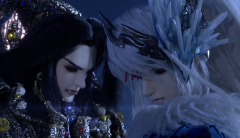
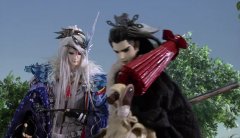
As expected, Thunderbolt Fantasy ends with a blast. While it does close the arc nicely, I can’t help but feel slightly underwhelmed by the climax. This final episode ties up two main storylines: Gui Niao challenged Ming Tian Hai in swordfight, and Shang Bu Huan faced the fearsome demon god Yao Tu Li, and provides us a nice little epilogue in the end. Well, not the end exactly because it was announced that Thunderbolt Fantasy will have a second season. Way to go anime industry. The world needs more puppet shows. I already feel blessed with the news myself.

Back to where we left of last episode, Gui Niao decides to ridicule Ming Tian Hai on what the antagonist truly proud of: his swordfight. Turns out that Gui Niao is an overpowered badass who not only good at deceiving people, but also a master swordsman. To put it more coherently, because he’s so good at sword fighting he eventually gets bored and becomes a master thief instead. This of course doesn’t bode well for Ming Tian Hai. I died laughing at the ridiculous of it all, so was the guy. Literally. The battle is so over the top that it shook the world, apparently. At this point, Reigan’s voice on the other show keeps popping in my head: These guys are children who failed to grow up. The way Ming Tian Hai felt crushed because he is defeated by Gui Niao, that he has to break down the sword, let the world destroyed, and died laughing. These actions are not unlike those kids who their favorite toys taken away from them, so they just make a nonsensical scene. But Gui Niao actually falls for that. He expects Ming Tian Hai submitted himself as loser, so when things don’t go as plan he loses his cool for the very first time. Oh pride, the most serious sin of them all.

I love to point out how important the swords represent in this series. For villains like Mie Tian Hai or the Screaming Phoenix Killer Sha Wu Sheng, the swords represent power and destruction. Mie Tian Hai seeks the ultimate power in the legendary sword, while the Phoenix Killer mercilessly kills everyone stand in his path. Our two mains don’t see it this way. Gui Niao realizes that using the swords excessively would eventually lead him to the path of killing and villainy, which he despises. Shang Bu Huan witnesses many people misuse the swords, so instead he collected them in order to dispose them altogether. The sword he eventually carries around is a piece of wood that he painted silver, same as Gui Niao with his pipe-sword. The legendary sword, on the other hand, ends up being destroyed meaninglessly. That irony plays very well with both the tone and the theme of Thunderbolt Fantasy. The show never intends to be a straight wuxia show, so it only makes sense that Gen Urobuchi flirts with all the tired cliché and makes something new of it. Furthermore, In the world of Thunderbolt Fantasy, swords are ultimately just a tool for human, as Shang Bu Huan puts it: “Whether it cuts something or protect someone just depends on who uses it.” It’s nothing deep I know, but it’s thematic relevance.

Shang Bu Huan steps up for the climax against Yao Tu Li, the female demon god. It’s interesting that the only two demon gods we see in this series are female. It should make sense though because like a notion of life and death is meaningless among demons, the same could be said for their gender. The way they reproduce is more of the process of replication, right? It is then revealed that not only Shang Bu Huan has a legendary sword for himself, he has 36 of them. When the right time comes he would choose the checklist of his swords’ inventory like you’d choose a weapon on your crappy online games. By the way 36 is not some random number, that number (and its multiplication) have been widely used in traditional Chinese literature/text (36 Stratagems; The Monkey King knows 72 transformations, there are 108 outlaws in Water Margin) and I’m again amazed that Gen Urobuchi takes note of that. While this fight is amazing, I can’t help but feel that all this resolution is way too quick, and thus too easy, for our main characters, especially since last week they built the stake up really high. In the end, both Gui Niao and Shang Bu Huan are just too overpowered that all the suspense is gone through the back door.

But in the end, I had a lot fun watching Thunderbolt Fantasy, considered that I know nothing about its existence up until the first episode came out. Now 3 months later it’s one of the most entertaining anime I’ve seen this year. Well, I will tell you in details once the final review comes up. But definitely you will see me talking about this show again when the second season is aired.

Some Quick First Impressions: Time Bokan 24, Heybot!, Monster Hunter Stories: Ride On

And here it comes. The first impressions are on your way. Start up with the children’s shows

Time Bokan 24

Short Synopsis: A kid is kidnapped by a time-travel rhinoceros beetle machine on his way to school, soon to find out he’s destined to be the one (going back time to find a ‘true’ history)

Mario: Your typical kid show where super-team kids have to go back history to find the real (and somehow “funny”) history. While the show has some merit in its premise (who doesn’t like the idea to go past time and witness what really happened in our history), Time Bokan 24 doesn’t really care to dig deep into the historical figures or events. Take this first episode for example, the only trait Cleopatra possesses in textbook history is ‘beautiful’, so the twist is that they are actually a comedy husband-and-wife unattractive-but-charming duo. No, it doesn’t make any sense for me either. And being billed as an action kid show, of course there is an action mecha fight out of nowhere in the climax. I haven’t mentioned any of the leads simply because by the end of this episode I already forget about them. This isn’t worth anyone time.

Potential: 0%


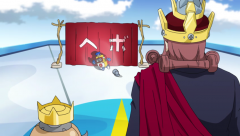
Heybot!

Short Synopsis: A kid was sent away on his birthday to find his precious “screw”, then he finds “the one” (Heybot robot)

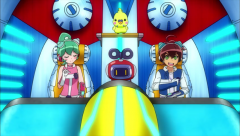
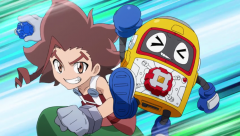
Mario: Imagine my utmost amazement when I actually find Heybot occasionally funny and entertaining. Yes, this is a series about a toy product, and the comedy is so randomly and throw at your face from every angle that its misses are as consistent as its hits. But for a children’s show to be this loose, and still remains entertaining on top of that, it’s a joy to watch. The main thing that makes this first episode really work is that Heybot never takes itself seriously, but instead keep “screwing” around. In this world (Screw Kingdom), everyone loves screw. For a kid show, the amount of hidden sexual jokes are overwhelming, if one really notices it. Lines like “Battery virgin”, “It’s a screw hole, so it means I stick it in, and screw”. “Feel so good!” could give any parents a hard time when watching with kids, but I’m glad the show sticks with it. The plot is as nonsensical as it could get, but you’re not watching this show for plot, you watch it for (the love of) screw!

Potential: 25%


Monster Hunter Stories: Ride On

Short Synopsis: A kid on his way to collect and hatch a monster egg, soon to find out that he’s destined to be the one (to be a monster rider).

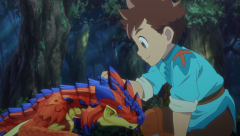
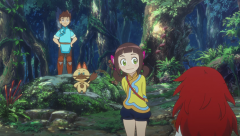
Mario: Monster Hunter doesn’t offer much context, except being a harmless kid action show. The plot of a kid who finds a monster egg to hatch, and later eventually become “the one” is a story that already been told thousand times. For what it’s worth the cast is generic but at least they aren’t annoying; and the monster designs look just like those monsters from Yugioh TCG. The backgrounds, as expected from children show, are colorful. The same can be said with those monsters and our character’s hairs. I have not much else to talk about this show unfortunately. This show is not a waste of time per se but there’s nothing truly stand out from it either.

Potential: 0%