Kemurikusa – 02 [Episode 02]

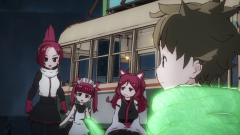
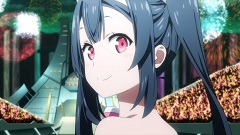
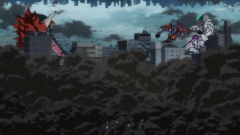
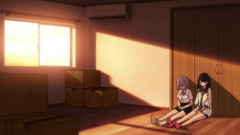
I’m glad that the girls (FYI, their names are: Rin our main girl, Ritsu the oldest cat-ears girl, and Rina the quadruplet) decide to explore to other islands because the world building of Kemurikusa is easily its biggest strength right now. I also appreciate the fact that the show doesn’t toss around exposition or explanation to its settings, instead we pick up pieces as we go along. This whole post-apocalyptic world revolves around the “kemurikusha” energy, which so far we see how they are color coded with different purpose. The “green roots tree” Midori serves as a energy source and produces leaves as food for our girls. It can also extend its roots to serve as a pipeline or communication line, and can maybe heal human’s injury (“maybe” because I’m not so sure if anyone from the cast is human or not). Then we have the yellow Kiiro which can be used as light and the blue water-detecting source called Aoi. Finally, the evil bugs have their red mist and their red kemurikusa and apparently Rina has that red kemurikusa on her as well. I don’t know what to make of it but maybe, just maybe these girls are born from the red kemurikusa source themselves?

While the story goes into some interesting territory, it’s Wakaba who serves as an self-insert protagonist annoys the hell out of me. His antic is grating, and he usually breaks the mysterious tone the show is trying to accomplish. A better comparison would be it feels as it he comes from another series altogether. It doesn’t help that Kemurikusa’s overall dialogues aren’t that great. They’re generic, cliche (chief among them is big sister Rin and her nyan speech), doesn’t have any flair and Wakaba’s constant babbling remains its biggest offender. The huge chunk of this episode is spent around Rina dragging him around the island. While Rina still doesn’t fully trust the boy, she does acknowledge her physical attraction to him which she thinks as a toxic. While their interaction is far from what I consider solid, we do learn one new thing from each of them. From Rina, it’s her total devotion to protect her sisters to the point she put their well-being above her desire. For Wakaba, the fact that he heals quickly when he’s injured might mean that he isn’t human after all. Another interesting note to take is that through Wakaba the old aqua kemurikusa starts to glow, albeit only momentarily, again. My theory right now is that he might be born from Midori’s source himself.

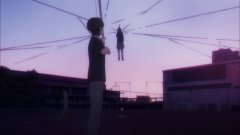
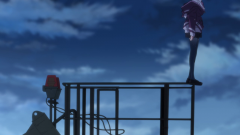
I can point out one single sequence in this episode that really sold its rich and mysterious world building. It happens right at the end where Rina decides to visit other island (which I believe is a strong premise), and we see the Midori energy carries the bus to the railway. Somehow that single scene reminds me to Ghibli’s world, which further strengthen my hope that this settings is gonna be more awesome as Kemurikusa goes on. Some might argue that this show’s aesthetic looks cheap and amateurish. For me though, I’m going to borrow the great Pedro Almodovar quotes regarding his debut failure: “When a film has only one or two [defects], it is considered an imperfect film, while when there is a profusion of technical flaws, it is called style.” Kemurikusa, for all its unpolishments, does have its own charms (along with GoHands’ W’z this season). After the first two episodes, Kemurikusa remains a flawed but intriguing watch.

Winter 2019 Anime Coverage


Like a cold you can’t get rid of, the new season has come and all the premieres have been aired. Overall, this Winter season looks to be an exciting one. It’s certainly the fewest shows in terms of quantity for quite a while, and shows that supposed to be stand out are doing a pretty good job. Mob Psycho 100 2 delivers one of the best episode in a while, Boogiepop tanks but the rest is what we could’ve predicted. This season also marks many shows cut-corner by animating entirely in CG, and the results are pretty clunky. I hope this trend won’t become dominant in the future.

Below is our schedule for 2019 Winter season:

Aidan: Yakusoku no Neverland

Mario: Boogiepop Phantom (2019), Kemurikusa, Kouya no Kotobuki Hikoutai

Lenlo: Dororo, Mob Psycho 100 II, Kaze ga Tsuyoku Fuiteiru (carry-over), Paranoia Agent (Throwback Thursday)

Wooper: Kaguya-sama wa Kokurasetai

Hooray for Wooper who will be back on board with us for the season. Extra hooray for Lenlo for working extra next season (I hope you survive, lad). And let’s hope for this 2019 year to be a better anime year than the last one.

KANPAI!!!

Boogiepop wa Warawanai (2019) – 02/03 (Boogiepop Does Not Laugh 2/3)

Welcome to Boogiepop, one of the hallmark franchise in the history of this medium. The Light Novels itself dated back in 1995 and is still considered as one of the earliest Light Novels ever released and is often credited as starter of the Light novem trend in Japan. The anime adaptation in 2000 remains one of the most disjointed and confusing anime ever made and the Boogiepop franchise has inspired (along with its LN sources) a movie adaptation and its universe is still remain well known to this day. A straight adaptation from its source has been a long way coming and this first 3 episodes in particular closes up what I believe is the first book of the whole franchise. This new anime keeps the tradition of its psychological thriller genre and the 2000 anime’s tradition: it’s disjointed, vignettes and it’s dense with information and multiple narratives that repeated-viewing might require in order to get the most out of the story. It took me two tries in the first two episodes in order to grasp what the hell is going on and remember all the names and faces. Like the 2000 anime version (which I watched, enjoyed but mostly forgot all the details), you can view all these events happened in the story as a piece in a big puzzle and until the puzzle itself is finished that it starts to make sense. While the general reception to this new adaptation has been muted, it’s packed with such layered narrative that I’m willing to take the risk to blog the show and smooth out all the plot threads so that anyone who confused by the episode can have a better grip to what is going on.

So we can start with the main catalyst of this arc, which are Echoes and Manticore. As we soon learn from Naoko Kamikishiro (for the sake of consistency I’ll use surnames for all characters) – in Boogiepop’s most info dump moments that they apparently shared a telepathic link – Echoes is an Alien who was sent to us to judge the human race. He’s fallen into an evil organization (which we know very little of at this point), and from there they create a failed clone of Echoes, Manticore. Unlike the original self who can only repeat what he hears (hence the name), Manticore can talk, eat human flesh and copy the appearance of the person he eats. In one of his attempt, he encounters Masami Saotome, whom offers him to create “slaves” and lures the human to Manticore. This narrative takes a big chunk in episode 2, and the string of disappearances from those girls (why not boys?) cause two other main plot threads, which are 1) Boogiepop comes into the picture by using the body of Touka Miyashita and 2) Kamakishiro meets Echoes one day and informs the eccentric Nagi Kirima to investigate before spirited away herself.

Nagi Kirimi emegers to be one of the real protagonist in the first arc. She’s also one of the most interesting character out there. Always considered herself of eccentric, she learns from Kamishikiro about Manticore, and gets suspended herself so that she can follow around the “slaves” and makes sure if they were Manticore. Kazuko Suema (a girl with glasses) makes a brief entrance when she follows up on Kirimi’s action. As of now I believe Suema, Kirimi and Miyashita are the main players in this whole universe.

Kamikishiro’s encounter with Echoes prove to be one of the important plot points for this arc. She’s an interesting character so it’s a shame that she’s killed off quickly and I still feel like I haven’t spent that much time with her (in fact from what I heard they cut many of her scenes and even an entire character was cut off). Her disappearance though, triggers her younger boyfriend Tanaka and Niitoki the President of the Discipline Committee, tagged along by Saotome, to search for her around school. Episode 3 comes into a climax where Saotome locates Echoes and Kirimi, slits the latter’s throat, and lets Manticore to kill his original self. Echoes “commits suicide” by becoming a pillar of light to transmit himself back to his world. You know the rest of the story so I don’t need to recap it here. Personally, I feel a bit underwhelmed by this sudden ending, but I gotta say it never fails to intrigue me. One of the fun in watching this anime is to make sense of what is going on and how a piece of information fits into the big picture. The story holds up for me so far, so it all depends how the execution gonna be like. While I feel that the characters can be stiff at times, and I’m a tad bit disappointed that the adapatation doesn’t follow the source that faithfully, Boogiepop still delivers many striking moments and so far they keep the mysterious atmosphere right. Just remember, all we see within an episode is always just snapshots of what is happening.

Some Quick First Impressions: Boogiepop wa Warawanai (2019), Egao no Daika and W’z

Boogiepop wa Warawanai (2019)

Short Synopsis: A teenage boy meets his crush’s costumed alter ego, Boogiepop, as rumors about disappearing girls spread through their high school.

Lenlo’s Review:

Ah, a new year, new season, time for a new first impressions post. What’s this, a mystery thriller about an urban legend and an angel of death? Why I would love to! A full explanation on what the Boogiepop is from an unreliable narrator? A split personality that appears in women, and then proceeds to murder or kill the thing murdering other young women? Social gossip? Well sure, sounds good I- wait, what’s happening? This is a lot of talking and not much really happening. Why does this entire episode suddenly feel more like a standalone than a series introduction? What is even happening anymore? Suffice to say, Boogiepop intrigued me at the start and then, over the course of 25 minutes, proceeded to completely lose my interest. It raised a bunch of questions, answered them unsatisfactorily and then basically shoved off. Its like Boogiepop thinks throwing you straight in the deep end of psychological disorders, myths and legends, and murder is a good way to start a show. I like it enough to give it another chance with the next episode or two, but as is, my interest in the series is lower than it has been since it was announced. Here’s hoping that’s just first episode blues for a notoriously hard genre to pull off though.

Potential: 40%

Wooper’s review:

I never got into the original Boogiepop adaptation, which first aired 19 years ago. Based on the first few episodes, my impressions were that it was gloomily lit, oppressively moody, and quite difficult to follow. For fans of the 2000s series who loved that challenging atmosphere, the fear surrounding this newer version must be that it will become too accessible. Those fears can be put to rest, however, since this first episode was an understated, non-linear collection of conversations that promised no easy answers. Though the premiere offers an explanation for who or what Boogiepop is, it’s not a complete one – in fact, it seems downright misleading. There are quick cuts to bits of murderous violence at several points throughout the episode, which echo the gossip swirling throughout the school where the episode plays out. The desired mood here is clearly unease, and the show does a few things to achieve it: hiring Kensuke Ushio to compose a droning electronic score, setting many of its scenes during the late afternoon to give its characters an odd glow, etc. Some of these efforts are hamstrung, though, by jerky animation, instances of muddy dialogue, and character designs (immediately recognizable as Parasyte knockoffs) that don’t seem to fit the series’ mystery-laden mood. Word on the street is that the second episode (which is already available online) is an improvement, so seek it out if you’re interested. As for me, after just one go, I’d say the series has my interest, but not my enthusiasm.

Potential: 50%

Aidan’s review:

Boogiepop started this season with a double episode premiere and as you likely seen from my preview, I walked into this one with great expectations. The first episode was slow, the animation of was surprisingly underwhelming(I don’t understand why it was decided to make extras faceless.) but at least it was fairly accurate to what I read from the novel and considered the double episode premiere to be a good move considering how the story works as a slow burn. Then I walked into episode two and just what in the holy hell happened here? What was supposed to happen was that we would see events from the new protagonist but instead it appears they opted for a different method for showing the rest of this story. Which is by chopping up the rest of the novel and rearranging in a manner to make it as confusing as possible. Truly I am flabbergasted. I don’t see the artistic expression of making your narrative harder to follow and in many ways it kills the story as characters are no on screen long enough to grow attached to, the story leaps back and forward in time with no abaddon and it’s hard to become invested when you are too busy figuring out just what the hell is going on. The focus should have been on showing the inner thoughts of the characters through animation, not on this ridiculous editing for the sake of…whatever they are trying to accomplish. I am hoping that this was a one episode thing or that once a new arc starts that they come to their senses and realise this is idiocy. And maybe I can see that beautiful animation that the first PV showcased appear.

Potential: 30%


Egao no Daika

Short Synopsis: A 12 year old princess ascends to the throne of a prosperous country, not knowing that it’s at war with the neighboring Empire.

Lenlo’s Review:

Ah, the lolibait of the season. This time with a princess idol who battles in robot mecha chess. I’ll be perfectly honest, I have no idea what I just watched. Egao no Daika is trying to do… everything really. Mystery plot over this “incident” and her parents, romance between her and her bodyguard, action with giant mecha battles. It’s all over the place. That said, the mecha battle itself actually… wasn’t terrible. If you can ignore all of the context around everything that happens in this show and just enjoy the mecha battles, you may have fun with it. If not though, just skip it. Egao no Daika’s author just shoved every trope they could find into one story, so I am sure you can find something you like better elsewhere in the season.

Potential: 5%

Wooper’s review:

Why is a 12 year old princess entrusted with the fate of an entire country just because her parents died?
Why does her first address to the nation look like an idol concert, complete with glow sticks and ridiculous crowd reactions?
Why are all the outfits and hairstyles so needlessly elaborate (and therefore difficult to animate)?
Why are there twin characters whose last name is literally “Vanquish”?
Why does one of them oppose the princess’ rule on the grounds of her naiveté, only to be charmed by that same trait fifteen seconds later?
Why do two high-ranking, ostensibly well-informed members of the government suddenly explain their country’s history to each other, complete with a holographic display that looks like a video game menu screen?
Why was there a need to refer to a futuristic-looking game with a green 6×5 board and pushpin-looking pieces as “chess”?
Why doesn’t the princess have anything better to do than to watch her bodyguard engage in a CG simulated mech battle with the Vanquish twins?
Why does she suddenly become a strategic genius midway through the battle, despite having lost horribly to her advisor at “chess” (and then questioning whether strategic thinking was “really something she needed”) just thirty minutes earlier?
Why are anime characters still vowing to “protect her smile” in 2019?
Why did I watch this show?

Potential: Why?


W’z

Short Synopsis:  A middle-school boy moonlighted as DJ in the virtual world and attracts fair share of enemies who are Hand Shakers

Lenlo’s Review:

I just got tricked into watching a sequel to Hand Shakers. What the hell.

I won’t even say watch this if you liked Hand Shakers, because no one liked Hand Shakers.

Potential: 0%

Mario’s review:

So this is indeed a sequel of HandShakers. It features the new cast so you don’t need any prior knowledge to watch it. Although the question remains: why bother watching it? As you might aware HandShakers is a rare anime that fails in arguably every single department (it fails so hard that it belongs to so-bad-it’s-good camp, but that’s another matter), and so far with W’z it doesn’t look like they’re gonna change. It has the exact same aesthetic as the screen in bathed in bluey filter. Characters look the same and they never talk like real human. We haven’t gotten into the fights yet so I’m not commenting on the CG battles yet, but the CG background characters stick out like a sore thumb. Even the main plot now is nonsensical. The only way you can enjoy this show is to set your expectation to be as low as HandShakers.

Potential: high chance of becoming the worst anime of 2019 by a landslide

Aidan’s review:

Honestly this is truly impressive. GoHands, never have I seen a studio so utterly full of confidence in their own style…and so utterly oblivious to their own failings. Try searching for my old impression of a series called K that they made before. Everything I said there applies here. They are repeating, every single failing. The pointless starting fight scene, the crap CGI, the BL baiting, the utter overuse of filters and lighting that washes out the screen along with characters so stock they still got the wrapping paper on. At this point a studio would learn, if they didn’t then they would at least learn after making one of the worst anime trainwrecks in Hand Shakers. But not only have they learned nothing…they made a sequel to Hand Shakers. What should be a complete black mark on their history and they made a bloody sequel to it. I don’t understand. Do they not want to be successful? Do they not want to make money? Are they under some mistaken impression of being animation visionaries? Because under all the scum of this series it does feel like there is genuine effort being put in but it’s all for naught when the package is an utter disaster such as this.

Potential: When are you declaring bankruptcy GoHands?
SSSS.GRIDMAN (Fall 2018) Anime Review – 87/100

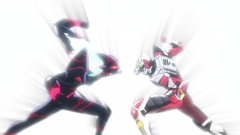
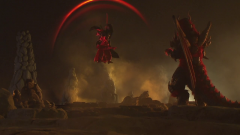
Let it be known that I’ve never been a fan of Trigger. For me, they’re one of the most style-with-no-substance studio on Earth with a tendency for god-awful fanservice, and total nonsense in terms of story and characters. Yet GRIDMAN completely caught me off guard in the first two episodes, and from there, there was never a dull moment. On the surface, it shares many of the studio’s (good) trademarks: an unconventional storytelling, bombastic action sequences and and eye for arresting visual. Yet its approach is completely different that the visual approach becomes a character of the show itself. On the next surface, GRIDMAN is a love letter to those tokusatsu shows, the Gridman franchise and even Transformers franchise that we see the sheer love from the staffs to all these homages. While you don’t need any of prior knowledge in order to follow this show, the ones who do know about these homages might enjoy the show more wholly. For my money, along with Revue Starlight, GRIDMAN is one of the best visual directed anime this year 2018 has to offer. A visual where not only it’s striking to look at, but also support its themes and laid out many small details about its world-building.

The main vibe GRIDMAN offers in the first few episodes lie in how offbeat everything happens on screen is. Character waking up with an amnesia; there are kaiju monsters standing motionless in the background. The school appears to be normal a day after its destruction. This offbeat sense could very well turn many viewers off, but not until later do we find out about the truth of this world and its characters that everything starts to fall into place and its visual choice starts to make a whole lot sense. If I have to point out another quality of GRIDMAN, that would be there’s a clear line between “minimalistic” and “going all out”.Usually, the battle scenes go is bathed with its bright color, dynamic CG sequences and epic feeling, but in its quieter moments (which usually happening ⅔ of the episode), it goes for saving-energy mode: minimal music, repetition shots, realistic dialogues, “camera” is in static mode. This is a bold choice since clearly dividing its segments like that would cause a tonal inconsistency or even not holding audience’s attention at all, but it’s a rewarding one because GRIDMAN creates a real sense of its mysterious world that feel wholly unique and unforgettable.

Some could argue that because of these clear dividend, GRIDMAN is a show of two halves: its mundane slice-of-life half through the point of view of Rikka, and its Gridman vs Kaiju monsters origins narrated by Yuuta. In fact, part of the claim is true. Looking back, GRIDMAN doesn’t seem to have a clear protagonist, as we were introduced to this world through Yuuta’s eyes, himself is a blank state, then all the emotional core is progressed through Rikka as she goes through her normal life and then the show leaves its climax arc to Akane, her God-like status and her existential crisis. Not all of these work well (Yuuta’s part is clearly GRIDMAN’s weakest part), but I’m surprised that this show brings another level of complexity to Rikka and while I’m a bit let down by the ending, the dream episode remains the best episode I’ve seen in 2018, and the single sequence of Akane jumping off the crane remains one of my favorite scene of the whole year.

GRIDMAN is also one of these shows where it embraces “show, don’t tell” school the the fullest. The visual style always give the sense of scale between the characters and how huge the kaiji monsters are. It features many distorted lenses, further informs us visually that the world these characters inhibit in are not necessary real. Most impressive of all, in my humble opinions, is how the show uses the distance between its characters to signify their chemistry. The best examples of this approach is Akane and Anti’s relationship, where you can see the clear distance, most of the time Akane is in higher position, looking down at Anti. In addition, My favorite one is in episode 3 that details Rikka and Shou’s getting sucked into their own misery. The visual framing, which frames these two looking different ways through mirror is the textbook example of how to inform character’s inner struggle purely through visual alone.

This show is also in love with putting as many details in its world-building, a bit obsessively like the way Wes Anderson usually spend to his worlds – mostly through the objects that surround the characters. While these details might not necessary relevant to the main plot, uncover these Easter eggs might prove rewarding and might open up to more interpretation this show aims to be. This is the show that the more you dig into it, the deeper the Rabbit hole goes, but damn I really do prefer if the show confirms some of its theory. The live-action sequence at the very end of show, for example, nicely sum up this show thematically, at the same time raising a hell lot of ambiguity to the table.

And for me, that is exactly the kind of anime I’m yearning for. It might not be perfect, it might be for an acquired taste (although I heard that it sells surprisingly well in Japan), it might not wrap up the best way it can, but it never afraid to take risk and ultimately it comes off as its own thing. I sure hold Akira Amemiya in high regard now.

Thunderbolt Fantasy 2 (Fall 2018) Anime Review – 86/100

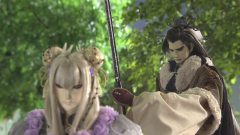
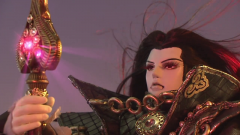
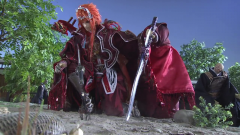
If anyone has been familiar with the first season of Thunderbolt Fantasy, you’d find yourself a lot to enjoy in this second installment. Served as a sequel, but not a direct continuation to the first, viewers don’t need the knowledge of the original in order to enjoy this ride. Thunderbolt 2 carries many trademarks that make this show such an install success since it came out: the puppetry technique makes it an unique viewing experience amongst anime fandom; the larger the life characters whose characters are the central protagonist in their own stories; the camp value of cheesy lines and back-and-forth conversations; and the somewhat unpredictableness of the plot. It serves as an entertaining and engaging ride on its own right, but to be fair, it’s pale compare to the freshness of the first season.

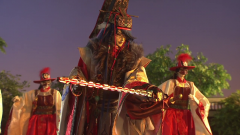
In this second season, we have a whole new supporting cast aside from our hero Shang Bu Huan and Gui Niao the Enigmatic Gale. The cast includes Lang Wu Yao – the ginger singer with his talking pipa, the Princess of Cruelty Xie Yinglou, the Dirty Cop Xiao Kuang Juan and the amoral monk Di Kong. While Thunderbolt proves once again it more than has its chops when it comes to make these characters as stand out as possible, for this season it falls more into straightforward side.There’s a clear line between the good guys and the bad guys, which makes a lesser impact compare to the ambiguity of good/evil in the original series. Princess Cruelty, for example, has haer redemption arc that, while still good, is the most conventional arc Thunderbolt has done so far.

The main storyline is another straightforward aspect of this season. It has a clear set of goals and well planned-out (too well indeed) goals: Shang Bu Huan wanted to get rid of his Index of Swords, unfortunately the plan fails and the enemy gets a hold of two evil swords. One thing that this season does improve is that we get a chance to see more legendary swords and their dangerous powers. These two new swords, Seven Blashphemous Deaths and the Night of Mourning, have a distinct designs and formidable powers. The former especially has quite a character for her deadly charming voice and her femme fatale personality. My favorite addition, however, is the one-wing Dragon who spits fire and talks human language.  

Speaking of characters, I’m glad to say that all the main players this season fit into this universe like a T. They’re over the top, but not simple. They’re all too proud of themselves and they bounce off with each other extremely well. Normally it’s an one-on-one conversations where these different personas clash, and most of the time it’s a treat to watch. Di Kong and Lang Wu Xao serve to be an excellent cast on its own, the former on how he’s dangerous purely because he has no evil temptation, and the latter because of his strict sense of justice. The Dirty Cop’s character is your love-to-hate type and his corruption is a bit to extreme to leave any ambiguity, and it’s a shame his character is the least relevant to the main plotline.

The visual has gotten much more flashy too. Characters doing their own “remarks” while speaking, the special effect, namely the spitfire and the blood-gushing are still something to behold. Even the way these characters run have a quirk of its own, making Thunderbolt a product that never fail to be anything less than spectacular. I think we’re in good chance for the final season that closes everything here. Witty, refreshing, never take itself seriously and always have the right amount of campiness and flashiness, puppets are here to stay.

Irozuku Sekai no Ashita kara (2018 Fall) Anime Review – 73/100

In the last few years, it’s great to see P.A Works has slowly created their own studio identity, putting more original works with consistent production values. Just in 2018, they produced 4 shows (quite a good number if you ask me), 3 of them were original: Maquia, Sirius the Jaeger and Irozuku. As I said, it’s a encouraging sign to see a studio that has control of its titles, but at the moment they still haven’t reached their full potential yet. The same pitfalls between Irozuku and Sirius the Jaeger, in particular, lies in its writing. They’re unremarkable and in Irozuku’s case, drags on for too long. Irozuku is a show that has a well-realized settings, a solid theme of finding love and gorgeous production, but it’s one of the case where it has no real plot, as a result in the middle chunk it feels as if the cast just wanders around in search for the plot.

You can see that aimlessness from our main lead, Hitomi, who is colorblind, afraid to use magic and shut off her own feeling. When she’s transported back to her Grandma’s timeline, she doesn’t know what her purpose is, or what she should do. Comes the supporting cast from the Art/ Photography Club who has different personality traits, but “surprisingly” always in sync when it comes to group decision. I take it as lazy-writing since at the end of the day, none of the cast raise above their established traits. The addition of energetic Kohaku moves the show forward a bit, but she’s also bogged down by the same approach.

I normally avoid to criticize a show for “nothing happens”, but it’s exactly the case here for Irozuku. The middle portion consists mostly of the cast hang out doing their club activities that both feel random in nature and nothing has progressed whatsoever. Although they spend majority of time together, the chemistry of the cast isn’t necessary strengthened, because they repeat the same atmosphere all over again. Not all of these relationships are one-note, however. Aoi and Hitomi has some neat moments together, as they settle down their own feeling for each other. Kohaku has some solid developments too on how she takes the responsibility of bringing Hitomi safe and sound.

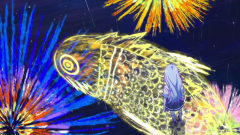
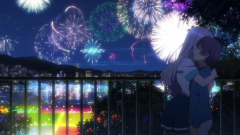
Irozuku is the show that mixes between magic and the normal day lives; and it’s the magic parts that are the highlights of the show. Whenever it comes to these scenes, the visual never fails to impress. Whether they’re colorful fireworks, the magic train or drawing-styles paintings or the sparks of the magic spell, everything looks gorgeous and it’s the visual alone that carries the message more than the narrative. It takes a trip to Aio’s painting with the black figure hopelessly chase the dead golden fish that tells much more about Aio’s artistic struggle than any word can convey. The same goes for Hitomi’s monochrome vision, every time it switches between color to black and white world, we see the world in her point of view and there’s always a hint of sadness carries across.

Thematically speaking, Irozuku centrals on finding your own happiness and love yourself as part of embracing and living the world. Throughout its run, Hitomi progresses from a shy little sad sack to someone who knows what she likes, from a girl who is afraid of her own magic to someone who finds the beauty in magic and the colors in her life. As it stands, I still believe Irozuku would be much stronger if it only had half of its runtime, or had a more solid middle arc. It remains a show that has clear starting and ending point, but don’t know the road the get there efficiently.

SSSS.GRIDMAN – 12 [Awakening]

GRIDMAN closes off its story on a grand spectacular finale and as far as spectacular goes, it does its job nicely. Personally I’m more impressed with this show in its quiet moments so I enjoyed it more in its last 6,7 minutes. I don’t know how much relevant GRIDMAN the anime is in regard to its original live-action. I mean, what’s the deal with the kaiju girl Anoshiras II and what’s the true role of GridKnight, but taken as an individual piece this ending is both straight-forward and confusing in the same manners. The straight-forward part is how the climax goes all out with its action: we have Gridman in full form versus Alexis in full form, and we do have all these cheesy lines that I’m sure serve as a homage to its original “Here comes my special moves – Fixer Beam” “Nanii? How can you have such godsent power?” “The power of MORALITY to destroy the immorality”. It’s fun to hear these campy dialogues out loud, and it’s even more entertaining when they’re boasted by the stellar animation. While I admit that the battle never wowed me, I can sense the love from the staffs to every single details of this battles.

What slightly bugs me, however, is the narrative led up to the final showdown between Gridman and Alexis. First, the way Alexis “uses” Akane is pretty inconsistent and abrupted. Here, in a span of 10 minutes, Akane turns into a kaiju (her scream is awesome, though), gets rescued by Anti, and immediately gets swallowed again by Alexis. In terms of narrative progression, you can easily cut down the “Akane becoming kaiju” part and nothing (except for the kaiju design) is lost. The same goes for Anti where he desperately tries to save Akane (which I thought was wierd to begin with because it’s not Yuuta or Rikka, but the least of all people Anti who saves the princess) just so that moments later he gets stabbed by the villain and was thrown aside for the rest of the battle. Don’t get me wrong, I love Anti. He’s, after all, the only character who grows the most in this show, signified by his blue eye color at the end, but I can’t shake the feeling that his own narrative arc is a bit shaky and not totally well planned-out.

But then, it comes to the “afterneath” section and while most of normal shows would retreat back to the new status quo, GRIDMAN manages to do something interesting here. We have a few-minute but feel like half-an-hour long sequence (hey, I’m not complaining) of only Rikka and Akane in a room together, further showcase how GRIDMAN is at its most comfortable when it strives for minimalism. Here, in a near-empty room, Akane has her redemption and Rikka has one of the best moments of the whole episode, as she gives the card holder gift to Akane, and wish that they could always be together, at the same time tells Akane not to let that wish come true. After all, Akane needs to move on from this cyber world, and the characters created by her will stay behind and have lives of their own. It’s a neat ending, but the decision to only let Rikka says goodbye to Akane sure leaves a lot of ambiguity here, which I will get to it later.

In a surprising move (which for me is a touch of “genius”, until I learn that it’s inspired by EVA’s ending), we have a live-action closure, a girl that looks awfully like Rikka that literally wakes up after the long sleep. The searing score was the one that played softly back from the beginning of the first episode. The ending will leave a lot of speculation of what is real and what not for sure, but ultimately I don’t think it matters that much. The main narrative is clear: Akane has her redemption arc and moves on, while Gridman and the Squads return to their hyper world and Rikka, real Yuuta and Shou stay back and live on.

As a whole, while I was a bit letdown to its final stretch, I’m still impressed with how much love and attention this show has for their world-building (it has a Wes-Anderson level of details here – the kind where it relies on the rich range of surrounding objects to defy the characters) and how it translates its themes by its visual craft – it’s one of the best visual directed show, along with Revue Starlight, that I’ve seen this year. Plot-wise, looking back I’m rather curious on how this show has many faux-protagonists to the point where you can’t really say whose narrative we are supposed to follow (it’s not necessary a bad thing), we start with Yuuta as we see the world through his eyes and his amnesia, but then in the middle Rikka demands us with her emotional tones and manage to sell them successfully as a normal girl trying to go through her life, then in the final arc it’s Akane takes the central stage. Not all of these transitions work, but it never fails to be anything less than intriguing, and that is a big compliment come from me.

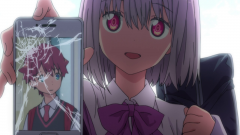
P/s: pure speculation: it’s no fun to not give my own take on what happened at the end, right? Here’s my own two cents: the girl who wakes up at the end is Akane (we have her *real life* uniform, the card holder and the broken Iphone, and the name Akane in the picture). But why does she look awfully like Rikka? Is Rikka the part of herself she doesn’t wish to acknowledge? That might be the case but then again, the ED hints to the fact that Rikka might be real after all. Visually, the silhouettes has Akane’s mannerism, but is there anything more than meets the eyes?
Thunderbolt Fantasy 2 – 12 [The Hunting Fox]

Boy, it sure feels great to see the biggest douchebag gets punched repeatedly to the face by his own dirty tricks. It also feels good when the femme fatale Seven Blashphemous Deaths Sword feels threatened towards Monk’s declaration of love. If there’s one thing that I still enjoy in Thunderbolt, it’s that the cast keeps redefining their roles. Who would’ve imagined that collected Monk can be this love obsessive and embrace the “Till death do us part” vow to heart? In term of general plot, I feel that this season is weaker than the first. While in the first season we have a band of misfits with a shared immediate goal, here we have many branches of characters who have different goals that don’t join together towards the climax. Dirty Cop basically just wants to screw around and gets his hands on more swords now. Our team wants to retrieve the Evil Swords, and the Fallen Monk just wants to dedicate his life to his wife Sword. The issue remains that the cast doesn’t really connect to each other in a big narrative sense. It’s until this late in the game that the Monk has some reason to fight against Shang Bu Huan, just because Femme Fatale Sword wants to buy some more time.
Moreover, while it’s still a joy to watch these larger than life characters behave on screen. This is the first time where I see the implausible characters behavior in Thunderbolt. So Dirty Cop fights our Ginger Singer and decides to turn the table by handing his evil sword to him, thus force him to take care of these manipulated soldiers. I could totally understand if Shang Bu Huan hesitates to harm these guys but with Lang Wu Yao? He’s the kind who will save his ass first rather than saving innocent people who get into his way. I still remember him warning Shang Bu Huan for not killing those puppets in early episodes so I just don’t get the change of heart here. Whichever the case, Shang Bu Huan appears right on time (almost too perfect timing if you ask me), and shoe Dirty Cop how he can handle orchestrating the whole puppet soldiers without any sweat. At the end, Enigmatic Gale Joins the gang on his own amusement. The back-and-forth bouncing off between him, our Hero, and the Singer is still campy and pretty hilarious.

On the other side of the battle, Fallen Monk and his wife find themselves in the Wasteland of Spirits. In another reversion of our expectation, it’s revealed that the Monk has never fallen for the magic charm of the Sword in the first place, but love it in his own will. It could’ve been greater if we witness the moment he met and acquired the Sword though. At the moment we just take it as what he told us. Then my MVP character appears, the indestructible dragon who raises up from the ground and gets killed by the Monk just as quick. Poor little dragon who always picks the wrong fight. Now, with the finale of the final showdown between our hero team and the Monk, with Dirty Cop will somehow chime in as well, I just hope for a bombastic and explosive climax.

Irozuku Sekai no Ashita kara – 11 [The Waning Moon]

And suddenly, after weeks of hovering around, Irozuku has some sort of urgency this week. You see, Hitomi’s spell starts to wear off and she only has 2 days left to say goodbye to this world. NOW the cast has some motivation to actually do necessary stuffs before time running out. That means Kohaku has to bare all the responsibility of bringing her back to her time safely, and Hitomi has to sort all her feeling out before the moment comes. Both the visual and the narrative are purposeful this week (something I can’t say for their previous episodes). In specific, the moment where she… whoops… vanishes into thin air, Irozuku makes it feel as if time has stopped. Or the moment later where Hitomi making those paper planes and communicate with Aoi by switching her light on and off, it works because it’s understated. These small moments like this is what Irozuku unfortunately missed during its middle section.

It still comes a bit out-of-nowhere the way Hitomi suddenly disappears and how Kohaku later informs us that it’s a sign that she has to go back home. I mean, we didn’t learn about this Okabe-situation before, and it doesn’t help that the day they want to cast the magic is on the same day with the School Festival. I’m willing to put all these aside, however, because this is the only rare times where I see the cast actually having some purposes. Chief among them is Kohaku, with all the burden of whether or not she can do it, and do it safely. Then it’s also a matter of gathering up the right material, which in this case is the pure magic sand. The rest of the club has some nice development where at first they’re sad to receive the news, but determine to do their best to help bringing Hitomi back to her timeline safely, even if they aren’t gonna see her ever again.

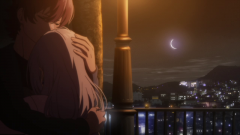
As for Hitomi, she doesn’t take this news too well. She knows it has to be done, but she doesn’t want to leave the world where she has good friends and where she finds her first crush, Aoi. There’s a saying that “either you have a sense of urgency today, or you have a sense of regret tomorrow”, this time both Aoi, and her wanted to say what they feel towards each other. What happens next is that they reach to each other without a single word. As they both race to each other’s house and meet halfway (boy, I’m glad there’s only one route to their houses), and embrace each other in a near-full moon. Time remaining might be too short for the two now, but finally they can be able to express how they really feel.