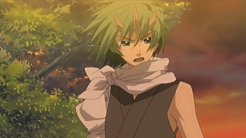
Nijuu Mensou no Musume – 11


To hijack this post for a bit, after a few days of using my new star-rating system, and quite a few problems have arisen (with many thanks to the commenters left their opinions):
– It’s too fuzzy
– It’s hard to relate the meaning of the scores, it’s unclear what the maximum number of stars is
– Some PCs can’t support unicode and instead only see a bunch of question-marks.

To conclude, it was a nice experiment, but the star-system sucks, and I’m going back to numbers out of 100 again. I’m going to keep rating, based on Storytelling, Characters, Production-Values and Setting. My biggest beef with my original rating system was indeed how it was inaccurate as hell. In the original system, I had basically ten categories for which I’d give out a rating, where the eventual rating would be their average. These categories always ended up overlapping each other.

With only four categories, this’ll mean that not every number will be utilized (the ratings will quite probably be 8o, 82,5, 85, 87,5, 90, etc. out of 100) but I hope it will make my reviews a bit clearer.

To continue hijacking this post, another thing that caught my attention about the reader survey was the relatively large amount of people who’d like to see the little summaries that I had a year ago back. Are there more who’re interested to see this return? Like, for example:

Short Synopsis: We learn a bit more about Haruka, and last week’s enemy continues to target Chiko
Good: Excellent change from light-hearted to dark throughout the episode
Bad: I’ve never been that big of a fan of brainwashing, and this is no exception. Auntie’s murder attempts keep getting more ridiculous.
Overall Enjoyment Value: 8/10

Very interesting, the way this episode started promised to be a strange beach-episode, but this series managed to add so much more that I’m surprised that it all fit into just 20 minutes. First of all, it is revealed that Haruka had a twin sister. She reveals this as her dead image keeps haunting her since the beach in this episode is the place where she died, and apparently Haruka blames herself for her death.

In the second half of the episode, our long-haired enemy returns again, and his/her weapon this time is brainwashing all those important to Chiko. Like mentioned above: I’m not too big of a fan of brainwashing, mostly those kinds that can be resisted easily. I mean, if you were a villain, using this technique, wouldn’t you make sure that the people you brainwash never get near the conditions to break out of this mind control? Here too: I’m still not sure why exactly Tome was the only one who broke free…

Still, apart from that, I was surprised at the sudden dark tone. When it wants to, this series takes no prisoners, and it immediately throws every one of Chiko’s friends against her. What were those pills supposed to do? I failed to pick that up. Were they just poison, or did they have another effect? Speaking of poison, I’m really not sure what Chiko’s aunt is thinking… before, she came with intricate plans to kill Chiko through poison, and now she has turned to throwing flower-pots at her head. Can’t she just hire a professional killer or something?

Hunter x Hunter Review – 82.5/100


It’s strange… the more I experiment with my new series rating-system, the more annoying the old system becomes…so that’s why I’ve decided to stop using this old system. In any case, the reason why the next old anime-review this time is partly because I had other things to do, and also because Hunter x Hunter has 62 episodes. And to think that after the series, I still need to watch three OVAs that came out after it, but those are for another time.

Hunter x Hunter starts out as a classic shounen-series. It takes a group of people with special powers (Bleach has shinigamis, Naruto has ninjas, Hunter x Hunter has… hunters), gives them a number of different powers and specializations, creates a number of large organizations and picks a generic young male to be the main character. Of course, with such a huge amount of episodes, I was redundant to check out this series, but ten episodes in, and I was hooked. This is everything a shounen-series should be.

Hunter x Hunter is basically divided into two halves, with an incredible difference between them. The first half feels like a huge game, where Gon (the main character) and his friends need to overcome a number of challenges in order to become hunters. It’s a standard shounen-plot, but its charms come from the cast of characters. It’s so much fun to watch not only the main characters, but also the side-ones as they try to become one of the hunters, and on top of that, the main villain stands miles above his counterparts in series as Naruto, Dragonball Z and Bleach.

This series only really sets itself apart from the rest of the genre with its second half, though. It starts out pretty bad, admittedly. The Zoaldyeck-arc is pretty much the worst arc of the entire series, only to be followed by yet another dull training-arc, but afterwards the series slowly unfolds into a story about the mafia, that for once isn’t about destroying/ruling the world. It’s here were Hunter x Hunter introduces real jobs, such as being a body-guard, and interesting ways for hunters to make money.

The problem with lengthy shounen (at least the ones I’ve seen), is that they get duller and duller as they go on, usually thanks to some kind of training-arc where the creators abuse their powers a bit too much in order to god-mode their main character beyond the point of believability. Gon indeed gets powered up a bit too much, but what I like about this series is that he still is nowhere near the power of the strong guys. Heck, even the main villains aren’t the strongest characters in this series. The creators also make use of the fact that Gon is just a child: it unconsciously lets his enemies spare his life, instead of killing him.

One major annoyance with this series (apart from the training arcs, that is), is that during the times of building-up, it’s got the “everyone who isn’t strong is an idiot”-mentality. Whenever Gon is facing weaker enemies than himself, they’re always portrayed as cocky idiots without any brains or tactical knowledge, and things like a one-in-ten-million talent are pulled out of the creators’ sleeve in an attempt to explain his superiority. Thankfully, there are enough characters with depth to them. Especially Kurapica is someone to watch out for, because the character-development he goes through is truly memorable.

Also, this series has avoided one more subtle pitfall of shounen-series: wounded characters remain hurt, and don’t get magically healed in the next episode. When characters get punched in the face, it remains swollen until it gets a logical reason to heal. The overall animation isn’t anything special, but I really appreciate details like that one. The soundtrack is also really effective for a shounen-series.

Overall, in terms of seriousness, Hunter x Hunter is definitely my favourite shounen-fighting-series. Overall, it still doesn’t match up to the humour and fights of the Law of Ueki, but it easily takes second place. The thing that worked against it the most was its main character: Gon. He does have a number of really memorable moments, but the creators waste way too much time in trying to make his power catch up to the strong people, and he often takes away the screen-time of the much more interesting characters. It’s a thing that unfortunately every series of its kind has. The rest of the cast is rock-solid, though, and especially the second and final quarter of the series deliver. I’m curious whether the three OVAs that came out afterwards will keep this same quality, or fall horribly like nearly every other show of its kind.

Storytelling: 8/10
Characters: 9/10
Production-Values: 7/10
Setting: 9/10

Telepathy Shoujo Ran – 02


Ah, it’s good to see another good series about middle-schoolers. I’m not sure why, but in average, I tend to like these series much more than the series that focus on high-schools. Perhaps it’s the impulsive way that they try to solve their conflicts, or their innocence. Or how your average middle-schooler is much less annoying than your average high-schooler. In any case, this is going to be the first show I’ll be blogging this season.

Overall, Telepathy Shoujo ran is a great way to start the season, though it’s not perfect yet. It’s a tad heavy on the angst already, and it’s a shame that that masked guy didn’t reveal himself nor his intentions at the end of the episode, because now I have no way of knowing whether its mysteries will be stupid or not. At the moment, there still is a chance of this series ending up in the pits of cheese like Suteki Tantei Labyrinth or with a stupid plot like Allison and Lillia. One series with a dead body spiked on top of a radio-tower is enough.

Still, the potential’s there: the slice-of-life moments are nicely done and detailed enough to keep my interest. Ran also started out like an interesting main character, and even the romance is pretty cute. It’s talked about death already, so it’s not afraid to be a bit dark, despite the young age of its characters, which is a plus as well. After rewatching, I also realized that it’s also using a lot of foreshadowing. Always good for building up.

Another annoying thing is the overuse of CG for the psychic scenes. I liked the method Night Head Genesis used much better, but I guess that it does the job, and it’ll be easy to get used to. It’s in any case a huge contrast between the normal world and characters, which I think is what the creators had in mind with it.

Apart from that, the art looks excellent, despite its simplicity. Yoshihiro Ike also managed to deliver a great soundtrack and the OP and ED are both really good as well, so this series is solid on the production-values as well.

Amatsuki Review – 90/100


I really like Studio Deen. Sure, they may screw up their series very often, but when they hit a classic, they really deliver an amazing series. Their newest series to add to that list is Amatsuki, with the interesting thing being that even after watching it I’m still not 100% sure why I liked it so much.

For starters, Amatsuki combines history, science fiction and fantasy with each other when the main character (Tokidoki) gets sucked into a virtual world, which ends up being the ayakashi-infested feudal Japan. At first sight, it’s not the most original premise, but it’s the execution that makes this series unique.

The dialogue in this anime is absolutely amazing. They’re really deep and detailed, and you can see that a lot of time has been put into them. It’s no wonder that this series shares a director with Le Chevalier d’Eon. These characters could start talking about watching paint dry and still make it come across as interesting.

On top of that, this series also has an excellent sense of storytelling. It carefully builds up everything that you need to know for this series (again with that excellent dialogue), and there have been so many subtle details added that makes this series come alive.

Then there’s also a very complex storyline. This series really likes to make the boundaries between good and evil as fuzzy and complex as possible: every character has some kind of secret agenda or own goal. Today’s friend may be tomorrow’s enemy, and vice versa. Because of this, this series is especially in its element when many characters are together at the sane place: there’s so much going on at the same time.

Obviously, this series’ main selling point is talking, so don’t even dare to come near this series if you’re expecting Naruto and Bleach-esque fights. Sure, there is some action in this series, but it often gets overshadowed by said dialogue. That’s not to say that the fights are bad, though. It’s quite the contrary: fights are brutal, they come out of nowhere in a light-hearted mood and progress to mercilessly beat down the characters, with large amount of blood.

This also isn’t a series that you can watch to relax. You need to constantly pay attention in order to catch all the subtle details and nuances to get the most out of this series, even though the overall pacing in this series is similar to that of .Hack//Sign (in other words: sloooow).

Whether or not you’ll like the graphics is a very personal thing. Studio Deen has always been a fan of brightly coloured and frilly character-designs. The same goes in Amatsuki: everything looks very stylish, but it’s just a matter of personal preferences. The soundtrack is an excellent one, though, although a few tracks may have been played a bit too much.

Overall, I recommend Amatsuki to those with patience. It’s a wonderfully written first half of a series that’ll be continued… some day. It’s very stylish, with a unique sense of storytelling and a complex storyline. Another outstanding series by Studio Deen.

Storytelling: 10/10
Characters: 9/10
Production-Values: 9/10
Setting: 8/10

Amatsuki – 13


Haha! Now I know for sure that the second season is only a matter of time. There is NO way that the creators planned this to be the final episodes. There were TONS of hints for a continuation.

The fox-story could have just been resolved and everyone could have just happily returned home. Instead, the fox-thing was resolved within five minutes, and in the rest of the episode we saw Princess Summoning Teiten, challenging it and getting killed by it, causing Amatsuki to go haywire. The ending credits showed a bunch of characters who haven’t even been introduced yet. If I had to guess, then the second season will arrive around spring 2009, just like the continuation of Druaga no Tou, I suppose.

On top of that, this episode also was as good as ever: it was both hilarious at one time and tense at the next. It really seems like Bonten isn’t the main villain here, and I still like how, despite his tough-look, he was trying to get his subordinate back all this time. I love how he just laughed at Tsuyukusa’s actions as if they were some kind of usual antics of the guy. There were lots of different nuances in this episode that are hard to describe, but make this series stand above most other anime.

This episode also showed how easily enemies can turn into friends and especially the other way around: Tokidoki is still affiliated with the princess, and the princess has a lot of enemies, as shown in this episode. A lot of allies may have been formed when trying to stop the fox, but now that she’s gone, I really wonder what will happen?

In any case, I am really looking forward to that second season. Especially since Gon is going to play a bigger role again. He’s been awfully absent here, being unconscious for three entire episodes and all…

Toshokan Sensou Review – 72,5/100


Nearly all of the Noitamina-series have been either horror or post high-school slice-of-life dramas. So when I found out that the next instalment planned to focus on politics and action, I was thrilled to see how Production IG would tackle this series. Unfortunately, I got my hopes up too high and Toshokan Sensou ended up being my least favourite Noitamina-series since Jyu Oh Sei. Such a shame.

There was really some potential behind the concept: in the near future, books will become heavily censored by an evil organization, and this series follows a library corps who have been given the authority to use military actions in order to protect the books. It was an interesting opportunity to watch a war-series that was heavily bound by political rules for its battles. You don’t see that often in anime where most wars are just of the nature of “shoot the enemy before they shoot you”.

Unfortunately, the downfall of this series was its short length. In the end, this series feels just like a fired shotgun shell: this series wants to stuff way too much in just twelve episodes: there’s action, there’s drama, there’s comedy, there’s romance, there’s stealth, there’s a coming of age-theme, there are both large and small-scale politics, there is philosophy (the role of books in today’s society), there’s angst, there’s political intrigue, there’s sensation… there is no way to fit that in just one season.

As a result, everything ends up just half-baked, since this series tries to focus on every single one of these themes. Therefore, it has no chance to go in-depth into any of these things. The two elements that ended up best in the end were the action and the romance: whenever the focus is on one of these, this series delivers. However, when things turn to angst, sensation or politics, prepare to roll your eyes: they’re incomplete as hell, pointless and without them, this series would have been so much better.

Thankfully, this remains Production IG, so at least the production-values are pretty good. The art style is pretty interesting, where the line-art differs in thickness whenever a character is featured in a close-up. Everything is bright and colourful, and the soundtrack is pretty solid as well.

It seems that whenever I have major expectations from a Noitamina-series, it ends up disappointing somehow, so for the next instalment (Antique Bakery), I’m not going to expect anything, even though it’s going to be animated by the godly Nippon Animation. It’s going to be a dull yaoi-show aimed at fangirls, period. Toshokan Sensou would have been so much better if the plot actually went anywhere, but in the end it’s just a half-baked series. It’s without a doubt a varied series: if you’re bored during one episode, you don’t need to worry because the next episode will deal with something entirely different, but it never really tries to be anything of substance. This is one of the reasons why I usually prefer 24-episode series over 12-episode ones.

Storytelling: 6/10
Characters: 7/10
Production-Values: 8/10
Setting: 8/10

Macross Frontier – 12


Well… yeah… at least I never saw this coming… it’s not every day where you can see an idol who cancels her first concert, crosses a galaxy and tames hordes of huge bloodthirsty soldiers just by singing. The sudden serious nature of this episode really caught me by surprise, but the most baffling was of course the way that it went from seriousness to silliness when Ranka arrived.

I’m obviously not that big of a fan of those Zentradi who all forgot about fighting and dumped their weapons, just because Ranka showed up. In fact, I’m wondering how they’ve even heard of Ranka. I can understand how she’s known in the Frontier-fleet, but I think that the entire universe is a bit too early to think about when she hasn’t even done her first live concert. Either that, or I hardly know anything about the Japanese idol-scene. I suspect it’s the latter…

One interesting detail is that Sheryl finally seems to realize that she isn’t going to get Alto that easily. In the last episode, she knew the date of Ranka’s first live concert, and one of the reasons she invited him to come along was probably so that he would miss said concert. Now that that plan failed, she became sick and Ranka found a device that crosses time and space in an instant (that may have required a bit more build-up, but whatever), I can see some nice character-development coming for the second half of this series. 🙂

Also, here’s a question to those who saw the original Macross: the “Macross” that Alto and Ranka ran into at the end of the episode, is that some kind of mecha that appeared in an earlier series?

xxxHolic: Kei Review – 90/100


xxxHolic Kei is the second season of the anime-adaptation of Clamp’s manga about modern Japanese folklore. In contrast to its predecessor, there are only 13 episodes, but to make up for it, the creators have put into these episodes the rumoured best chapters in the manga. The result is a second season that surpasses its first season in quite a few areas; not only in terms of manga, but also the anime staff learned some new tricks.

Without a doubt, the highlights of the second season are the first three and the final three episodes. Both contain rock-solid chapters, where the main characters Watanuki, Doumeki and Himawari (who have already been fleshed out really well by the first 24 episodes of the first season) really come together and get some major character development. The final episode is surprisingly light-hearted, but it does provide a perfect closure for the series.

The rest of the series is filled with stories, more reminiscent of the first season. They range from Yuuko, teasing Watanuki for the umpth time to some really effective standalone horror-stories. What’s interesting is how compared to the first season, the creators make use of much, much more foreshadowing. The stories in the first season always didn’t feel like a part of a whole, and this is fixed really nicely by the second season, which constantly drops hints and characters of stories that are still to come, which brings an interesting sort of unity to a series that consists out of random stories.

The animation has also improved a lot. You can see that the creators got a bigger budget for the second season, which makes especially Watanuki’s ramblings into some great visual comedy. Unfortunately, the animation dulls a bit in the less important episodes. The creators made good use of their CG to support the supernatural aspects of this series, and also the sound department is better than ever, although some tracks may have been played a few too many times.

Unfortunately, I can’t call the second season better than the first season. There’s something that holds it back from doing this, and it’s not just the length. In the second half of the series, there’s one particular multi-episode arc that breaks the flow of this series: the Kohane-arc. The only purpose of this arc is to show a mistreated little girl, and nothing else. Nothing really new gets introduced, and the way this girl gets abused despite her awesome powers have a good chance of breaking your suspense of disbelief. Especially for a 13 episode-series, if two episodes disappoint, it will be much more noticeable than if there were 24 episodes.

Still, xxxHolic Kei definitely carries the highlights of xxxHolic. It’s less consistent than the first season, due to the disappointing Kohane-arc, but to make up for that, it features the Spider Queen and Himawari-arc, along with a number of successful standalone episodes. The art has become better, and the characters also make use of the time that was spent on fleshing them out, so this series has been just as enjoyable as the first season for me.

Storytelling: 9/10
Characters: 9/10
Production-Values: 9/10
Setting: 9/10

xxxHolic – 37


Aww, such a sweet episode to close off this series. The decision to make the final parts of xxxHolic focus on the heart-warming, rather than the tension was a great one, as it’s provided a wonderful closure to the series. It’s clear that this is the end of the xxxHolic anime, and I’m glad to see that it left on such a positive note.

In this episode, it feels like every character who’s made an appearance in multiple stories returns, and along with that, we sometimes see characters from the stories in the first season return as random by-passers. On top of that, the animation was really good, and the best tracks of the soundtrack were played throughout the episode. Overall, the anime staff did an excellent job for the second season.

Overall, I must say that xxxHolic Kei has done a pretty good job in living up to my expectations. Obviously, my expectations for the second season have been a bit too high, which made the lesser points of this series stand out much more than usual. Despite this, though, the spider queen arc and Himawari-arc were especially worth it.

Some thoughts about anime rating systems

I must thank everyone for replying on the reader survey, because I got a lot of interesting feedback. I’ll try to consider some of the things you suggested, but what caught my attention the most is the criticism for my rating-system. In a way, I agree. Most of the times, I don’t see the difference between 83/100 and 84/100, so it would be near-impossible to try and explain this.

The things these guys have said on the matter got me thinking about the right rating system for Star Crossed. This guy has a point as well: why waste so many different ratings on the bad shows? Why should one have so many room to differentiate all the different kinds of badness?

I don’t think that there’s one universal kind of rating scheme, it all depends on the reviewer. In my case, I’m in my element when I can praise a series to heavens, and while it’s fun once in a while to bash bad shows, I’d much rather spend time on the good stuff. Then I took a look at my list of reviews, and noticed that I already split up the series into basic categories, and wondered if I somehow could combine some sort of ambiguous star-like rating with this:

“100-94: A masterpiece, the best of the best
93-90: Outstanding series, with perhaps one or two small flaws here and there
89-87: Excellent series, definitely worth a watch
86-83: Great series, really enjoyable to watch.
82-77: Good, but could have been better
76-72: Has some great points, but significant flaws are holding this series back
71-65: An average series with one or two great parts
64-56: Mediocre series, not really worth your time
55-40: Bad series, stay away from these
<39: Painful, garbage, crap, etc”

I’ve never been that much of a fan of the 5 star-rating, for some strange reason. I’ve tried a few times, but they never really express what I want to: 5 different kinds of options do feel like to little, and if I include those half-stars, I’m with the problem again that the lowest categories will hardly be used. In fact, why do we always need to use a rating system with a number of options that can be divided through 5 or even 10? Why not something like… seven? So:

✩✩✩✩✩✩✩: A Masterpiece
✩✩✩✩✩✩: Outstanding
✩✩✩✩✩: Excellent
✩✩✩✩: Great
✩✩✩: Good
✩✩: Decent
✩: Mediocre

And the bad series just get a category with no stars at all. I mean, both Lucky Star and Shining Tears were unwatchable, and I can’t see why you’d want to differentiate between the two, if I’m not going to recommend it anyway. I’d much rather have a detailed distinction between the good series. And my current scoring would be relatively easy to change into this system.

The next idea was splitting these ratings up in different parts, to differentiate on what makes a series good. I refrained from doing this, mostly because I don’t agree with the standard system that review-sites as and Myanimelist are having. They make it seem like good animation and music together have just as much weight as a good story and characters, while I’m personally much more interested in storytelling. It’s no use to add in extra categories, because that’ll just end up cluttered. After a bit of thinking, I came up with the following areas that I find important:

Storytelling (you can have a magnificent story in your head, but if it isn’t told well, it’s worthless)
Characters (do the characters connect? Are they fleshed out and developed well enough?)
Production-Values (thanks Autonomous Monster; this is basically a combination between graphics and music. In other words, a series with a high rating in this category is a proverbial feast for the senses)
Setting (In other words: how much time has been put into designing the setting, and keep it consistent? How complex is the setting, and does the storyline make full use of this?)

I’ll call it the SCPS Rating system for now. For the next couple of weeks, I’m going to try and experiment a bit with this system. I’ll still continue to give out numerical ratings, in case this was a bad idea, but for each review I’ll give out a star-rating for each of these four categories, along with an overall one and see how things go. If it works well, I might dish out these star-ratings for individual episodes as well.