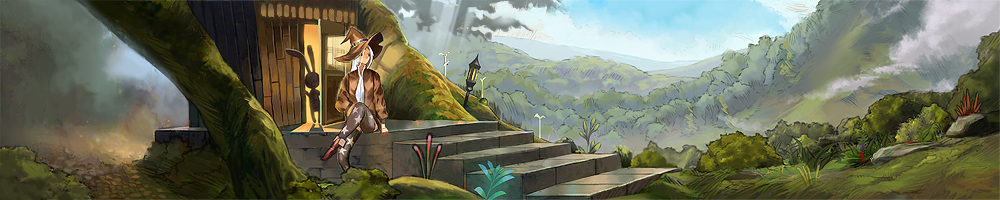


For the series that had the most hard to remember title of the past summer season, I was expecting something like a fairy tale story with some moe elements. Instead, we got a moe story with some fairy tale elements. Obviously that was a bit of a disappointment, but it’s still a pretty decent series.
I think the best way to describe this series is that it’s generally well executed, but it has a number of things that ended up holding it down. JC Staff really put some of their best animators on this series, which really results in a show that is chock full of interesting animation, with rich and detailed movements. It’s well directed, the dialogue is also pretty well written and presented. The characters are lively and are portrayed as such. At these aspects, it’s a very charming series.
Unfortunately, this is one of those series where it’s really the plot and content that hurts it the most, in which your mileage may vary depending on how much you can stand moe and harem stereotypes, because this show is chock full of it. Maids, tsunderes, boob jokes, punks, magicians, popularity contests, fireworks, pool episodes, you name it and this show probably has it. This is great for if you love these kinds of things, but personally I was rather annoyed with all of the stock situations that this series came up with, even though it often provided some sort of twist or creative twist to their cases. You can see that this series likes to be tongue in cheek about its subject material, and it’s very much a homage to various moe stereotypes, but for my tastes it wasn’t tongue in cheek enough.
The presentation is, like mentioned above, pretty solid, though there are some strange and notable exceptions. You know the good comedies, who even when a joke falls flat remain fun and interesting to watch. Ookami doesn’t have that: when a joke falls flat, it really falls flat, and this show often has a tendency to repeat those jokes over and over again. The most notable here are the boob jokes (there are way too many of those here, and they just refuse to leave), but the narrator also has some moments in which she thinks she’s funny while she actually isn’t.
This is also one of those series that doesn’t try to hide the fact that it’s based on a still on-going series of light novels. It just ends. There is no real conclusion, and the final episodes fail miserably in their attempts to at least have some sort of climax by introducing way too many new side-plots and turning the big bad guy of the series into an evil genius with huge holes in his plans. And to the rest of the villains of this series, the creators aren’t really kind either: most of them just end up as one-dimensional punching bags for the lead characters, so they fail to introduce any kind of tension.
And yet… despite all that I said here… I do kindof like this show. The lead characters are pretty charming and nicely characterized, and all of the protagonists have their own backstory and personality. The episodic nature of this series prevents it from dragging on and the fairy tale roots of the series aren’t really a core of the series, but they do provide the series with a nice amount of symbolism which really helped this series. It is indeed a show focused heavily on moe stereotypes, but I have watched tons of blander moe shows.
| Storytelling: | 7/10 – Solid, though a bit too reliant on stereotypes at times. |
| Characters: | 8/10 – The good guys are interesting to watch, the bad guys not so much. |
| Production-Values: | 9/10 – Excellent animation, I have to admit. |
| Setting: | 7/10 – Too many moe stereotypes that will turn off those who aren’t interested in them. |
Suggestions: And frankly, I like it that the creators used the least sappy story for last. This series always had its cheese problem: despite its excellent plot, it’s the reason why I’m never going to rate this show as a masterpiece. Still, it is one of those examples which really makes up for its cheese. Out of all of the arcs of the second half though, I find the Suppon arc the most interesting. That’s not to say that the other arcs didn’t stand out, though: Mario’s was the most intense, Joe’s was the most heart-warming, Cabbage’s was the funniest and Baremoto’s made the best use of the flaws of its character. They all had their own way in which they stood out, and that’s what made this second half work so well. As for the Americans… yeah, they were decent I guess. The biggest problem was that they were portrayed like most thugs in anime: without much of a personality (except for that one boxer guy perhaps). The voice actors actually got their accents quite right and it wasn’t like the usual Engrish here. But at the same time, you can really hear that this dialogue was written by a Japanese, and then translated to English without trying to make it sound natural from the mouth of an American. But yeah, this is just me, saying things. I have no idea how natural anime sounds in the ears of Japanese people. I liked the chemistry between them, and the creators made good use of the tension and the fact that Yura was actually really liking the one she wanted to kill in the first place. I really wonder what that attack would have looked like with Yura out of the picture, which would have allowed Nurarihyon to show some of his powers: I’m very interested to whether this guy still has his bite, or whether he has just turned into a regular old guy. I never really understood how youkai age, to be honest: they seem to be able to live forever, or at least for many centuries, and yet some of them age while others don’t. When a youkai is in an old man form, does that also mean that he’s weaker than his younger version? I liked Yura a lot, especially now that this episode finally gave her the chance to actually summon her full force. Her weakness is still pretty big, though: she only has to hope that she can buy enough time to actually summon all of them. Especially since she works alone, she is very easy to surprise and take out at this rate, though I guess it’s worth the effort considering the great stuff she can pull off when she actually does manage to summon all of her Shikigamis. The rest of this episode was quite light-hearted, but all of it was pretty enjoyable. The youkai together remain cute, and even Rikuou’s classmates are nice enough to watch when they don’t belong to the main focus of the episode. I already mentioned at the shoutbox that we had a beyond awesome staff working on this episode: Sayo Yamamoto, the director of Michiko e Hatchin doing the storyboard and the script written by Hiroshi Ounogi, who also wrote Noein and Birdy the Mighty. It’s like Superman having tea with Batman here. And seriously, even knowing that, this episode kicked ass beyond belief. I don’t even know where to start with how magnificent this episode played out. So much happened at once (I guess that that was the point of the previous two episodes: becoming so quiet and dull in order to just strengthen the ridiculously huge impact this episode would have). Mikaze’s sex appeal went beyond the roof here (and it was actually used extremely well in the first half of this episode), the inner paranoia of her spells on Bunmei were wonderfully portrayed and the entire episode itself was just amazingly animated. This episode was just disturbing. I mean, we could expect Mikaze to be up to something, but I absolutely loved how the creators just threw everyone’s hidden identity at your face here. Mikaze knowing the exact recipe of Bunmei’s cooking was just creepy. That kissing scene… I can’t believe how far and graphic that actually went. You could really see the influences of Michiko e Hatchin here. Another favourite was that scene in which Maya kicked the heck out of Bunmei here. Talk about brutal! I mean, I’m just baffled by this series. The thing is that it had its share of mediocre episodes, and it is mostly awesome when it has the right episode staff (I really have to applaud the producers here in getting the best people they could get here). I mean, episodes 1, 6 and 11: I consider all three to be the three single best episodes out of any show that started in the past summer season. I found it really strange that right before the ending, this series would waste so much time on random stories. But I really didn’t expect the creators to bombard us with so much at once here. Occult Gakuin, I applaud you. Thankfully though, this episode fully acknowledged that he was a disaster, and instead of the earlier episodes the creators chose a very restrained way for his story: we get a bit of his history, then we get to see what he did to Rei, then we get a confrontation and after that he’s simply kicked out. I really did not expect this kind of subtlety from a show that markets itself with zombies and boobs. There were some parts I didn’t like, like at the start of the episode in which those adults refuse to cooperate (but then again, I also don’t understand the hordes of people who demonstrate for the most moronic reasons), but overall I like this change of pace. I already said that this series sets itself apart with its atmosphere, and there was this strange melancholy during that scene in which all those nuclear bombs were launched that I really liked. At the same time, I like how the creators chose the climax of this series to revolve around rescuing the loved ones of Rei and Komuro. It’s down to earth, yet it’s bound to be exciting, there’s going to be an interesting deadline that the creators can use. The thing with this series is that its action may not be as good as Sengoku Basara, nor is its premise really refined or original not to mention the pointless fanservice, but it is much better balanced and varied than the other major action title of this season. Edit: a small correction here: I just discovered that High School of the Dead will just be twelve episodes long. So yeah, it’s going to end next week, which makes it quite a strange choice for a semi-final episode. – This series keeps its action scenes short and sweet: it wisely chose not to drag out the action for too long. I mean, I’ve said this before: this really is the school example of a series you can only judge after it fully ends. Out of all the series this season, this one really lets the most depend on its finale, even more than Occult Academy. And unlike Occult Academy, I still have full confidence that the creators know what they’re doing. All they need to do is give everything they’ve got, like what they did with the sixth episode, and that will make the entire series worth it. In the meantime, I enjoyed the action of this episode a lot. It was well directed, and a pretty nice taste of what’s to come. I especially loved the parts in which Date Masamune was so cool that he could have entire conversations on his horse while in the air, in the middle of explosives. I also loved the rest of that explosive horse scene. The entire episode was just a ploy of Toyotomi and his allies to slow down his enemies enough for his main force, and I liked how all those plans seemed to be working. Aside from the usual tension, this episode really made the characters shine in so many different ways. I loved all those moments that were focused on character antics, ranging from Akasaki celebrating his goal to Hauer punching Kuroda because he had gotten so annoying (especially the way in which Tatsumi noted that Kuroda had a talent for annoying people). Most of the time, my favourite series of each season are dark, with quite a bit of angst, death and destruction. Giant Killing however is completely different. It’s an incredibly bright and fun series that hits just about all the right buttons. I can only imagine how awesome the next episode is going to be: it’s there where everything in this series is going to have to come together: with twelve episodes left, and Tsubaki’s chance to score 2-2 ruined because of that defender who is really really tired, the match is at a point at which anything can happen now. I also love how this match is evolving with every single episode: first everything was focused on stopping the onslaught of attackers, most notably Kubota, then the focus moved to Natsuki as an attacker, and now this episode, instead of focusing on Tsubaki, it focused on Dulfer’s strategy collapsing and the main dilemma he has to face: what is more important, your ideals or winning every match you’re in? The long term versus the short term. NB. This is also something I noticed as I started making screenshots, but the camera angles in this episode were really good here: they were varied, creative, and really helped to bring up the best in the characters. The animation in this series is generally nothing to write home about, but there are these rare scenes that are actually animated quite well and smooth. This show has fun playing with these cliches, strangely enough. I really thought that Takashiro at the end saved Yuki there. But nope, it’s a completely new character. This character however isn’t anything like Reiga’s boss: he’s just another one of his subordinates. His intervention makes perfect sense as someone who prefers to work in the background, realizing that Reiga is overpowered with his emotions. Speaking of which, I really thought that Reiga’s emotions would cause him to turn into one of the good guys. Instead, they end up trying to kill Yuki. I mean, this was just subversion after subversion after subversion. At the start of this show, I tended to laugh at it. But really: this episode had two FREAKING DRAGONS duking it out. Now if that isn’t awesome, then I don’t know anymore. This finale is really progressing smoothly so far: it uses these semi-cliches, but it also shows how the characters have developed, it is well paced and takes its time without dabbling in endless quiet before the storms (this episode again took 5 minutes for everyone to catch their breath, only to move over to the real finale: the storming of Reiga’s castle). I mean, the second half of this series has been really skillfully written. I only have two beefs with this episode. The first I’m a bit iffy about is introducing a character, right at the end of the SEMI-FINAL episode. I mean, I know Luka’s brother versus him is going to make for an awesome final episode that will very likely delve into Luka’s past in order to explain how he left his clan (to save that for the final episode… excellent idea), but couldn’t his introduction have happened a tiny bit sooner? Also: Reiga’s motivation. Humans are evil, they pollute the planet. Copied and pasted directly from the Evil Handbook of Generic Villains. I expected better from you! – In this episode, Sabaaku hands Sasorina, Kumojacky and Cobraja a gem that lets them upgrade their desatorians. Where did he get that and why didn’t he use that before? Those gems… I have this hate love relationship with them. On one hand, they did make the fights more interesting. On the other hand: Sasorina was about to develop, dammit. I really liked how she was changing at the beginning of this episode, and here that damn evil Sabaaku had to step in and do something about it. Still, the above questions were the things that you could expect from a mahou shoujo. It in any case didn’t prevent this series from being excellent again, especially since it took Yuri under the loop again, and especially the relationship between her and Tsubomi. This episode definitely succeeded in giving a bit of colour to her character and it made her more than the angsting Yuri. On top of that, this episode carried on the theme of the previous episode of the loss of fairies, as the characters thought of the possibility of losing Chypre, Coffret and Potpourri. Always great to flesh them out. Here’s the thing: for the past summer season, there have been three series that stood out to me: Shiki, because it had the best atmosphere, Occult Academy, because it had the best execution, and Kuroshitsuji II, because it had the best plot (a possible fourth on this list would be Sengoku Basara Two because it had the best action, but that entirely depends on its final three episodes). Because Kuroshitsuji II did what many other series failed at, and became more interesting to watch than I could have hoped for, I guess that I just was obliged to check out that first season now – not all of it, mind you. This is one of those series that at times seems to be actively trying to be bad with its random stories and insert-episodes, so this is a review of just the episodes 5-8 and 17-24. If you want an impression of the entire series, just note that I couldn’t make it even past the second episode. Twice. Without the random annoying side-story, Kuroshitsuji becomes quite a snappy and diverse series about the occult in England around 150 years ago. There are a few holes in the plot here and there, but they’re all simple enough that they can be just guessed, so I can recommend this method of watching for the people who are interested in Kuroshitsuji’s darker parts, but have no indention of sitting through hordes of uninspired light-hearted moments that only take ten seconds to become annoying. Because I must say, those darker parts were quite worth it. This series sells itself with bishies doing the most impossible stunts, but behind it is an interesting and quite often disturbing world with quite a bit of intrigue. The lead character Ciel starts out as a bit of a questionable lead character, but he turns out to be quite an interesting anti-hero who has given up on life, just for the sake of his revenge. The darker parts of this series is where the unique selling point of Kuroshitsuji also really shines: Sebastian fits right in with this dark atmosphere, and even the few anticlimactic uses for his powers turn out to be hilarious, like they should be. Having said that, though, I do want to say that I still like the second season of Kuroshitsuji better. Alois and Claude (and Johanna possibly too) are by far the most interesting characters in the entire franchise, and these two really made a huge spectacle of the second season. The first season tries, and it has some neat villains too by the way, but none of them really get close to how fun it was to just see those two flamboyant characters parade across the screen. Sebastian and Ciel are interesting, but in the end they aren’t really the most complex characters and there is no development between them either. Especially Ciel makes a number of rather strange and stupid decisions throughout the series. Still, I liked the plot here, the creators put in some very interesting ideas for Ciel to tackle, and overall I had no problems getting though this series and I quite enjoyed it. Kuroshitsuji is a strange series though. I can easily have seen the first season as 13 episodes, and my guess would be that it would have been much more accessible and balanced than that it is now. And yet for some reason this show paraded all over with its bishies and shallow side-stories, even though beneath it is actually pretty good. This isn’t another case of Kobato, whose first half was simply inoffensive before it could get to its good part. Kuroshitsuji’s random stories are annoying beyond belief; they are completely different from that it really is about, and I really don’t want to watch anything more of that. Suggestions:
– GA Geijutsuka Art Design Class
– Kannagi
–
7 Comments
Rainbow – 24


Okay, so contrary to what I first thought, the Suppon arc is going to take up three episodes. That makes me all the more curious to that mysterious final episode through which the creators are going to close off the series (please! Heitai!), but as the final multi-episode arc of this series, Suppon’s story works really well. For the biggest amount of drama, the creators could have chosen to save Mario or Joe for last. Instead, they chose the much more mellow and melancholic Suppon: a guy who really embodies the major theme of this show through and through.
Rating: ** (Excellent) Nurarihyon no Mago – 11


So with this episode, apparently the real story of Nurarihyon no Mago should have started. And really, I’m impressed so far. Not with the potential, but the idea of the author to start things off with Nurarihyon and Yura, as they immediately get attacked by whatever evil youkai that have moved into town.
Rating: * (Good) Seikimatsu Occult Gakuin – 11


Wow…. these are the kinds of episodes that blow you away. It did to me at least.
Rating: **** (Fantastic) High School of the Dead – 11


I was expecting the worst here. I mean, at the end of the previous episode, the way that that demented teacher knocked on the door was like saying “Hello, I’m your endboss. May I come in?”
Rating: ** (Excellent) Sengoku Basara – 22


Now this is more like it. This episode was entirely building up to that finale again, but it also packed a punch when it comes to action. This really shows a number of things about this series:
– This series knows that an action series isn’t just about action, but also creating a good setting and characters to carry this action are just as important.
– This series has huge balls and guts to let everything depend on the final two episodes.
Rating: ** (Excellent) Giant Killing – 24


I hate the cliff-hangers of this series with passion. I mean, keeping a hook until next week is one thing, but the tension is killing me here. The creators here have this tendency to cut off at the most tense episode of the series. This is just unbelievable: this entire episode was building up for something that happens two seconds after the end of the episode.
Rating: *** (Awesome) Uragiri wa Boku no Namae wo Shitteiru – 23


Ah, you know the cliches: a character is certain to die: there’s some kind of deadly projectile heading in his direction, and only a miracle can save him, which indeed happens as he is saved at the last moment by a friend of his. Or take the cliche in which the lead villain has lost most of his powers, only for suddenly another end boss to get introduced. This episode had both of these cliches, yet it did not, if that makes any sense.
Rating: ** (Excellent) HeartcatchPrecure – 31


And here we have it: the upgrade episode. Both the bad guys and the good guys received new powers. Now, as much as I like this series, I’m going to be critical again here, because there are a few questions that bother me here:
– How do Precures discover new abilities anyway? Do they just… “level up” and instantly know how to use new powers? I mean, the golden Precures here… where did they come from? Did they just think of this in the heat of the moment or something?
– Why is there a fanclub for the biggest geek in the school?
Rating: ** (Excellent) Kuroshitsuji Episodes 05-08 and 17-24 Review – 80/100


So, yes…. I caved in.
Storytelling:
8/10 – Good atmosphere, well told, a pretty good sense of build up.
Characters:
8/10 – Nothing special or well developed, but an interesting cast nonetheless with a nice chemistry to watch.
Production-Values:
8/10 – To me, the second season was also better in this aspect, but the art looks consistently solid and the soundtrack is also pretty adequate.
Setting:
8/10 – Okay, it’s England with a lot of liberties taken, but this series makes very good use of these liberties to show a very interesting setting here.
– Suteki Tantei Labyrinth
– Trinity Blood
–
7 Comments