2017 Anime Summary

Aidan: Another year and another tick down on the death counter but it certainly has been a pretty good year for anime. We had some stinkers, some major disappointments but there were certainly shows that will be remembered and even some that will be touted as being the best of the best.

The other writers and I have decided that the choices for this list will be based on majority vote between the five of us. You can complain that your own preferred show didn’t make the final list but there is a very good chance that it was nominated and slowly knocked out as we tallied the votes together. Also, do take note that we haven’t seen everything this year had to offer so there are anime that have slipped under the radar. It is only our opinion and thus is nothing ironclad nor is it contractually binding. You may like something that we hate and that is perfectly fine (provided it’s not Eromanga Sensei because bloody hell…).

Each writer has taken it upon himself to write a section about the winners but keep in mind that just because someone wrote it, does not mean they specifically nominated it. Down below, you will see each of the writer’s ballot for their own top ten choices. With that being said, let’s put Star Crossed Blog’s final stamp on the anime year of 2017.

Worst of the Worst

Worst Show: Hand Shakers

Mario: I’m not at all exaggerating when I consider that encountering a total wreck like Hand Shakers is as rare as running across any modern classic. For Hand Shakers to be a product that goes wrong in almost every department, with its rage-inducing visual mess with fisheye lens, random camera zoom, distracting CG that moves on different frame rate than the 2D models, incompetent writing filled with of illogical leaps, INCEST, terrible treatment to the female cast, the consistently one-dimensional outlandish characters, and softcore porno sounding OST. Given the main theme of the show is about meshing connections, it’s rather remarkable how the presentation is this constant battle between all the elements of the show trying to intertwine with each other. Hand Shakers is also a glaring example of how an anime studio pushed way too hard on showing off their “signature’ style without considering if it fits the material to the point where it becomes a gimmick (Shaft, beware!). The saddest thing is that its failure doesn’t come from a lack of care, as I can see real effort were put into it, but to make a show this terrible is no small feat. Hand Shakers redefines what we perceive as bad, and maybe THAT is how it will be remembered for years to come.

Runner-ups: Berserk (2017) – For poorly adapting of one of the most acclaimed manga ever written.  Eromanga Sensei For the exact opposite reason of Berserk (2017), where there were solid production values for a show that represents everything that is wrong about modern anime, which makes it even more painful to watch than forgettable fluff.


Biggest Disappointment:
Seikaisuru Kado

Lenlo: It’s difficult to write this category, because for all of its faults, I still enjoyed Seikaisuru Kado. The problem is that it could have been so much more. For the first half of its run, Kado did a great job of setting up its characters and running with the theme of “alien contact changing our world”. The CGI, while not beautiful like Houseki no Kuni, was used inventively to simulate 3D shapes in creating interesting scenes. However, in a single episode, it plummeted from being an intriguing sci-fiction to an unmitigated disaster of a shounen. Plot threads got abandoned, dialogue was thrown out the window in favor of flashy combat and the philosophizing was pointless. Because of its fantastic start and subsequent disgusting end, Seikaisuru Kado is the most disappointing and soul-crushing anime of 2017. It only beats out Berserk (2017) because no one expected anything from that trainwreck in the first place.

Runner-up: Berserk (2017)
Continue reading “2017 Anime Summary”

After the Rain – 03 [Raindrops]

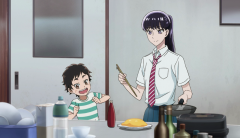
Gosh, the romance tension sure escalated quickly, which for my money is for the better. This week we have Tachibana in both her lowest and highest (AKA entirely in her unstable mood), the 45-year-old clueless victim who tries his best to brake the relationship from going too far, and a coming date of the two at the end. The last part stands to me as the only sour (last) note to this extraordinary episode. You see, that “date” is obviously a plot device so that the two of them can spend more time together, and it breaks the established mood although by that point I was already invested in the two of them and their romance to let it pass. The factor that I appreciate the most out of this episode is of course, Kondou’s reactions to Tachibana’s confessions. Ameagari skates the thin ice in this sensitive issue but the show manages to pull it off with even more sensitive approach. The guy not only act like a normal 45-year-old guy would do, but he convinces her with many sounding, sensible reasons and appropriate actions. Responding straight to Tachibana about her confession, for one thing. Giving her two main reasons to reconsider her options, one of them because of the huge age-gap (which she couldn’t care less), and the other because of his own empty self (an empty middle-aged boy with no dream or hope – so much honesty here). The second reason is important here, he feels himself unfit for someone like Tachibana, whose life is just at the beginning of her stage, and she’s attractive on top of that.

But it’s the emptiness that seemingly bring the two together. That brings me back to the first half of this episode, Tachibana meeting the track club members. After seeing them enjoy running and making progress, she’s deeply frustrated and left. A brief montage of the events led to her injury further demonstrate the fact that 1) now that her track career is gone, Tachibana feels empty, thinking that she has hit the thick wall ahead. And 2) she meets Kondou in the exact time when she was at her lowest point, the moment really gets into her that she finds the spark in the man. Many could say that it’s unrealistic, but I totally believe that’s how young people fall in love, especially the love at first sight. That frustration from seeing her being left behind by the wheel of present and the track field which once made her special lead her to pursuits the love to Kondou AGAIN, in the rain (it sure rains like hell in Ameagari). And when the message is out there’s no holding back there, for both of them.

This third episode makes it the first time we entirely see the events play out from Kondou’s point of view. After he tries his best to avoid the love message from Tachinaba in every possible way he can think of: first seeing it as a formal compliment from the girl, then taking it as a dream, then as a prank (there are nice little sequences play out in his head there); he deals with her the best way anyone could. What really sells me is the way Ameagari displays his perspective in an insightful and subtle manner: we could see his nervousness through his drinking the can that had cigarette ash in (he experiences the true bitterness of that love, as some might say), or through him searching for cigarettes but couldn’t find it. His thoughts as well, are so personal but well-placed and honest. Despite all the “you should reconsider this” stuffs, I can see how her confessions affect him in a good way. He feels flattered by the thought of someone attracted to him, he feels young again (with the smart visual of him in his teen self), he feels love and being loved again. And honestly, what is wrong with two people falling in love?

My bottom line: this is the best episode not only for Ameagari, but I consider it the best of episode I’ve seen so far this Winter season. I’ve heard someone compare this to Wong Kar Wai’s romance films. While at first I thought this’s too early a game to make any concrete statement, with this episode I do feel a resemblance here, especially the way they develop well-grounded characters we care for and their mature love relationship.

The Versus Show: Boku dake ga Inai Machi (ERASED) vs. Ano Hi Mita Hana no Namae wo Bokutachi wa Mada Shiranai

[slideshow_deploy id=’25280′]

It has been quite a while since the last time we had this, right? Now, game on for some new match-ups. This time I pick 2 shows from recent years, both dealing with the death of a childhood friend(s), and arguably both of them received commercial and critical success in their run (as of this writing they receive a very close rating over MAL). Both deal with grief, confusion, and the allusion of fixing one’s mistake. Both have a diverse cast with their own emotional growth, strength and weakness. Both produced some of the most heart-breaking, tear-jerking and emotionally roller-coaster we have witnessed for the last few years. Both are made by A-1 Pictures. One is a drama, the other is a thriller, but ultimately they’re both character-driven shows. Without further ado, please welcome on stage, ERASED and AnoHana

Boku dake ga Inai Machi (ERASED)


Studio: A-1 Pictures

Season: Winter 2016

Episodes: 12

Source: Manga

MAL Rating: 8.57

When tragedy is about to strike, Satoru Fujinuma finds himself sent back several minutes before the accident occurs. The detached, 29-year-old manga artist has taken advantage of this powerful yet mysterious phenomenon, which he calls “Revival,” to save many lives.

However, when he is wrongfully accused of murdering someone close to him, Satoru is sent back to the past once again, but this time to 1988, 18 years in the past. Soon, he realizes that the murder may be connected to the abduction and killing of one of his classmates, the solitary and mysterious Kayo Hinazuki, that took place when he was a child. This is his chance to make things right.

Boku dake ga Inai Machi follows Satoru in his mission to uncover what truly transpired 18 years ago and prevent the death of his classmate while protecting those he cares about in the present.. (from MAL)

Excerpt from our site’s original review:

“This series has some great presentation and direction though it does make it somewhat predictable in how it highlights what’s to come. Predictable does not mean boring though and this tale has a lot of heart. There are a number of great scenes that can play with your emotions and each episode does leave a feeling of dread for a tragedy to come. Though those episode cliffhangers do build up expectations which the ending fails to deliver.The female cast is ridiculously strong with Satorus mother being one of the best parenting figures one could have.

Ultimately what decides your enjoyment of this show is your level attachment to the characters. The focus is clearly character driven and if you find yourself not caring for them, I am afraid the plot will not hold anything to compensate. But if you find yourself getting drawn into these characters then I believe your experience with this show will be a positive one but remember to walk into it with the right expectations.”

Versus


Ano Hi Mita Hana no Namae wo Bokutachi wa Mada Shiranai.


Studio: A-1 Pictures

Season: Spring 2011

Episodes: 11

Source: Original

MAL Rating: 8.56

Jinta Yadomi is peacefully living as a recluse, spending his days away from school and playing video games at home instead. One hot summer day, his childhood friend, Meiko “Menma” Honma, appears and pesters him to grant a forgotten wish. He pays her no mind, which annoys her, but he doesn’t really care. After all, Menma already died years ago.

At first, Jinta thinks that he is merely hallucinating due to the summer heat, but he is later on convinced that what he sees truly is the ghost of Menma. Jinta and his group of childhood friends grew apart after her untimely death, but they are drawn together once more as they try to lay Menma’s spirit to rest. Re-living their pain and guilt, will they be able to find the strength to help not only Menma move on—but themselves as well? (from MAL)

Psgels’ original review:

“Ever heard of the phrase “short but sweet”? This is the key to the best Noitamina-series out there: most of them can only be eleven or twelve episodes long, so they really need to know how to use their time, and this series is a brilliant example of how this timeslot should be used. It leaves no moment wasted, it never drags, and it’s always developing its characters, delivering heavy drama, and moving back and forth between showing new things about its characters and fleshing them out.

If you are looking for an emotional roller coaster however: watch this. Few series can boast to be this well laid out, especially when so small. Everything fits just perfectly. I’m not a fan of moe, but this show is so good that it immediately won me over.”


This poll is no longer accepting votes

What will you be watching this fall?


HAPPY VOTING GUYS!

Violet Evergarden – 03 [May You Be an Exemplary Auto-Memoir Doll]

Well, we have another original anime-material this week and I consider this episode slightly stronger than last week, although its main shortcomings still remain. The biggest improvement in terms of narrative, is how Violet Evergarden shifts their perspective to another secondary character. I still have issues with Violet the character, so it’s a nice change (and more bearable) to see her issues through someone else’s lenses. This week, our Violet attends the Auto Memories Doll class and we have a pretty much Violet’s routine here: her salute, her precise at receiving orders and her mechanical arms. And like all of us could have predicted, she excels on typing and grammar, but totally fail on transferring emotions to the letter. Only three episodes in and I’m already tired with all those same beats. It doesn’t even make sense to me how Violet ghost-writes Luculia in such a dry report-like, given her personality she could just write exactly what the girl says. The thing is, Violet not only has difficulty of expressing her own, or other’s emotions, she has a hard time understanding the feeling others have. She hardly expresses any emotions at all except when it comes to Major whathisname. As a result, her letter in the end, and her graduation because of it, don’t feel earned to me. They feel too quick, too compressed for such a change from Violet.

Thankfully, aside from our little Violeta’s development, we also have the story of Luculia and her own struggles with her brother. In a way an indirect victim of the war (the War settings are put into good use here), her brother is tormented for the dead of their parents, whom he feels that he failed to protect. That lead to his own destruction: drinking, fighting, being useless. Luculia feels unable to communicate with him, as all the raw emotions are botched up inside that it becomes impossible to be normal again. Communication, or to be more precise, the ability to communicate, is by far and large the central theme of Violet Evergarden and Luculia story succeed of deepen that theme with some emotional affecting moment and the strong visual flair that brings out the emotions just by the way they tone down the melodramatic moments. Most of my complaints about the show so far come from its script, namely its obvious and predictable narrative beat and its boring titular character. In fact, Luculia herself sometimes feels like a vehicle to unlock Violet’s emotion, thus she doesn’t really flesh out as a true character. We never know her own reason for becoming a Doll, for example, or why she becomes invested to Violet – the driest girl on Earth. Even the Auto Memories Doll workshop itself seems too rushed for its own good.

It’s the masterful visual storytelling so far that raised the bar to this material. The settings are beautiful and gorgeous. When Violet and Luculia get into the top of the tower and see the city from up high, the city looks attractive and impressive, yet somehow bring the strong feeling to the forefront. The visual focuses more on the character’s little gestures and their eyes than any big emotional overacting, which for me fare much better in terms of emotional impact. The first “letter” that Violet is decidedly simple; but express all the feeling that Luculia want to transfer across to her brother. I suspect this is the format we will get as the show moves on from its prelude phase, Violet encounters different people with different stories, and ghost-write and learn about their emotions in the process. I’m fine with that, as long as the show doesn’t get repetitive and gives a reasonable development to Violet to get her out of this robot shell.

A Place Further than the Universe – 04 [Four Caterpillars]

Universe takes another firm step towards the Antarctica trip, this time more about the actual preparation: parents’ approval, training and the likes. We’re still far away from the final destination, and I suspect it’d take a few more episodes before the girls arrive to the South Pole. Not that I complain because these build-ups make this journey much more believable. It helps that the direction so far smartly conveys the tones it tries to bring across. Take the scene where Mari tries to get her Mom’s approval for example. The show knows how to play up the fear of Mari of being caught red-handed for arranging her trip without her Mom’s knowledge (Mari, it’d be wiser to ask your Dad instead). It constantly builds the atmosphere up, and then play out in a spooky playful nature (remember what did the little sister do when they realize their Mom knows? She shuts the door. I’m outta here. Case closed). Priceless. Or take the scene where the girls being underwhelmed inside the old van? Universe shows us not only their disappointments, but the condition of the car: the girls crammed up in small seats, stack of papers about funding, the small note sticking at the cassette telling them it’s broken, an expensive car passing it to put more salt to the wound… Those little details certainly help make this preparation phase more entertaining.

On to the 4-day training trip, I certainly feel related to how clueless the girls are when they have to do the actual field trip. Simple matters like which eye they should use, your left or my left, take note about altitude… the basic of mountain climbing, but there’s always first time for everyone. On that field trip, the girls meet their captain, Toudou Gin, whom sharing with Shirase the same pain: the loss of Shirase’s mother. It creates quite a tense tension between the two, so I expect we will learn more about her mother through their chemistry once they’re arriving to Antarctica. One potential conflict before they’re reaching the destination, though, is how Megumi (Mari’s best friend) feels a bit “uneasy” towards Mari’s plan. She has been the voice of reason for Mari to walk the fine line between “reaching your dream” and “taking realistic actions”, but her warming about feeling regret when you’re trying to hard but not achieving it sound off to me. It’s the opposite, and it’s not like her to say something like that. I guess we will have to wait until next week to see what Universe has in store for us regarding this plot thread.

One of my fear after the quartet is finally formed, is how then they will become less dominant and exist only as the group’s member with no real personality. Well, so far Universe hasn’t fall into that trap yet, given the cast still produces some neat chemistry together, and give both Mari and Shirase some more ground to develop. In Universe, Shirase has always been the one who drives the plot forward, and Mari is our emotional investment. This time again, when talking to Gin, she makes it clear that although Shirase was the invite them to the trip, it’s ultimately HER trip now – the place where she herself really wants to go and explore, along with all the friends she has made. Antarctica show is still looking strong at the moment.

Kokkoku – 3 [The Third Moment]

Welcome to another episode of Kokkoku, the premier time based anime of the season. This week we have growing mysteries and intelligent villains. Lets jump in.

To start off, I want to talk about our main cast and the mystery surrounding them, as that seems to be the core of Kokkoku. Blood and family ties have come up often, both in regards to our heroes and the villains. Blood is what is used to activate the Stasis Stones, though we don’t yet know if it matters whose blood is used. It also appears that each member of our leading family has some sort of ability. The Grandfather is able to teleport short distances while Juri is able to expel people from Stasis. So far neither has been able to use the others abilities, though it is possible they might learn them in the future. If blood does matter however, I am curious what abilities the villains will develop, as they also have a stone and can enter the Stasis. Next up is the mysterious spirits.

Continue reading “Kokkoku – 3 [The Third Moment]”

Darling in the Franxx – 02[What it means to connect]

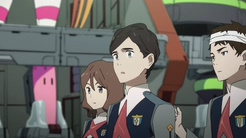
As it stands now, this is essentially an animated version of a double entendre. Each line is laced with a double meaning so heavy that you can postface lines with the words “That’s what she said.” and it would fit perfectly. I find my stance on this to be rather mixed as while the fanservice is ridiculously blatant what with it’s robots piloted by ass controls and changing room boob groping, it feels like the show itself recognises just how silly it all is. Let me put it this way, shows like Cross Ange present their fanservice with a straight face as it has the age old cliches we all know and hate while Franxx seems to be having fun in acknowledging its own absurdity. I honestly chuckled when one of the pilot said upon starting his machine “Did I do it right? I didn’t suck?” and having his partner reassure him that he did fine. Still while this playfulness is rather comical, it does conflict with the serious plot the story appears to be trying to present. For you see, when you are trying to make a point, it can be difficult to be taken seriously when your statements sound like a sex joke. I mean Franxx doesn’t suck hard but it does suck a little, and while sucking a little can be enough to satisfy some people, I know there are those of us who would prefer it to perform better so that we aren’t left limp when the time comes for it to go fast and heavy. You may be beginning to see my point.

It is pretty apparent that this series is paying homage to mecha series like Evangelion and its contemporaries and as odd as it may be to say, I think that it would be a mistake for this series to attempt to take a darker turn in it’s later episodes and attempt an Evangelion. For you see, nothing will top Evangelion, it is on a pedestal so high and fortified by age, legacy and nostalgia that even if you made a series that was objectively a better version of it in every way, it still wouldn’t top Evangelion. Even Evangelion couldn’t top Evangelion, that’s the point we are at. Attempting to do so would just make this another one of those shows that followed it can came up short and i feel that the idea’s have really all been done. So while this may sound ludicrous to you readers, I believe Franxx should put it’s focus on it’s other aspect which happens to be using mecha as allegory for relationships. I know it sound odd for me to suggest this considering my rant above about this series approach to sex but I feel this is the only real path for Franxx to be its own entity. Mecha and sex have been previously compared before and even the idea of using them as pseudo relationships, off the top of my head I can name Aquarion Evol which dabbled in this. But if there is one aspect that anime has hardly explored, it’s the nature of relationships. In anime, a relationship has a beginning and an end but never a middle. Romance anime either end at the confession or time skip to the marriage and very little of the rather tremulous ground that is the relationship itself is covered. So if this anime can somehow use the ground of mecha to explore sexual relations then this could turn out rather interesting.

Already we have some ammo for this kind of story as this episode can essentially be taken as a tale of erectile dysfunction. The main has to prove his worth by trying to pilot a franxx again but this time he is paired up with another girl called Ichigo who seems to be romantically interested in him. Despite a promising start the robot ends up rejecting the connection leading to the girl trying to get the main “in the mood” so to speak. I am not really pushing to make this symbolic connection either, in fact it’s rather obvious this is what it’s alluding to. Being “in the mood” is looking to be a big factor when piloting these robots as his opponent, cocky little upstart he is, effectively kills the mode in his robot when he openly admits that he would take the Ichigo as his partner, essentially the equivalent of calling out another woman’s name during intercourse. This pisses off his partner, shuts down the robot and we have an ending with Ichigo making the rather suggestive comment that the main was “awful”.

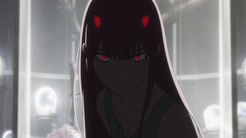
So we have a love triangle here, Zero two is the dangerous girl whose been with a number of guys and is experienced, exciting and spontaneous. Not to mention she’s a dominant bold partner in piloting which may be a factor in getting the main ”in the mood”. Ichigo on the other hand is a submissive partner whose boring, predictable and ordinary, essentially the safe relationship option. But we also have the issue of cheating as Ichigo already has a partner whom she is highly compatible with and well he seems to be aware of her feelings. I admit this may be me simply trying to justify the high amount of suggestive fanservice into something more acceptable as people did with Kill La Kill and I fully admit that this might not be the intended focus of the series. But it certainly would give me something more interesting to talk about.

Junji Ito Collection – 03[The Crossroads Pretty boy – The lovesick dead, Slug Girl]

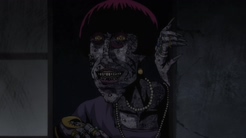
Our two stories today regard the handsome man at the crossroads and slug girl. The handsome man story was given the most screen time and it is a decent story, albeit unfinished. What was presented here was only the first part of the story and I believe it will be continued in later episodes. But what we have here is a town haunted by a mysterious figure whom people have taken to asking about their love life. Which would be fine if the mysterious figure didn’t always claim that their love would be unfulfilled and his words have such an effect that the girls commit suicide. There’s never really and explanation as to why or how this monsters came to be but if I had to make a guess I would say the monster of this town is the mysterious fog that appears whenever the pretty boy is walking about. The catalyst for these events seems to be an incident in the main characters past, where he told a pregnant woman that her love was doomed and that caused her to commit suicide. This appears to have given the fog a taste for blood as it appears to be trying to trap more girls souls within it by spawning the pretty boy and having him make girls commit suicide. At least that’s my interpretation though it doesn’t quite explain that the murders seems to only start up once the main character moved back into town.

The big question here is whether the handsome mans words are some kind of mind control considering the effect he has on his victims or if the mans words only have such an effect because they cause the victim to realise something. We have a case here of a girls friend asking the pretty boy about her friends love life only for the pretty boy to say that she should worry about her own. His words causing the girl to aggressively pursue the main character as though he were her last chance at love. Eventually leading to her suicide when he rejects her numerous advances. Considering how the girl becomes like a woman possessed as she transforms into a ugly visage of herself it would be easy to say that it’s all just some form of mind control. However it could be that this girl did have worries about her own love life and the pretty boy’s words merely confirmed her greatest fears of never finding love. Thus she pushes herself to find love no matter what and her efforts just backfired disastrously. Though it could be some kind of primal instinct stimulated that pushes for the ultimatum of either procreate or die. Thus this begs the question that if the main character did accept her advances then could she have potentially gone back to normal?

Slug girl was given the shorter runtime of five minutes but the story it presents is a rather good example of Junji’s approach to absurdist horror. There is no explanation as to why it happened but for some reason a girls tongue turned into a slug. While the first transformation was horric, the second does bring to light a certain problem I have with Junji ito’s works. Name that Ito has a tendency to go a bit too silly with his ideas. An example would be a chapter from his work Uzumaki where the people of the town gain the ability to create whirlwinds by spinning their fingers. A rather weird tonal shift for what was a rather tense grim story. Here we have the parents of the girl convince her to bath in a bath full of salt to kill the slug. I feel the parents went a bit overkill by having her bath in salt considering that her mouth was the main area affected and oddly enough this resulted in the girls body completely disappearing, leaving her as just a head with a slug coming out of its mouth like some kind of messed up snail. The implication that the girl is somehow still alive despite being reduced to a snail shell is a rather disturbing concept but I just find the logic of it to be rather flimsy. Sure it’s all fiction and it doesn’t make sense to have her tongue turn into a slug in the first place but it just feels like Junji had a disturbing idea and took it to too much of an extreme to be taken seriously.

Mahoutsukai no Yome – 15 [There is no place like home]

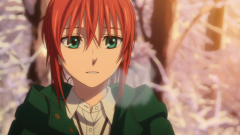
Welcome to another week of Mahoutsukai no Yome. This week continues Chise’s bad relationship with water, Elias’s with Fae and gives Silky a history. Lets jump in!

To start off, I want to talk about the best part of this episode, that being Silky’s history and alone time. For the longest time Silky was a pointless background character, and she largely still is. But now she is a character with a backstory and relationships outside of our leads. Silky’s solo time is spent well, with her cleaning the entire house and demonstrating her loneliness as time passes. Mahoutsukai even uses the chibi are they have been shoving down our throats in the perfect manner, since Silky cant talk. Mahoutsukai is much more successful at making me care about Silky here than say, Joel. Most likely because of the lack of speech, forcing the artists and the watched to pay more attention to Silky’s movements and expressions. It’s a great buildup to her backstory and the better half of the episode.

Continue reading “Mahoutsukai no Yome – 15 [There is no place like home]”

After the Rain – 02 [Rain Drops on Green Leaves]

It has been exactly a year since I last blogged you, noitaminA shows, and this time again it’s another romance drama. Unlike Scum’s Wish last year, however, Ameagari has one simple premise, but it executes the idea with such grace. This second episode is even stronger than the first, setting the stepping stone for Tachibana and Kondo’s relationship. Now, big elephant in the kitchen so you know where I stand on its most “problematic” aspect. I don’t have a problem on the suggested relationship between 17 year old girl towards the 45 year old man. It is neither fantastical premise (It’s uncommon, but such relationship exists; and it’s easier than you might think when a junior having a crush on their senior), nor is it illegal or morally deranged. The age of consent in Japan is, curiously enough, 13 years of age. Granted that each province in Japan provides their own law in order to protect underaged children (usually about 16 year of age) from sexual abuse, but sexual tension is never the intent of Ameagari. At this moment, my gut telling me Tachibana falls for the wrong guy, but it’s not DUE TO their age gap.

What raise this little romance drama to the top of its genre is the excellent production values. While Ameagari never exactly stand out, the quality is amongst the best this season has to offer, simply because how the audiovisual storytelling and smart framing contribute neatly to the tone and the theme of this romantic story. Walking on such a tricky premise (ya know, a love story with such age difference already raise a yellow flag out of the gate), it’s remarkable that there isn’t any real misstep so far. I was impressed by Ameagari’s eye for details in those seemingly insignificant moments. For example, I love every moment of the one-minute entrance of this second episode where we simply follow Tachibana in the train to her workplace. There is a nice contrast between her and other girls her age, there is an attentiveness to the everyday life of our protagonist, and the music score is pitch perfect to bring the atmosphere out (weird consider how much I was put off by Violet Evergarden’s score). Or the scene where Kondo drives her to the clinic, we could see his stuffs in the backseat: a ball, a jump rope, and a bunch of umbrellas. What do they tell about his personality? A lot I say. As we know last episode he prepares extra umbrellas in case of his co-workers held up by the rain. At least he seems like a truly kind person.

It helps that both our main Tachibana and Kondo are immensely are relatable and likeable bunch, in that order. The entire plot so far is told by Tachibana’s point of view, and like everybody her view is peppered by her own subjective perspective. Moments where she has a chance to talk to Kondo feel purposely light and hopeful. Scenes involving her and the track feel sad and nostalgic, and moments between her and her classmate Yoshizawa feel overly nonsensical and comical. The latter especially due to the fact that she doesn’t care one inch about her friend, but doesn’t she realize he’s in the very same situation with her regarding their crushes? For Kondo, so far Ameagari successfully frames him as a goofy likable kind man, the man who would go out of his way just to make sure that his co-worker is safe and sound. The majority of plot progression this week centres around Tachibana gets herself injured again after sprinting to the guy who forgot his phone, so Kondo takes her to the clinic and goes house-visit the next day. Tachibana has gotten loose around him, a sign in which he himself notices, but the real plot-changer comes afterward, when she actually confesses to him, and he dodges it. What a smart way to get out of the problem, Kondou, although I suspect he still doesn’t really get it. No matter, we have 9 more episodes along the way, but from what I have seen in the first two episodes (near flawless accomplishment), there will be a lot of good materials to look forward to.