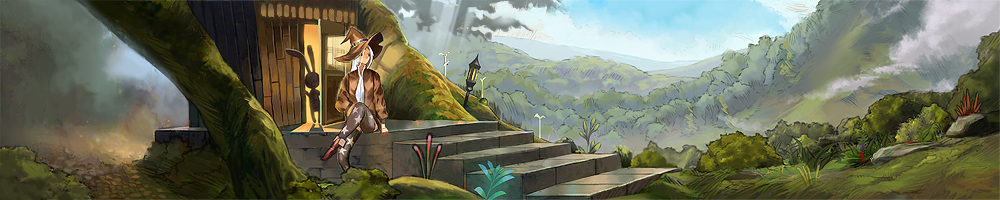
Druaga no Tou ~The Aegis of Uruk~ Review – 86/100


Fantasy Game adaptations have always been a rather notorious genre, due to the huge amount of lazy productions. These series seem to think that “fantasy” means “lack of realism”, and where the end result is almost always an uninspired story about a young swordsman travelling from A to B, saving the world and getting the girl. There are two animation-companies who have managed to break this tradition: Bee-train and Gonzo. Even though .Hack//Roots and .Hack//Dusk were rather questionable, Bee-train did produce .Hack//Sign, which looked more at the philosophy-part of gaming, and the charming adventure story Popolocrois. Then Gonzo came and delivered the hilarious MMORPG-parody Master of Epic, and with Druaga no Tou (or the Tower of Druaga) they did it again.

Druaga no Tou is based on an arcade-game from the eighties. It follows a band of questionable heroes as they try to climb a tower to save the world, but that’s where the generic stuff ends. Finally there’s another series that’s put a bit of thought into its setting, and a lot of ideas went into it to keep things interesting. I especially liked the magician who fights with golf-clubs.

The real charm of this series, however, is that it knows exactly how much it should take itself seriously. It’s not entirely silly, because you can never get a good story out of it, and it doesn’t take itself too seriously at times, which helps swallow the fact that this remains a story about a young inexperienced male on his first adventure. There are a few hilarious episode that successfully parody and homage a number of classic games, but there are enough episodes that focus on the more realistic side of the setting, and Jil (the male lead) is constantly reminded that he’s just an inexperienced attention-seeker, both by the other characters and by the story itself.

When compared to other similar series, Druaga no Tou did a pretty good job, but the fact remains that it’s a miracle that the main party survived, considering that they all were just inexperienced, especially considering the huge amount of people who failed to do the things that they did.

Gonzo had been quite pathetic ever since Bokura no ended, with their only contributions to the past Autumn and Winter season being the crappy Dragonaut and Rosario to Vampire. Special A also went nowhere, and Blassreiter still misses something because it keeps focusing too much on emo, but Druaga no Tou really delivered once it caught steam. I’m glad to see that 2009 will see a second season, because there’s enough left for this series to play with, and with a bit of luck the characters will really warm up and develop significantly there.

Kurenai Review – 86/100


Kurenai is quite possibly the most solid of the series that came out during the past spring season. It’s a well-written series. If you liked True Tears and want to see how it would have been with a bit less romance and a bit more action, then it’s likely that you’ll like Kurenai. This series is not going to hit any heights, but it’s perfect for a quick watch.

Aside from the solid writing, Kurenai has another thing it can boast about: its voice-acting. It joins Mahou Shoujotai and Red Garden in the very short list of series that have their voices recorded before the animation-process. The result is that the voice-actors are less restrained, and have more freedom in portraying their characters, which leads to a number of excellent dialogues, with the highlight being episode six.

Unfortunately, because the writing is so solid, the inconsistencies tend to stick out like a sore thumb. There are two or three points in this series that make you wonder what the creators have been smoking, because they don’t make any sense at all in the light of the involved characters, especially around the second half of this series.

With Brains Base, you can of course expect gorgeously animated fight-scenes, and indeed, whenever characters start fighting, the animation shines. Overall, Kurenai is probably too short for the story to make any real impact, but it’s got a likable cast of characters, great dialogue, excellent animation and terrific voice-acting.

Overman King Gainer Review – 83/100


I first learned about Overman King Gainer through its OP that you’ll either absolutely love or absolutely hate. In my case, it was the former, so I just had to watch the series, hoping that it would be more than just a cheesy mecha-show. As it turns out, twenty-five years after creating Gundam, Tomino still knows how to make a good anime.

As it turns out, he left the realism as seen in Mobile Suit Gundam for what it is (after all, after creating 200 episodes and various movies of Gundam, how much more can you play with realism?) and instead he decided to focus on creativity. The result is a series that might be nothing special when concentrating on the big picture, but is filled with lots and lots of details that sparkle with creativity. The setting in the middle of Siberia, the Exodus where entire cities travel for hundreds of miles, looking to “break free”, the mobile suits designs, you can see that a lot of time has been spent to make the setting as original as possible, and it really works.

Tomino also didn’t forget how to pull off good action. In this series, there are no episodes dedicated to intermezzos or aftermaths. Every single episode has something fun in store for its viewer, leaving hardly any chance to get bored. So much is happening on-screen. This is really an anime that’s meant as entertainment, and I call this mission accomplished.

Interestingly, Overman King Gainer has the same weakness as Mobile Suit Gundam: both have a main character that becomes the pilot of the main mecha through very questionable reasons. This one needs a bit of minutes to get the hang of it, after which he can pilot the thing as a master, only because he happens to be good at video games. This will indeed give you improved reflexes, but there’s also the matter of getting accustomed to the new controls, and learning to endure the physical strain on your body while fighting.

The plot overall isn’t the most solid ones around by far. During some fights, the writers pull random powers out of thin air, just to keep the story flowing smoothly, and there are quite a few sloppy explanations that rely too much on the viewer’s imagination. The ending also goes on for too long. I really feel that this would have been perfect for 22 or 23 episodes, simply because the climax takes bloody ages, becoming a bit too serious for its own good. Thankfully, this series manages to finish with the bang that it was supposed to deliver, but the road to this descends to a generic “stop the world from getting destroyed”-plot that moves too far away from what made the rest of the series so enjoyable.

It’s interesting to see the evolution of such a prominent director. Overman King Gainer isn’t better than Gundam, but instead it’s fresh and fun. If you liked series as Gurren Lagann or Code Geass, you’ll probably like this one as well, and personally I enjoyed this one the most: it’s got the fun and down-to-earth factor that Code Geass seems to be lacking, and the engaging storyline that I was missing in Gurren Lagann. It’s far from perfect, but very enjoyable nonetheless. I wonder what Tomino’s up to right now. He hasn’t released anything since the Wings of Rean, has he?

Hataraki Man Review – 85/100


Hataraki Man joins Omoide Poro Poro on the very short list of anime with a female main character who’s older than 25. It’s another series to have aired in the famed Noitamina-timeslot. It’s an anime about a workaholic. I originally dropped this series because I didn’t think that such a concept wouldn’t be worth exploring. So I was wrong.

Hataraki Man is a series that’s always critical of itself and its characters. Throughout only eleven episodes, it shows how the female lead (Hiroko) and her colleagues deal with their jobs, how they manage their stress, why they work the way they do and what goes on inside their minds. Every episode focuses at a different side-character, along with Hiroko. What we have here is a well-written series with characters you can connect to. Some episodes also refer to events that happened in past episodes, creating a series that feels whole, instead of a bunch of random episodes.

It’s almost a shame when the final three episode take the focus more away from the side characters, onto Hiroko. Don’t get me wrong: it’s here where the series manages to deliver some powerful climaxes, but somehow it feels a bit out of place in this series. Because of the extra attention to Hiroko, several side-characters end up left behind without development, even though they had enough potential to be put under the magnifying glass. The final three episodes also try to stuff a bit too much bad luck for Hiroko in too little time, and the result feels sort-of soap-opera like.

Nevertheless, we’ve got ourselves a very fine example of Noitamina here. It’s got energy, a good rocky soundtrack, OP and ED, the setting is very original for an anime, and I feel like anyone who’s dealing with stress. Although the animators do need to pay attention to their romanji a bit. ^^;

DNA² Review – 81/100


There aren’t many shounen romantic comedies that I’ve actually liked. Most of them end up dull, stereotypical, clichéd, uninspired, too much focused on moe, et cetera, et cetera. Though once in a while, one comes along that’s actually worth it. Examples of this are Magikano, Umisho and of course Mahou Tsukai Tai. Thankfully, DNA² managed to join this list.

Really, how often do you run into a harem where it’s at least made plausible that every single female falls in love with the loser male lead. Him being shot by a bullet that turns him into a mega-playboy may sound a bit far-fetched, but it works surprisingly well in this series. It makes sure for a couple of hilarious situations, and the love-triangles that emerge from it are actually worth it. There are no fillers, and the creators know exactly how to use their time and keep things interesting, with a plot that continues to get pushed forward.

Unfortunately, there’s a rather large downside to DNA²… The comedy is hilarious, the romance is rock-solid, but the action downright sucks. These action-scenes have a nasty tendency of getting in the way of what’s really important in this series, and the characters turn into super-saiyan wannabes with way too exaggerated power-ups. This anime especially falls flat on its face during the OVA that concludes this series. The comedy is entirely taken out, in favour of a more epic plot, but at the same time it also degrades into a boring cheese-fest, and the actual climax is downright disastrous. I could have tried to sugar-coat this, but you know when the creators are having a bad day when they’re reaching out to use the power of love as a plot device.

Nevertheless, DNA² is among the better shounen romantic comedies. Especially the first half is really worth watching, and many of its current counterparts can learn a lot from this series, for example comedic timing, proper build-up, the avoidance of stereotypes and a bit of wit.

Kara no Kyoukai – The Garden of Sinners – 01 Review – 82/100


Ah, I finally got the chance to watch this one. If I recall correctly, The Garden of Sinners 01 is the first part of a series of seven movies, based on short stories by the creators of Fate/Stay Night and Tsukihime, produced by the Ufotable that did Manabi Straight and Tales of Symphonia. After watching the 45-minute long first part, I’m eager for the next ones, because It had quite a few good points.

It’s rare to see a mystery-movie nowadays, since most of them focus on either action or drama. The Garden of Sinners deals with the topic of suicide and adds a supernatural touch to it, and the result works quite well. A lot of effort has gone into the dialogue, and it ends up meaningful and thought-provoking, but the real highlight of this movie is without a doubt the gorgeous graphics. Ufotable received a big budget to work with, and they knew exactly how to use it. Yuki Kajiura’s soundtrack may not be among the best of her work, but it still manages to make The Garden of Sinners into a feast for the senses.

The storytelling is a bit sloppy, though. We hardly learn anything about the main characters: where did Shiki’s l33t-powers come from? How did the boy lose his consciousness? How did Shiki lose her arm? What kind of job does she do anyway? Why is she the only one who goes after the string of suicides? All questions that remain unanswered, and I hope that the next movies will at least answer the most basic ones, and give some much-needed background to the characters. At this point, I found it hard to sympathize with them, because I knew hardly anything about them.

And there is of course the matter of Haagen Dasz. The pizza hut references in Code Geass and Darker than Black is one thing, but these commercials always knew how to stay in the background. In the Garden of Sinners, a bunch of pointless scenes are wasted, simply because they only focus on a bunch of packs of Haagen Dasz.

Still, overall this movie made good use of its limited time to deliver a solid enough mystery-story. Now let’s see what the other movies will have in store.

Gilgamesh Review – 87/100


After the fun, light-hearted and brightly coloured Kero Kero Chime, the obvious next thing would of course be a mysterious dark and gritty horror-series. Enter Gilgamesh, a series that fits this description perfectly. Ad in the end, Gilgamesh turned out to be an excellent series, and a great recommendation for any Japanese-styled horror-fan.

In Gilgamesh, it’s not the storytelling or the dialogue that stand out (they both do their job, but they’re nothing extraordinary), but instead the story and characters themselves are the highlight of this series. A large part of the series is a character-study, backed up by an excellent story that knows how to build up and back up said characters. The characters are surprisingly down to earth and aside from some of the lesser important “villains”, every character is fleshed out and developed. This series continues to get better once it hits its second half, but the first half also has a couple of pretty memorable moments.

One thing I like about mystery-series is their ending: they’re either complete flops or pure excellence, depending on how creative the scriptwriters are feeling. As for Gilgamesh: you’ll either love or hate it, because the ending is unconventional to say the least. I personally loved the final episode, but if you prefer your endings to be along the lines of “Hero saves the world and gets the girl”, you won’t be too happy with it.

As for the bad points: the animation. The character-designs are actually gorgeous, and they will make you think that a good guy is actually a bad guy when you first see him (or her), but a number of shots in the first half have characters walking around like a bunch of thunderbirds, and this series also gratefully likes to re-use animation of previous episode. The storyline also has a few bugs here and there around the middle: in the world of Gilgamesh, computers are supposed to have stopped working, but at one point a character suggests to look up some information on a computer, but this is nothing major.

I also feel that the background of the lead children could have been a bit more elaborate. Don’t get me wrong, their backgrounds are complete, we just hardly get to see anything of it apart from a large number hints here and there. I guess that this was done to give these kids an air of mystery, but at the moment I’m still edging to know how Tatsuya’s mother changed, and in what kind of mess Fuko and Madoka were before the story began. Overall though, I had a great time watching this. I often had to force myself to stop watching in order to do other things, because the cliff-hangers kept making me hungry to see more of the storyline.

Kero Kero Chime Review – 83/100


This time, I wanted to check out something I knew absolutely nothing about. So that’s why I went for a strange obscure shoujo-adventure from the 90s. Don’t ask why, I’m not sure myself. Anyway, to my surprise Kero Kero Chime actually turned out to be good. Talk about overlooked!

The way Kero Kero Chime sets itself apart from most other shoujo comedies is its sense of humour. Really, I can’t recall many shoujo-series that spend so much emphasis on sarcasm. Believe it or not, but Kero Kero Chime can be surprisingly witty at times. There are of course enough quirky characters in this series, but the added degree of sarcasm really adds an extra spice that makes this series much more enjoyable than your average comedy.

Those who’ve been following my blog will probably also recall my annoyance with a lot of comedies that get dull after their first ten or so episodes. Examples of this are Bamboo Blade, Zoku Sayonara Zetsubou-Sensei and Magikano. And here comes Kero Kero Chime, and it actually successfully avoids these flaws. Heck, it really stays enjoyable until the end and finishes off with an actually nice climax for such a series. The characters know when to be stereotypes and when to not be them, which allows them to get fleshed out and developed well enough to keep both their quirks and the comedy fresh for thirty episodes.

But yeah, I think you can already see from the screencaps that this series can be very childish at times. It’s not as bad as the pencil and eraser from Power Puff Z, but if you’ve got something against kiddie-shows then this series will be hard to get into. The comedy is also hit or miss: even though most of the episodes work, there are a few amongst them that are embarrassingly dull, especially around the middle of the series. There’s also a little issue with the voice-actors for the male and female leads: at times, they can’t carry their characters, so be aware of this while watching.

Seriously though, if you want a comedy that makes you laugh and don’t mind a bit of childishness, then you should consider checking out Kero Kero Chime. It’s also great to see a shoujo-adventure-series from the 90s that doesn’t involve a main female character with a “godmode-beam”. Instead, Minori only can jump very high and swim very well, while Aoi (the male lead) only has one power throughout the entire series: the power to turn into a frog when he comes into contact with water. Add a narcissistic crystal, a tea-serving forest-fairy and an obsessive doll-maker, and you’ve got lots of hilarious banter.

Just one warning if you do end up watching this: stay away from episode 23. Those monkeys fainted for a reason!!!

Mobile Suit Gundam Review – 85/100


One thing I like about watching a classic anime is to recognize the different anime that would pay homage to it in later years. Hayao Miyazaki’s Laputa: Castle in the Sky is another example of this. Mobile Suit Gundam (0079) brought the mecha-genre away from the cheesy giant robot-shows of Go Nagai to a more serious and realistic side, and traces of its influence can still be seen in today’s anime. Haro from Gundam 00 actually turns out to be one such example, and the three kids in Eureka7 have also been taken from the original Gundam.

After watching this series, I finally understand a bit why the post Universal Century-Gundam series are so shunned by the UC-fanboys, and at the same time I came to appreciate a series like Gundam 00 a whole lot more, but more on that below. The battles in Mobile Suit Gundam are indeed extremely realistic, and there’s one key element that made this possible: the great focus on logistics. With this, military bases suddenly don’t have limitless supplies anymore, and the fact that this series is mostly about just one battleship, instead of an entire fleet makes this one war-series that features some intense battles. It also never loses steam: every episode has at least one battle that fits in the story, rather than filling the audience’s need of action. And this intense attention to detail indeed seems to be missing in the other Gundam series I’ve seen so far (Gundam Wing and 00)

The second great strength of this series is the amount of attention it gives to the enemy forces. It’s not like they develop every single enemy soldier into a likable character, but this series gives a terrific overview of all the different kinds of enemies that you can run into the battlefield. All have their own priorities and agendas, ranging from low-ranked soldiers to high officials, none of them is ignored.

Still, the thing is that this series hasn’t been perfect. Based on the stories of the fans of UC, I expected Mobile Suit Gundam to be something like the epitome of realism, but this doesn’t turn out to be true, as it has a lot of points where it could have done better. The most obvious being of course Amuro, the lead hero. The guy just looks at a manual, and within three days he’s able to pilot a complex mobile suit like an expert and he also turns into a master tactician. Something that would take ordinary soldiers years of training. The reason this series gives for these abilities later on in the series is rather weak. If you want to god-mode your characters, you’ve got some good explanation to do, and the thing about Newtypes feels just like a lazy excuse to let a teenaged boy be the centre of attention.

Probably because of this, Mobile Suit Gundam also has a really weird difficulty-curve. In regular anime, the different enemies get tougher and harder to defeat as the series goes on, but here it’s just the opposite: during the first half, the enemies are all really tough and hard to beat. They come with interesting tactics and don’t let themselves get killed that easily. Then the second half hits and even though the enemies seem to get their hands on a more advanced mobile suit with every single episode, they also become a lot more stupid. At one point, they just become sitting ducks for Amuro to hit. I was rather disappointed by that, to be honest. When you realize that the enemies aren’t a threat anymore, the series does lose a bit of its tension. I think this is also the reason why the ending screwed up so badly.

Don’t get me wrong: Mobile Suit Gundam is a great series, but these flaws do remain. Of course, the following paragraph will be just speculation as I haven’t seen Zeta nor Victory Gundam, but I suspect that these two, despite whatever greatnesses they may hold, weren’t completely perfect either. The thing is that every Gundam-series seems to have its own strengths and weaknesses, and there’s no way you can be perfect at everything at such a large-scale series. Mobile Suit Gundam focused more on low-scale battles with a focus on logistics, while Gundam Wing on the other hand focused more at philosophy and large-scale politics. If you keep expecting the same thing as the originals, then you indeed will be disappointed.

That’s also what I find so interesting about Gundam 00, as only now I realize that it was partially an attempt to flesh out the areas in which Mobile Suit Gundam didn’t do so well. While the original series had a clear good and evil side with the Earth Federation and Zeon, Gundam 00 never depicts anyone as truly good or evil. Gundam 00 also never bothered to god-mode its characters, and instead only focused on upgrading its technology, and the closest things that resemble Newtypes have actually been explained well and don’t stand out too much. There also wasn’t really an explanation behind the huge level of technology of the White Base and Gundam on Mobile Suit Gundam, and Gundam 00 managed to find a pretty good explanation of a plot that took 200 years to prepare.

On the other hand, Mobile Suit Gundam shows more how the different battles affect the mentality of the pilots, it’s cast of characters is more dynamic. It also doesn’t have any characters that sit in their rooms for episodes after each other being emo, and whenever a character’s angsting, you’ll know that in the next episode that person will have already progressed past this angsting-stage. In this way, you can see that these two series complement each other pretty nicely. What you miss in Mobile Suit Gundam, you can find in Gundam 00 and vice versa.

Normally my reviews are geared towards readers that haven’t seen the anime in question yet, but in this case, I had too many thoughts I wanted to share. I tried to avoid spoilers as much as possible, but apologies if I ended up spoiling something. Despite its age, Mobile Suit Gundam is worth your time if you like war-stories. As it turns out, every war-anime is different and focuses at something different. Simoun had the religious influence, and showed what really happens if your technology is miles above that of your enemy; Heroic Age had space-battles of the highest possible epic-scale; series as Toward the Terra focused more on their characters and Flag was all about realism. I must say, that it’s a really diverse genre that you can’t possibly stuff into just one series.

Zoku Sayonara Zetsubou-Sensei Review – 81/100


There’s one big pitfall that strikes quite a lot of comedy-series: getting increasingly less interesting as the end nears. Generally, there are two causes for this: the insertion of forced drama at the last minute and a refusal to develop the cast of characters. The second season of Sayonara Zetsubou-Sensei manages to avoid the former, though I wish I could say the same for the latter.

It’s a shame, because Zoku Sayonara Zetsubou-sensei starts out better than ever. In the first half, there are a number of priceless episodes that really deserve to be watched (my favourites were the art-one and the gibberish-one). Episodes have also been divided into three parts to prevent them from getting boring, and for a while, this series overflows with laughs. But as is goes on, it becomes increasingly apparent that the creators shot themselves in the foot with their cast of stereotypes.

The thing with stereotypes is that they may be funny when they’re introduced, but there’s no way for them to remain funny for 26 full episodes without some development. In this series, it takes longer than usual, but the final six or seven episodes just lack the spark that made the rest of the series so great. Only two or three characters receive minimal development, and that just isn’t enough for such a huge cast. The social commentary that was once so interesting degrades into “social commentary of the week”, and ends up getting dull.

It’s a shame, I really thought that Shinbou had seen the light, but he still has a bunch of weaknesses, despite his unique style that made Shaft stand out. The second half of Sayonara Zetsubou-sensei is still funny, but nowhere near the standards that were set by the rest of the series. Still, if you finished the first season, then you at least need to watch the first half of the second season.