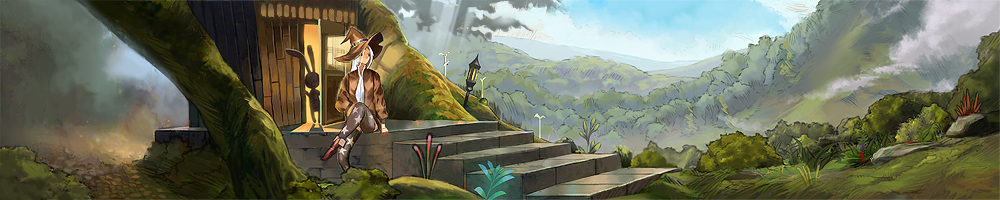


 After watching Kaleido Star and Strange Dawn, you can pretty much consider me a fan of Sato Junichi, the guy who directed them. Umi Monogatari is his latest work; it’s nowhere near his best, however it still is a very solid series: focused, emotional and powerful. This series demonstrates that even with a simple story and clichéd setting you can do a lot of nice things.
What impressed me the most about this series is that it has so many ingredients that anime has become infamous for, and it makes them work. It has a big-boobed hot chick in a swimsuit as a main character, alongside her is her younger sister, also in swimsuit. We have this evil power that brainwashes everyone, there’s an angsty love triangle subplot, people getting into fights over the smallest misunderstanding and let’s not forget the animal sidekick.
There is really a LOT of angst and drama in this series. Usually in anime, this means a lot of cheese, but here the creators manage to make a very emotional series while avoiding getting ludicrous or melodramatic by keeping the characters genuine. Especially Marin and Kanon are a couple of very likable character. They’re well fleshed out and avoid being stereotypes. Especially Marin cries a lot, but for once you feel that it’s part of her character, rather than having her cry for the sake of melodrama.
While a cheesy mahou shoujo at first sight, Umi Monogatari at heart is a story about adolescence: a tale of growing up, expanding your horizons, getting into fights and trying to make up again, which never is easy. It’s also about discrimination and misunderstandings, and it has a lot of meaning put into the emotions of the different characters.
Granted though, the plot is very simple; if you’re not into the characters, or like a fast-paced plot in which a lot of stuff happens at the same time, you’re not going to like this series. Umi Monogatari is more like one of those series that takes its time in subtly developing its characters. Still, that final episode really has been the best ending I’ve seen so far in this season, and has a good chance of being among the best endings of the shows that ended during the Spring and Summer Season, even though I usually dislike those sorts of endings.
After watching Kaleido Star and Strange Dawn, you can pretty much consider me a fan of Sato Junichi, the guy who directed them. Umi Monogatari is his latest work; it’s nowhere near his best, however it still is a very solid series: focused, emotional and powerful. This series demonstrates that even with a simple story and clichéd setting you can do a lot of nice things.
What impressed me the most about this series is that it has so many ingredients that anime has become infamous for, and it makes them work. It has a big-boobed hot chick in a swimsuit as a main character, alongside her is her younger sister, also in swimsuit. We have this evil power that brainwashes everyone, there’s an angsty love triangle subplot, people getting into fights over the smallest misunderstanding and let’s not forget the animal sidekick.
There is really a LOT of angst and drama in this series. Usually in anime, this means a lot of cheese, but here the creators manage to make a very emotional series while avoiding getting ludicrous or melodramatic by keeping the characters genuine. Especially Marin and Kanon are a couple of very likable character. They’re well fleshed out and avoid being stereotypes. Especially Marin cries a lot, but for once you feel that it’s part of her character, rather than having her cry for the sake of melodrama.
While a cheesy mahou shoujo at first sight, Umi Monogatari at heart is a story about adolescence: a tale of growing up, expanding your horizons, getting into fights and trying to make up again, which never is easy. It’s also about discrimination and misunderstandings, and it has a lot of meaning put into the emotions of the different characters.
Granted though, the plot is very simple; if you’re not into the characters, or like a fast-paced plot in which a lot of stuff happens at the same time, you’re not going to like this series. Umi Monogatari is more like one of those series that takes its time in subtly developing its characters. Still, that final episode really has been the best ending I’ve seen so far in this season, and has a good chance of being among the best endings of the shows that ended during the Spring and Summer Season, even though I usually dislike those sorts of endings.
| Storytelling: | 8/10 |
| Characters: | 9/10 |
| Production-Values: | 8/10 |
| Setting: | 8/10 |


 Well, this is going to be my hardest review to write this season: explaining why the heck I considered Shangri-La among my favourites for the past half year. Even though there is a lot to dislike this series for, it’s really a series that proves to be very solid entertainment for those willing to suspend their disbelief.
I think it’s best explained as follows: imagine a series with a straightforward story, a simple and small cast and a slow pacing. Now imagine a series with a huge setting, a large and diverse cast of characters who all have their own motives and stance, a multi-layered story with a fast pacing that delivers buckets of plot twists each episode. Now, which of these two is likely to have more plotholes? And which one is probably going to be more exciting?
That’s basically the thing with Shangri-La. Granted, throughout the series Kuniko does a number of things that are rather hard to suspend your disbelief at (including breaking the laws of physics), and plotholes are also pretty common for those who pay attention. But at the same time, it had just about everything I look for in an anime.
The concept of Carbon Trading might seem weird at first, but it’s a pretty neat idea for this series to work with, and the setting that this series built around this concept is rich and imaginative. There are lots of different parties with all different priorities, morals and values, and the same goes for the cast: there are a lot of characters, and yet there are hardly two characters with the same outlook on life: everyone feels like an individual, and is interesting to watch and develop. My personal favourite was Karin, who gets the most development in this series.
My favourite part of this series was the plot, though. Throughout the majority of the series, you’re never going to know what to expect. Especially a good portion of the middle part of this series is features an truly excellent mystery plot, in which every revelation only makes the setting even more intriguing than it already was. Every character has so his or her own secrets, that together form a multi-layered storyline that just keeps delivering.
Unfortunately, this series plays the “lazy”-card right at its ending, which is without a doubt rushed. I’m not sure why there are only 24 episodes for this series because it definitely could have used two more episodes to wrap up the story better. The story right now just wants a happy ending a little too badly, even though it has to use lots of deus ex machina to get there. A shame.
The visuals for this series are an interesting beast. They range from rushed to absolutely gorgeous. Especially the first couple of episodes suffer from a collection of rushed shots and drawings, but at the same time some episodes feature the single most visually pleasing shots that I have seen for the past half year. The animation also picks itself up very nicely in the second half, and delivers some really good use of CG and shading to make this a very aesthetically pleasing series. The soundtrack of this series is also among my three favourite soundtracks of the past half year (with the other two belonging to Phantom and the Guin Saga).
So yes, you’re going to have to bring a cup of suspense of disbelief when you want to watch this series, and if you’re not trying to turn over every stone in search of a flaw you’ll be rewarded by a great story with a great setting that always manages to bring something new to the table, instead of dragging at the same point over and over. It’s a fun and diverse series, but I can understand why many hate the plotholes with passion.
Well, this is going to be my hardest review to write this season: explaining why the heck I considered Shangri-La among my favourites for the past half year. Even though there is a lot to dislike this series for, it’s really a series that proves to be very solid entertainment for those willing to suspend their disbelief.
I think it’s best explained as follows: imagine a series with a straightforward story, a simple and small cast and a slow pacing. Now imagine a series with a huge setting, a large and diverse cast of characters who all have their own motives and stance, a multi-layered story with a fast pacing that delivers buckets of plot twists each episode. Now, which of these two is likely to have more plotholes? And which one is probably going to be more exciting?
That’s basically the thing with Shangri-La. Granted, throughout the series Kuniko does a number of things that are rather hard to suspend your disbelief at (including breaking the laws of physics), and plotholes are also pretty common for those who pay attention. But at the same time, it had just about everything I look for in an anime.
The concept of Carbon Trading might seem weird at first, but it’s a pretty neat idea for this series to work with, and the setting that this series built around this concept is rich and imaginative. There are lots of different parties with all different priorities, morals and values, and the same goes for the cast: there are a lot of characters, and yet there are hardly two characters with the same outlook on life: everyone feels like an individual, and is interesting to watch and develop. My personal favourite was Karin, who gets the most development in this series.
My favourite part of this series was the plot, though. Throughout the majority of the series, you’re never going to know what to expect. Especially a good portion of the middle part of this series is features an truly excellent mystery plot, in which every revelation only makes the setting even more intriguing than it already was. Every character has so his or her own secrets, that together form a multi-layered storyline that just keeps delivering.
Unfortunately, this series plays the “lazy”-card right at its ending, which is without a doubt rushed. I’m not sure why there are only 24 episodes for this series because it definitely could have used two more episodes to wrap up the story better. The story right now just wants a happy ending a little too badly, even though it has to use lots of deus ex machina to get there. A shame.
The visuals for this series are an interesting beast. They range from rushed to absolutely gorgeous. Especially the first couple of episodes suffer from a collection of rushed shots and drawings, but at the same time some episodes feature the single most visually pleasing shots that I have seen for the past half year. The animation also picks itself up very nicely in the second half, and delivers some really good use of CG and shading to make this a very aesthetically pleasing series. The soundtrack of this series is also among my three favourite soundtracks of the past half year (with the other two belonging to Phantom and the Guin Saga).
So yes, you’re going to have to bring a cup of suspense of disbelief when you want to watch this series, and if you’re not trying to turn over every stone in search of a flaw you’ll be rewarded by a great story with a great setting that always manages to bring something new to the table, instead of dragging at the same point over and over. It’s a fun and diverse series, but I can understand why many hate the plotholes with passion.


 After watching the new Mazinger, and realizing how well it was written I started to wonder whether the director,

 Well, so that’s it for this season.

 Well, I’ve made up my mind. I just finished episode 150 of Gintama, and it was indeed awesome. The perfect way to close off the series, no matter where you are in the series. Still, with this I’m going to drop this series. It’s the same with Ranma 1/2: I’d rather remember the classic first part, rather than stick with it for a few good episodes in a sea of mediocrity, especially since the good episodes don’t even come close to the standards that the series set in the past. But this review isn’t about the three digit episodes of Gintama, you can read about those

 At the start of this year I wasn’t exactly the biggest fan of romance, but damn. 2009 has surely proved to be an excellent year for this genre. The year already started out with gems as Clannad’s After Story and Genji Monogatari, then it continued with the truly excellent Ristorante Paradiso and Cross Game, and if that wasn’t enough the Summer season only continued this trend of awesomeness with Spice and Wolf II and, of course, Aoi Hana.
At first sight, Aoi Hana may seem like your average lesbian series with lots of girls who cheesily fall in love with each other, but this series quickly proves those suspicions wrong when it subverts just about every cliché in the romance genre imaginable. FOR ONCE, romantic relationships are portrayed realistically, rather than those overly romanticized relationship you see in most average romances. For once, you see childhood friends who really behave like childhood friends, rather than the creators using the childhood friendship as a cheap plot device to get the lead couple in love with each other. For once, the two lead characters don’t end up falling in love with each other, and instead the main romance plays out between one of the lead character, and a side-character. And really: for once in a gay show we see actual straight romances. In fact, there’s only one lesbian in the entire series (Fumi, one of the lead characters). The rest is either straight or bi.
On top of that, this series is incredibly well told. there’s a huge amount of subtlety within the relationship of the most important characters in this series: the way they behave, feel and interact with each other is really done with a superb attention to detail. The series is only eleven episodes long, and yet the personality of each character can’t just be explained in one sentence. There’s absolutely nothing that’s shallow in this series.
The animation for this series also really stands out among the best in the romance genre. It’s very subtle, and portrays very accurately how all of the different characters move. But it’s especially the scenes in which people are touching each other, whether holding hands or messing with each other’s hair, in which the animation really makes those movements feel so incredibly real.
I feel hard-pressed to pick up any flaws for this series. Obviously, you don’t want to watch this series if you dislike a slow-paced series, but it really is a must-watch for any fan of the shoujo-ai genre in the way that it so realistically portrays lesbian relationships. There are a few scenes here and there that could have used a bit more build-up (like Kyouko’s fiancee, or the ending), but those moments are few and far in between. Aoi Hana really is one of my top picks of the past Summer Season.
At the start of this year I wasn’t exactly the biggest fan of romance, but damn. 2009 has surely proved to be an excellent year for this genre. The year already started out with gems as Clannad’s After Story and Genji Monogatari, then it continued with the truly excellent Ristorante Paradiso and Cross Game, and if that wasn’t enough the Summer season only continued this trend of awesomeness with Spice and Wolf II and, of course, Aoi Hana.
At first sight, Aoi Hana may seem like your average lesbian series with lots of girls who cheesily fall in love with each other, but this series quickly proves those suspicions wrong when it subverts just about every cliché in the romance genre imaginable. FOR ONCE, romantic relationships are portrayed realistically, rather than those overly romanticized relationship you see in most average romances. For once, you see childhood friends who really behave like childhood friends, rather than the creators using the childhood friendship as a cheap plot device to get the lead couple in love with each other. For once, the two lead characters don’t end up falling in love with each other, and instead the main romance plays out between one of the lead character, and a side-character. And really: for once in a gay show we see actual straight romances. In fact, there’s only one lesbian in the entire series (Fumi, one of the lead characters). The rest is either straight or bi.
On top of that, this series is incredibly well told. there’s a huge amount of subtlety within the relationship of the most important characters in this series: the way they behave, feel and interact with each other is really done with a superb attention to detail. The series is only eleven episodes long, and yet the personality of each character can’t just be explained in one sentence. There’s absolutely nothing that’s shallow in this series.
The animation for this series also really stands out among the best in the romance genre. It’s very subtle, and portrays very accurately how all of the different characters move. But it’s especially the scenes in which people are touching each other, whether holding hands or messing with each other’s hair, in which the animation really makes those movements feel so incredibly real.
I feel hard-pressed to pick up any flaws for this series. Obviously, you don’t want to watch this series if you dislike a slow-paced series, but it really is a must-watch for any fan of the shoujo-ai genre in the way that it so realistically portrays lesbian relationships. There are a few scenes here and there that could have used a bit more build-up (like Kyouko’s fiancee, or the ending), but those moments are few and far in between. Aoi Hana really is one of my top picks of the past Summer Season.


 For those who were confused: the Jungle Emperor Leo remake is not a full fledged TV-series of 80 episodes. It’s a TV-special celebrating the 80th birthday of Osamu Tezuka. It’s about one hour and 45 minutes long, and directed by the director of Code Geass of all people. Still, while this show has its flaws it still serves as a very nice family movie that perfectly captures the childish side of Osamu Tezuka, and yet isn’t afraid to become dark and serious.
Jungle Emperor Leo is an environmentalist anime, and with these kinds of stories there always are plenty of obvious pitfalls. A lot of environmentalist stories lack any sort of subtlety, and often contain entire monologues on the creators’ morals. Yes, we get that the earth is in danger. We get that man is evil. Now stop shoving it down our throats!
Typical of Osamu Tezuka, the basic premise of this special is overly idealistic: humans are evil and make animals suffer. However, it brings a lot of twists to the table, and I mean a lot. This isn’t just a matter in which some character you thought to be evil turn out to be good and vice versa, but there’s a very imaginative back-story behind everything that really makes you think about where humanity is going with the pollution of the earth. It criticizes modern technology, but at the same time it also pays homage to it. The main villain, while he’s obviously got a very sick and twisted mind, isn’t pure evil either: if it wasn’t for his actions, the animals would have been even worse off, and his feelings for his son give a surprising human touch to him.
In the lead are two young children: a young lion and a young boy. These two form the back-bone of this special, and while they’re not the most interesting characters, they do their job of keeping the series going without getting boring because the creators put a lot of time in fleshing the two of them out. They’re both charming, yet flawed characters that are nice to watch if you can accept the fact that they’re a couple of little kids and that the boy can talk to animals for no apparent reason. The majority of the rest of the cast also has well backed-up reasons for their actions, which is always a nice thing.
Unfortunately though, the ending is pretty cheesy, and nullifies a lot of development that went into the setting. It’s too idealistic and solves things way too easily. Plus, it’s got this thing in which small animals are able to win fights with fully grown animals… which is pretty lame no matter how you look at it. This special really tries, but in the end it can’t fully shake its stereotypical nature.
This anime reminds me a lot of Miyori no Mori: both involve kids who somehow can talk to beings they’re not supposed to see, and protect them from evil humans. In the end, I like Miyori no Mori better because even though it too was idealistic, it feels more complete and heart-warming, plus it showed a more realistic portrayal of its lead character. Nevertheless, Jungle Emperor Leo really served its job as a homage to Osamu Tezuka, and the creators stuffed a lot of nice elements in it.
For those who were confused: the Jungle Emperor Leo remake is not a full fledged TV-series of 80 episodes. It’s a TV-special celebrating the 80th birthday of Osamu Tezuka. It’s about one hour and 45 minutes long, and directed by the director of Code Geass of all people. Still, while this show has its flaws it still serves as a very nice family movie that perfectly captures the childish side of Osamu Tezuka, and yet isn’t afraid to become dark and serious.
Jungle Emperor Leo is an environmentalist anime, and with these kinds of stories there always are plenty of obvious pitfalls. A lot of environmentalist stories lack any sort of subtlety, and often contain entire monologues on the creators’ morals. Yes, we get that the earth is in danger. We get that man is evil. Now stop shoving it down our throats!
Typical of Osamu Tezuka, the basic premise of this special is overly idealistic: humans are evil and make animals suffer. However, it brings a lot of twists to the table, and I mean a lot. This isn’t just a matter in which some character you thought to be evil turn out to be good and vice versa, but there’s a very imaginative back-story behind everything that really makes you think about where humanity is going with the pollution of the earth. It criticizes modern technology, but at the same time it also pays homage to it. The main villain, while he’s obviously got a very sick and twisted mind, isn’t pure evil either: if it wasn’t for his actions, the animals would have been even worse off, and his feelings for his son give a surprising human touch to him.
In the lead are two young children: a young lion and a young boy. These two form the back-bone of this special, and while they’re not the most interesting characters, they do their job of keeping the series going without getting boring because the creators put a lot of time in fleshing the two of them out. They’re both charming, yet flawed characters that are nice to watch if you can accept the fact that they’re a couple of little kids and that the boy can talk to animals for no apparent reason. The majority of the rest of the cast also has well backed-up reasons for their actions, which is always a nice thing.
Unfortunately though, the ending is pretty cheesy, and nullifies a lot of development that went into the setting. It’s too idealistic and solves things way too easily. Plus, it’s got this thing in which small animals are able to win fights with fully grown animals… which is pretty lame no matter how you look at it. This special really tries, but in the end it can’t fully shake its stereotypical nature.
This anime reminds me a lot of Miyori no Mori: both involve kids who somehow can talk to beings they’re not supposed to see, and protect them from evil humans. In the end, I like Miyori no Mori better because even though it too was idealistic, it feels more complete and heart-warming, plus it showed a more realistic portrayal of its lead character. Nevertheless, Jungle Emperor Leo really served its job as a homage to Osamu Tezuka, and the creators stuffed a lot of nice elements in it.


 Okay, so apparently Urban Legend Story Hikiko was an OVA, released about a year ago. It’s a fully CG-Rendered movie done by some guy who also seems to have worked on Catblue Dynamite. Since I’m always in for a bit of good horror, especially since the past spring and summer season didn’t have any of it, I decided to give it a shot. So, did this movie do its job and give me a good scare?
Well, it did give me a good laugh…
This OVA is THE example of why 3D-rendered movies have a looong way to go at this point. While in theory, it seems like a logical thing to do: you can get smoother animation, there is more detail, you can get a more dynamic background and a more realistic set of character-designs than the drawings of traditional anime. It sounds all nice in theory… but this movie just looked so incredibly fake.
It’s a shame, though: this OVA does have a very neat story: there’s plenty of build-up, a deep main character, a nice set of plot twists. In traditional 2D animation, it would have been a pretty good horror OVA. The big problem however is that the characters’ expressions and motions look incredibly unrealistic. So unrealistic that they’re nearly impossible to take seriously. This may be because I’ve been too much used to anime, but even though there’s plenty of animation in this, but all the animation feels jerky, and especially the facial expressions of the characters look nowhere near accurate and more like a bunch of puppets.
There’s a saying in art that goes as follows: “if you can’t make it, fake it”, and 2D anime has become very good at this. It knows that its artwork is very detailed for animation standards, and that there’s no way to continuously animate everything in drawings, and so over the years they’ve perfected the art in simulating movement even though there isn’t any. As long as it doesn’t stand out as “fake” or “too much” in any way, these cinematic effects really work.
3D animation has yet to discover these techniques, and instead just try to… animate. The thing is, that unless you’ve got the budget of a small country or the imagination of Hayao Miyazaki, there is no way to perfectly emulate every subtle nuance in human movement, and this movie especially fails at it. The few attempts it makes to make up for the lack of movement are some of the most pathetic cinematic techniques all around, like a couple of cheap but loud sound effects during the intense part, and lots of shaking the camera around while looking at the characters with extremely scared faces.
The thing that 3D animation is going to have to learn is the art of cutting corners. American 2D-animation does this by extremely simplified drawings, Japanese animation does this by trying to limit the number of frames that need to be animated. At this moment, there’s nothing wrong with the artwork: show any still frame in this movie, and it looks gorgeous. Combine them… and they don’t.
Okay, so apparently Urban Legend Story Hikiko was an OVA, released about a year ago. It’s a fully CG-Rendered movie done by some guy who also seems to have worked on Catblue Dynamite. Since I’m always in for a bit of good horror, especially since the past spring and summer season didn’t have any of it, I decided to give it a shot. So, did this movie do its job and give me a good scare?
Well, it did give me a good laugh…
This OVA is THE example of why 3D-rendered movies have a looong way to go at this point. While in theory, it seems like a logical thing to do: you can get smoother animation, there is more detail, you can get a more dynamic background and a more realistic set of character-designs than the drawings of traditional anime. It sounds all nice in theory… but this movie just looked so incredibly fake.
It’s a shame, though: this OVA does have a very neat story: there’s plenty of build-up, a deep main character, a nice set of plot twists. In traditional 2D animation, it would have been a pretty good horror OVA. The big problem however is that the characters’ expressions and motions look incredibly unrealistic. So unrealistic that they’re nearly impossible to take seriously. This may be because I’ve been too much used to anime, but even though there’s plenty of animation in this, but all the animation feels jerky, and especially the facial expressions of the characters look nowhere near accurate and more like a bunch of puppets.
There’s a saying in art that goes as follows: “if you can’t make it, fake it”, and 2D anime has become very good at this. It knows that its artwork is very detailed for animation standards, and that there’s no way to continuously animate everything in drawings, and so over the years they’ve perfected the art in simulating movement even though there isn’t any. As long as it doesn’t stand out as “fake” or “too much” in any way, these cinematic effects really work.
3D animation has yet to discover these techniques, and instead just try to… animate. The thing is, that unless you’ve got the budget of a small country or the imagination of Hayao Miyazaki, there is no way to perfectly emulate every subtle nuance in human movement, and this movie especially fails at it. The few attempts it makes to make up for the lack of movement are some of the most pathetic cinematic techniques all around, like a couple of cheap but loud sound effects during the intense part, and lots of shaking the camera around while looking at the characters with extremely scared faces.
The thing that 3D animation is going to have to learn is the art of cutting corners. American 2D-animation does this by extremely simplified drawings, Japanese animation does this by trying to limit the number of frames that need to be animated. At this moment, there’s nothing wrong with the artwork: show any still frame in this movie, and it looks gorgeous. Combine them… and they don’t.


 Sora wo Miageru Shoujo no Hitomi ni Utsuru Sekai, or Munto TV, was the biggest disappointment of the past Winter Season. Here the creators had a great chance to take a flawed OVA, and spread it across the airtime of a TV-series so that the setting and the characters could finally get the chance to be developed properly. So, what do they do? A bloody recap. Only the final three and a half episodes featured new material, which was way too little for a story of this caliber. Still, with a movie scheduled, it still could redeem itself. But yeah, I guess that you can all see by the rating for this review that it obviously didn’t.
Oh, the
Sora wo Miageru Shoujo no Hitomi ni Utsuru Sekai, or Munto TV, was the biggest disappointment of the past Winter Season. Here the creators had a great chance to take a flawed OVA, and spread it across the airtime of a TV-series so that the setting and the characters could finally get the chance to be developed properly. So, what do they do? A bloody recap. Only the final three and a half episodes featured new material, which was way too little for a story of this caliber. Still, with a movie scheduled, it still could redeem itself. But yeah, I guess that you can all see by the rating for this review that it obviously didn’t.
Oh, the 

 Okay, time for me to review another really obscure movie that I stumbled upon a few weeks ago. Chocchan’s story is an adaptation of an autobiographical story of a mother during the second World War. Unfortunately, the only version that I could find was a Finnish sub, of all things, so unless you happen to know Finnish or Japanese, don’t bother to ask where to get it. If however, you do get the chance to watch this movie and don’t mind a quiet and slow-paced story, then I really recommend it.
The thing with this movie is that it’s wonderfully down to earth. Even though it plays during the very dark World War II, it never forgets its main focus: the characters. A lot of horrible and depressing things happen throughout the movie, but it never attempts to do things over-theatrical. This is a movie full of subtle details in the characters’ developments.
It’s also one of the few movies I’ve seen to pull off some actual credible and believable character-development. It shows the life of the main characters, starting right from the moment she gets engaged until more than ten years later, when she bore her fourth child. there are numerous time-skips throughout the movie that also allow her children to be developed this way. Seriously, in anime it’s very rare to see a mother or parent with this much depth; let alone in a movie.
The downside to this movie is its music. Whereas the storytelling is full of subtlety, the music isn’t. The story is supposed to be subtle, but a lot of the most dramatic moments lose their touch when an incredibly loud set of violins thunder through the speakers, overpowering just about everything else. A soundtrack often does wonders in enriching a story, but this is one of those few anime that would have been better without any music at all.
Nevertheless, this series really succeeds in creating a cast of “real” and likable characters and does a really good job at showing the struggles of a mother during the second World War, not knowing whatever happened to her husband who was recruited by the army. It deals with heavy themes and struggles, and yet it’s well acted without crossing the borders into melodrama. Especially if you’re a fan of the World Masterpiece Theatre, you’re bound to like this little movie.
Okay, time for me to review another really obscure movie that I stumbled upon a few weeks ago. Chocchan’s story is an adaptation of an autobiographical story of a mother during the second World War. Unfortunately, the only version that I could find was a Finnish sub, of all things, so unless you happen to know Finnish or Japanese, don’t bother to ask where to get it. If however, you do get the chance to watch this movie and don’t mind a quiet and slow-paced story, then I really recommend it.
The thing with this movie is that it’s wonderfully down to earth. Even though it plays during the very dark World War II, it never forgets its main focus: the characters. A lot of horrible and depressing things happen throughout the movie, but it never attempts to do things over-theatrical. This is a movie full of subtle details in the characters’ developments.
It’s also one of the few movies I’ve seen to pull off some actual credible and believable character-development. It shows the life of the main characters, starting right from the moment she gets engaged until more than ten years later, when she bore her fourth child. there are numerous time-skips throughout the movie that also allow her children to be developed this way. Seriously, in anime it’s very rare to see a mother or parent with this much depth; let alone in a movie.
The downside to this movie is its music. Whereas the storytelling is full of subtlety, the music isn’t. The story is supposed to be subtle, but a lot of the most dramatic moments lose their touch when an incredibly loud set of violins thunder through the speakers, overpowering just about everything else. A soundtrack often does wonders in enriching a story, but this is one of those few anime that would have been better without any music at all.
Nevertheless, this series really succeeds in creating a cast of “real” and likable characters and does a really good job at showing the struggles of a mother during the second World War, not knowing whatever happened to her husband who was recruited by the army. It deals with heavy themes and struggles, and yet it’s well acted without crossing the borders into melodrama. Especially if you’re a fan of the World Masterpiece Theatre, you’re bound to like this little movie.