Kino’s Journey -The Beautiful World- – 05[Country of Liars -Waiting for You-]

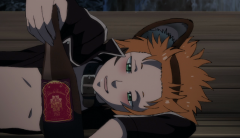
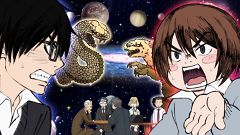
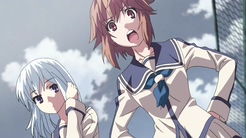
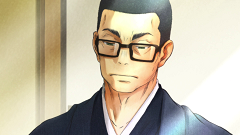
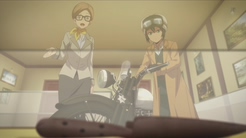
Now this is the Kino I remember. Somber stories that aren’t about Kino showing up and being cool but instead about people and fascinating food for thought. We have two stories this week which both include heroes. The first story involves Kino paying a visit to a museum in honor of a traveler who saved the country. It started off slow but it does present an interesting way of showing how people glorify idols and forget they are human as they are. The tour guide constantly dresses up everything this traveler did and owned as if it has some grand meaning while Kino and Hermes silently establish the cruder truth between each other. This is a bit too much of a segway but it reminds me a lot of how some talk of Evangelion and it’s creator Anno. I have seen people speak of Anno like he was some incredible mastermind who always knew what Evangelion would be right from the beginning and weaved an intricate canvas of direction and detail to make it what it is. In reality Evangelion was more lightning in a bottle that became what it was more due to a dwindling budget and Anno’s mental state at the time. But that is it, after the fact people dress up the accomplishment as some grand effort of genius which glorifies the moment of it’s conception. Sort of how some may dress up how they met there lover as some grand event when it could have been much more mundane in reality.

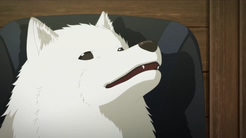
Thus enter the motorrad, a sentient being whose been propped up for display and the only other motorrad to be introduced aside from Hermes. Again the tour guide fashions up a grand story of the motorrad going silent perhaps in mourning of his previous master or having died with him. But the reality is that the motorrad is in pure display at being put up for display and denied the freedom of riding the lands as a motorrad should. The people have glorified the object as a memory of a great man but in doing so have denied that thing it’s very purpose. There was real emotion in seeing the bike pled Kino to take him out of there or destroy him, only to fall into despair again when Kino revealed that she could do neither of those things. This is the Kino I know, she listens to the stories of the people but never interferes. Instead letting things play out, regardless how they may turn out. Still she did at least throw a little hope the motorrads way by telling a boy to reveal his desire to travel to the bike, perhaps resulting in the boy starting to travel much in the same way Kino did.

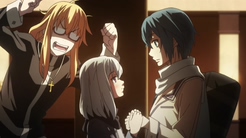
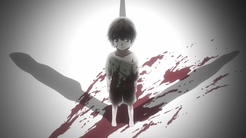
I liked the first half of this episode but it was the second half that truly stole the show. The story is of a country full of liars as this episode is named after but much like any other Kino story, the title is not quite what it appears. It is true that this country is full of people lying to each other but the intent is rather different from one might expect. This story flips the table many times and your opinion on the situation completely changes with it. We have a bitter story of a man waiting for his lover to come back to a story of a man gone mad after accidently killing his lover in a revolt against the country’s king, to the story of the lover returning to look after her now insane lover who no longer recognises her to an oddly heartwarming reveal of the man not being insane at all and choosing to pretend to be because he is happy with the situation and doesn’t wish to disrupt it.

It’s an odd situation where everyone is lying to each other and yet out of that everyone is still happy to continue lying because their life is better. It’s so conflicting that no one knows the truth and yet are content in the lives they live. In an old episode of Kino there was a situation where everyone could read each other’s minds and that tore society apart while this episode is almost a antithesis of that story. Where no one truly knows what the other person is thinking and hiding and yet are happier than those that know everything about everyone else. The hedgehog’s dilemma laments that people cannot get close to one another without hurting each other but if there is distance through deceit then can a more meaningful relationship be formed? Even if everyone is lying to you does that mean you will be unhappy? Ahhh…this kind of thought…I missed you Kino.
Juuni Taisen – 05 [A Wolf in Sheep’s Clothing]

Sorry for a slight delay of this post, as for the last few days I took a little break from anime to catch up with other stuffs. Turned out that instead of catching up, I ended up surfing the webs meaninglessly, shopping unnecessary stuffs online, sleeping way too early and still manage to feel tired and wrecked the next day. Very counterproductive I must admit. At this rate, I might get back to the project sooner than I think. Now back to Juuni Taisen, this week Juuni Taisen has one of its worst showing, with the pacing drags big time here. The plot progression is just an extension of what we already know or what we could have guessed. Monkey can’t seem to get through her peace message to Rabbit’s head (Surprise! Surpise!). Horse didn’t die the last time, but that raise a big head-scratching issue for me: Bull isn’t a guy to let his opponent escape that easily – I hope there is something else beneath it, otherwise it’s a very weak development for me. Rat’s experiencing a hard time escaping Zombie-headless Snake (why Zombie Boar can barely move, but Zombie Snake can run, sense the opponent’s movement, and approach Rat with a sound tactical attack?). In fact, this episode keeps stalling on forwarding the plot that the only plot progression we gain towards the end is that Sheep might team up with the Tiger (Tigress?)

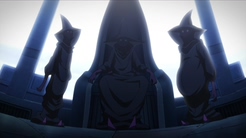
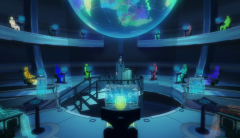
But we do learn some context about the Zodiac War. The big battle is watched by a group of faceless rich and powerful people, in a War-room inspired meeting room, to gamble and might possibly change the world based on who will win the battle. A proxy war so to speak, but the one that I don’t particular care for (come on. They’re faceless people here). But this reveal does sign us the direction Juuni Taisen might go in the future. Maybe this is what Chicken means by persuaying the warriors not to kill each other. Could it be that she wanted the Zodiac warriors to team up and destroy the Zodiac War system, once and for all? Anyways, it doesn’t make a dash of sense for me that they have to wait for 6 remaining warriors to bet. Isn’t it, like, defeat the whole purpose of horse betting? Apparently, Nisio wrote a spin-off story about this tournament from the point of view of one of these faceless people. Wonder who might it be? The… yellow faceless figure there? The figure… with woman voice? My guess is as good as anyone here.

As this is a Sheep’s episode, we have an extended flashback about him and we learn a bit of everything about his life. A weapon specialist, an experienced warrior, a former Zodiac War winner (which happened in a SPACE!!! Damn, I want one of those stories) and ultimately his happy life spent taking care of his grandson. Basically a skilled soldier who married into a family with great Zodiac tradition, it’s his normal family time spent that make him one of the most humane character of the cast right now. One other factor that makes his story stands out is that he has fulfilled a happy life, and now the only reason to join the battle is to protect his grandson. A solid reason, but unfortunately, not a refreshing one. If there is one warrior of this tournament is ready to die without any regrets left, it’s Sheep.

But that doesn’t mean he doesn’t put up a fight to survive. He was the one who ready to blow up everyone before Monkey intervened by breaking the floor. He was one of the few who didn’t swallow the poison. Now, he works his way through, chess-style, to figure out the favorites and the ones that he should team up. It’s fun to see the wise man reasoning and mapping out his plan, but when we have more information than him regarding who’d still on the battlefield, I can’t help but feel that the time spent for him serves very little purpose. And for a wise man who knows everyone’s, including his own, position, he makes a grave mistake of underestimating someone else. Rat and Tiger are considered the weakest warriors by Sheep, and as I considered Rat an underdog, with this episode I can confirm that Tiger will have something up her sleeves as well (and the fact that she’s the last third of the reverse Zodiac order helps significantly too. She can’t die before her arc comes, right?).

In the end, episode 5 of Juuni Taisen is the show’s weakest episode so far. The plot’s stalling at times, Sheep’s backstory isn’t that special, the battles feel unnecessary long and no one dies this week. Consider that the faceless VIP waits for half of the field is gone in order to bet, and the fact that the next episode will be half of the show’s run, I expect a multiple, (and hopefully brutal) deaths next week.

As of now,

Deaths: Snake, Boar, Dog, Chicken

Favorites to win: Monkey, Rabbit, Bull, Rat

Might remain within top 6: Tiger, Dragon, which means Horse and Sheep might leave the field next.

Fate/Apocrypha – 17[Traumerei]

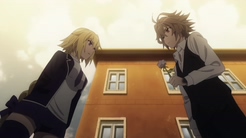
You know what? I think I have been been wrong about Joan in how I pair her and Sieg as the things dragging down this series. Joan isn’t all that bad, in fact she could be an interesting character if she just had someone who could get her out of her comfort zone. Yes, the problem isn’t Joan but rather Sieg is all to blame for this. He’s a shameless self insert character whose personal existential crisis is stereotypical and his general personality is just a void without emotion or any real character. He’s a Kirito or take your pick of any of the bargain bin light novel protagonists. Nothing quite exemplifies this more than this episode where “Insert your face here” goes out on a date which this series primary waifu bait. They try to excuse it as an attempt to draw out Jack the Ripper but the plan itself is rather flawed seeing as Jack really should know that Joan is a Ruler class and she also knows something is up with Sieg.

Anyway this date was a painful experience and truly out of line from what i expect from this franchise. True, the first series also features a date between Shirou and Saber but god dammit at least Shirou had character to work with. This episode was about Joan attempting to interact with a piece of wood! I swear I can see how much she seems to struggle with her role here as she attempts to get Sieg to say anything remotely interesting. As they montaged though the event of their “date” it was as though Sieg was some random background character in the images rather than the main protagonist. However I am thankful to A-1 for cutting out a part of the date that involved Sieg asking Joan about whether servants can get pregnant. That was certainly a conversation that I really don’t need to hear. Sadly A-1 also cut out a large part of the Jack fight which would have been really interesting to see and this seems to be a common thing with A-1. Ruining the characterisation and fights that were in the source material. The Apocrypha source material did start out really strong and while I have heard that the source does end up wasted potential, I feel it deserved better than this adaption. But well, C’est la vie.

THere is a nice parallel between Joan and Shirou here as both were killed but have different ways of looking at it. Shirou hated the people that killed him but tossed aside that hatred for the greater good. While Joan couldn’t even bring herself to hate those that killed her. Joan is a saint in every sense of the word and thus she is more deserving of the role to bring salvation to mankind. Can someone like Shirou, who harbors hatred in his heart and resorts to any means necessary to achieve his goals, truly bring humanity’s salvation? Honestly no, because he’s the villain and something’s got to be wrong with his plan. Otherwise we have the Shakugan No Shana final problem where the villains have a plan that’s great for everyone and the heroes only fight them because they are the villains. I remember feeling very confused that the show wanted me to cheer Shana on when by all accounts she was completely in the wrong.

So to clarify, the attack that Jack used on Joan was supposed to be an instant kill technique and was nullified by Joan’s attributes as a ruler. What was supposed to happen was Jack using children wielding knives to attack Joan so she could get away. This was important for two reasons, the idea of Jack giving knives to children and getting them to attack Joan is wonderfully dark. And this was the real reason that Atalanta joined in the fight as seeing Jack take advantage of children really pissed her off. We were also supposed to get Atalanta’s backstory which was to explain just why she has such a soft spot for children. The Apocrypha anime really is shafting a lot of the character development just to move the story forward and I think it would have been a better idea to remove Sieg’s presence entirely and use any screen time he took up to flesh out the cast. Jack and her Master also lost a lot of characterisation as there was a whole series of chapters detailing how Jack was summoned and how she killed her master and decided to be a servant to the hooker that was intended to be a human sacrifice. It’s a pity as I really do love the whole demented Mother/Daughter relationship that these two have. Seeing her master sacrifice herself to save Jack could have been a very good moment, in fact it was executed rather well. But it just didn’t have the screentime to justify it. We got the payoff with none of the buildup and so it just falls hollow.

Dies Irae – 03[The End of the Nightmare Is a Beginning]

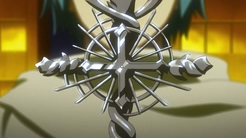
I believe we can safely declare this anime a trainwreck of an adaption. Truly proof that having an anime for animes sake isn’t going to turn out well, nor that following source material alone makes an classic. This anime was crowdfunded by the fans to get an animated version of Dies Irae. Well they got it. However they didn’t think that with such a meager sum that they would get a good Dies Irae anime. Thus we have an anime that makes no real effort to include the anime only watcher while proving to be an inferior experience for the source fan. Much like how Tsukihime fans declare that the Tsukihime adaption of 2003 “does not exist”, it looks that the adaption of Dies Irae is on track to be denied of its existence as well. The sad thing for me is that this was more or less expected, I would have been very surprised if they managed to pull off an adaption of the Visual Novel. Especially when said visual novel depends of the writer’s prose to enhance the events of the story. Masada Takashi’s writing can be overbearing and heavily chunni-tasic but it nonetheless gave the story character. Dies Irae on a surface level is very much a style over substance story and if you can’t sell the style of the narrative then it truly all falls flat on it’s face.

So if you are an anime only watcher who just so happens to want to continue with this(Not sure what you would) then allow me to clue you in on just what the hell is going on. For the anime took the liberty of cutting out the scenes at the beginning of this episode which would have cleared things up. Why Kasumi killing people? Because Ren subconsciously made her a surrogate to the power he received from the Guillotine. And by subconsciously I mean he was manipulated by the vice commander of the Nazi’s to give her power so he would be pulled into this death game the Nazi’s are setting up. What the hell is a that swastika thing the priest was going on about? The nazi’s need to open these seals which have been placed around the city in order to summon their leader into the city. Swastika’s are unsealed either when a member of the nazi squad dies at the place or the seal is fed a certain number of human souls. Take note that in this world souls are essentially magical power. The more souls you absorb the more powerful you become, hence why they show the members of the Nazi group as a giant pile of red skulls sometimes.

So now Ren has taken his power back from Kasumi and now he’s in this game for real. The game is that he needs to kill all the members of the Obsidian round table before they can unseal all the swastika’s and summon their leader. Who will proceed to burn the world to hell should he ever descend. The opening scene of this anime pretty much spoiled how this will turn out for Ren but I suppose it was a given that the big bad would have to be fought. I really have to marvel at just how little this anime cares to clue it’s audience into what is even happening. We had several jarring scenes transitions such as the quick change from Kasumi and Ren to Mercurius and Marie or how abruptly they montage though the point which was to show Kasumi and Ren bonding right before everything goes south. To show how immensely Kasumi hates how Ren and Shirou keep her out of the loop and how she wishes she could at least help them with their problems instead of constantly getting pushed to the side. It’s part of her inherent destined tragic fate, one which each character in this story has. Kasumi is destined to forever be the bystander, to be oblivious and unable to help her dearest friends in their most dire time of need. That said, it doesn’t excuse her character being so dreadfully boring.

Kino’s Journey -The Beautiful World- – 04[Ship Country -On the Beach-]

I have noticed a degree of negativity with this brand new Kino series and true enough, so far it is proving underwhelming. Not bad, but it’s predecessor set a high bar to follow up on. But I believe it’s important to note that the problem here isn’t how the stories are adapted. Instead it’s what stories have been chosen to be adapted. So who have we to blame for choosing the stories? Surely the studio? Well nope, unfortunately the blame belongs to the readers. The stories chosen were picked out of the most popular voted stories in a poll run in 2015. Now things make a lot more sense to me, such as why the story choices are the ones where Kino plays a more active role. I understand that with the 20 volumes of Kino out that it’s hard to pick and choose which stories are worth adapting (Though in my opinion, it should be all of them.) but depending on a popularity poll tends to have mixed results. For what is popular does not equal quality. I don’t think there is any real problem which how the stories are being adapted as the first and third episodes were spot on adaption wise. Both colosseum and this episode suffered from the stories being too big to fit into one episode. Even then I don’t think the stories would have benefited from being elongated. I think we will still get some great episodes mixed in here, it’s just such a shame that more thoughtful stories are going get sidelined for stories that make Kino look cool.

Anyway for a change of pace it’s Shizu and RIko in the protagonist seat as they head to a country which is a floating ship on the sea. Society is split into two groups with the common folk below deck, malnourished and in poor living conditions while the leaders of the ship live above. The story is a bit rushed, in particular when it comes to the little girl who is now a part of Shizu’s crew. But I do like the moral of this particular story. Shizu sees the doomed society and unlike Kino with her no interference policy, decides to take up arms to save the people. In any other story his efforts would be rewarded and he would be touted as a hero. Not this one. The people he saved didn’t asked to be saved and don’t take kindly to some stranger telling them to live on land. Completely ignorant of their own poor status, they decide to board the ship once again ignoring the warning that in a few years the boat will sink, dooming them all. You can take it as an environmental lesson where in people ignore the damage to the world until it’s too late. You can take it as criticism of government where people depend on governments to do right by the people when governments only care for themselves. You can even take it as a lesson on how people will venomously refuse to acknowledge a problem until it’s staring them right in the face. Or even as satire that countries aren’t waiting around for some mysterious hero to come and solve all their problems. Or if we are to get really elaborate, the subtitle of this episode is also the name of a post-apocalyptic novel about a group of people waiting for the inevitable fallout of radiation from a World War to kill them which somewhat parallels the future these people will have to face.

The explanation for this whole situation is that a disease killed off all the adults on the ship country which only left the shi[s AI and the children on the boat. The AI managed but didn’t know how to care for the children, meanwhile the children grew up ignorant and didn’t know how to repair the ship. It does go a way of explaining their child’s dismissal of Shizu’s claims but acts more for an explanation on why the girl was excluded from the society. I found the last minutes of this episode to be rather forced as there wasn’t much build up for the giant escalation of the situation. Having the Tifana girl stab Shizu was certainly unexpected but I found the logic behind it to be rather extreme. Basically her interpreting Shizu telling her to go back to a ship that doesn’t want her as some claim that she is useless to him and thus is thrown away. This was a rather sudden development in the novels too and does feel like an excuse to get her to join Shizu’s merry crew. Thus the parts of this episode that dealt with the country’s situation was the most engaging but when the plot brought things to deal with this girl and Shizu, I found it far to typical for the likes of Kino’s narratives. The only real part I liked about these two was the small moment where they stop in the rain to listen to the drops hit Shizu’s coat. I reminds me of the old moments between Kino and Hermes where they talk of strange topics which bring a sense of wonder to the series.

Houseki no Kuni – 04 [Soul – Meat – Bone]

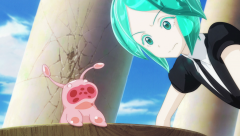
It’s incredible how much of a problem-prone Phos is, since almost every episode ends with Phos find themselves in deep shit.  If I go with the logic in Monogatari series it’s because Phos themselves attracts the attention from all kinds of trouble. Nothing much happened this week… is what the plot leads us to think. Underneath its surface, however, there’s a lot going on here. In truth, this episode is incredible. With this episode, they explore what I believe the core concepts of Houseki, and if the first dream sequence hasn’t signalled you clear enough, Houseki is rooted very deeply in Buddhism symbols and ideas. It’s funny to raise comparison between two shows I’m blogging this season: Houseki no Kuni and Girls’ Last Tour, but while this week Girls’ Last Tour explores the idea of God and religion, those themes are far removed from Houseki’s context despite being influenced heavily from Buddhism’s concepts. You see, Houseki is more interested in the separation/ independence between body, mind, and flesh and for me they really take core ideas of Buddhism to heart without relying on religious angle. Pretty awe-inspiring is what I say.

Let’s talk about this week’s title, because it’s important. Flesh, bone and soul. Three elements to form a human being. As the old tale from Ventricosus’s planet suggests, the fifth moon where the human used to live (AKA us) was destroyed, resulting in them split apart into 3 separate kinds of being: Gems, Admirabilis and Lunarians. One important thing to note is that those species are created in their most basic forms: Gems as their most basic elements – the bone, Snail is the one of the most basic type of lifeform – the flesh, and with the soul – symbolized by the religious images. Now that the character designs make so much sense and I’m in awe with the creativeness that the mangaka Haruko Ichikawa has thought up (bravo!). Then the idea that The Lunarians purposely fight off and kidnap the Gems and Admirabilis in order to become human again is seriously blow my mind. This division of beings also brings up one intriguing question: what is Kongo-sensei then? He’s obviously no Gems and based on how the Lunarians bow to him in his dream meditation, he could only be a human. So why does he help the Gems to fight off Lunarians here? My take for now is that he doesn’t want those beings reverse back to human form. Last week I had undermined Phos’ new ability of talking to snail as a silly quirk, but after this episode it’s clear to me that Phos holds the keys to open the that exploration between the three races.

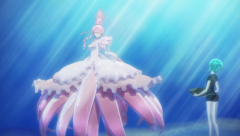
Heavy themes and ideas aside, this week I’m quite surprised myself that the show’s humors hit the marks very well. Those moments like Phos purposely mistranslates or the snail being all bibbidi-doo over Kongo-sensei, or Red Beryl as a costume designer? What a cool job she has. Talking about Ventricosus, just look at the amount of transformation she done this week. From being a giant snail who basically brainwashed, to a little snail with soul (funny how we can see the souls of those gems and snails but those who suppose to be “the Soul” – the Lunarians, are portrayed as soulless) and then transforms into a beautiful being who look not unlike the Gems with big boobs (sorry but it’s kinda important in Houseki). I suspect transformation (or even hybridisation) will serve as another main theme of Houseki going forward. The idea of transformation, again, is rooted in Buddhism’s concept as transformation centers around the concept of death (welp, I think I’m still doing alright here despite being a non-religion myself). With this episode alone, Houseki opens to more thematical deep, and I’m already impressed how original and symbolic Houseki continues to be. Turn out last week I was trying too hard to sell Houseki’s appeal because with this episode 4 I can confidently say that Houseki will become something special. Mark my words.

3-gatsu no Lion – 24 [Chaos/Kumakura]

Ask the average 3-gatsu fan who embodies the heart and soul of the show, and they’re likely to say Momo, the precocious preschool-aged sister in the Kawamoto trio. Another popular pick would be Hinata, whose sensitivity and unflagging support for Rei make her an invaluable member of the cast. Yet despite their big fanbase and importance in balancing the series’ tone, we hardly got a glimpse of them in the last episode, and they were nowhere to be found in this one. Though I haven’t read the manga, I’ve heard that Hinata will be the focus of a big arc in the near future, so I guess Umino-sensei is saving the ever-popular sisters for that moment. In the meantime, we got to reconnect with plenty of familiar faces in this episode, including Nikaidou, Smith, Gotou, and Kyouko. How nice to be reunited with friends!

I talked a lot last week about Yanagihara, who became one of the show’s most captivating characters practically overnight, and he cemented that feeling for me in “Chaos.” The man really commands a room, shutting down Rei and Nikaidou’s antics and forcing others to accommodate his need for space as the Meijin title match continues. Many other pros tolerate the eccentricities of their fellow shogi players, but Yanagihara puts the game above all else – including people, one suspects. Not even Gotou, whose imposing frame and viper’s tongue cause people to tread carefully around him, can phase the old master as he studies the Souya/Kumakura match. Still, there’s a chill in the air during their scene together, with mournful strings blaring in the background as they size each other up. Based on Rei’s dislike for Gotou (who is sleeping with his adopted sister), one might assume this tragic background track is meant to foreshadow a conflict between the prodigy and his most hated opponent. It seems to me, though, that Yanagihara and Gotou will be the ones sitting across the board from one another before too long. Their personalities and schools of thought are too different not to clash with shogi as a metaphor.

Contrary to my prediction about the Meijin match, Kumakura managed to take it to a seventh and final game. Given the way Souya checkmates him to protect his title, however, it’s safe to say there’s still a sizeable skill gap between the two. I was impressed by the way the show handled this scene: the match commentator and nearly every pro in the shogi hall couldn’t make sense of the move, but after thinking for a while, Kumakura gracefully admitted defeat, stunning nearly everyone. Apart from the two men engaged in combat, only Yanagihara realized it was mate in 17 moves, and only after playing it out did the truth become obvious to everyone else. 3-gatsu isn’t exactly a top-shelf psychological anime, but I’m always intrigued by the way it portrays its 9-dan players as existing on another plane of reality. Souya typically looks so fragile that a strong gust might blow him to pieces, but the wind in his world blows where he commands it. The show keeps giving us peeks into Shimada’s home, where the former challenger appears to be playing along with the current TV broadcast, never leaving his house or contacting anyone. If getting swept 4-0 can do this much damage to a man, how much anguish must Kumakura be experiencing, having tasted victory only to get blown back by Souya’s superhuman foresight?

Even with such a pivotal match taking place this early in the season, the highlight of this episode was what we learned about Gotou after he left the shogi hall. Rei’s biggest problem with the man isn’t just that he’s sleeping with Kyouko, but that he’s having an affair with her, and for anime-only fans, that fact has stained our perception of his character… until now. In a very tender hospital scene, the show reveals that his wife Misako is in a coma, and that the skincare products Kyouko bought for him were intended for her. Kyouko knows this, and asks if she ought to accompany him during his visit, but despite their continued intimacy, Gotou doesn’t want a lover’s comfort while visiting the woman he married. The show generates nothing for pity for these characters here, including Kyouko, whose feelings of loneliness and paternal abandonment drive her to show up at Gotou’s apartment later that night. She sweet-talks her way in, overriding his protests in a brief moment of levity, but the mood becomes sorrowful again as Kyouko observes his physical and emotional exhaustion. Forced to put her selfishness aside, she finds that she can’t get angry with him, which leaves her with only their shared pain to consider. This type of emotional gut punch is one of the things I love most about 3-gatsu, but deep down I’m waiting for the moment when Rei must contemplate his own pain and loss once again, since that’s what drew me to this show in the first place.

Girls’ Last Tour – 04 [Photograph – Temple]

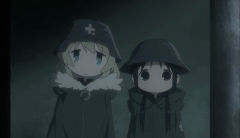
We have another solid entry of Girls’ Last Tour as this weeks the show focuses back to the dynamic duo with some light philosophical touch. In Girls’ Last Tour, they run around the idea that civilization is a foreign concept. Those girls are stripped away the existing knowledge of the past era, our girls can only rely on Chi-chan’s limited knowledge to figure out the world around them, and at large the very core of our civilization’s sophistication loses its meaning. Usually, Girls’ Last Tour addresses the meaning of high-concept terms (like “war”, “God” this week) through the eyes of our main duo. Due to the fact that those girls have little to no understanding about the concept of tradition, society and civilization, they explain those concepts based on their practical and logical reasons. “War” for example, is just a glorified term of “Conflict”. “Gods” that were once worshiped, likewise, are nothing more than stone statues and in that sense, “What is Cheese” is equal to “What is God” since those girls don’t understand the context of it.

Yuu struggles to comprehend why people put so much efforts for a fake paradise, in which Chi-chan argues, Pascal’s Wager style, that the belief is based not on an appeal to evidence that God exists, but rather that it is in their interests to believe in God and it is therefore rational for them to do so. Like the way Yuu freaks out when she is left alone in the dark. When she has no one else she can rely on, she holds on to her gun (such good metaphors here) and realizes the importance of Chi-chan’s company. The same can be said with the worshipers. For the unknown and terrified afterlife, believing in God they will receive a good reward in the other side of the world. A heaven paradise.

This episode also features the stone statues quite prominently. I guess that the higher the level Chi-chan and Yuu explore, the more modern and complex civilization they encounter. In this level, religion was keep popping as they go along since those stone statues represent worshiped gods. If you haven’t noticed, all the stone statues’ look to the left, only the one “God” who looks to the opposite side. I love such tiny bit of details like that. Also another tiny detail that blink and you miss is that the camera that Kanazawa gave them last week signifies the year they might live in:  year 3230. Talking about the camera, the first half we have the girls playing with their new toy: taking pictures as they move along. The girls then make a pointed comparison about the food will be all used up one day, but the pictures are there forever. When the world breaks down and there will be no more living person left, those pictures are still there, preserved by the moment it was taken. Chi-chan then has an idea to preserve that very moment: the two of them together. The moment they move slowly closer to each other is pretty intimate. The girls still have a rock-solid chemistry together. To answer all the philosophical, deep questions these girls find themselves into, Yuu nails it the most:

“What is Cheese – food”

“What is God – not food”

“Why do people live – food”

Dies Irae – 02[The Claws and Fangs of the Beast]

On the list of top ten worst ways to start an anime episode, I think that panty shots is quite high. Well if it means anything I at least appreciate that Ren didn’t flush up and start stammering, instead acting relatively normal about it. Unlike Kasumi who well reacted in the usual manner of resorting to kicking his teeth in. Like Ren said, you can’t blame the guy if you are the one that put it in his line of sight. So for all one or two of you that are actually still keeping up with this series I say this is the episode you drop. I can’t blame you honestly as this adaption is truly making me question whether the visual novel itself was all that great. It is truly a mark of a bad adaption if it causes you to think lesser of the source. I do remember the beginning of DIes Irae being slow but for visual novels this is usually par for the course. Think of any visual novel adaption and you will likely find it’s beginning to be rather slow paced. Believe it or not this is actually moving at a faster pace than the visual novel and for that I am glad. Truth be told i didn’t really start getting interested in DIes until after this little serial killer arc was done.

Fight animation is better than it was in episode zero but in comparison to fight animation we get today it’s quite lacking indeed. I do recall someone remarking that this anime reminds them of early 2000’s animation and not in a good way. Indeed that is the impression I get as well but part of what is contributing to that is Dies Irae’s obvious inspiration. The visual novel came out a couple years after Fate and many were still chasing Fate/Stay Night’s success and you can certainly see that. Though to be fair the plot actually mirrors another Type Moon work by the name of Tsukihime. The persist in this episode is obviously Kirei inspired and the general serial killer plotline is much like that of Tsukihimes beginning plotline, which also insinuated that the main protagonist may be unconsciously a serial killer.

It’s a pity that the anime skipped over the dialogues between Mercurius and Reinhart as those two really could supervillain monologue. Though the translators might have serious trouble when they start talking. They already appear to be having trouble as terms are mistranslated. For one they are called Lisa, Riza. Calling Valeria the priest of the grail instead of the Golden Vessel. But the biggest mistranslation here is calling the obsidian round table, the black round table. I hear that fans offered to give a terms guide to the translators at crunchyroll to help them stay consistent with the visual novel translation but seems they didn’t take that offer. I mean I can understand a level of apathy with this series but this is a matter of professionalism. If you are going to do the job then do it right. What could make this more of a problem is if the Simuldub of this series(Yes, Funimation is doing one.) goes off the Crunchyroll translations rather than the proper terms. Again though, I did understand if that level of consideration isn’t applied as the series itself isn’t going to do any real justice to it. Still I would like to be surprised and see this series improve as the true story begins.

3-gatsu no Lion – 23 [Setting Sun/Ramune]

When 3-gatsu no Lion first aired in the fall of 2016, there was a heated controversy among manga fans about the appropriateness of Shaft’s adaptation. The show was undeniably faithful to its parent material in terms of story, but its abstract visuals and quirky mood shifts gave it a different flavor than its predecessor. Although Umino-sensei personally requested that Shaft handle the TV series, the decision was met with resistance by part of her fanbase, some of whom swore off the anime completely. Happily, I approached 3-gatsu last year with no prior expectations to weigh me down, and it became one of my favorite series in recent memory, and a virtual lock for my top 10 list in a couple months. Despite my love for the work, I opted not to read the manga during the offseason (a self-imposed restriction I’ll be sure to lift one day), so these blog posts will be written without knowledge of future events. I also want to say a quick thank you to Mario, who has graciously allowed me to continue where his coverage of the story left off six months ago. Cheers, mate!

After the previous season concluded on such a hopeful note, I was curious about which version of Rei we’d get in this opening episode: sadsack Rei or social Rei. Despite his clear growth leading up to this point, 3-gatsu hasn’t been afraid to isolate its main character as he struggles to break free of his anxiety and depression. The show opted to continue where its hopeful season finale left off, though, so we got to spend a delightful half hour with a friendly, optimistic Rei. Seeing him in a teaching role within the new Shogi Science Club was really satisfying – some of the best teachers are driven to give to others the type of care they never received, which I sensed from him in this opening scene. His style of instruction was gentle, but occasionally urgent, as if knowing just when Noguchi (the mustachioed senpai of the club) needed a push to continue with his frustrating shogi training. I really enjoyed the back-and-forth between these two, since Noguchi is much more mature than Rei, but maintains a willing attitude as a student for the benefit of his new friend. Their relationship isn’t just a one-way street, either, with the elder boy walking Rei through the process of creating homemade ramune candy, which he eagerly brought back to the Kawamoto household to share with the girls.

The lack of screen time given to Akari, Hinata, and Momo was a little disappointing, but the majority of this cast is interesting enough to have entire episodes structed around them. This one cut between the club’s viewing of the Meijin title match, the match itself, and the private musings of two legendary figures, who I’ll talk about in a bit. The current Meijin, Souya, is an unstoppable force in the shogi world, but it’s his opponent who dominated their scenes together. We only got a glimpse of Kumakura Kengo last season, but we received much more than that here, as he positively devoured the sweets that were brought to him during the match. The peculiar shots of delicate cakes being crushed, all set to a heavy electric guitar riff, were about as Shaft-y as you can get in a scene featuring two adult men eating. This was the one spot where the show’s visual presentation was distracting for me, but it was certainly a memorable way to convey Kumakura’s strength and intensity. Stern-faced and looming in stature, Kumakura appears to present a difficult obstacle for the Meijin, but given Souya’s place as 3-gatsu’s “final boss,” I doubt he’ll struggle too long before putting away his challenger.

The first of the two legends I mentioned earlier is Jinguuji Takanori, the chairman of the Japan Shogi Association. We’re already familiar with the fun-loving, responsibility-shirking chairman from his multiple appearances in the previous season, but his character took on a different dimension in his conversations here. The man sitting across from him was Yanagihara Sakutarou, whose name I only found by Googling, since it wasn’t mentioned in the episode. I really appreciated that 3-gatsu went for naturalism during his first appearance, rather than putting a title card on screen to inform us of his name, date of birth, JSA rank, blood type, and favorite foods. From the dialogue between these two men, we learn that Yanagihara is set to face Souya in a future tournament, where even the reigning shogi champ will occupy the role of challenger. Yanagihara is nearing 60, but his wry sense of humor is very much intact; though he confesses to fearing the Meijin, his tone verges on disrespectful as he describes Souya’s talent. The chairman even labels his playstyle as “mocking,” an accusation which his friend protests only half-heartedly. Based on their playful, layered conversation, I’m already looking forward to the moment when Yanagihara steps into the ring to face his destined opponent.