Fate/Apocrypha – 21[Antares Snipe]

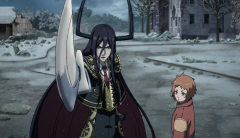
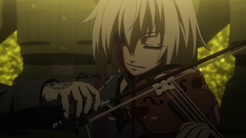
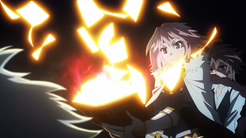
When Apocrypha slows down, it’s story shows it’s cracks. But when it’s an action showcase it actually becomes quite entertaining. The characters don’t have the time to be developed but they shine in combat when they clash, sometimes showing parts of themselves the series otherwise doesn’t allow for. Astolfo for one was actually useful for once and I found myself invested in his struggle to disarm the Hanging Gardens beam cannons. Part of the reason is because Astolfo isn’t acting his usual aloof self due to a new moon being out. As the legend goes, Astoflo’s sanity was taken by the moon and when a new moon is out he temporarily regains his sanity along with his noble phantasm.

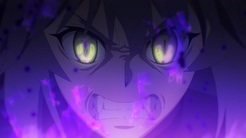
So instead of the fearless comic relief he has been throughout the series, he’s much more serious and even feels fear. This gives his fight to take out the gardens some rela weight and i was genuine tension in the scene. Well…it was also partly helped by Sieg running off to fight Karna. I don’t know what it is but that kid can suck the emotion and fun out of a scene in a instant. I was convinced that this was Astoflo’s last stand and that he was about to exit the war but he surprised me by surviving. It certainly was amusing to see Seramus also mistake him for a girl before getting dive bombed by Mordred.

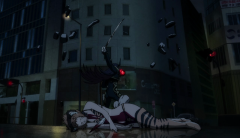
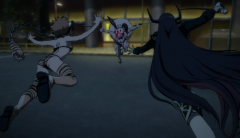
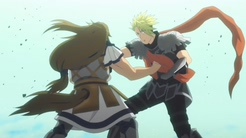
They follow this is what is by far the best fight scene Apocrypha has had yet and likely the best fight in the series as Achilles uses his noble Phantasm to stop time around the plane, making it that the only way Chiron and him can fight is through hand to hand combat.(Mortal Kombat if you will) I must say that was one fantastic fight scene seeing Chiron and Achillies beat the hell out of each other in the stopped time. Sure the animation and art could have been better but it still managed to make this one hell of an anime fight. Special mention to Chiron stomping on Achilies scarf to make him into his personal punching bag.

Alas Achilies comes out on top and Chiron exits the war, although Chiron manages to use his noble phantasm to remove Achilies protection by striking his heel. Chiron even manages to get Achilies to promise to hand over one of his noble phantasms to the black team and oddly enough the end credits sequence shows that he’s keeping to it, likely giving his chariot to Astolfo. This series has it’s ups and downs as well as not living up to the potential it truly had, but it’s episodes like this that make me glad I stuck with it. There is a few great moments in this series for a Fate fan and though it likely won’t be as highly regarded as other works, it’s still a worthwhile watch.
Dies Irae – 08[Promise]

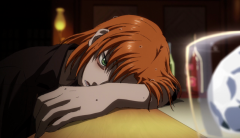
Netflix has funded thirty anime which will air in 2018 and this has brought concerns over whether Anime as a whole could be westernised in order to cater to an overseas demographic. I find the chances of this unlikely and the more likely result is a more diverse lineup of anime for both Japanese and overseas demographics. However if Anime was westernised then that could lead to the removal of excessive unnecessary fanservice in shows as they would not longer need to pander towards Otaku in an effort to gain more Blu-Ray sales. So why is it that I am starting off this post on the latest episode of Dies Irae with this information? Well one because this is another one of those nothing happened episodes(Which I need to think up a term for) wherein the plot barely moved forward and not a whole lot was present in this episode. The other reason however is because to fill up screen time during a long exposition scene, it was decided to show Marie stripling off and trying on different clothes. So I will state that if this mythical westernation of Anime were to happen, this is one aspect of anime I certainly wouldn’t miss. Of course my enemy isn’t so much the idea of fanservice but rather lazy fanservice. When fanservice is part of a series appeal then it is understandable why it’s present but what annoys me is when a series attempts to have its cake and eat it too and throws in fanservice without considering its effect on the story. It’s akin to having a benny hill sequence in Lord of the Rings, immersion breaking.

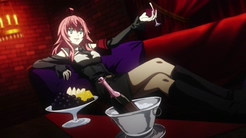
So let’s round up what happened in this episode. Kasumi was taken by Shirou and Ellie for her own protection, Ren calls them up and gets information on the Swastika’s locations, Ren and Marie visit School to find all the students mind controlled and Shirou and Eilie face off against Rusalka only to get devoured anticlimactically. We had two rather intrusive fanservice scenes in this episode, the first with Marie trying on clothes while Ren was two feet away from her and Rusalka making out with some guys before she goes and murders everyone in the room. I admit the second scene isn’t exactly out of character for Rusalka as she does tend to get around. IN fact at this point she’s pretty much slept with half the guys at Ren’s school. Still I always felt that Rusalka generally didn’t do this while on the job so to speak and i also originally thought that she couldn’t transform between her younger and older self. After all I thought the whole point of her downgrading herself into a lolita was to make her live longer as she is nearing the end of her lifespan. The fight scene wasn’t much to speak off, just Shirou and Ellie firing bullets while Rusalka shrugs them all off. If this was the last we saw of them then this would certainly be a disappointing end to the interesting characters of the protagonist side.

Regarding Marie i find her new personality to be immensely annoying. I wasn’t quite fond of it in the visual novel but in animated form I am forced to see just how incredibly pandering her character really is. This is likely the kind of person that otaku believe to be the perfect girlfriend…in theory. After all, she’s caring, cute and love you? Surely you don’t need her to be anything else. But of course this is in theory as in reality girls like Marie would be very boring and in the worst case scenario, annoying. Sort of like a child who grew out of the phase where everyone found them cute but still tries to act cute for attention, only for it to be very aggravating. Maybe if I could get invested in her love with Ren I might find her more interesting but the fact of the matter is that their relationship is shallow as a puddle. I don’t even understand at what point Marie fell for Ren as she’s only known him for a few days and there wasn’t really any point I could see her growing remotely interesting in him. Does this girl know anything about him at all? Of course I may be jumping the gun here as they haven’t confirmed that she’s in love with him but frankly it’s inevitable. With Shirou and Ellie, i get why these two are together, as they just work on the same wavelength but an easy girlfriend character like Marie, no matter how pretty she may be, just seems so…dull.

Juuni Taisen – 10 [A Tiger May Die, But It Leaves Its Skin]

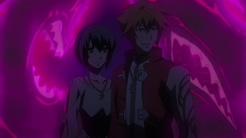
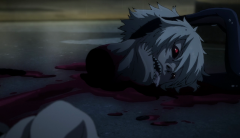
Juuni Taisen again expands a huge flashback in the middle of the current story, but this one hits all the right notes because naturally its heart is in the right place. It’s episode like this that I am glad I’m still sticking with Juuni Taisen and regain my faith to the overall quality of this show. Forget my slam on the representative of women warriors in Juuni Taisen few weeks ago, because with this episode, Tiger becomes one of my favorite character and the whole female cast is up there as the show’s best written characters (3 out of 4 if you ask me with Monkey, Tiger and Chicken are all spectacular, only Boar isn’t that developed but since she was out after the first episode, I can get behind that). Continued right the last episode left off, the long-awaited duel between Bull and Tiger is permanently interrupted by the Zombie Rabbit – a typical move from Nisio’s writing. Despite the fact that I can forgive the carelessness of both warriors, given they didn’t know that Rabbit was a necromantis (something we learned right at the first episode), hence aren’t prepared for his sneaky, underhanded attack; I still don’t get why Rabbit bites his tongue could activate his self-control zombie mode ability. Self-sacrifice by biting off his tongue? Listen, the main reason you die from biting your own tongue is due to the amount of blood loss (bleeding to death), so it doesn’t make any goddamn sense here, technically. Only reason I can come up is that Rabbit was a zombie from the very beginning (look at his red eyes and his unpredictably moves), but then why does he think it’s a good idea to get his body chopped off like this? He can’t regenerate his body, can he?

I must admit I wasn’t ready for another flashback of Tiger, and I certainly didn’t anticipate that flashback to be this poignant and bittersweet. Snake and Dragon’s 2 part-er, take note. This flashback not only builds from the previous one about Tiger who eventually lost herself to drinking and killing because of the mad world, but also adds another dimension to her character development, with charming dynamic between Bull and Tiger to boost. Like I mentioned last week, in many ways, Bull and Tiger share the same fighting styles, but not necessary the same mentality. Tiger kills enemy recklessly because she’s lost and suffering, so to see Bull killing them with a calm demeanour, she can’t help but think Bull knows exactly what he’s doing – a warrior who always does the right thing. When confront with that question himself, Bull comes up with an answer: first, you choose to do it, then do it (the way he demonstrates the idea is priceless by the way). The moral here is the intention. That encounter eventually leaves a big impact to Tiger that she finally has a goal in her life: to meet him again and get him to acknowledge her.

Life is always a little bit more beautiful when you have something to look forward to, so naturally seeing Tiger having her personal goal is already a joy to watch. And I won’t lie when I say I’m eager for her sobering up and doing everything in her power to get into the Zodiac Wars just to meet the person who changed her path of life. She saves Bull without even thinking – her very act of doing the right thing. This episode also sells me on the warm chemistry between Bull and Tiger as we can see the spark of their relationship not only from Tiger’s, but from Bull’s perspective as well. Bull is the man of action, which is to say he doesn’t talk much or think much because his resolve is always clear as the sky. Yet within his time spent with Tiger he talks the most, he isn’t willing to let her die because he has never been saved by anyone before, not knowing that it was the debt she’s repaying him. In addition, Bull never has any intention to kill Tiger as far as I concern, and that makes their final conclusion: he has to finish her off (as Tiger requested) before she turns into a zombie, the more bittersweet and heartbreaking. Bull finally acknowledges Tiger as a warrior just as she wished, and I as well acknowledge her for having such a compelling and moving character arc. The race is now a three-way battle between Bull, Bunny and Rat, and with Rat’s nowhere to be found it’s not a good sign. With only two episodes left, I expect Rat teaming up with Bull to kill an annoying zombie plague and maybe put my beloved Monkey into an eternal rest. At the same time, I am content with Juuni Taisen for now because we’ll always have Paris this episode to linger on.
Kino’s Journey -The Beautiful World- – 09[Various Countries]

I will likely be spending most of this post talking about one segment of this episode as just as the title suggests, these are a series of stories involving different countries. But before I get into that I must truly question why these particular stories were chosen. I have stated before that I love Kino for it’s introspective parables and how they make you think but today’s episode was mainly comedy for some reason. None of the stories are put together with any kind of cohesion and some I question the point of animating at all. For example, at one point this episode went from a serious dark story to complete slapstick at the drop of a hat as a story about a cooking country was introduced. A country gets Kino to cook something for them and it is revealed that Kino is a terrible cook whose meals are nearly fatal. My how hilarious, the cute girl who has confidence in cooking but all her cooking is lethal. That’s a joke so unique that I have only seen it a couple of hundred times. I mean i just finished playing through the third game in the Blazblue series(Story is still god awful but I made i this far for the gameplay) and that has this very same joke.

Why was this deemed animation worthy? It’s a story setup for a single joke that’s already been done to death, not to mention it doesn’t make much sense that Kino can’t cook. She can survive on her own and has fed others before, it’s makes no sense that she can’t cook The beginning segment is also equally pointless as it just sets up that Kino’s master has traumatised bandits enough to be very selective of who they attack. There are so many other stories that could make the cut, why this? For example, I know a short Kino story where she journeys to a land that is burning all the toys, magazines and playthings of the children on the grounds that without they will grow into pure and good adults. But whent hey let the kids ask Kino a question, one of the children asks her how to burn alive all the adults of the country. That’s the story, short but undeniable Kino. The moral may be a bit too blatant but I much prefer this to having a story about Ti hanging a wish on a statue.(Again, why choose to animate this?) The story about Kino visiting a country that she wasn’t allowed to remember is a good way of doing humor in this series as if provides a philosophical angle while entertaining a humorous one.

Not every story in Kino’s Journey is a gem which is to be expected considering it’s episodic nature but I feel there should have been far more scrutiny on choosing which stories get animated. I am fairly certain that three quarters of this episode didn’t need to be animated and could have been replaced with superior stories. There are just some odd choices going on here, such as having the author’s afterward in the credits of this episode. It gave the episode a weird finality which had me concerned whether this would only be a nine episode cour but luckily that appears to not be the case. Now onto my favorite part of the episode, a land where everything is awarded virtue points and doing good deeds gives you leeway in the country. This is a fascinating concept because the system has it’s ups and downs. Namely that it encourages people to perform good deeds but makes the act somewhat disingenuous as everyone is only after points rather than displaying genuine goodwill. But what makes this concept most interesting is that your virtue points can cancel out any wrongdoing that you commit. Under the grounds that it’s unfair for a man of many good deeds to be condemned because of one wrongdoing and a bad man being absolved due to one good deed. The man whom Kino talks to in this story had accomplished great deeds but he soon reveals that the only reason he did all of it was because he wanted to earn enough points to kill a single person.

Now I actually find the system genius for this as it appears that it takes a massive amount of points to cancel out murder and here a murderer spends his life performing good deeds for the sake of killing someone. And when he finally has what he needs, he’s old enough to see the folly of it and has no one he wishes to kill. This is absolute genius, for a evil man is made into a benefit for society and when the time comes when he can do evil, he no longer has the will to. But the big question of this story is do we judge a man by his character or do we judge him by what he has accomplished? For this man was evil but still accomplished great things worthy of respect. Does it matter if his motives for doing so where unsavory? I feel this message hits harder at the recent news of the author of Rurouni Kenshin, a well loved shounen series, was revealed to be a pedophile who had a large amount of child porngraphy. For now and forever that series will have the authors sin staining it but again the question remains. Can we respect that this man created a well loved franchise despite how rancid his character is? Do we judge a person in history by what he accomplished or by who he really was?

For there were many horrible people who accomplished great things that we benefit from even in this age. The Fate Franchise has built itself on taking the legends of people and building characters around them, characters which are likely nothing like their real life counterparts and yet to some like myself, have completely replaced their image. I wish that Alexander the great was like that of Rider from Fate/Zero but in truth he was likely a much worse person and I would not like him at all. So in truth is the form of immortality that is records is not truly a record of people, but rather of accomplishment? For what they people thought, felt and even who they truly were has been lost to the ravages of time. Cutting this off bluntly but I think this post is long enough, next episode appears to be another remake of an old story and again I feel like we could just get a new story instead of this. The kind land made for a great closing episode to the original series and having it be in the middle of the series like this is just odd.

Houseki no Kuni – 09 [Spring]

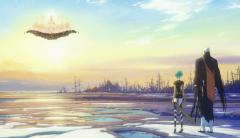
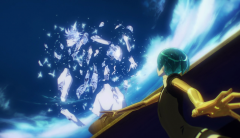
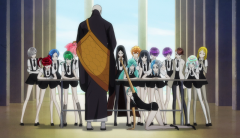
Houseki approaches summertime this episode and this week feels like a breather after the intensity from the last few weeks, by that I mean Phos didn’t get into any real trouble by the end of this week. Not to say this episode is anything less amazing compared to last several weeks. One of the factor that I still regarded Grimgar quite highly despite its shaky overall production is that they nailed the feeling of grief admirably, something that the anime medium usually glosses over too quickly. The loss of someone close/ dear to you usually leaves a lasting, permanent impact, so naturally I found myself tuning out whenever the main protagonist overcomes that loss just several episodes like nothing ever happen. Here in Houseki, the loss of Antarc still lingering over Phos, and although Phos doesn’t have any significant alteration in their physical body, this week marks a tremendous change in Phos’ personality. At the beginning of this episode, we see the more collected, no-nonsense Phos and they still mourn over the loss of Antarc, whom they feel their capture was entirely their fault. The nightmare/hallucination of Phos about Antarc, in particular, is a powerful and realistic moment about people gem who experienced post-traumatic stress disorder.

Back to spring, when all the gems wake up from hibernation with a new job, and new pairs of spring uniform. Phos receives unanimous popular for their new alloy arms, which can stretch, turn, attack and making a wall at will. The other gems, behave exactly like children who receive new toys, at first scare of Phos’ arms, but then the curiosity takes a better of them. With the old Phos, the sudden popularity and recognition from their peers are all they could ask for, but now that Phos actually has all the attention, they don’t know how to deal with it. “Not a single good thing has come from it”. This line nails perfectly how the current Phos feel. Phos is now strong at battle, can single-handed hold off the Lunarians’ attacks, just like what they wished right at the beginning of the series. But everything else is off. They still can’t fulfil what they promised to Cinnabar, they lost what they consider their best comrade. My favorite moment of this episode has to be when Phos cries their gold tears, in which Kongou sensei calmly responses “This is merely a defect found in ancient organism and nothing to fault yourself for”. Somehow this line really sums up Houseki’s eye-opening world flawlessly.

One thing I didn’t pick up on my last coverages is how the Lunarians have several different types attacking the Gems. I guess the different in types all depending on the Jewel materials they used to attack the Gems. My take is that the old, classic type is the type that has none of such material. Which comes to a fascinating scenario: Imagine how Phos would react when the Lunarians use Antarc’s fragments as their core materials. Granted, Antarc is fragile in nature so there is a low chance that would happen. One more interesting factor in this episode is how Phos slowly lost their memories as well. Not sure when they response to Rutile that they don’t remember Cinnabar is just a total scam or the truth, but with Phos slowly losing their memory (due to their loss of fragments), changing both in their personality and appearance, what’s left to the original Phos except their gorgeous Tomoko Kurosawa’s voice? Are they considered the same gem then? As this is the episode dedicated to the new personality of Phos, the background visual appropriately has more colourful setting with the yellow reflection from the sun. The visual motif changes as well, as previous episodes we often see Phos lying on the grass, this time though they’re standing on it, but still feel lost and directionless. The visual and the music is as dead on as ever. This might be a slow episode, but Houseki again successfully establishes Phos as a compelling protagonist, and I really hope in the last 3 episodes, we gonna have a powerful arc that close up this magnificent, unique anime in a satisfying manner.

Girls’ Last Tour – 09 [Life]

Leave it to Girls’ Last Tour to not only address the meaning of life in their lifeless world, but also what does life itself even mean. “What is life?”, that question is asked several times during the episode, and the girls can only come up with the most direct, simplest answer to this grand question. We are the life form, robot sure isn’t. Even us, the viewers, in this age and day, don’t even consider robot as a lifeform, do we? Since life is organic, including the capacity for growth, reproduction, functional activity, something that a mere robot doesn’t have. Girls’ Last Tour challenges that notion, as the show follows our girls into the one of the remaining fishery. The place is still automated functioned by a giant robot, and further inside is another robot who takes care of the last remaining fish in this fishery (if you noticed we’ve seen a lot of “last” in this series: the last flying airplane, the last potato few episodes back). The girls argue robots don’t have consciousness, yet their coding POV pretty much suggests that they process a consciousness of their own. The girls argue they can’t think on their own, yet in this episode they manage to do just that: talking to the girls, managing to keep on going even though the human race is gone. The girls argue that they don’t have feeling, yet they share a level of empathy that eventually touch them. Don’t those make the robot, then, a fully animated being?

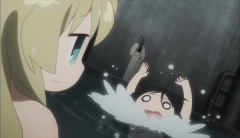
And in fact, the concept of life that the robot explains is far beyond the life-concept of human being. The living things, organic and non-organic being include, inside the world forms a wholly giant organism. That world used to be “alive”, but now all we see is the remains of this death world. One of the main takeaway from the girls about “life” at the end, is that “maybe “life” means something that has an end”. That takeaway again aligns so well with Girls’ Last Tour main theme’s and its outlook of life. Throughout this episode, Chi-chan experiences herself in a brink of death by nearly get drowned in the fish pool. The plot soon thickens as the big robot decides to demolish the building, meaning the little robot and the last living fish will be soon dying as well. As soon as the girls acknowledge that the robots have life, they have to end the life of the big robot in order to save other lives. Killing it so to speak. This sequence won’t be as affecting without the moment when the big robot looks back, right before the Chi-chan pulls the trigger. That moment is an acknowledgement about the life the big robot has, as well as the acceptance that eventually everything will have to die, so the best way to die is to live on and hang in there (to borrow the lines from Kino’s Journey few episodes back).

The sense of empathy is another theme Girls’ Last Tour successful raises this week. Just look at how Yuu changes her attitude towards the fish: at first, she just wanted to eat the goddamn fish, then she is allowed to feed the fish, later on when she knows the fish is in danger, she decides to step in to save it. Empathy also plays a significant role in small robot part, as it sounds and behaves the most humane out of anyone in the cast so far and to the big robot, as I can see the empathy level of the robot towards the girls: it knows Yuu tries to kill it yet it seems to understand the reason behind it and gives in. It’s when you are truly alive that you can feel empathy. Girls’ Last Tour, once again, says so much by showing so little, asks so much about the deeper meaning of life with its low-key yet sometimes ambiguous approach. Another real winner episode for me.

3-gatsu no Lion – 30 [Midday Moon/Adventurers]

Look at me, posting this review just hours after episode 30 showed up online! This must be the start of a new chapter in my blogging career, and my reward is a pretty good episode of 3-gatsu. I say “pretty good” rather than “great” because, as is often the case with this show, one of the manga chapters it covered was much better than the other. Thankfully, the team at Shaft seemed to recognize this, because they devoted a lot more time to Nikaidou’s story than to the dialogue between Rei and Hayashida-sensei. This is the second of these student-teacher chats that we’ve seen this season, and while they’re important for establishing Hayashida as a fatherly presence in Rei’s life, this one wasn’t as strong as the original. The close-ups, head tilts, and repetition of past jokes (countering “monster parents” with other monsters) were particularly distracting this week. Really, the only thing I gleaned from this scene was the way in which the Kawamotos’ father disappeared – he found a new girlfriend, abandoned his family, and started a new one somewhere else, just like that.

There’s more that could be said about “Midday Moon,” but the Kawamoto family wasn’t the real focus of this episode. That honor belongs to Nikaidou, who some 3-gatsu fans cite as their least favorite character due to his role as a loud, hotheaded rival character. If there were ever an episode capable of changing their minds, though, it would be this one, which explored his history as a shogi player, his struggle with chronic illness, and his fierce competitive mentality. Shimada is the perfect conductor for these flashbacks due to his status as Nikaidou’s shogi “brother” and his recent mentorship of Rei. Even more than his present relationship to their characters, however, his initial dislike of Nikaidou is what sells “Adventures” as a complete story. Shimada first dismisses him as a rich kid looking for kicks, resenting his wealth because of the poverty in which he himself grew up. But after perusing his semifinal match records, he realizes Nikaidou is an obsessive student of shogi, and that his sickness must have created the conditions where he’d be able to fully devote himself to the game.

Knowing this about Nikaidou, it’s easier than ever to draw a parallel between him and Kiriyama, his arch rival. Rei was essentially forced into shogi in both his biological and adoptive families, and continued to use it as an unhealthy mode of escape even after becoming independent. For both boys, the game functions as something of a curse, but it’s also a life preserver in an ocean of pain both psychological and, in Nikaidou’s case, physical. He can’t bear the thought of anyone going easy on him, because for him, shogi is the only contest in the world where he’s on a level playing field with everyone else. That’s why he begs Shimada not to tell Rei about his illness – not only does he want to avoid burdening his friend, but he also wants to maintain their rivalry as a means of personal growth. As I watched this scene, I remembered Kyouko’s past strategy of telling Rei about the strained family life of another shogi player, hoping to sabotage her stepbrother by generating sympathy for his opponent. The hurt that Rei experienced in childhood makes him scared of hurting others, so it seems Nikaidou was on the right track by concealing his condition from his best friend.

The question of whether Rei can still treat Nikaidou as a rival is left unresolved here. Shimada reveals that his opponent in the semifinals forced a second game after a threefold repetition, which has a direct equivalent in chess. In that game, such deadlocked board states are typically avoided, but can be intentionally pursued to manipulate the game clock, which appears to be what Nikaidou’s opponent had in mind. Whether he purposely took advantage of the boy’s poor health isn’t clear to us yet, but either way, Rei has an opportunity to avenge his friend in the finals. That match will function as a landmark moment in Rei’s shogi career, but Shimada is more interested in whether he can still be merciless Nikaidou, as his opponent was. And although Rei is determined to win his next match, he dodges Shimada’s question, which signals to me that he now sees Nikaidou in a totally different light. Even if the finals end in victory for Kiriyama, it’s going to take a lot more than a trophy and a promise of vengeance to bridge the gap that has formed between them.

Fate/Apocrypha – 20[Soar through the Sky]

We return to what I feel Apocrypha does best, action, and what an episode to kick off the final confrontation. We have the black team approaching the hanging Gardens of Babylon in a group of airplanes. This kicks off a fights between Atalanta and Joan, as well as Achilles and Chiron. This fight is great, thrilling and for once the animation and sound design don’t ruin it. It’s an explosive confrontation between these servants as they jump from plane to plane trying to take each other out. Quite frankly this is what I came to this show for, to see historical figures duke it out in the more over the top ways possible. Of course learning about these figures and seeing how they interact and are characterised is a personal draw in this franchise for me but it’s clear we won’t have time for that. Still I do lament its absence even if signs of deeper characterisation are present. For example, we know that Achilles cares a lot for Atalanta but as a matter of fact the reason for this is because Atalanta was his first crush. When he was trained, Chiron used to tell Achilles stories about Atalanta which caused Achilles to gain a schoolboy crush on her. His caring for her in this series is actually his leftover feelings from that period. Though this requires clarification as while I seen it mentioned, I cannot find anything referencing it. There is also the nice detail that Achilles deeply regretted killing an Amazon Queen during his life and because of that he swore to never unleash the power of his spear on a female opponent. I really do wish that little details like this were included and utilised in the anime. Likewise i can’t really find anything about Chiron having a degree of precognition but hey, Achilles never had a flying chariot and it makes the fight more interesting.

It’s nice to have a little Shakespeare and amusing as hell that Shirou knew that Shakespeare would prefer to write the ending of this story as a tragedy rather than allow a happy ending. In other words Shakespeare actually wants Shirou to fail cause the tragedy of it would be far more interesting. So why does Shirou have to force Shakespeare to not turn his recount of this story into a tragedy? That is because Shakespeare’s writings have power, in fact he can pick up a pebble off the ground and turn it into a E rank Noble Phantasm. He can create up to C rank noble Phantasms just by writing about the object. As such there is a very real possibility that what Shakespeare writes about Shirou’s plan could affect it and Shirou cannot take that chance. Thus like a forceful editor, he must order Shakespeare to not write such an ending. It’s funny that in a way Shakespeare could have saved the world from Shirou’s plan but only done so because it would be more interesting to him. I really do love his character and the way in which he manages to get Semiramis to reveal more of her character goes to show how much more of a boon he could have been to the story if he was given more screentime. Just having Shakespeare running around inquiring into the servants characters could have given so much development to them.

So time for Nasuverse 101. In the Nasuverse there is magecraft and there is true magic. Magecraft is the kind that mages in this series use and it is magic but it has it’s limitations. True magic on the other hand, has no limitations. Bring back the dead, time travel to the past, enter alternative dimensions, even achieve true immortality. These are the things possible for true magic. There are five known true Magic’s but for simplicity sake we shall only talk about the one that is relevant here, that being the third magic, Heaven’s Feel. Heaven’s Feel is materialisation of the soul, essentially removing the soul from the body and allowing it to interact with the real world. What this would accomplish would be to give a kind of immortality as souls would never die and live forever. In fact the manner in which servants are summoned into the real world is a kind of third magic. This magic is actually the main goal of the Holy Grail War for the Einzberns as well as Zoukens main goal. This is also the reason that the Holy Grail War can be alternatively called “Heaven’s Feel”, in case this wasn’t confusing enough. Thus in the after credits scene of this episode we have Shirou’s goal be to use third magic on all humanity, hereby making humanity immortal and rendering death obsolete. In truth this isn’t the best solution as while it may work in theory, i believe there are Nasu works in which humanity has obtained immortality and it lead to the problem of humanity stagnating. It’s unlikely that he will succeed giving the current narrative but I hope we see some good fights till then.

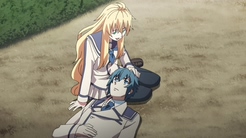
Dies Irae – 07[Swastika]

After the episode we had last time, it’s only fitting that this episode is more down to earth. Don’t want to burn out the staff animating action scenes like that every week. So this week we have our protagonist and antagonist sitting at a table to have a little chat. In that regard it’s nice to get to know Reinhard and his general demeanour of arrogance. But unlike Gilgamesh, he doesn’t belittle his opponents. Frankly Reinhard wants Ren to put up a fight, to push him to use his full power so that he can feel alive. For Reinhard is suffering from the same thing that Shirou is suffering from, a constant sense of deja vu.(Or foreknowledge if you prefer. People get huffy about them not being the same but the general rundown is people feeling like they have been through something before and thus it feels trivial and routine.) It’s amusing to see Reinhard have the complete upper hand and yet just give back Marie after Ren declares he will kill him. From this talk we learn a few things. That Reinhard is looking to remodel the world into something fulfilling to concur and he requires eight swastika’s to be released around the city. A city which was apparently constructed for the sole purpose of being sacrificed to Reinhard. And that Mercurius is the being who gave Reinhard the power and drive to do all of this.

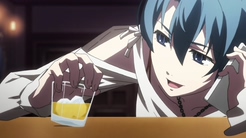
Now to address the line likely to have raised a few eyebrows which is where Rea asks Ren to either rape her or kill her. So first off you cannot ask someone to rape you, because asking them to do it is giving consent and it’s not rape if you consent to it. If he was assaulting you against your will, then it’s rape. Basically you are asking him to sleep with you, not rape you. Secondly, this out of nowhere request actually has some logic behind it, flimsy though it may be. Basically in order for Reinhard’s plans to succeed, Rea needs to be alive and a virgin. Though the second aspect, unknown to Rea, isn’t really needed. Now i will need to go on a tangent here to explain this scene better but let me begin by stating that it is a common misconception among the anime community to consider Visual Novels, eroge and Dating sims to be different words for the same thing. This is not the case as Dating Sims are more stat focused games about dating girls. Eroge stands for erotic game and pretty much stands for any game featuring erotic content. Visual novels can sometimes fall into this category though the level of erotic content varies between games. For example, DangonRonpa qualifies as a visual Novel but it isn’t a eroge. Whereas Huniepop qualifies as a dating sim and a eroge but not a visual novel. It can get murky due to the terms vagueness but the terms are not mutually exclusive. Now where Dies Irae comes into this is that the game is technically an Eroge but primarily a Visual Novel. But the only reason it can be considered a Eroge is because sex scenes were crowbarred into the story because of a strange obligation in the VN industry.

This is something somewhat influenced by Fate/Stay Night which originally wasn’t going to have erotic content but Type Moon thought that the game wouldn’t sell unless it had erotic content. It was a huge success and thus from that point forward all visual novels crowbarred sex scenes into their narratives. You can always tell when these scenes come in because they are jarring and sudden. Often bringing with it a serious downgrade in writing quality. So with this we finally get to Rea’s abrupt “Bang me or kill me” request. Here’s the thing, this part featured a sex scene, or at least I assume as I played the all ages version of Dies Irae.(Some of you may call blasphemy on that but hey, I ain’t waiting months for a adult patch to come out. Besides I don’t even care about sex scenes and truly didn’t feel like I was missing out on anything) As such the script demands sex, so sex must happen. Logic or proper timing be damned. And it is these things that makes it awkward to recommend visual novels to others. Well line aside i felt the whole heart to heart here was falling a bit flat, with Rea and Ren relating their similar feeling that they somehow both knew that this event would happen, and lament the loss of their ordinary life. It’s just…I don’t really care about these two. I have said it before but I find the protagonist side of this story to be quite underwhelming. As a last note, Marie is back and after getting stabbed in the chest she had upgraded her emotional range from innocent puppy to moeblob waifu. Sigh…such a pity that a lackluster character should have such an appealing design.

Juuni Taisen – 09 [The Man Who Chases Two Rabbits Catches Neither]

Oh fuck… Turns out Dragon’s plan all along was to chime in, just so that he is immediately taken down by the flying Rabbit. Lame. What a load of crap. I mean, Dragon has been contributing absolutely zero significance to the plot so far. The reason he wasn’t the first one to have his head chopped off? Because he was standing behind Snake. The reason he survived within the top 5? Because he’s freaking flying and hiding. And just when he makes a speech last week and decides to fight, bam, his body gets cut in half. Duh. I don’t feel like I care anymore.

Maybe Dragon’s very purpose in the story comes afterward, when the now Zombie-Dragon again combines Zombie-Snake as an invincible team to battle Bull and Tiger. I honestly don’t get Bull’s plan part that suggest Tiger taking the ice tank because Bull could have done it himself without relying on the not-to-good-with-thinking Tiger. Anyways, I kinda enjoy the dynamic between Bull and Tiger. Believe it or not they’re quite similar when it comes to fighting style: all aggressive, lone-wolf, no strategy style (simply because they’re too strong and quick to even need a strategy). That is exactly why their style doesn’t work well against zombies, whose body parts keep risen again after getting chopped up. Fortunately, Tiger finally caught on with the plan and uses the ice tank from Dragon to finish those annoying zombies off.

I was curious to see how Juuni Taisen tackles this Rabbit episode, arguably the most mysterious, maddening character of this series. He is the only one who doesn’t have a prolife page in the Light Novel, implying that his backstory is a mysterious one. As it reveals, this week we have… Tiger’s extended backstory instead on how she was a spirited fighter and then broken down due to the ugliness of war and thus turns her into the bloodthirsty beast who drunk on blood and booze and stop worrying about anything else. If there is a central message in Juuni Taisen: their world is harsh, grey-morally and mad and those who still keeps a bright, hopeful sentiment (like Monkey and in an extend, Chicken) will be the first to die. What I find amused about this particular backstory is how Tiger was raised in such a traditional dojo, something that when we saw her fighting stance in few previous back we wouldn’t have guessed correctly. Drinking away, stop thinking and worrying too much in a way free herself to all the commitments and her moral dilemma about the pointlessness of it all. She starts to lose sense of time, of the faces around her and her life seems to be an extended, endless day with more soldiers to kill and booze to drink.

Bull and Tiger meet the formidable Rabbit and to our surprise, they kill Rabbit at a single whoop. But consider Rabbit has fair amount of dirty tactics, I come to suspect that this is all his plan along. Anyone noticed he bites his tongue before getting chopped off? After all he’s a necromantic so it only makes sense that he could raise himself back from the death. In addition, he still has Monkey lurking around somewhere and her ability is simply too powerful. The production this week fares a bit better than the poor execution last week, although the obvious CG still stands out too much in a bad way. A lot of fight scenes this week, however, will somewhat compensate for the lack of any fighting in previous few weeks. So I expect next week will be a fair fight between the best-dynamic fighters to date, and then we will see how Rabbit comes back from the death to haunt those two. In a meantime, Rat just waits out for everyone killing themselves and then claim a victory lap by doing absolutely nothing.